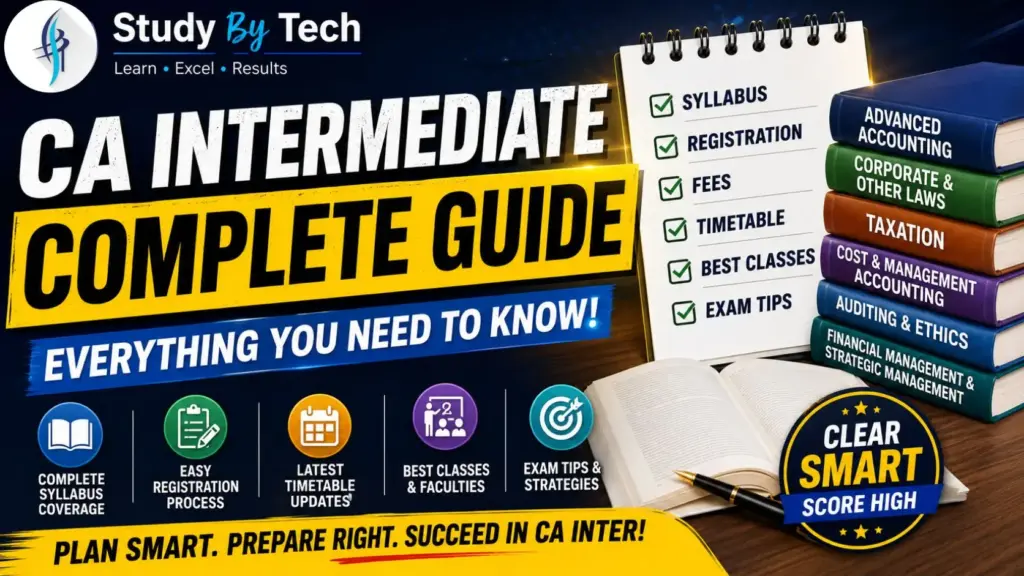
CA Inter Master Guide: Syllabus, Registration, Online & Offline Classes, Exam Strategy & Coaching CA Inter is the second stage of the Chartered Accountancy course, and this guide covers everything you need to start it. It’s for CA Foundation passers and eligible graduates. You’ll learn the two entry routes, the six-paper syllabus, the ₹18,000 registration fee, the passing rules, the 8-month study period, and a five-phase study plan. Your key takeaway: stay close to ICAI material, because over 80% of exam questions come from it. Your complete roadmapFrom eligibility to exam day9 minute read Enroll NowWatch Demo LecturesDirect Entry in CA Table of Contents 1. What is CA Intermediate? Overview & Routes 2. Syllabus & Exam Pattern (New Scheme) 3. Registration Process & Fee Breakdown 4. Exam Pattern, Admit Card & Timetable 5. Coaching Options: Online vs Offline 6. Best Faculty at StudyByTech 7. Proven Study Plan & Exam Strategies 8. What to Do After CA Foundation Enroll in the Best CA Intermediate Coaching Frequently Asked Questions Key Takeaways Two entry routes Foundation Route (pass CA Foundation) or Direct Entry (graduates with min %). 6 subjects, 2 groups The new scheme has 6 papers (3 per group), 300 marks each. Passing criteria 40% in each paper and 50% aggregate in a group. Score 60+ for exemption. Registration fee ₹18,000 for both groups. ₹14,000 for a single group. 8-month study period Mandatory between registration and exam month. Exam cycle Conducted three times a year: January, May, September. 5-phase prep Concept coverage, revisions, PYQs, mocks, final revision. ICAI material is gold Over 80% of exam questions come from ICAI’s certified content. 1. What is CA Intermediate? Overview & Eligibility Routes The CA Intermediate course is the second stage of the Chartered Accountancy qualification. It forms a link between theory and practice. This course comprises 6 compulsory subjects that can be divided into 2 groups of 3 subjects each. Eligibility Routes to Register for ICAI Intermediate Candidates can enter the CA Inter course through two primary routes: Foundation Route Pass the CA Foundation exam ➜ CA Intermediate Register on the ICAI SSP portal ➜ Direct Entry Route Commerce Graduates/PG (≥ 55%), Other Graduates/PG (≥ 60%), CS Executive / CMA Inter The CA Foundation Route The CA Foundation exams of ICAI must be cleared. Direct Entry Route The CA Foundation exam can be skipped if you satisfy any of these conditions: Commerce Graduates or Post-Graduates with 55% marks. Non-Commerce Graduates or Post-Graduates with 60% marks. Candidates who have completed the Intermediate level exams from ICSI (CS Executive) or ICMAI (CMA Intermediate). 2. CA Intermediate Syllabus & Exam Pattern (New Scheme) According to the ICAI updated scheme, the curriculum comprises six relevant subjects with 600 total marks for the examination. Each exam paper contains 30 percent objective questions (case scenario MCQs) and 70 percent descriptive questions. Group-Wise Subjects & Marks Distribution Group 1 (300 Marks) Paper Subject Marks Key Topics Paper 1 Advanced Accounting 100 Accounting Standards (AS), Preparation of Financial Statements, Amalgamation, Consolidation. Paper 2 Corporate & Other Laws 100 (70+30) Part A: Companies Act & LLP Act (70 Marks)Part B: FEMA, General Clauses Act, Interpretation of Statutes (30 Marks) Paper 3 Taxation 100 (50+50) Section A: Income Tax (Direct Tax – Sources of Income, TDS/TCS, PGBP)Section B: GST (Indirect Tax – Supply, ITC, Time and Value of Supply) Group 2 (300 Marks) Paper Subject Marks Key Topics Paper 4 Cost & Management Accounting 100 Marginal Costing, Standard Costing, Process Costing, Budgeting & Variance Analysis, Material & Labour Cost. Paper 5 Auditing & Ethics 100 Standards on Auditing (SA), Ethical Aspect of Auditing, CARO 2020, Internal Control and Audit Reporting. Paper 6 Financial Management & Strategic Management 100 (50+50) Section A: FM (Capital Budgeting, Cost of Capital, Capital Structure, Ratios)Section B: SM (Strategic Analysis, Competitor Analysis, Strategy Implementation) Criteria for Passing and Exemptions Criteria for Each Subject A subject must obtain at least 40% marks in order to qualify. Criteria for Aggregate The overall passing percentage is required to be a minimum of 50% marks in total, 150/300 subjects. Exemption Criteria If any subject has been passed with an overall score of 60%, you won’t need to give a paper test for that subject again, but the aggregate percentage needs to be maintained. Want the full paper-wise list with ICAI study material links? Read our CA Intermediate syllabus guide. 3. CA Intermediate Registration Process & Fee Breakdown To enroll for ICAI CA Inter, you’ll have to submit the application form online through the ICAI Self Service Portal (SSP). Guide for Registration Process Step 1 Login to ICAI official portal SSP ➜ Step 2 Choose Student Cycle, then CA Intermediate Registration ➜ Step 3 Submit scanned documents (CA Foundation Marksheet/Graduation Certificate, 10th and 12th Marksheet, ID, Passport size Photo) ➜ Step 4 Choose your route (Foundation or Direct Entry) and group (both or one) ➜ Step 5 Pay the fee online and take a printout of the receipt Official ICAI CA Inter Fee Structure Fee Head Both Groups (INR) Single Group (INR) Registration Fee ₹ 15,000 ₹ 11,000 Student Activity Fee ₹ 2,000 ₹ 2,000 Articles Registration Fee (if applicable) ₹ 1,000 ₹ 1,000 Total Official ICAI Fee ₹ 18,000 ₹ 14,000 ⏳ Mandatory Study Period: ICAI mandates an 8-month study period between the registration date and the exam month. 4. CA Inter Exam Pattern, Admit Card & Exam Timetable ICAI conducts CA Intermediate examinations 3 times a year: in January, May, and September. Exam Pattern & Duration 100 marksPer paper (30 MCQ + 70 Descriptive) 3 hoursPer paper, plus 15 minutes of reading time CA Inter Exam Schedule Exams are scheduled across an 11-day window with a 1-day gap between consecutive papers: Group Day 1 Day 3 Day 5 Day 7 Day 9 Day 11 Group I Paper 1: Adv. Accounts Paper 2: Law Paper 3: Taxation — — — Group II — — — Paper 4: Costing Paper 5: Audit Paper 6: FM-SM Download CA Inter Admit Card ICAI releases the CA
CA
CA Parag Gupta is one of the pioneers in the Teaching industry for SCMPE and is considered the best faculty in the world of Old/New Course Costing.
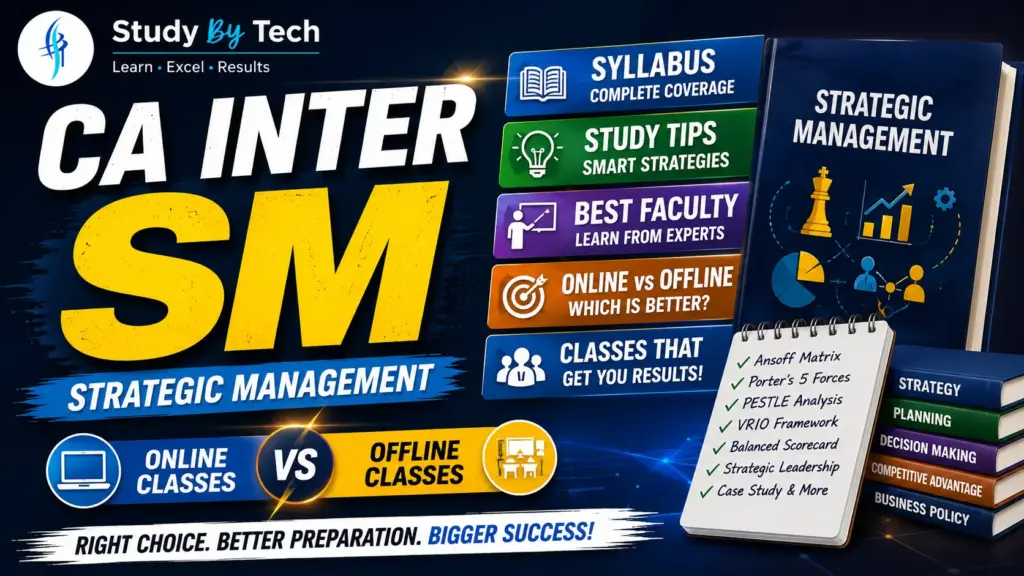
CA Inter SM: Syllabus, Study Tips, Best Faculty & Online vs Offline Classes 🎯 Your complete guide to Strategic Management (Paper 6B). From syllabus to scoring 40+ out of 50, here’s everything you need to master SM. CA Inter SM is Strategic Management, Section B of Paper 6 in the ICAI CA Intermediate course, and it carries 50 marks. This guide is for CA students who want the syllabus, key models, case-study answer format and online vs offline class options. The key takeaway: master Ansoff, BCG and Porter’s models, use ICAI terminology, practise case-based MCQs, and answer case studies in four steps to aim for 40+ out of 50. 📑 Table of Contents What is CA Inter Strategic Management? Is SM Easy in CA Inter? ICAI CA Inter SM Syllabus & Weightage Key Strategic Models You Must Master CA Inter SM Strategy that Works Online vs Offline Classes Best Faculty at StudyByTech Frequently Asked Questions ⭐ Key Takeaways SM = Paper 6B: 50 marks (30% MCQs + 70% descriptive). Highly scoring. 5 chapters: Introduction, External and Internal Analysis, Strategic Choices, Implementation. Key models: Ansoff Matrix, BCG Matrix and Porter’s Five Forces are tested often. ICAI terminology: “core competencies” and “sustainable competitive advantage” score more. 4-step case format: Problem → Framework → Facts → Conclusion. Case-based MCQs: 15 marks come from them, so practise them. What is CA Inter Strategic Management? Strategic Management in CA Intermediate teaches you to think like a business strategist. It tests how well you can analyse market opportunities, build corporate strategy, assess competitive advantage and handle organisational change. You can check the latest scheme on the ICAI website. Overview of Paper 6 Section B Subject name: Strategic Management (SM) Total weightage: 50 marks Exam pattern: 30% integrated case-scenario MCQs (15 marks) + 70% descriptive practical questions (35 marks) Exam time: 3-hour integrated exam along with Financial Management (FM) Is SM Easy in CA Inter? Many students who cleared CA Foundation ask: is SM easy in CA Inter? The short answer is yes, with a big caveat. SM has fewer concepts than numerical subjects like Costing or Advanced Accounts. But students struggle to score high because they treat SM like an English essay-writing subject. ❌ Why Students Lose Marks in SM Writing general/casual answers Ignoring heading titles in modules Skipping case study practice Lack of strategic diagrams ✅ How to Score 40+ Out of 50 in SM Using official ICAI technical terms Memorising standard framework titles Structuring answers into 4 clear zones Drawing matrices (Ansoff, BCG, SWOT) If you master the core concepts, retain ICAI terminology and practise case studies, SM becomes one of the easiest subjects to score an exemption in. ICAI CA Inter SM Syllabus & Weightage Breakdown The updated CA Inter SM syllabus under the ICAI New Scheme has 5 chapters: Chapter Number & Title Expected Marks Key Focus Areas Chapter 1: Introduction to Strategic Management 8–10 Marks Concept of Strategy, Strategic Management Process, Strategic Leadership, Vision, Mission and Objectives. Chapter 2: Strategic Analysis: External Environment 10–12 Marks Competitive Landscape, Porter’s Five Forces Model, PESTLE Analysis, Industry Driving Forces, Strategic Groups. Chapter 3: Strategic Analysis: Internal Environment 8–10 Marks Value Chain Analysis, Core Competencies, Competitive Advantage, Portfolio Analysis (BCG Matrix, Ansoff Matrix, ADL, General Electric). Chapter 4: Strategic Choices 10–12 Marks Corporate Level Strategies (Growth, Stability, Retrenchment), Business Level Strategies (Porter’s Generic Strategies), Directional Growth. Chapter 5: Strategy Implementation & Evaluation 8–10 Marks Strategic Control, Operations & Resource Allocation, Digital Transformation, Organisational Structure & Change Management. Key Strategic Models You Must Master for Exams ICAI often tests practical applications through a few key models. Make sure you know these: 1. Ansoff’s Product-Market Growth Matrix How companies grow through products and markets: Market Penetration: present products in present market. Market Development: present products in new market. Product Development: new products in present market. Diversification: new products in new market. 2. BCG Growth-Share Matrix Classification of business units: Stars: high growth, high market share. Cash Cows: low growth, high market share. Question Marks: high growth, low market share. Dogs: low growth, low market share. 3. Porter’s Five Forces & Generic Strategies Five Forces: New Entrants, Buyers, Suppliers, Substitutes, Rivalry. Generic Strategies: Cost Leadership, Differentiation, Focus. Question MarksHigh growth, low share StarsHigh growth, high share DogsLow growth, low share Cash CowsLow growth, high share Relative market share: Low → High Market growth: Low → High CA Inter SM Strategy that Works 📘 1. Keep an SM Terminology Dictionary Handy Keep a small notepad of SM terms. Instead of writing “the company is better than its rivals,” write “the enterprise is using core competencies to build a sustainable competitive advantage.” 📝 2. Follow the 4-Point Structure for Case Studies When you solve case questions in the exam: 1. Highlight theCore Problem 2. FrameworkDefine the model 3. FactsLink to framework 4. ConclusionStrategic solution 🧠 3. Solve Case-Based MCQs Since 15 marks go to case-based MCQs, practise reading the case and picking the right strategic option without wasting time. CA Inter SM Classes: Online vs Offline Classes Your daily schedule and location decide which learning mode suits you best: Feature CA Inter SM Online Classes CA Inter SM Offline Classes Flexibility & Convenience Learn from anywhere with HD recorded or live interactive lectures. Requires daily commuting to offline coaching centres. Speed Control & Revisions Re-watch lectures at 1.2x/1.5x speed during revision rounds. Single-pass live lecture experience. Doubt Support Direct mentor chat, Telegram community and call support. In-person, face-to-face doubt clearance after class. Cost & Time Savings Highly affordable. Saves 2 hours of daily travel time for self-study. Involves higher tuition fees and travel costs. CA Inter SM Best Faculty at StudyByTech When choosing the best CA Inter SM faculty, look for someone who does more than read from books. You need a guide who shows how real-life corporate cases, market situations and ICAI presentation criteria work. What StudyByTech Offers ICAI module-wise coverage, 100% based on past year questions and revision test papers. Summary charts for all 5 chapters, plus
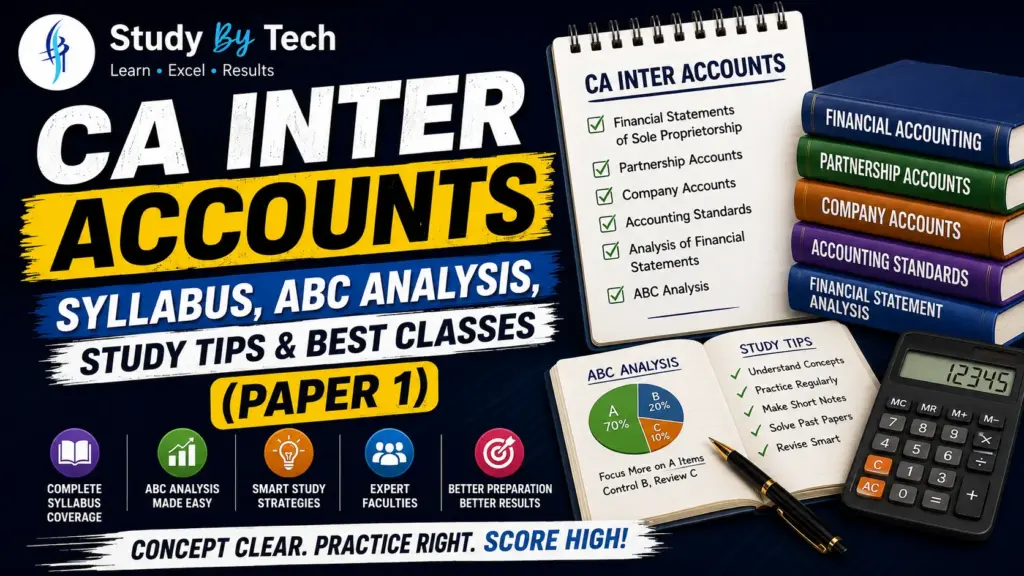
CA Inter Accounts: Syllabus, ABC Analysis, Study Tips & Best Classes (Paper 1) CA Inter Accounts, or Paper 1: Advanced Accounting, carries 100 marks, with 30% case-based MCQs and 70% descriptive practicals. This guide is for CA Intermediate students who want to score 60+ or earn an exemption. You’ll get the syllabus and weightage, an ABC analysis, four proven answer-writing tips, and a 3-month revision timetable. The key takeaway: Accounting Standards carry 40–45 marks, so make them the backbone of your preparation. Your complete guide to mastering Advanced AccountingFrom syllabus to self-study tips8 minute read Enroll in Offline/OnlineWatch Demo Lectures Table of Contents 1. Syllabus & Weightage (New Scheme) 2. ABC Analysis for Advanced Accounting 3. Useful Tips & Techniques 4. 3-Month Revision & Study Timetable 5. Online vs Offline Coaching 6. Join the Best CA Inter Accounts Classes Frequently Asked Questions Key Takeaways Paper 1 Advanced Accounting: 100 marks, 30% MCQs, 70% descriptive. Accounting Standards AS: 40–45 marks. The backbone of the paper. ABC analysis Focus 70% of your time on Category A topics (50–55 marks). 3-phase revision Concept clearing, then consolidation, then mock tests. Working notes Up to 40% of marks are for working notes. Schedule III Always present financial statements in the prescribed format. Error log book Note down difficult adjustments for last-minute revision. Daily practice Solve 8–12 practical problems daily during the first month. 1. CA Inter Advanced Accounting by ICAI: Syllabus & Weightage As per the ICAI Scheme, Paper 1: Advanced Accounting holds 100 marks and includes 30% case-based MCQs and 70% descriptive practical problems. For the full paper list, see the CA Intermediate syllabus guide. Core Syllabus Modules & Chapter Breakdown Module 1 AS & Concepts Framework & General AS Valuation & Measurement Disclosure Standards AS 4, 5, 7, 9, 14, 17, 18, 19, 20, 22, 24, 26, 29 Module 2 Corporate Accounting Company Accounts Amalgamation & Reconstruction Financial Statements (Sch III) Consolidation (CFS) Module 3 Specialized Accounting Branch Accounting Departmental Accounts Partnership Accounts Module-Wise Marks Weightage Accounting Standards (AS): 40 – 45 Marks (Compulsory Question 1 + Integrated Sub-questions) Company Accounts & Financial Statements: 30 – 35 Marks Specialized & Advanced Accounting: 25 – 30 Marks 2. ABC Analysis for CA Inter Advanced Accounting Put your effort where the marks are. Spend 70% of your time in the early stages of preparation on the sections that carry high weightage in the exam: Category Topics Weightage Category A(Very Important) Accounting Standards: AS 4, 5, 7, 9, 14, 18, 20, 22, 28.Corporate Accounting: Consolidated Financial Statements, Amalgamation of Companies, Internal Reconstruction.Financial Statements: Schedule III Balance Sheet and P&L Statement with all Adjustments. 50 – 55 Marks Category B(Moderately Important) Accounting Standards: AS 11, 13, 16, 19, 24, 26, 29.Advanced Topics: Branch Accounting (Foreign & Dependent), Buyback of Securities, Redemption of Debentures & Preference Shares. 30 – 35 Marks Category C(Less Important / Quick Revision) Basic AS: AS 1, 2, 3.Others: Departmental Accounts, Investment Accounts, Accounting for Bonus Issue. 15 – 20 Marks 3. Useful Tips & Techniques to Pass CA Inter Accounts Exams 📘 Tip 1: Treat the Accounting Standards as the Back Bone Students tend to think Accounting Standards are nothing but theory. In reality, the Institute of Chartered Accountants of India examines the practical aspects of AS. To get full marks, remember the correct AS number and title. Then split your answer to an AS question into three paragraphs: First paragraph Mention the AS number along with its important legal aspect. ➜ Second paragraph Interpret the facts mentioned in the exam question as per the AS provision. ➜ Third paragraph Give a definite conclusion with the required accounting treatment or valuation. 📊 Tip 2: Never Skip Working Notes When solving numericals (like Amalgamation, Consolidation, Schedule III accounts), ICAI gives up to 40% of the marks for the entire question to working notes. Label your working notes properly, like Working Note 1: Calculation of Purchase Consideration, Working Note 2: Calculation of Goodwill/Capital Reserve. Refer each working note figure to the main ledger/Balance Sheet. 📝 Tip 3: Learn to Format Answers in Steps Financial statements must always follow the format given in Schedule III of the Companies Act, 2013. Neat debits and credits, proper line items and an orderly sequence will win the examiner’s favor. 📓 Tip 4: Have an “Error Log Book” When you solve practical questions from the ICAI study material, PYQs and RTPs, mark the adjustments where you went wrong. Note those difficult adjustments in a small book you can review a day before the exam. 4. Structured 3-Month Revision & Study Timetable To get multiple revision rounds in before exam day, follow this disciplined study planner: Phase 1 (Month 1) Practical Concept Clearing & Daily Problem Solving. 3 hours daily. Solve 8–12 comprehensive practical problems. Focus: Category A topics + core Accounting Standards. ➜ Phase 2 (Month 2) Consolidation, Special Chapters & AS Drills. 2 hours daily. Focus on Category B & C chapters. Daily 45-minute drill on Accounting Standards. ➜ Phase 3 (Month 3) Full Mock Tests, RTPs, MTPs & Timed Solves. Solve the last 4 attempts of ICAI past papers under a strict 3-hour timer. Complete 2 full-length evaluated mock test papers. 5. CA Inter Accounts Classes: Online vs Offline Coaching Depending on your daily routine, location and learning preferences, you can choose between CA Inter Accounts online classes and CA Inter Accounts offline classes: Feature CA Inter Accounts Online Classes CA Inter Accounts Offline Classes Flexibility & Speed Study at your own pace with 1.2x/1.5x playback options. Re-watch complex adjustments. Fixed schedule at traditional face-to-face coaching centers. Coverage & Modes Live interactive streams, Google Drive, and Pen Drive modes available. In-person classroom lectures with fixed timing. Doubt Support Dedicated Telegram groups, mobile app support, and direct mentor query calls. Instant face-to-face query resolution after class lectures. Cost & Commute Highly cost-effective; zero commute time saves 2 hours daily for practice. Involves daily travel time and higher overall batch fees. CA Inter Advance Accounts Classes & Fast Track
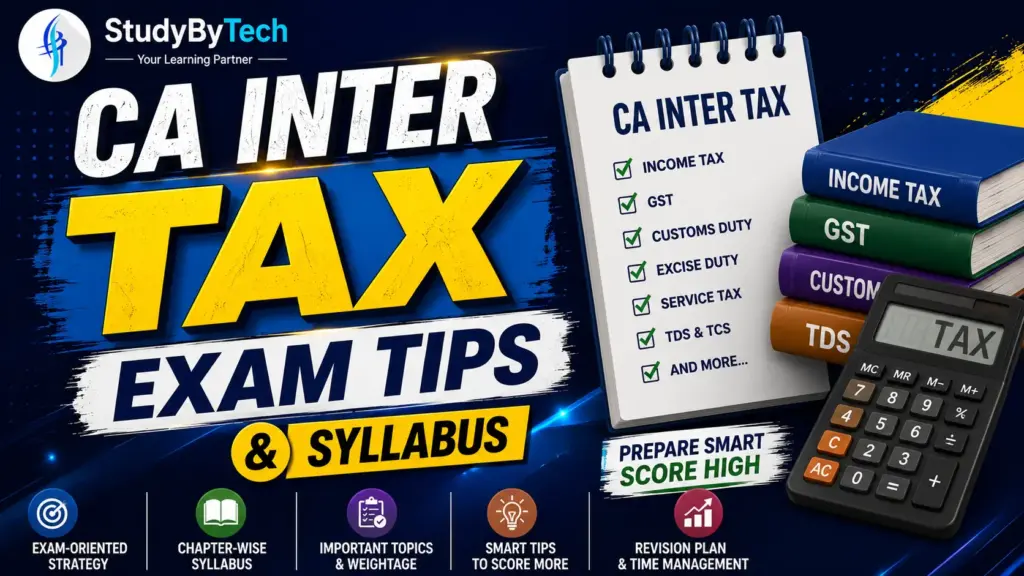
CA Inter Tax: Complete Syllabus, ABC Analysis & Exam Tips & Tricks (Jan 2027 Exams) CA Inter Tax is Paper 3 of CA Intermediate Group 1, and it’s split evenly: 50 marks for Income-tax Law and 50 for GST. This guide is for CA students targeting the Jan 2027 exams. You’ll get chapter-wise weightage, an ABC analysis, a 4-step answer format, a time plan for the 3-hour paper, and common pitfalls. The key takeaway: put 70% of your early effort into Category A topics, which carry roughly 60% of the marks. 🎯 Your ultimate strategy guideFor Income-tax Law & GSTNo fluff, just the right plan Enroll in Offline/OnlineWatch Demo Lectures 📑 Table of Contents 1. CA Inter Tax Overview (Jan 2027) 2. Chapter-Wise Weightage & Revision Strategy 3. Strategic ABC Analysis for Smart Preparation 4. Practical Study Tips & Exam Tricks 5. Key Pitfalls to Avoid 6. Learn from the Best Faculty Ready to Top in Your First Attempt? Frequently Asked Questions ⭐ Key Takeaways Balanced paper Income-tax (50 marks) + GST (50 marks). Both need equal attention. ABC analysis Focus 70% of your time on Category A topics that carry ~60% marks. 4-step answer format Statute → Rule → Application → Final Answer. It gets you partial marks. Time allocation 15 min reading → 20 min MCQs → 60 min GST → 100 min Direct Tax. Working notes = marks Write assumptions clearly (for example, the tax regime under Sec 115BAC). One resource Avoid switching between too many books. It creates visual memory. Cite sections Mentioning section numbers (like Sec 54, Sec 17(5)) fetches full marks. 1. CA Inter Tax Overview (Jan 2027 Syllabus Structure) Under the ICAI scheme, Paper 3: Taxation in CA Intermediate is divided into two balanced sections totalling 100 marks: Section Focus Area Marks Key Objective Section A Income-tax Law (Direct Tax) 50 Marks Develop conceptual clarity and compute total income under various heads. Section B Goods and Services Tax (Indirect Tax) 50 Marks Master provisions of CGST & IGST, ITC rules, and procedural compliance. Section A: Income-tax Law – 50 marks Section B: GST – 50 marks 📌 Reminder for Jan 2027: Follow the latest study materials published by ICAI for Part A (Income-tax Law) and Part B (GST). They include the necessary Finance Act modifications and statutory updates relevant to 2027. 2. Chapter-Wise Weightage & Revision Strategy To maximise your score, prioritise topics based on their historical exam weightage and difficulty level. Section A: Income-tax Law (50 Marks) Chapter / Topic Expected Marks Priority Key Focus Areas Computation of Total Income & Tax Liability 10 – 12 A Comprehensive problems combining multiple heads, AMT, and special rates. Heads of Income (PGBP & Capital Gains) 10 – 14 A Sec 54 exemptions, Indexation, Disallowances under Sec 40/40A, Presumptive taxation. Heads of Income (Salaries, HP, Other Sources) 8 – 12 B Perquisites, Deduction under Sec 24, Gift provisions under Sec 56(2)(x). TDS, TCS & Advance Tax 6 – 8 A Sec 194-IA, 194-IB, 194R, 194Q, Advance tax due dates, interest calculations. Deductions from GTI (Chapter VI-A) 6 – 8 B Sec 80C, 80D, 80DD, 80G, 80JJAA, and 80TTA/80TTB. Clubbing, Set-off & Carry Forward 6 – 8 B Order of set-off, loss carry-forward limits, minor child income clubbing. Residential Status & Scope of Total Income 4 – 6 C Deemed resident rules, taxable income based on residential status. Return of Income & Self-Assessment 4 – 6 C Updated return (Sec 139(8A)), due dates, fee for late filing (Sec 234F). Section B: Goods and Services Tax – GST (50 Marks) Chapter / Topic Expected Marks Priority Key Focus Areas Input Tax Credit (ITC) 10 – 12 A Blocked credit (Sec 17(5)), apportionment rules, ITC utilisation order. Time & Value of Supply 8 – 10 A Sec 12 & 13, Valuation rules, discounts, voucher treatments. Supply under GST & Charge of GST 6 – 8 A Schedule I, II, III, Reverse Charge Mechanism (RCM) applicability. Exemptions from GST 6 – 8 B Healthcare, education, passenger transport, agricultural services. Tax Invoice, Debit/Credit Notes, E-Way Bill 6 – 8 B E-invoicing thresholds, e-way bill validity & exceptions. Registration & Payment of Tax 4 – 6 C Mandatory registration threshold limits, interest on delayed payment. GST Returns 2 – 4 C GSTR-1, GSTR-3B due dates, QRMP scheme features. Priority key: A high, B moderate, C low. 3. Strategic ABC Analysis for Smart Preparation Split your CA Intermediate Tax syllabus into three parts so you spend 70% of your time on the issues that matter most: Category A · High ~60% Marks Direct Tax: PGBP, Capital Gains, Total Income Computation, TDS/TCS. GST: Input Tax Credit (ITC), Supply under GST, Time and Value of Supply. Category B · Moderate ~30% Marks Direct Tax: Salaries, Deductions (Chapter VI-A), Offsetting and Carry Over of Losses. GST: Exemptions, Tax Invoice and E-way Bills, Payment of Tax. Category C · Low ~10% Marks Direct Tax: Fundamental Ideas, Residential Status, Rules of Filing Returns. GST: Basic Overview, Registration of GST, Basic Return Filing. Category A: ~60% Category B: ~30% Category C: ~10% 4. Practical CA Inter Tax Study Tips & Exam Tricks 1. Master the 4-Step Answer Presentation Format Step 1 Reference to the relevant statute ➜ Step 2 Explaining the relevant exemption/rule/limitation ➜ Step 3 Application with appropriate figures ➜ Step 4 Final answer with tax liability 2. Time Allocation Strategy for the 3-Hour Exam ⏰ 15 min · Reading Rapidly review the paper, decide which optional question to skip, identify easy MCQs and GST questions. ➜ ⏰ 20 min · MCQs Solve 30 marks of MCQs quickly while your mind is fresh. ➜ ⏰ 60 min · Section B (GST) GST questions are clear, simple and easily scorable. ➜ ⏰ 100 min · Section A (Income-tax) Start with smaller heads, then go for the big Total Income question. 5. Key Pitfalls to Avoid ❌ Forgetting Working Notes Every working note earns between 0.5 and 1.5 marks. Write your assumptions clearly, for example whether the taxpayer
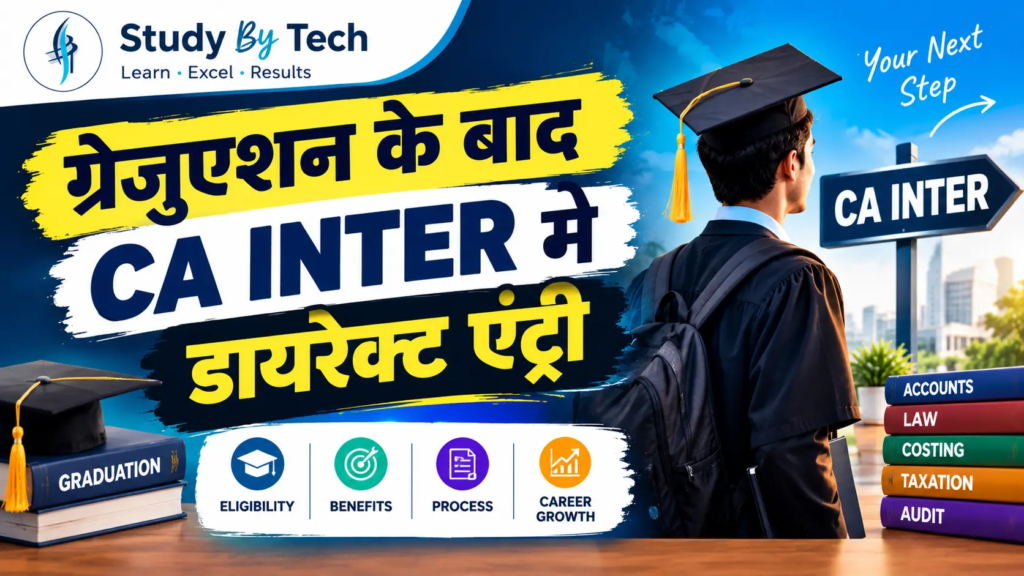
सीए डायरेक्ट एंट्री: CA Inter & CA Final की सम्पूर्ण मार्गदर्शिका (हिंदी में) ग्रेजुएशन के बाद सीए बनने का सबसे तेज़ रास्ता | फाउंडेशन स्किप करें सीए डायरेक्ट एंट्री ICAI की वह योजना है जिससे ग्रेजुएट सीधे CA Inter में प्रवेश लेते हैं और फाउंडेशन स्किप कर देते हैं। यह गाइड CA Inter & CA Final का सपना देखने वाले ग्रेजुएट और CA छात्रों के लिए है। कॉमर्स ग्रेजुएट के लिए 55% और नॉन-कॉमर्स के लिए 60% अंक चाहिए। इस रास्ते से CA 4–4.5 साल में बन सकते हैं, रजिस्ट्रेशन फीस ₹18,000 है (ICITSS फीस अलग) और आर्टिकलशिप 2 साल की है। StudyByTech | India’s No. 1 CA Classesहिंदी में पूरी जानकारी डायरेक्ट एंट्री स्पेशल क्लासेस – डेमो लेंCA Inter ClassesCA Final Classes विषय सूची (Table of Contents) डायरेक्ट एंट्री, फाउंडेशन और नॉन-कॉमर्स रूट सीए डायरेक्ट एंट्री क्या है? पात्रता (Eligibility) स्टेप बाय स्टेप रजिस्ट्रेशन प्रोसेस डायरेक्ट एंट्री बनाम फाउंडेशन – तुलना तालिका स्टडीबायटेक का विशेष मार्गदर्शन क्या डायरेक्ट एंट्री मुश्किल है? अक्सर पूछे जाने वाले सवाल (FAQs) CA Inter क्लासेस में एडमिशन मुख्य बातें (Key Takeaways) सीधा प्रवेश सीधे CA Inter में प्रवेश, फाउंडेशन नहीं। पात्रता कॉमर्स ग्रेजुएट: 55% | नॉन-कॉमर्स: 60%। CS या CMA इंटर पास भी पात्र। समय बचत डायरेक्ट एंट्री से 4–4.5 साल में CA, जबकि फाउंडेशन रूट में 5–5.5 साल। फीस ₹18,000 (रजिस्ट्रेशन + एक्टिविटी + आर्टिकलशिप) + ICITSS कोर्स फीस अलग। आर्टिकलशिप नई योजना में 2 साल, और इंटर के दोनों ग्रुप पास करने के बाद ही शुरू। डायरेक्ट एंट्री, फाउंडेशन और नॉन-कॉमर्स रूट डायरेक्ट एंट्री सीधे CA इंटर में प्रवेश, फाउंडेशन नहीं कॉमर्स ग्रेजुएट: 55% | नॉन-कॉमर्स: 60% समय बचत: 4-4.5 साल में CA नई योजना: आर्टिकलशिप 2 साल प्रोविजनल रजिस्ट्रेशन (फाइनल ईयर) फाउंडेशन रूट 12वीं के बाद फाउंडेशन पास करना ज़रूरी कुल 5-5.5 साल लगते हैं बेसिक अकाउंटिंग सीखने का मौका ग्रेजुएट्स के लिए अनावश्यक देरी नॉन-कॉमर्स ग्रेजुएट बी.एससी / बी.ए / इंजीनियरिंग: 60% → डायरेक्ट एंट्री स्टडीबायटेक ब्रिज कोर्स एक्स्ट्रा सहायता ICAI की ओर से स्पेशल छूट एक्स्ट्रा मेहनत से बेहतरीन करियर सीए डायरेक्ट एंट्री क्या है? (पूरी जानकारी) इंस्टीट्यूट ऑफ चार्टर्ड अकाउंटेंट्स ऑफ इंडिया (ICAI) हर साल हजारों स्नातकों को Direct Entry Scheme के तहत सीए कोर्स में फाउंडेशन स्तर छोड़ने की सुविधा देता है। यह मार्ग विशेष रूप से B.Com, BBA, BMS, M.Com, MBA Finance, BAF और अन्य स्ट्रीम (साइंस/आर्ट्स) के ग्रेजुएट्स के लिए है। ग्रेजुएशन के बाद सीए बनने का यह सबसे प्रभावी और समय बचाने वाला विकल्प है। समय बचत फाउंडेशन स्किप से 8-12 महीने बचते हैं, डायरेक्ट एंट्री से 4-4.5 साल में सीए संभव। फीस संरचना CA Inter रजि: ₹15,000 + ₹2,000 (स्टूडेंट एक्टिविटी) + ₹1,000 (आर्टिकलशिप) = ₹18,000 + ICITSS कोर्स फीस अलग। आर्टिकलशिप नियम (नई योजना) 2 वर्ष की प्रैक्टिकल ट्रेनिंग। अब 9 महीने की पुरानी शर्त खत्म, सीधे 2 साल। इंटर के दोनों ग्रुप पास करने के बाद ही आर्टिकलशिप शुरू। पात्रता (Eligibility) – कौन कर सकता है डायरेक्ट एंट्री? कॉमर्स ग्रेजुएट/पोस्ट ग्रेजुएट (B.Com, BBA, BMS, M.Com, MBA Finance) – न्यूनतम 55% अंक नॉन-कॉमर्स ग्रेजुएट (B.Sc, B.A, B.Tech, BCA आदि) – न्यूनतम 60% अंक ICSI (CS) इंटरमीडिएट या ICMAI (CMA) इंटर पास छात्र सीधे CA इंटर में प्रवेश पाते हैं। अंतिम वर्ष के छात्र: प्रोविजनल रजिस्ट्रेशन कर सकते हैं, लेकिन ग्रेजुएशन प्रमाणपत्र 6 महीने के भीतर ICAI को जमा करना अनिवार्य, नहीं तो रजिस्ट्रेशन रद्द और फीस ज़ब्त। स्टेप बाय स्टेप रजिस्ट्रेशन प्रोसेस Step 1 ICAI के SSP पोर्टल पर जाएं और नया अकाउंट बनाएं। ➜ Step 2 “Direct Entry Route” का चयन करें, CA इंटर के लिए आवेदन करें। ➜ Step 3 10वीं, 12वीं, ग्रेजुएशन की मार्कशीट, फोटो, सिग्नेचर, ID प्रूफ अपलोड करें। Step 4 ऑनलाइन फीस जमा करें – ₹18,000 (रजिस्ट्रेशन + एक्टिविटी + आर्टिकलशिप रजिस्ट्रेशन)। ➜ Step 5 कन्फर्मेशन मिलने के बाद आपकी 8 महीने की स्टडी पीरियड शुरू। अब CA इंटर की तैयारी करें। ➜ Step 6 ICITSS (Orientation Course + IT) कोर्स प्रोविजनल पीरियड के दौरान कर सकते हैं, लेकिन आर्टिकलशिप केवल इंटर क्लियर करने के बाद शुरू होगी। डायरेक्ट एंट्री बनाम फाउंडेशन – तुलना तालिका पैरामीटर डायरेक्ट एंट्री (ग्रेजुएट्स) फाउंडेशन रूट प्रवेश स्तर सीधे CA इंटर CA Foundation → Inter न्यूनतम अवधि 4 – 4.5 साल 5 – 5.5 साल योग्यता % कॉमर्स 55% / अन्य 60% 12वीं में 50% आर्टिकलशिप अवधि 2 साल (नई योजना) 2 साल फाउंडेशन एग्ज़ाम नहीं देना पड़ता देना अनिवार्य स्टडीबायटेक का विशेष मार्गदर्शन – डायरेक्ट एंट्री छात्रों के लिए बेस्ट रणनीति 1 सबसे पहले ICAI मॉड्यूल, RTP, MTP को प्राथमिकता दें – परीक्षा में अधिकतम प्रश्न इन्हीं पर आधारित होते हैं। 2 कांसेप्ट क्लियर करने के लिए StudyByTech की LIVE इंटरैक्टिव क्लासेस ज्वाइन करें – ऑनलाइन/ऑफलाइन दोनों माध्यम उपलब्ध। 3 समय प्रबंधन: आर्टिकलशिप के चक्कर में पढ़ाई को न टालें – पहले इंटर क्लियर करने पर फोकस करें। 4 रिवीजन प्लान: हर विषय का कम से कम 3 बार रिवीजन करें। मॉक टेस्ट नियमित रूप से दें। 5 ग्रेजुएट्स को फायदा: आप अकाउंटिंग, बिजनेस लॉ की बेसिक समझ रखते हैं – इसका लाभ उठाएं। डायरेक्ट एंट्री स्पेशल क्लासेस – डेमो लें क्या डायरेक्ट एंट्री मुश्किल है? चुनौतियाँ और समाधान CA इंटर सिलेबस ग्रेजुएशन से काफी एडवांस है, लेकिन ग्रेजुएट्स में मैच्योरिटी और डिसिप्लिन होता है। आम गलतियाँ जल्दी आर्टिकलशिप शुरू करके पढ़ाई पर ध्यान न देना ICAI स्टडी मटीरियल को नज़रअंदाज़ करना टाइम मैनेजमेंट में कमी समाधान एक रोज़ का 6-7 घंटे का रूटीन बनाएं हर हफ्ते टेस्ट दें StudyByTech के अनुभवी फैकल्टी से मार्गदर्शन लें लाखों छात्र पहले यह रास्ता अपना चुके हैं – आप भी कर सकते हैं! अक्सर पूछे जाने वाले सवाल (FAQs) – हिंदी में Q1. क्या मैं ग्रेजुएशन के फाइनल ईयर में डायरेक्ट एंट्री के लिए अप्लाई कर सकता हूँ? हाँ, ICAI प्रोविजनल रजिस्ट्रेशन की सुविधा देता है। लेकिन ग्रेजुएशन पूरा होने के 6 महीने के अंदर 55% (कॉमर्स) या 60% (अन्य) की मार्कशीट जमा करना अनिवार्य है। Q2. बिग 4 (Deloitte, PwC, EY, KPMG) डायरेक्ट एंट्री वालों को आर्टिकलशिप देते हैं? बिल्कुल! Big4 उन छात्रों को प्राथमिकता देती हैं जिन्होंने CA इंटर पहले या दूसरे प्रयास में डिस्टिंक्शन के साथ पास किया हो। संचार कौशल और आत्मविश्वास भी ज़रूरी है। Q3. सीए डायरेक्ट एंट्री
After CA Inter & CA Final Exam Result: Expert Tips and Strategies
After CA Inter & CA Final Exam Result: Expert Tips and Strategies Your CA Inter & CA Final result sets your next move, and the first 48 hours matter most. This guide is for CA students and covers all four outcomes. Passed CA Intermediate? Finish ICITSS training, clear SPOM, then hunt for articleship. Missed it? Study your certified copies and fix Costing. Cleared CA Final? Go for ICAI campus placements and upskill. Missed it? Master SPOM Set B (SCPM), because it feeds the IBS paper. For CA Inter & CA Final students48-hour action plan5–7 minute read CA Foundation ClassesCA Inter ClassesCA Final ClassesStudyByTech OffersContact us Table of Contents Part 1: The CA Inter Result – What’s Next? Part 2: The CA Final Result – The Final Leap Result Cheat Sheet: All Four Outcomes Conclusion FAQs on CA Inter & CA Final Results Want to Enroll in Our Classes? Key Takeaways Passed CA Inter? Do this in order: ICITSS training, SPOM exams (Set A, B, C, D), then your articleship hunt at a Big 4 or mid-sized firm. Failed CA Inter? Analyze your certified copies, focus on Costing (40 to 70), and build LDR revision notes. Passed CA Final? Register for ICAI Campus Placements, then upskill in Excel, Power BI and SAP. Failed CA Final? Master SPOM Set B (SCPM) for the IBS paper, use the keyword technique for Audit, and summary charts for IDT. The release of CA Inter and CA Final results is a defining moment. Whether you’re celebrating a pass or figuring out a fail, what you do in the next 48 hours shapes your career. At StudyByTech, we’ve split the path forward into two clear blueprints. Part 1: The CA Inter Result – What’s Next? Scenario A: You Passed CA Inter! Congratulations! You’re now a semi-qualified professional. Here’s your 3-step plan for what comes after CA Intermediate: Step 1 Complete ICITSS (ITT & OC) ➜ Step 2 Clear SPOM exams (Set A, B, C & D) ➜ Step 3 Start your articleship hunt 1. Complete ICITSS training (ITT & OC) immediately Before you step into an office for articleship, you need to finish the Integrated Course on Information Technology and Soft Skills (ICITSS). What it includes: 15 days of Information Technology Training (ITT) and 15 days of the Orientation Course (OC). Registration: You do it through the ICAI SSP Portal. Pro tip: Seats fill up within minutes of result declaration. Register ASAP to avoid a 3-month delay in starting your articleship. 2. Clear SPOM exams (Set A, B, C & D) Under the new scheme, you must clear the Self-Paced Online Modules (SPOM) before you’re eligible for CA Final. Strategic advantage: Understanding Set A and Set B (SCPM) will save you in CA Final, because this syllabus is heavily tested in the IBS paper. 3. The articleship hunt Aiming for the Big 4 or a reputed mid-sized firm? Make sure your resume shows the technical skills from ITT and the soft skills from your OC training. Scenario B: You Didn’t Pass CA Inter Analyze the “why” Request certified copies from ICAI. Was it a lack of conceptual clarity or presentation errors? Focus on Costing Struggled here? Try Parag Gupta Sir’s Costing Booster Batch, built to turn a 40 into a 70+. It can help you maintain aggregate in groups, which can help you pass. LDR strategy Start building Last Day Revision notes now. If you can’t revise a subject in 1.5 days, you won’t pass it in the exam cycle. Part 2: The CA Final Result – The Final Leap Scenario A: You Passed CA Final! You’re now a Chartered Accountant. The job hunt: Register for ICAI Campus Placements. Focus on technical rounds and your communication skills. Upskilling: Industry wants a tech-savvy auditor. Master Advanced Excel, Power BI and SAP to raise your market value. Scenario B: You Didn’t Pass CA Final The CA Final hurdle is high, but you can clear it with a tactical shift. 1. The IBS (Paper 6) “secret key” The Integrated Business Solutions (IBS) paper is where most students get stuck. Here’s where its marks come from: Marks from SPOM material: 40–42 Of which from SCPM (Set B): 22–24 The trap: Most students neglect Set B and treat it as a formality. Mastering the SPOM (SCPM) syllabus is the single most effective way to pass IBS. Explore CA Final SCPM classes. 2. Tactical subject tips Audit & IDT: Use the “keyword technique” for Audit Standards. For IDT, use summary charts to master the GST logic in a single day. FR & AFM: These are your scoring engines. Master Ind AS adjustments in FR and Forex/Derivatives in AFM. Result Cheat Sheet: All Four Outcomes Your result First move Focus areas Don’t miss Passed CA Inter ICITSS (15 days ITT + 15 days OC) via the ICAI SSP Portal SPOM Set A–D, articleship at a Big 4 or mid-sized firm Register fast. Batches fill within minutes. Failed CA Inter Request certified copies from ICAI Costing (40 to 70), LDR notes Separate conceptual gaps from presentation errors. Passed CA Final ICAI Campus Placements Advanced Excel, Power BI, SAP Technical rounds and communication skills. Failed CA Final Master SPOM Set B (SCPM) Audit keywords, IDT summary charts, Ind AS in FR, Forex/Derivatives in AFM Don’t treat Set B as a formality. Conclusion Getting your CA Inter or CA Final result is a big milestone, whatever the outcome. Use this time to reflect, plan and take proactive steps. Whether you’re stepping into the professional world or preparing for another attempt, bring determination and a strategic mindset. Every step, forward or back, is part of your journey to becoming a successful Chartered Accountant. Stay positive, stay focused, and keep striving for excellence. FAQs on CA Inter & CA Final Results Q1: I just passed CA Inter. Can I start my articleship tomorrow? Not quite. You must first complete your ICITSS training (15 days of ITT and 15 days of OC). Once you finish and the certificates are
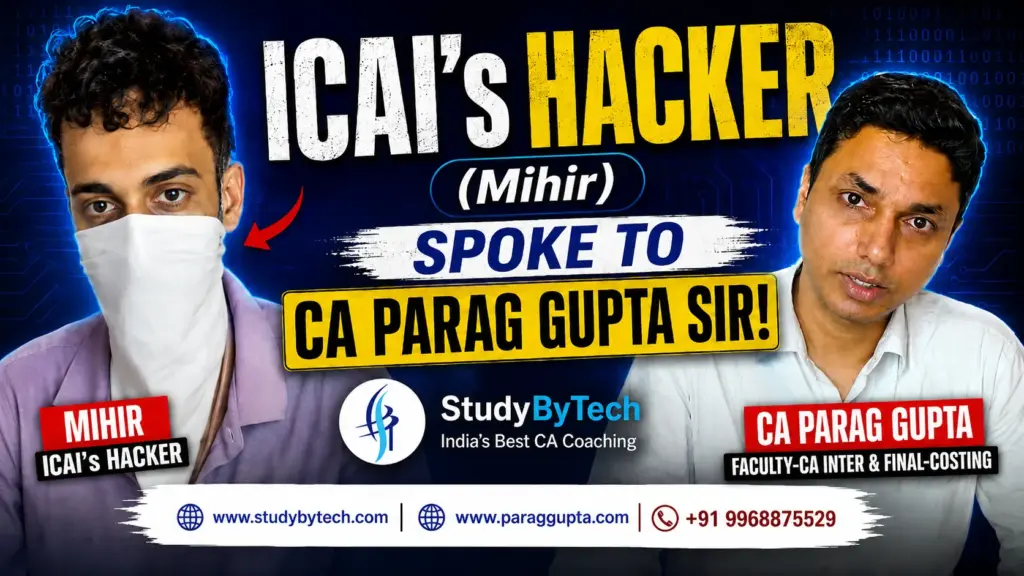
The ICAI Portal “Hack”: Ethical Intention or Malicious Act? CA. Parag Gupta and hacker, Mihir Shishulkar clarify the Controversy
The ICAI student’s body was also panicked out over the results of the CA Final Exams being released only one day from now. Not only that but allegations concerning data breaches also began circulating on various social media sites, resulting in panic and anxiety for many students waiting for their CA Final results. In an effort to get to the bottom of this, CA Parag Gupta, who is a very well known Costing faculty member, conducted an exclusive video conversation with a man named Mihir, (watch the full discussion here) who was at the heart of this controversy. The Initial Claim and the Atmosphere of Panic Around this time, Mihir came forward with information on serious security flaws at the ICAI’s examination site and informed the ICAI about them. After disclosing these issues, the conversation turned negative very quickly. On the dark web, Mihir’s name was reportedly misused and manipulated to suggest that he hacked into the ICAI’s exam site to manipulate students’ results when in actually he acted ethically in reporting the issues. CA Parag Gupta opened the discussion by emphasizing the seriousness of the matter. He clarified that his primary goal was to address the panic among students and that he had no way to independently verify the technical details of the claims . “I am not very proficient in ethical hacking… my purpose was only to talk to Mehur ji to bring students out of a panic situation,” he stated . He acknowledged that while he was giving Mihir the benefit of the doubt, if any malicious intent was proven, the law would take its course. Mihir’s Defense: An Ethical Disclosure Mihir presented his side of the story, maintaining that his actions were strictly for ethical reasons. The individual also claimed he found the weaknesses at 5:56 pm on June 12th 2026 and reported them to ICAI by 6:00pm, one hour later. He walked CA Parag Gupta through the alleged flaws, which he said included: Mihir emphasized that he did not modify any data and that the students’ answer sheets and marks were safe. “I have not leaked any data… your data is not modified,” he assured the students . He also showed screenshots from outside the database tables as proof of his access, stating he had over 200,000 records available . The Core Concern: Is the Data Safe? The most crucial question for students remains: Is their data compromised? Online reports suggest that the situation is likely a rumor. TCS, which maintains the data for ICAI, has reportedly confirmed that no data has been compromised . A chartered accountant, Dr. Rohit Ruwatia Agarwal, shared on social media that TCS had confirmed to him that there was “no substance” to the rumors of a data leak . Mihir’s own claims support this. He repeatedly stated that his access was for reporting vulnerabilities and that he did not steal or modify any data. CA Parag Gupta’s Final Appeal to Students After the interaction, CA Parag Gupta made a heartfelt appeal to the students. He emphasized the importance of not falling prey to panic, especially with results around the corner. He advised students to: Conclusion According to the video, the vulnerability that was found by the individual is now getting their chance to be heard (represented) as an impartial mediator, CA Parag Gupta, calms the worried students. While it is felt that the ICAI and other cybersecurity professionals have the true technical details of the situation, from Mihir’s account there is no reason to believe that his actions that disclosed this vulnerability were not ethically motivated nor that the student’s data had been compromised. Students are asked to remain calm, patient as they await the results and rely upon the official communication from the Institute of Chartered Accountants of India.
Best CA Inter Cost Classes: Booster vs Full Course | CA Parag Gupta
🏆 Best CA Inter Cost Classes by CA Parag Gupta (Ex-Examiner) Best CA Inter Cost Classes 2026: Booster Batch vs Full Course Struggling to choose between a Booster Batch and a Full Course for CA Inter Costing? You’re at the right place. CA Parag Gupta — India’s most trusted Costing faculty — offers both. This guide helps you pick the best CA Inter cost classes based on your attempt date, prep level and learning style. ✨ Quick decision: Need revision & exam-focused practice in 45 days? → Booster. Want deep mentorship & test series? → Full Course. ⚖️ Booster Batch vs Full Course: Which one is for you? Compare side-by-side to find your ideal batch. Both are part of the best CA Inter cost classes. ⚡🚀 Booster Batch Fast · Targeted · 45 Days 🎯 Ideal for: Sept 2026 attempt / students who already studied but need concept strengthening + rigorous question practice; 100% course coverage ⏱️ Duration: 45 Lectures (Recorded) 📽️ Mode: Recorded | 100% Syllabus Doubt sessions with Parag Gupta sir 8th Edition book for question practice For those who have less time to cover full syllabus Explore Booster Batch → *Recorded mode| Doubt resolution directly by Parag sir 📚🎓 Full Course (Regular) Complete · Interactive · Mentorship 🎯 Ideal for: Jan 2027 attempt & onwards | Regular tests & Mock tests 🖥️ Modes: Live Online · Offline · Recorded 📝 Includes: Full course + Books + Handwritten notes + Doubt session with sir + Weekly Tests + Test series 1-on-1 doubt solving sessions & personal mentorship Test Series + Mock tests included Highly interactive small batches for personalised attention View Full Course → *Personalized guidance | test series & mock tests included 📌 How to choose the best CA Inter cost class for YOU ✅ Choose Booster Batch if: Your attempt is within 3-4 months. ✅ Choose Full Course if: You are starting fresh, need live interaction, and regular tests to build confidence. Both are considered the best CA Inter cost classes in India amongst students. Your attempt date is the key. 👇 Get Free Resources (59 Questions & Book Sample) Why CA Parag Gupta is the Best Faculty for CA Inter Costing Ex-ICAI examiner | Each attempt Top scorers are Parag sir’s student | 20+ years experience 🏅 Ex-Examiner Edge Parag Gupta Sir, an ex-ICAI examiner, teaches answer formatting, it’s presentation, keywords, and examiner mindset. His book & classes gives real exam patterns. 📈 Top Scorers Every year, max rankholders and top scorers are Parag Sir’s students. His integrated approach (Regular tests + doubt discussion) leads to consistent success. 🎁 Book + Video Combo Buy the CA Inter Costing book (latest edition) and get 20 hours of free full-course video access — perfect for hybrid learning. 📌 Exclusive Exam Toolkit Highly recommended Boost your marks with Parag Sir’s legendary resources – trusted by rankholders 🎯⭐ 59 Questions to score 60+ in CA Inter Costing Curated by CA Parag Gupta Sir — the legendary last-day revision list. Contains the most exam-relevant, high-weightage questions handpicked to help you revise smartly. Students who practice this list confidently score 60+ marks even with limited time. ✨ “Magic 59 questions” — covers high-yield topics | perfect for final touch ✅ Ideal for last-minute revision & conceptual recall✅ Based on ICAI patterns & past exam trends✅ Trusted by CA inter toppers & rankholders 📥 Access 59 Questions List → *OneDrive link | direct access to Parag Sir’s exclusive question bank 📘🏆 CA Inter Costing Best Book by CA Parag Gupta India’s most recommended costing book for CA Inter. Covers 100% ICAI syllabus with case-study based approach, RTPs, MTPs, past exam papers and unique conceptual flow. The 8th edition comes with a complimentary 20 hours free video access to regular batch classes. 📺 Bonus: 20 hrs FREE video lectures from Parag Sir’s full course ✅ In-depth coverage of process costing, variances, marginal & standard costing✅ Concept + practice combined | ex-examiner insights✅ Updated for new ICAI scheme 📖 Get the Best Book → *Free 20-hour video access on purchase | EMI available 📣 Student Testimony “Parag Sir’s list of 59 must-do questions helped me focus on what really matters — I could revise the most critical topics before exam day. A game-changer for costing!” 📞 For course / book queries: [email protected] | 📲 +91 9968875529 CA Intermediate requires conceptual clarity and application. Parag Gupta’s classes at StudyByTech follow ICAI study material with targeted revision. Choose the best CA Inter cost classes for your attempt today. ↑
ICAI Self-Paced Online Module Details, Registration & Process
CA Final classes CA Final IBS classes(SPOM-set B portion) StudyByTech Offers Contact us In the fast-paced world of Chartered Accountancy, staying ahead of the curve is essential. With the advent of self-paced modules by the Institute of Chartered Accountants of India (ICAI), aspiring professionals now have a flexible and personalized way to enhance their skills and knowledge. In this comprehensive guide, we’ll delve into the details, registration process, and benefits of ICAI’s self-paced modules, empowering you to take control of your CA journey like never before. Understanding ICAI Self-Paced Modules: ICAI’s self-paced modules are designed to cater to the diverse learning needs and preferences of CA aspirants. These modules offer a flexible and convenient way to access high-quality study materials, lectures, and assessments at your own pace and convenience. Whether you’re a full-time student, a working professional, or someone with other commitments, self-paced modules provide the flexibility to learn anytime, anywhere, without compromising on the quality of education. Registration Process: The registration process for ICAI’s self-paced modules is simple and straightforward, allowing candidates to enroll with ease. Here’s a step-by-step guide to getting started: step 1– Visit the ICAI Website: Begin by visiting the official website of the Institute of Chartered Accountants of India (ICAI). step 2 – Navigate to Self-Paced Modules Section: Explore the website to locate the section dedicated to self-paced modules. step 3 -Choose Your Module: Browse through the available modules and choose the one that aligns with your learning objectives and career goals. step 4 -Register Online: Fill out the registration form provided on the website, providing accurate personal and contact information. step 5 -Make Payment: Complete the registration process by making the required payment online through secure payment gateways. step 6 -Access Study Materials: Upon successful registration and payment, you’ll gain access to the study materials, lectures, and other resources associated with the module. ICAI Self-Paced Module: What is Remote Proctoring? Basically, remote proctoring helps maintain the integrity of online exams by making sure everyone follows the rules, just like in a traditional exam hall. It gives students peace of mind that their hard work is being evaluated fairly and honestly, even when they’re not in a physical classroom. In ICAI’s self-paced modules, remote proctoring ensures that exams are conducted with the same level of security and credibility as in-person exams, allowing candidates to demonstrate their knowledge and skills confidently from the comfort of their own homes. ICAI Self-Paced Module Registration To register for the ICAI Self-Paced Module, students must visit https://icai.org/. The registration announcement will be available in the Students section of the Institute website and the PT test portal. The ICAI Self-Paced Module is not more accessible or challenging than the Center-Based Test, as it follows the same assessment criteria. Candidates must have a laptop or desktop computer to take the ICAI Self-Paced Module (Home Based Test), as mobile phones or tablets are not supported. Benefits of ICAI Self-Paced Modules: Flexibility: Self-paced modules offer unparalleled flexibility, allowing you to tailor your learning schedule to fit your lifestyle and commitments. Whether you prefer studying in the morning, evening, or during breaks, you have the freedom to learn at your own pace. Personalized Learning Experience: With self-paced modules, you take control of your learning journey. You can revisit challenging topics, skip ahead to areas of interest, or dedicate extra time to concepts that require more attention. This ensures a personalized and effective learning experience that caters to your unique needs. Quality Content: Experienced professionals and subject matter experts develop ICAI’s self-paced modules, guaranteeing high-quality study materials, lectures, and assessments. Cost-effectiveness: Self-paced modules are often more cost-effective compared to traditional classroom-based coaching. Without additional expenses for commuting or accommodation, you can save time and money while still accessing top-notch education. Accessible Anywhere, Anytime: Self-paced modules allow you to access study materials and lectures from anywhere with an internet connection. Whether you’re at home, in the office, or traveling, you have the flexibility to study at your convenience, without being bound by time or location. Conclusion: In conclusion, ICAI’s self-paced modules offer a flexible, convenient, and effective way for CA aspirants to enhance their skills and knowledge. By leveraging these modules, you can take control of your learning journey, access high-quality study materials, and prepare for success in your CA exams with confidence. So, why wait? Register for ICAI’s self-paced modules today and unlock your full potential as a chartered accountant.go through on studybytech for more information. FAQS Q1. How do I register with ICAI? Visit the official website of ICAI: icaiexam.icai.org. Fill in all the required details and click on generate OTP. To complete the validation process, enter the OTP you received. Q2. What are the 4 self-paced modules of ICAI? The ICAI CA New Scheme of Education and Training comprises four self-paced online modules: Set A, Set B, Set C, and Set D. These modules cover various subject areas. Q3. When will the ICAI CA New Scheme of Education come into effect? The ICAI CA New Scheme of Education and Training will be effective July 1, 2023. Q4. What is a self-paced online module in CA? In the context of Chartered Accountancy (CA) education, a “self-paced module” may refer to a learning approach where candidates have the flexibility to study at their own pace. CA programs, such as those offered by professional accounting bodies, often consist of multiple levels or stages of examinations. CA Final SCPM covers Balanced Scorecard, ABC, and Transfer Pricing. Parag Gupta is among the few faculty teaching SCPM with real company data.
CA Final IBS September 2025: Complete Exam Review & Future Strategy
Let’s dive into a comprehensive analysis of the CA Final IBS September 2025 examination. After all, it’s essential to understand exactly what the examiner asked from each subject and how the paper’s structure has evolved. This analysis will help both current students and future aspirants strategize effectively. Take a look on Parag sir’s review on CA Final IBS Sept 2025 exam: CA Parag Gupta Major Shift: CA Final May 2025 CA Final Sept 2025 Group 1 weightage was 40 marks FR was of 12 marks Group 1 weightage was of 53 marksFR was of 22 marks Group 2 weightage was 43 marks Group 2 weightage was of 37 marks SPOM- 42 marksOut of which SPOM-set B was of 24 marks & SPOM-set A was of 18 marks SPOM- 35 marksOut of which SPOM-set B was of 22 marks & SPOM-set A was of 13 marks Group 1 Takes Center Stage The most significant observation from September 2025 is the substantial increase in Group 1 weightage. Group 1 weightage increased from 40 marks to 53 marks, a staggering 32.5% increase which shows evidence of a purposeful change on the part of the examiner, signaling an increase in the emphasis placed on foundational subjects. Financial Reporting (FR) has seen the most substantial level of change, from 12 marks to 22 marks. This is significant enough that students will no longer be able to treat FR as an afterthought. Group 2 Sees Strategic Reduction In contrast, Group 2 has seen a substantial reduction in its weightage. The weightage has decreased from 43 to 37 marks. This adjustment validates the examiner’s rebalancing approach. While this group, made up of Direct Tax (DT) and Indirect Tax (IDT), holds a smaller mark weightage as part of the total than before, it is still a notable part to achieve overall success. The SPOM Reality Check: Your Make-or-Break Subject Now, let’s discuss the elephant in the room – Self Paced Online Module(SPOM). Many students ask, “Which subjects of SPOM are most important for CA Final IBS exam?” Here is the full story: Current Attempt (September 2025): Total SPOM: 35 marks SPOM-set A(SCPM): 22 marks Law: 13 marks Previous Attempt: Total SPM: 42 marks SCPM: 24 marks Law: 18 marks While SPOM has slightly decreased from 42 to 35 marks, here’s the critical insight: if you want to clear IBS, you must give maximum attention on SCPM. Why? Because SCPM has emerged as the most important subject for CA Final IBS exam. Why SCPM is Your Gateway to Success Look at the pattern: while other subjects’ figures keep fluctuating up and down, SCPM’s figures are almost consistent. This consistency makes one thing absolutely clear – you cannot ignore SCPM, and you certainly cannot take it lightly. If you approach it casually, your entire paper will suffer. For future aspirants, juniors, or those who haven’t appeared this time, here’s what you need to focus on: treat SCPM preparation exactly like you prepared for Group 1 and Group 2. Don’t fall into the trap thinking that “SCPM can be managed with a limited set of MCQs.” This mindset is fundamentally wrong. The Study Strategy That Actually Works You need to study systematically and wholeheartedly. Check which topics are located where. As students face problem in exam despite having an open-book examination lasting 4 hours, students fail to locate which topic is where and what has been asked from which section. They get stuck and waste precious time. Revise the gist of the concepts, to make it possible to complete th exam. Conclusion: Your Path Forward At the September 2025 CA Final IBS exam, it has been clearly demonstrated that consistency beats erraticism. While the weightages of either Group 1 or Group 2 may change, SCPM remains your constant stable parameter that can facilitate or hamper your IBS results. Do not take a chance with your CA Final journey. Respect the importance of SCPM and prepare for it accordingly, and SCPM will become your greatest asset in giving you the ability to pass the IBS paper. Consistency with preparation leads to consistent results in CA Final. Parag Gupta sir’s SCPM classes have special emphasis on IBS portion of SCPM syllabus, helping CA final students to study & revise the course as per IBS(Paper 6) exam. Want to enroll to CA Final SPOM-set B + IBS(SCPM portion) classes? FAQ’s Which subject to choose for SPOM? SPOM comprises four sets – Set A (Corporate and Economic Laws) and Set B (Strategic Cost & Performance Management) are compulsory for all students. Set C provides 10 elective subjects such as Risk Management, Sustainable Development, International Taxation. Set D comprises 4 multidisciplinary courses such as Constitution of India, Entrepreneurship, Psychology, and Digital Ecosystem. Parag sir’s lectures of Set B (Strategic Cost & Performance Management) are thorough in nature, explaining difficult costing & Strategic management principles simple manner. What is IBS in CA final? IBS is Paper 6: Integrated Business Solutions – a mandatory multidisciplinary case study paper for CA Final Group 2. It integrates all seven subjects of the earlier CA syllabus into integrated business situations. The paper tests students’ skills in analyzing intricate business situations and offering complete solutions. Is the spom exam easy? SPOM papers are relatively simpler than CA Final exams. These comprise MCQs with no negative marking and unlimited attempts. Yet, recent trends indicate Set B(Costing) becoming tough for most students, so adequate preparation is required. Is IBS an open book exam? Yes, IBS Paper 6 is an open book exam. As per ICAI’s official notification, Final Paper 6: Integrated Business Solutions is an open book and case study-based examination. You are allowed to bring all your subject materials, ICAI modules, concept notes, and question banks to the exam. CA Final preparation demands advanced understanding. Parag Gupta mentors students through mock tests and doubt-clearing at StudyByTech.