CA Inter Costing Exam: A Real-World Guide to Syllabus, Weightage & That Coveted Exemption
Master Paper 4: Cost and Management Accounting with expert insights, chapter-wise marks distribution, and a proven step-by-step strategy to score 70+
1. What Does the CA Inter Costing Paper Actually Look Like?
Before we talk about studying, let’s talk about what you’ll face on exam day. Knowing the structure in advance removes the shock factor. The CA Inter Costing exam (Paper 4) is a mix of descriptive numerical problems and case-based MCQs, totaling 100 marks over 3 hours, plus 15 minutes of reading time.
| Exam Parameter | Details & What It Means for You |
|---|---|
| Total Marks | 100 Marks |
| Duration | 3 Hours (+15 minutes reading time) |
| Format | Descriptive numerical problems & Case-based MCQs |
| Negative Marking | None |
| Language | English / Hindi (as per your registration) |
The paper contains six questions. Question 1 is compulsory and usually consists of four sub-parts of 5 marks each. From the remaining five questions, you must answer any four. That choice is powerful. Use those 15 minutes of reading time wisely to decide which question to skip and to plan your sequence. It sets the tone for your entire three hours.
2. Where Do the 100 Marks Actually Come From?
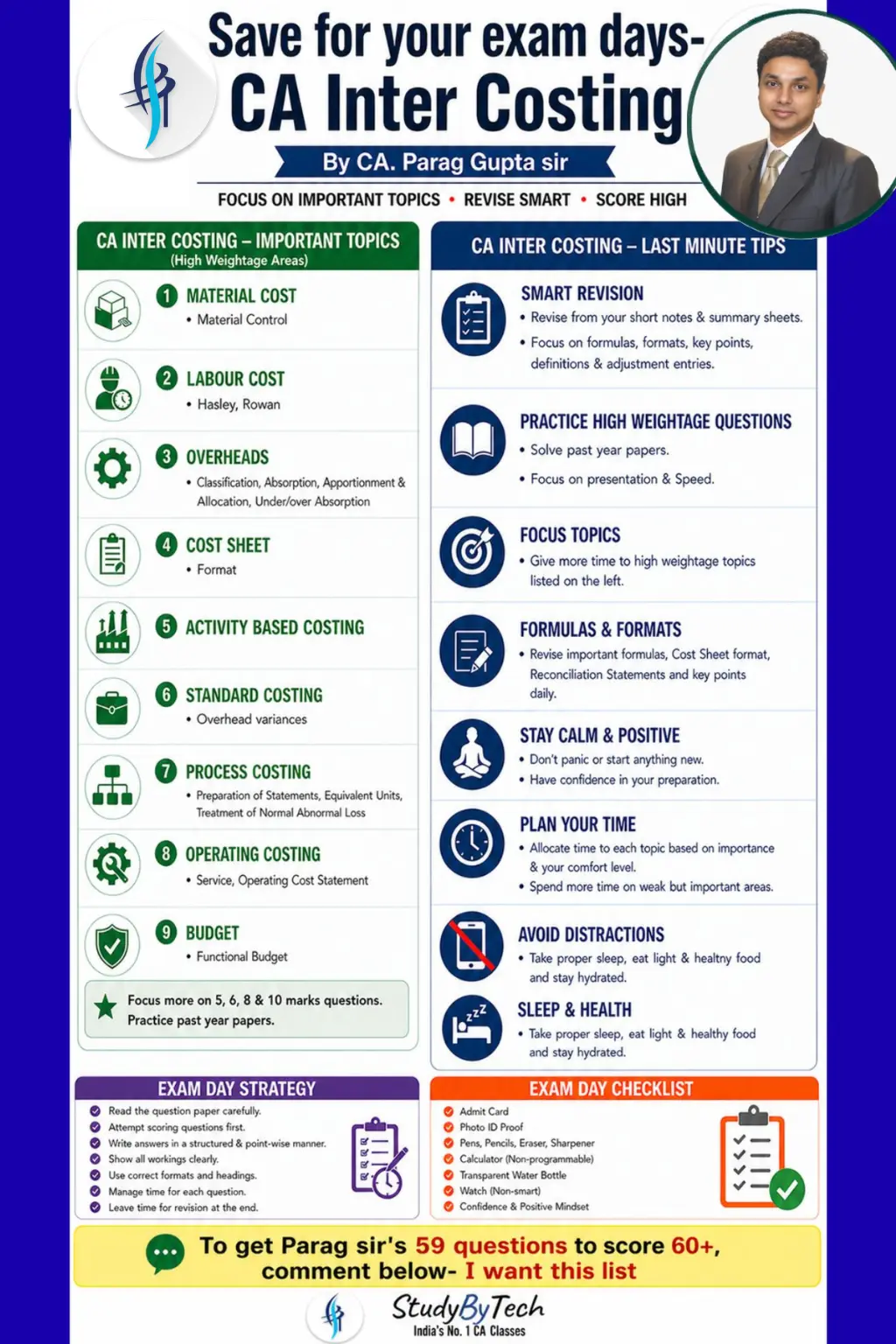
Not all chapters are equal. Some consistently command 10–12 marks, while others hover around 4–6. Treating them all with the same intensity leads to burnout. Here’s the realistic, trend-based CA Inter Costing weightage you need to guide your study.
Module 1: Elements of Cost & Cost Ascertainment
| Chapter | Approx. Weightage | Key Focus Areas |
|---|---|---|
| Introduction to Cost & Management Accounting | ~4 Marks | Pure theory; definitions, objectives, classifications |
| Material Cost | ~4–6 Marks | EOQ, stock levels, inventory valuation |
| Employee Cost (Labour) | ~4–8 Marks | Halsey, Rowan, labour turnover ratios |
| Overheads | ~4–6 Marks | Primary/secondary distribution, machine hour rate |
| Activity-Based Costing (ABC) | ~8 Marks | Cost drivers, cost pools; often a standalone question |
| Cost Sheet | ~10–12 Marks | Format-driven, highly scoring, foundational |
| Cost Accounting Systems | ~4–6 Marks | Integral & non-integral accounts |
Module 2: Costing Methods & Decision-Making Tools
| Chapter | Approx. Weightage | Key Focus Areas |
|---|---|---|
| Job, Batch & Contract Costing | ~6–8 Marks | EBQ, profit on incomplete contracts |
| Process & Operation Costing | ~4–6 Marks | Equivalent production, normal/abnormal loss |
| Joint Products & By-Products | ~4–8 Marks | NRV method, physical unit method |
| Service Costing (Operating Costing) | ~6–8 Marks | Transport, hospital, hotel; data organization |
| Standard Costing | ~10–12 Marks | Material, labour, overhead variances |
| Marginal Costing | ~8–10 Marks | P/V ratio, BEP, MOS, make-or-buy decisions |
| Budgetary Control | ~6–8 Marks | Flexible budgets, cash budgets |
3. The 4-Step Strategy to Aim for an Exemption
Most students prepare by passively watching lectures and solving a few module sums. That’s why the pass percentage remains stubbornly low. Here’s a battle-tested approach to score 70+ in the CA Inter Costing exam.
Step 1: Build Concepts, Don’t Just Collect Formulas
When you memorize a variance formula without understanding why the components sit that way, you’re building on sand. For every formula, ask yourself: what exactly is this comparing? Once the logic clicks, even tricky ICAI adjustments won’t shake you. This upfront investment pays off exponentially later.
Step 2: Make the ICAI Module Your Best Friend
Over 70% of practical exam questions are structural adaptations of illustrations and back-exercise problems from the official ICAI Study Material. Solve every illustration—not once, but until the process feels natural. Maintain a separate practice notebook. Physical writing reinforces memory in a way that scanning a screen never will.
Step 3: Filter & Log Critical Questions (The L1-L2-L3 Method)
While solving problems, categorize each one:
- L1 (Easy): You can solve quickly and accurately. These go into maintenance mode.
- L2 (Tricky Adjustments): Solvable but with a specific twist you need to watch for.
- L3 (Must-Revise): Gave you trouble. Conceptual error or time trap. These become your revision priority list.
When the final week arrives, you’ll laser-focus on L2 and L3 problems instead of drowning in familiar material.
Step 4: Simulated 3-Hour Mock Examinations
Costing papers are notoriously long. The most common post-exam regret is “I knew everything but could only attempt 75 marks.” The antidote: take at least two RTPs, two MTPs, and the past three years’ question papers under a strict 3‑hour timer. No pausing, no peeking. The discomfort builds speed and mental stamina.
4. Small Mistakes That Can Cost You Big (And How to Avoid Them)
- Skipping working notes: ICAI awards step marks generously. Even if your final answer is right, missing cross-referenced workings can lose you up to 30-40% of a question’s marks. Show your logic clearly.
- Mismanaging the 15-minute reading time: Don’t read the paper line by line. Use this window to identify the optional question you’ll drop and to sequence your first three answers. Start with a confidence-building question.
- Writing theory answers like essays: About 20-30% of the paper is theoretical. Use bullet points, be concise, and include ICAI technical keywords. The examiner wants precision, not paragraphs.
- Leaving questions unattempted: A blank page guarantees zero. Even writing the relevant formula and a partial attempt can fetch 2-3 crucial marks that make the difference between 58 and 63.
I’ve seen bright students lose marks they didn’t need to lose. Here are the four points that break my heart every time.
5. A Final Thought
I’m not going to tell you the CA Inter Costing exam is easy. It isn’t. But here’s what I know after years of sitting across the table from students just like you: it’s coachable. The concepts don’t change. The patterns repeat. And the students who treat preparation as a deliberate, timed, honest process — not just endless hours of passive watching — are the ones who walk out of that exam hall with a quiet smile. You can be one of them.
Q: How do I study for CA Inter costing?
1. Prioritize the simpler chapters first.
2. Study the study materials provided by ICAI in-depth.
3. Create notes & solutions for each chapter.
4. Always evaluate your level of preparation.
5. Take Mock tests.
6. Don’t depend solely on selective study.
7. The full syllabus must be finished before revision.
Q: Is CA Inter cost difficult?
If you have not adequately prepared for this, Paper 4 of the costing and management accounting section of the CA examinations might be rather challenging. To pass the exam with decent marks, you need to practice your practical skills a lot.
Q: Are CA Inter costing classes for Jan 2027 & May 2027 started?
Parag sir will start new batches in the 1st week of July 2026.
Q: Who is best for costing CA Inter?
A well-known professor among the students is CA. Parag Gupta. CA Parag Gupta sir is the ideal pick if you’are looking for the top instructors for the CA Inter Cost & SM and CA Final costing. His distinctive method of instruction ensures that each student fully comprehends the material. Each student receives individualized attention from him, which makes passing the exam simple.
Q: Where can I find 50+ question list of Parag sir for CA Inter costing to get 60+ marks in exams?
Click here to get Parag sir’s exclusive 50+ question list to score 60+ marks in CA Inter Costing exam.
Ready to Secure Your Exemption in CA Inter Costing?
Access structured video lectures, chapter-wise formula charts, and personal mentorship programs designed to make your preparation efficient and exam-focused.
Explore CA Inter Costing Exam tip