Author name: Studybytech

Ansoff Matrix | Overview, Strategies and Practical Examples
Blog, CA Inter

Ansoff Matrix

CA Inter Classes ICAI Registration Process, Fees, & Syllabus Admit Card Exam Dates Study Guides & Tips CA Inter faculties FAQ What is the Ansoff Matrix? In today’s dynamic business landscape, strategic planning is paramount for sustainable growth and market dominance. The Ansoff Matrix, devised by Igor Ansoff in 1957, remains a cornerstone framework for businesses aiming to expand and diversify their market reach. In this comprehensive guide, we delve into the intricacies of the Ansoff Matrix, elucidating its components, applications, and strategic implications for businesses across various industries. Understanding the Ansoff Matrix The Ansoff Matrix is a strategic planning tool that offers a structured approach to identifying growth opportunities by evaluating market penetration, market development, product development, and diversification strategies. This matrix comprises four quadrants, each representing a distinct growth strategy tailored to address specific business objectives and market conditions. Each box of the Matrix corresponds to a specific growth strategy. They are: Market Penetration Market Penetration strategy focuses on increasing market share within existing markets by promoting existing products to current customers or attracting new customers through aggressive marketing and sales initiatives. This strategy entails leveraging brand equity, optimizing pricing strategies, and enhancing customer engagement to drive sales and revenue growth. Market Development Market Development strategy involves expanding into new markets or geographical regions by adapting existing products or services to meet the unique needs and preferences of target audiences. This strategy necessitates conducting market research, identifying lucrative opportunities, and formulating tailored marketing campaigns to penetrate new markets effectively. Product Development Product Development strategy centers on innovating and launching new products or services to cater to evolving consumer demands and market trends. This strategy entails investing in research and development (R&D), fostering creativity and innovation, and collaborating with cross-functional teams to conceptualize, design, and commercialize innovative products that resonate with target audiences. Diversification Diversification strategy entails entering new industries or market segments by leveraging core competencies, resources, and capabilities to capitalize on untapped opportunities and mitigate risks associated with market saturation or competitive pressures. This strategy requires conducting a comprehensive market analysis, assessing organizational strengths and weaknesses, and formulating strategic partnerships or alliances to facilitate successful diversification initiatives. Ansoff Matrix and Financial Analysis There is a widespread misperception that financial analysis is only a quantitative endeavor. The drivers of corporate growth must also be understood by analysts, as they will influence many model assumptions, in addition to the fact that they must be able to interpret assets and liabilities, sift through 10K filings, and create financial models. What distinguishes elite analysts from the rest is their capacity to convert qualitative results from an Ansoff Matrix, a Porter’s Five Forces framework, or a SWOT or PESTEL analysis into model assumptions. The ability to model growth drivers well is a crucial component of high-quality due diligence; consequently, these factors can significantly influence credit metrics and valuation estimates. Conclusion Ansoff matrix remains a versatile and invaluable tool for businesses aspiring to thrive in the ever-evolving global marketplace. By understanding its core principles, applying its strategic frameworks, and adapting its methodologies to suit specific business contexts and market conditions, organizations can unlock new growth opportunities, capitalize on untapped market potentials, and position themselves for sustained success in the digital age. FAQ’s Want to subscribe to latest lectures by Parag Gupta sir?

a stack of study guides titled 'The Ultimate Guide for How to Leverage Pass Percentages for Success in CA Foundation.' The guides feature StudyByTech's logo.
Blog, CA Foundation

How to Leverage Pass Percentages for Success (CA Foundation)

CA Foundation Classes ICAI Registration Process Subjects, Syllabus & Exam Pattern Admit Card Exam Dates Exam Tips About the faculties FAQ Pass-percentage analysis is pivotal for every CA Foundation aspirant. It serves as a compass, guiding you through the intricacies of exam preparation. The Institute of Chartered Accountants of India (ICAI) has set stringent criteria for passing the CA Foundation 2025 examinations. A candidate must secure a minimum of 40% marks in each paper and an aggregate of 50% marks across all four papers combined. Falling short of these benchmarks can lead to disappointment. Strategize, Tactfully, and Smartly for the CA Foundation. Studying for CA exams isn’t just about cramming textbooks; it’s about strategizing smartly. Here’s where StudyByTech comes into play:. We understand the nuances of CA exam preparation and provide tailored courses designed to maximize your chances of success. Our expert faculties offer comprehensive guidance, ensuring that you grasp complex concepts with ease. Unlock Your Potential with StudyByTech: At StudyByTech, we believe in fostering an environment conducive to learning. Our online and offline classes cater to diverse learning preferences, allowing you to study at your own pace. Whether you prefer the flexibility of online learning or the structured approach of classroom sessions, we’ve got you covered. Our individualized attention ensures that no query goes unanswered and no concept remains unexplored. Expert Faculty: Your Pillar of Support: One of the cornerstones of StudyByTech is our esteemed faculty. We boast a team of seasoned professionals, each a master in their respective fields. From accounting principles to taxation laws, our faculty members leave no stone unturned in imparting knowledge. With their guidance, you’ll not only understand the course material but also gain insights that transcend textbooks. A Roadmap to Success for the CA Foundation: Success in CA exams isn’t a distant dream; it’s a tangible reality with StudyByTech. Our meticulously crafted study material, coupled with regular mock tests, equips you with the skills and confidence needed to ace the exams. We understand that each student is unique, which is why we offer personalized guidance to address individual strengths and weaknesses. Conclusion: Your Journey Starts Here As you embark on your CA journey, remember that success isn’t just about hard work; it’s about working smart. With StudyByTech by your side, you’ll navigate through the complexities of CA exams with ease. Our holistic approach to education ensures that you not only pass the exams but also emerge as a proficient and knowledgeable professional. So why wait? Join StudyByTech today and embark on a journey toward a rewarding career in chartered accounting. Remember, with the right guidance and determination, the sky’s the limit. Let StudyByTech be your partner in success. FAQ’s

CA Foundation Exam Form 2026: Dates, Fees, Step-by-Step Guide
CA Foundation

CA Foundation Exam Form Sept 2026: Dates, Fees & Step-by-Step Guide

CA Foundation Classes ICAI Registration Process Subjects, Syllabus & Exam Pattern Admit Card Exam Dates Exam Tips About the faculties FAQ’s 📌 Key Takeaways – CA Foundation Exam Form Sept 2026 Your complete, stress-free guide to filling the ICAI SSP portal 1 Important Dates for Sept 2026 Exam Form Opens: July 6, 2026 | Last Date (No Late Fee): July 19, 2026 | Last Date (With Late Fee): July 22, 2026 | Correction Window: July 23–25, 2026. The window is only ~15–17 days – don’t delay! 2 Exam Form Fees + Required Documents Fees: ₹1,500 (India, regular) | ₹600 late fee. Documents to keep ready: Passport-size photo, signature (scanned), CA Foundation Registration Number, Aadhaar/ID proof, Class 12 details, payment method (UPI/Card/Net Banking). 3 Step-by-Step Process + Common Mistakes to Avoid Steps: Login to ICAI SSP Portal → Check profile → Select “Foundation Exam Form” → Fill details → Upload docs → Choose center → Pay fees. Avoid: Waiting till last date, wrong photo/signature, incorrect exam center, skipping detail verification. 📅 Form Opens: July 6, 2026 ⏰ Last Date (Regular): July 19, 2026 💰 Exam Fee: ₹1,500 (India) 🛠️ Correction Window: July 23–25, 2026 🌐 Portal: ICAI SSP Portal 💡 Pro Tip: Fill the form early to get your preferred exam center (limited seats). Use a laptop, not mobile – the portal’s mobile interface often glitches during payment. Filling out the ICAI exam form is often more stressful than the exam itself! One wrong click can lead to a rejected application. At StudyByTech, we’ve helped thousands of students navigate the SSP portal. Here is your definitive, ‘no-stress’ guide to the CA Foundation September 2026 exam forms. CA Foundation Exam Form Sept 2026 As per the latest update by Institute of Chartered Accountants of India: Event Sept 2026 Session Form Opening Date July 6, 2026 Last Date (No Late Fee) July 19, 2026 Last Date (With Late Fee) July 22, 2026 Correction Window July 23 – 25, 2026 👉 Important: The exam form window is very short (~15–17 days), so don’t delay. Step-by step guide to fill the form Documents Required (Keep Ready Before Filling) 💡 Pro tip: Most students waste time searching documents during form filling—prepare beforehand. CA Foundation Exam Form Fees (2026) 👉 Always try to submit before the late fee—no benefit in delaying. Step-by-Step Process to Fill CA Foundation Exam Form Follow this simple process: 💡 Tip: Fill early to get your preferred exam center (limited seats). Common Mistakes Students Make (Avoid These) 👉 These mistakes can cost you an entire attempt. Correction Window – Your Last Chance If you make any mistake: What Happens After Filling the Exam Form? After submission: Final Advice Don’t treat the exam form as just a form.It’s the entry ticket to your CA journey.Fill it carefully, early, and without mistakes. FAQ’s

CA Foundation Syllabus & Subjects 2026
Blog, CA Foundation, Exams tips

CA Foundation Syllabus & Subjects 2026 – Complete Updated Guide for Students

CA Foundation Classes ICAI Registration Process Subjects, Syllabus & Exam Pattern Admit Card Exam Dates Exam Tips About the faculties FAQ’s 📌 Key Takeaways – CA Foundation Syllabus 2026 What every CA aspirant must know before starting preparation 1 4 Papers, 400 Marks – Updated ICAI Scheme 2026CA Foundation now has 4 papers: Accounting (100), Business Laws (100), Quantitative Aptitude (100 – includes Maths, LR & Stats), and Business Economics (100). 2 subjects removed (BCR & BCK) – syllabus is now more focused. 2 Passing Requirement + Negative MarkingNeed 40% in each paper and 50% aggregate overall. Paper 3 (Quantitative Aptitude) and Paper 4 (Economics) are objective type with negative marking – accuracy matters as much as speed. 3 6–8 Months Preparation + Smart StrategySerious preparation requires 6–8 months with daily study, concept clarity (not rote learning), ICAI question practice, and regular mock tests. Revision and consistency matter more than long study hours. 📚 Total Papers: 4 🎯 Total Marks: 400 ✅ Passing: 40% each + 50% aggregate ⏱️ Prep Time: 6–8 months 📖 Eligibility: After Class 12 🎓 Ready to start your CA Foundation journey? View StudyByTech CA Foundation Batches → | 📞 Counseling: +91 9968875529 If you are planning to start your Chartered Accountancy journey, understanding the CA Foundation syllabus is the first and most important step. Many students begin preparation without knowing the exact subjects, chapter weightage, exam pattern, or the changes introduced under the latest ICAI scheme. Because of this, they often waste time studying less important topics while missing scoring areas. In this updated guide, we will cover the complete CA Foundation Syllabus & Subjects 2026, including paper-wise topics, exam pattern, marking scheme, preparation tips, and important updates every student should know before starting preparation. According to the latest ICAI structure, the CA Foundation course now consists of 4 papers covering Accounting, Law, Quantitative Aptitude, and Economics. CA Foundation Course Overview The CA Foundation exam is conducted by the Institute of Chartered Accountants of India and acts as the entry-level examination for students who want to become Chartered Accountants. Students can register after Class 10, but they become eligible to appear for the exam only after passing Class 12. CA Foundation Subjects 2026 The latest CA Foundation syllabus contains 4 papers: Paper Subject Marks Type Paper 1 Accounting 100 Subjective Paper 2 Business Laws 100 Subjective Paper 3 Quantitative Aptitude 100 Objective Paper 4 Business Economics 100 Objective The syllabus focuses more on conceptual clarity and practical understanding rather than rote learning. Paper 1 – Accounting Syllabus Accounting is considered one of the most important scoring subjects in CA Foundation. It builds the base for CA Intermediate and future professional studies. Important Topics in Accounting Students who practice regularly usually score very well in this paper because most questions are concept and format based. Paper 2 – Business Laws Syllabus Business Law is a theory subject, but it becomes easy when students understand concepts instead of memorising everything blindly. Important Topics in Business Laws One common mistake students make is ignoring writing practice. In Law, presentation and keywords matter a lot. Paper 3 – Quantitative Aptitude Syllabus This paper is divided into three parts: Part Topic Marks Part A Business Mathematics 40 Part B Logical Reasoning 20 Part C Statistics 40 Important Mathematics Topics Ratio & Proportion Equations Linear Inequalities Time Value of Money Permutation & Combination Sequence & Series Basic Calculus Important Logical Reasoning Topics Seating Arrangement Coding-Decoding Blood Relations Direction Test Important Topics in Statistics Topics Students usually find this subject difficult initially, but daily practice improves speed and accuracy significantly. Paper 4 – Business Economics Syllabus Economics helps students understand business environments and market behaviour. Important Topics in Economics Topics Economics is considered one of the highest-scoring papers if concepts are clear and revision is done properly. CA Foundation Exam Pattern 2026 Before starting preparation, students should understand the latest exam pattern. Key Highlights The updated scheme focuses more on conceptual understanding and analytical skills. Important Changes in CA Foundation Syllabus Under the new scheme: This change has made the syllabus more focused and manageable for students. Best Preparation Strategy for CA Foundation Common Mistakes Students Make Many students on Reddit also mention that self-practice and consistency matter more than just watching lectures. How Much Time is Required for CA Foundation Preparation? For most students, 6–8 months of serious preparation is enough if studies are consistent. Students who study daily with proper revision and mock tests generally perform much better than those who study irregularly for long hours. Is CA Foundation Difficult? CA Foundation is not impossible, but it definitely requires discipline and consistency. Students often feel overwhelmed because they try to complete everything quickly instead of building concepts step-by-step. With the right strategy, regular practice, and smart revision, clearing CA Foundation in the first attempt becomes achievable. Final Words The CA Foundation syllabus is designed to build a strong base for your Chartered Accountancy journey. Instead of getting scared by the syllabus size, focus on completing topics gradually with consistency. Remember, students who succeed in CA Foundation are usually not the ones studying 15 hours daily. They are the ones who revise regularly, practice questions properly, and stay disciplined throughout preparation. If you start early and follow a structured study plan, scoring well in CA Foundation becomes much easier. FAQ’s

CA Foundation Admit Card 2026
Blog, CA Foundation, ICAI news & updates

CA Foundation Admit Card Sept 2026: Things You Should Not Miss!

📌 Key Takeaways – CA Foundation Admit Card 2026 Important dates, download steps, and error correction for ICAI Sept 2026 exam 1 📅 Important Dates – CA Foundation Sept 2026Admit Card Release: August 2026 (two weeks before exam)Exam Dates: September 2, 5, 7, and 9, 2026 2 ⬇️ How to Download – Step-by-StepVisit ICAI official website → Login with Registration ID & Password → Click on ‘CA Foundation Admit Card’ link → Download & save. Forgot password? Use ‘Forgot Password’ link with email or registration number. 3 ✅ What to Check & How to Fix ErrorsVerify: Name, photo, signature, registration number, exam center, medium.Corrections allowed for: Exam city, group, medium, syllabus – no fee charged. Contact ICAI helpdesk or use SSP portal. 🏛️ Official Website: icai.org / eservices.icai.org 📄 Subjects: Accounts, Law, Maths, Economics ⚠️ Required at Exam: Admit Card + Valid ID Proof ICAI will release the CA Foundation Sept 2026 admit card online on its official website. Candidates would be able to download the CA Foundation admit card for Sept 2026 session from the official websiteCandidates must login with their registration number and password in order to download the CA Foundation Sept 2026 admit card. Important Things To Take Care About Your Admit Card CA Foundation 2026 Admit Card – Important Dates EVENTS Dates (2026 Session ) CA Foundation admit card release date 2026 August 2026, Two weeks before exam date CA Foundation 2026 exam date Sept 2, 5, 7, and 9, 2026 How To Download CA Foundation Sept 2026 Admit Card? Candidates can follow the steps given below to download the admit card for CA Foundation 2026: Important Details To Check In ICAI Admit Card Candidates should carefully check the following details mentioned in the admit card of CA Foundation 2026: How to Retrieve the ICAI password? In case a candidate forgets the login credentials and password, they have the option to create a new password. Candidates can then download the admit card of CA Foundation by following the steps given below: Option 1 – Set login credentials using email, enter email ID, registration number, mobile number, security question and answer and click on submit. Option 2 – Login using credentials such as CA Foundation registration number, Date of birth, security question and answer and click on the submit button. Option 3 – Candidates can also choose the option to find their login credentials using (SRN + Barcode + PIN), enter the registration number, exam application barcode number and personal identification number and click on submit. Steps to Rectify Errors in CA Foundation Admit Card In case of any error in the CA Foundation hall ticket, candidates should follow the steps given below: Important Instructions: Tips for success Conclusion Your admit card is not just a piece of paper; it is a symbol of your resilience and ambition. It is a reflection of your unwavering commitment to your dreams and aspirations. So, as you step into the examination hall, carry your admit card with pride and confidence, knowing that you have what it takes to succeed. Enroll in Our CA Foundation Classes FAQ’s

ca foundation subjects
Blog, CA Foundation

Subjects in CA Foundation 2026- Marks & weightage

📌 Key Takeaways – CA Foundation 2026 Subjects What you need to know about the new ICAI scheme 1 4 Papers, 400 MarksCA Foundation 2026 includes Paper 1: Accounting (Subjective, 3 hrs), Paper 2: Business Law (Subjective, 3 hrs), Paper 3: Quantitative Aptitude (Objective, 2 hrs), and Paper 4: Business Economics (Objective, 2 hrs). 2 Paper-wise Weightage HighlightsAccounting: Partnership & Final Accounts (30-40%) | Law: Contract Act (25-30%) | Maths: Time Value & Calculus (30-50%) | Economics: Production, Demand & Markets (35-40%) 3 Exam Pattern & MarkingSubjective papers (1 & 2): No negative marking | Objective papers (3 & 4): 1/4 mark deducted per wrong answer. First CA Foundation exam under new scheme: September 2025. 📚 Total Papers: 4 🎯 Total Marks: 400 ⏱️ Paper 1&2 Duration: 3 hours each ⏱️ Paper 3&4 Duration: 2 hours each 📅 First New Exam: Sep 2025 CA Foundation Exam 2026 The CA Foundation exam is a gateway to the prestigious Chartered Accountancy profession in India. The exam is conducted by the Institute of Chartered Accountants of India (ICAI) for students who have completed Class 12th and are aspiring to become Chartered Accountants.Embarking on the journey to become a Chartered Accountant (CA) the CA Foundation exam marks the beginning of this path. In the year 2026, aspiring CAs will delve into a range of subjects, laying the foundation for their future success. Let’s explore the subjects offered in CA Foundation 2026 and how StudyByTech , led by Parag Gupta sir who has an experience of more than 20 years in teaching CA students, full guidence of subjects in CA Foundation 2026 Detailed CA Foundation September 2026 Syllabus – Under New Scheme The CA Foundation exam, conducted by the Institute of Chartered Accountants of India (ICAI), covers a wide range of subjects to test the knowledge and skills of aspiring Chartered Accountants. The subjects included in the CA Foundation exam 2026 are: These subjects are designed to provide a strong foundation in accounting, law, mathematics, statistics, economics, and business knowledge to the candidates. It is important for candidates to thoroughly study and understand these subjects to pass the CA Foundation exam Paper 1 – Accounting subjective: TOPICS SUB TOPICS THEORETICAL FRAMEWORK 1 Meaning and Scope of Accounting.2 Accounting concepts, principles and conventions.3 Capital and revenue expenditure, capital and revenue receipts, contingent 4 assets and contingent liabilities.5 Accounting Policies.6 Accounting as a measurement discipline – valuation principles, accounting 7 estimates. Accounting Standards-concepts and objectives. ACCOUNTING PROCESS 1 Recording accounting transactions: principles of double entrybook-keeping, books of original entry-journal,subsidiary books,cash book, ledger-format,posting from journals and subsidiary books,balancing accounts.2 Preparation Of Trial Balance.3 Rectification Of Errors Depreciation and Amortisation Tangible and intangible assets- meaning & difference, concepts,methods of computation and accounting treatment of depreciation/amortisation,change in depreciation method Bills of Exchange and Promissory Notes Meaning of bills of exchange and promissory notes and their accounting treatment; accommodation bills. Preparation of Final accounts of Sole Proprietors Elements of financial statements, closing adjustment entries, trading account,profit and loss account and balance sheet of manufacturing and non- manufacturing entities Financial Statements of Not-for-Profit Organizations Significance and preparation of receipt and payment account, income and expenditure account and balance sheet, difference between profit and loss account and income and expenditure account Accounts from Incomplete Records (excluding preparation of accounts based on ratios). – Partnership And LLP Accounts 1 Final accounts of partnership firms and LLP.2 Admission, retirement and death of a partner including treatment of goodwill.3 Dissolution of partnership firms and LLPs including piecemeal distribution of assets Bank Reconciliation Statement Introduction, reasons and preparation of bank reconciliation statement Inventories Meaning, basis and technique of inventory valuation, cost of inventory, net realisable value and record system Company Accounts 1 Definition Of Shares And Debentures. 2 Issue Shares And Debentures,forfeiture of shares,reissue of forfeited shares. 3 Redemption of preference shares and debentures(excluding purchase and redemption of own debentures sinking fund method). 4 Accounting For Bonus Issue And Right Issue. Paper 2: Business Laws subjective TOPICS SUB TOPICS Indian Regulatory Framework Major Regulatory Bodies such as the Ministry of Finance, Ministry of Corporate Affairs, SEBI, RBI, IBBI, Ministry of Law and Justice, etc. The Indian Contract Act, 1872 General Nature Of Contract, Consideration, Other essential elements of a valid contract,Performance Contract,Breach Of Contract, Contingent and Quasi Contract, Contract of Indemnity and Guarantee, Contract of Bailment and Pledge, Contract of Agency The Sale of Goods Act, 1930 Formation of the contract of sale, Conditions and Warranties,Transfer of ownership and Delivery of goods,Unpaid seller and his rights. The Indian Partnership Act, 1932 General Nature of Partnership, Rights and Duties of partners, Reconstitution of firms, Registration and Dissolution of a firm The Limited Liability Partnership Act, 2008 Introduction-covering nature and scope, Essential features, Characteristics of LLP, Incorporation and Differences with other forms of organisations The Companies Act, 2013 Essential features of company, Corporate veil theory, Classes of companies,Types of share capital, Incorporation of company, Memorandum of Association, Articles of Association, Doctrine of Indoor Management The Negotiable Instruments Act, 1881 Meaning of Negotiable Instruments, Characteristics, Classification of Instruments, Different provisions relating to Negotiation, Presentment of Instruments, Rules of Compensation Paper 3: Business Mathematics Objective: TOPICS SUB TOPICS Part A: Business Mathematics Ratio and proportion, Indices and Logarithms Ratio and proportion, Indices and Logarithms Equations Linear Equations Upto Three Variables, Quadratic and Cubic equations in one variable. Applications in Business Related Problems. Linear Inequalities Linear Inequalities in one and two variables and the solution space Mathematics of Finance ◦ Simple Interest◦ Compound Interest◦ Nominal and Effective Rate of Interest◦ Present Value◦ Net Present Value◦ Future Value◦ Perpetuity◦ Annuities◦ SinkingFunds◦ Calculating EMICalculations of Returns:Nominal and Effective rate of ReturnCompound Annual Growth Rate(CAGR) Permutations and Combinations Basic concepts of Permutations and combinations: Introduction, the factorial, permutations, results, circular permutations, permutations with restrictions, Combinations With standard results Sequence and Series Introduction Sequences, Series, Arithmetic and Geometric progression,RelationshipbetweenAMandGMandSumofntermsofspecialseriesand BusinessApplications Sets, Relations, and Functions. Basics of Limits and Continuity Functions Basic applications of Differential and Integral calculus in Business and Economics (Excluding the trigonometric applications)

CA Foundation Accounts 2026_ Complete Guide for Beginners
Blog, CA Foundation, CA Foundation Accounts

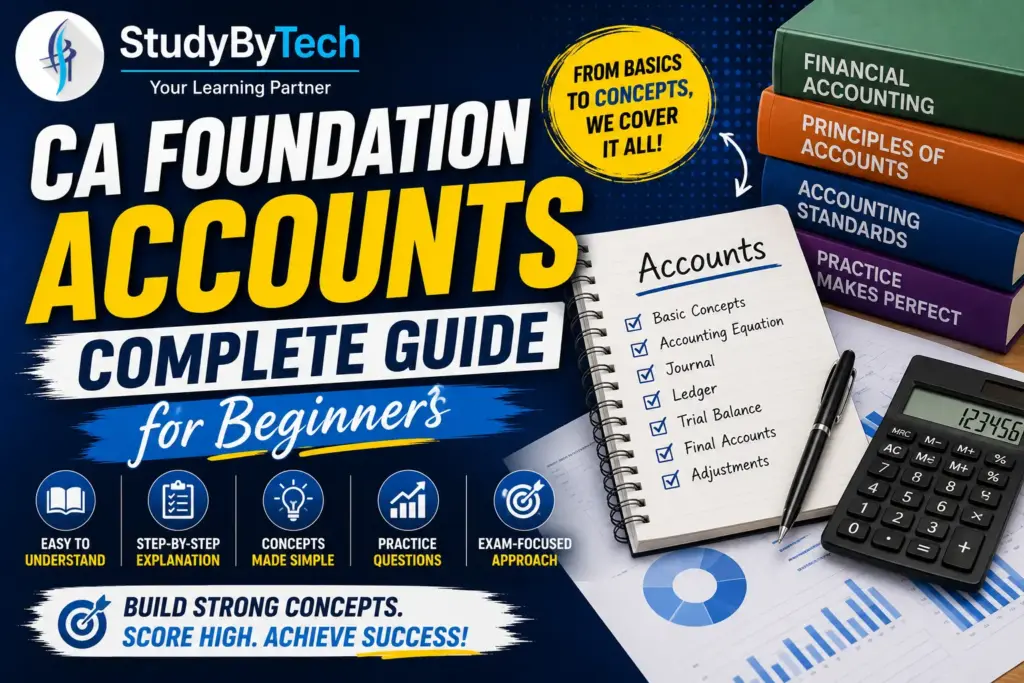
CA Foundation Accounts 2026: Complete Guide for Beginners

📌 Key Takeaways – CA Foundation Accounts 2026 What every beginner must know to score 70+ 1 Exam Pattern & Syllabus100 marks, 3 hours, subjective paper. No negative marking. Key topics: Final Accounts, Partnership, Depreciation, Rectification, BRS, Bills of Exchange. 2 3-Step Preparation StrategyStep 1: Build concepts (why entries are passed). Step 2: Solve ICAI illustrations & chapter-wise questions. Step 3: Mock papers + PYQs in exam conditions. 3 Common Mistakes to Avoid❌ Ignoring narration & presentation❌ Memorizing without understanding❌ Skipping full-length questions✅ Daily practice (even 3-5 questions) + mistake notebook = 70+ marks 📖 Subject: Principles & Practice of Accounting 🎯 Target Score: 70+ (achievable) 📚 Primary Resource: ICAI Study Material ⏱️ Daily Practice: 3-5 questions minimum 📘 Want structured coaching? Check CA Foundation Accounts 2026 Classes → Preparing for Accounting in CA Foundation can feel overwhelming at first. Many students come from different educational backgrounds, and for some, Accounts is completely new. But here’s the good part — CA Foundation Accounts is not difficult if your concepts are clear.Most students struggle not because the subject is tough, but because they try to memorize journal entries without understanding the logic behind them. In this guide, you’ll learn: What is CA Foundation Accounts? CA Foundation Accounts is one of the most scoring subjects in the CA Foundation examination conducted by Institute of Chartered Accountants of India. The paper mainly tests: If your concepts are strong and you practice regularly, scoring 70+ is very achievable. CA Foundation Accounts 2026 Exam Pattern Particulars Details Subject Name Principles and Practice of Accounting Marks 100 Exam Type Subjective Medium English / Hindi Duration 3 Hours Negative Marking No The paper focuses heavily on practical questions, so writing practice is extremely important. CA Foundation Accounts 2026 Syllabus 1. Theoretical Framework 2. Accounting Process 3. Bank Reconciliation Statement One of the easiest scoring chapters if practiced properly. 4. Rectification of Errors Students often lose marks because they ignore narration and adjustment effects. 5. Depreciation and Provisions Very important for exams and concept building. 6. Bills of Exchange Frequently asked in exams. 7. Financial Statements 8. Partnership Accounts Usually considered one of the most important units in the syllabus. Most Important Chapters for CA Foundation Accounts These chapters usually carry high weightage: Students should never skip these chapters. Best Strategy to Prepare for CA Foundation Accounts 1. Focus on Concepts First Do not jump directly into marathon question solving. Understand: 2. Practice Daily Accounts is a practical subject. Even solving: can improve your speed significantly. 3. Solve ICAI Questions First Many students use random books but ignore ICAI material. Always prioritize: because exam patterns are usually based around them. 4. Maintain a Mistake Notebook Write down: Revising mistakes before exams saves a lot of marks. Common Mistakes Students Make in Accounts Ignoring Narration Even correct entries may lose presentation marks if narration is poor. Not Practicing Full-Length Questions Students often practice only small sums and panic in exams during lengthy adjustments. Learning Without Understanding Memorization works temporarily but fails in tricky adjustment questions. Avoiding Revision Accounts requires repeated revision because formats and treatments can be forgotten quickly. How to Score 70+ in CA Foundation Accounts Here’s a realistic approach: First Reading Second Reading Third Revision Consistency matters more than studying 12 hours randomly. Best Books for CA Foundation Accounts Students generally prefer: But remember — too many books create confusion. Stick to one main source and revise it multiple times. Why Most Students Fail in Accounts Most failures happen because students: Accounts rewards practice and presentation. The more questions you solve, the more confident you become. Final Words CA Foundation Accounts may seem difficult initially, but once concepts become clear, it becomes one of the highest-scoring subjects in the entire CA Foundation syllabus. Instead of trying to complete everything quickly: That approach works much better in the long run. FAQ’s

ca-inter-for-mcq-sm
CA Inter, SM

Solve CA Inter MCQ for SM with Parag Gupta sir’s expertise

Introduction Strategic Management (SM) is a critical subject in the CA Inter curriculum, playing a pivotal role in shaping future Chartered Accountants. For this CA Inter MCQ for SM are introduced by Parag Gupta sir so that you could understand how deep is your understanding for this subject. As students navigate the complexities of this subject, it becomes essential to adopt effective learning strategies. One such strategy gaining immense popularity is the use of Multiple Choice Questions (MCQs). Parag Gupta sir’s, renowned as India’s best faculty for CA Inter SM, has been providing a daily dose of MCQs on his social media account & his website: www.paraggupta.com. In this blog, we’ll explore the significance of CA Inter MCQs for SM and how Parag Gupta sir’s offerings contribute to an enriched learning experience. The Power of CA Inter MCQ for SM: 1. Conceptual Clarity: MCQs are designed to assess a student’s understanding of concepts. The process of selecting the correct option requires a deep comprehension of the topic. As such, engaging with daily MCQs becomes a powerful tool for reinforcing and solidifying conceptual clarity in strategic management. 2. Exam Simulator: CA Inter examinations are renowned for being difficult, assessing students’ knowledge as well as their capacity to apply it in practical settings. MCQs closely simulate the exam environment, preparing students to tackle diverse questions within a limited time frame. This practice is invaluable in enhancing exam readiness. Because 30% of the paper is considered an objective paper in the CA Inter SM (i.e., without any negative marking), CA Inter multiple-choice questions are considered an essential part of preparing for the CA Inter exam. 3. Quick Assessment and Feedback: The instantaneous feedback that MCQs offer is revolutionary. Students can instantly gauge their performance, identify weak areas, and rectify mistakes. This iterative process of learning and correcting shortens the learning curve overall and makes studying more effective and efficient. 4. Retention and Recall: Studies have shown that the act of recalling information enhances memory retention. By regularly engaging with MCQs, students actively retrieve and reinforce their knowledge. This promotes long-term memory, which is essential for passing the CA Inter test, in addition to helping students retain important concepts. Parag Gupta sir’s Daily CA Inter MCQ for SM: A Learning Companion 1. Expertly Crafted Questions: Parag Gupta sir’s recognized as India’s best faculty for CA Inter SM, brings his expertise to the forefront with meticulously crafted MCQs. These questions go beyond rote memorization, challenging students to apply theoretical knowledge to real-world scenarios. This approach aligns with the practical orientation of the CA Inter exams. 2. Comprehensive Coverage: The field of strategic management is vast, encompassing a multitude of topics. Parag Gupta sir’s ensures comprehensive coverage through a diverse range of MCQs. This ensures that students are well-prepared for the varied challenges presented by the CA Inter SM syllabus. 3. Timely Updates: Keeping pace with the dynamic nature of the CA Inter syllabus, Parag Gupta sir provides daily updates on his website. This commitment to regularity not only keeps students engaged but also ensures that they are aware of any changes or additions to the curriculum. It reflects a dedication to providing the most relevant and up-to-date resources. ICAI study material also includes MCQs for each chapter, so students are also recommended to make a habit to solve these MCQs along with Parag sir’s expertly crafted MCQs for CA Inter SM to gain the full understanding of each concept. Conclusion In the challenging journey of becoming a chartered accountant, mastering strategic management is a non-negotiable requirement. The strategic use of CA Inter for MCQ SM in preparation adds a dynamic and effective dimension to the learning process. The fact that Parag Gupta sir is willing to share daily MCQs for CA Inter SM on his website is a great gesture that will help aspiring chartered accountants succeed. Students can strengthen their conceptual understanding and acquire the abilities they need to ace the CA Inter examinations by working with these excellent CA Inter for MCQ SM. As we navigate the ever-evolving landscape of education, leveraging resources like Parag Gupta sir’s daily MCQs becomes essential for staying ahead of the curve and emerging as successful professionals in the field of accounting. The value of daily multiple-choice questions (MCQs) becomes clear as students go on this life-changing journey. They provide a strong foundation in the principles of strategic management and are an invaluable aid for passing exams. FAQ’s

What to do after CA Foundation exams
Blog, CA Inter

What to do after CA Foundation exams?

Finishing your CA Foundation exams feels like a huge relief. After months of studying, mock tests, revisions, and stress, suddenly you have free time — and one big question in your mind: “What should I do now?” Some students feel confident about clearing the exam. Some are confused about their performance. Others are worried about results. But the truth is simple: The period after CA Foundation exams is extremely important. The students who use this time smartly stay ahead in CA Intermediate preparation and reduce future pressure. In this blog, we will discuss the best things you should do after CA Foundation exams, mistakes to avoid, and how to prepare yourself for the next stage of the CA journey. First of All — Take a Small Break You have worked hard for months. Your mind and body need recovery. Take 4–7 days to relax: Many CA students immediately start overthinking after exams: But constantly analyzing papers changes nothing. Instead, use this time to mentally recharge. A fresh mind performs better in CA Intermediate. Understand the Reality of CA Journey CA Foundation is only the first step. The real challenge begins in: That’s why students who start planning early usually perform better in the long run. Even if you are unsure about your result, this waiting period should not be wasted. If You Are Confident About Passing If your papers went well, this is the perfect time to start early preparation for CA Intermediate. Why Start Early? CA Intermediate syllabus is much bigger than Foundation. Students often underestimate: Starting early gives you: Most successful CA students begin preparation before results. Start Exploring CA Intermediate Subjects You do not need to study 10 hours daily right now. Start slowly: Important CA Intermediate subjects include: Initially, focus more on understanding the level difference between Foundation and Intermediate. Improve Your Skills During the Waiting Period One mistake many students make is only waiting for results. Instead, use this time to build practical skills. Skills You Can Learn Today companies value practical knowledge along with academic performance. Students and mentors across CA communities also discuss the importance of consistency, practical skills, and early preparation during this transition phase. Focus on ICAI Study Material Many toppers repeatedly say one thing: ICAI material should be your first priority. Whether you prepare through coaching or self-study: Experts continue to recommend ICAI study material, revision practice, and mock tests as the core strategy for CA success. Make a Simple Study Routine Do not suddenly create a 14-hour study timetable. Start with a balanced schedule: The goal is consistency, not temporary motivation. As many CA students share online, consistency matters more than extreme study schedules. What If You Are Not Confident About Passing? First, do not panic. Many students feel their exams went badly but still clear Foundation. Until results are declared: If results do not go as expected, your preparation will still help in the next attempt. Avoid These Common Mistakes After CA Foundation 1. Taking a Very Long Break A 1-week break is fine.A 2-month break destroys momentum. 2. Comparing Yourself With Others Everyone’s CA journey is different. 3. Ignoring Health Sleep, exercise, and mental health matter during CA preparation. 4. Only Watching Motivation Videos Motivation helps for one day. Discipline helps for years. 5. Waiting for “Perfect Time” There is no perfect time to start Intermediate. Start small and continue consistently. Should You Join Coaching Immediately? It depends on: But early guidance helps many students because CA Intermediate requires: Choose faculty carefully based on teaching style and support system — not only popularity. Build Good Habits Before CA Intermediate This is the best time to improve: These habits matter more than studying for extremely long hours. Final Advice for CA Foundation Students Your CA Foundation exams are over, but your CA journey is just beginning. Do not waste the post-exam period in: Instead: Small consistent efforts during this phase can create a huge advantage later.Remember: CA is not a sprint. It is a long journey of consistency, patience, and smart preparation. Still Confused? So Here Parag Sir is available with a video to help FAQ’s

how to get rank in ca?
Blog, CA Course

How to Get Top Rank in CA with StudyByTech Classes

Are you aspiring to achieve top ranks in your CA exams and wondering how to elevate your preparation to the next level? Look no further! In this blog post, we’ll explore valuable insights and strategies to help you climb the ladder of success in your CA journey, with a special focus on the exceptional resources provided by StudyByTech for CA classes. Understanding the CA Exam Landscape The Chartered Accountancy (CA) exams are known for their rigorous nature and high competition. To secure a top rank, it’s crucial to comprehend the exam pattern, syllabus, and the level of preparation required. CA aspirants should have a comprehensive study plan covering all subjects and ample practice with mock exams. The Role of Quality Education For CA One of the key elements in achieving success in CA exams is quality education. Here’s where StudyByTech comes into play. Known for its exceptional CA Classes, StudyByTech offers a comprehensive and structured curriculum designed to cater to the specific needs of CA aspirants. Advantages of StudyByTech CA Classes 1. Expert Faculty:  StudyByTech boasts a team of experienced and knowledgeable faculty members who are experts in their respective fields. Their guidance can prove invaluable in understanding complex concepts and mastering challenging topics. 2. Comprehensive Study Material:  The study material provided by StudyByTech is meticulously crafted to cover the entire CA syllabus. It is updated regularly to align with any changes in the exam pattern, ensuring that students are well-prepared. 3. Interactive Learning Environment:  StudyByTech classes provide an interactive learning experience, with live sessions, doubt-solving forums, and personalized attention to each student. This fosters a conducive environment for effective learning. Effective Study Strategies While quality education is crucial, it is equally important to adopt effective study strategies. Here are some tips to enhance your preparation: 1. Time Management:  Create a realistic and well-structured study schedule. Allocate sufficient time to each subject and prioritize based on your strengths and weaknesses. 2. Consistent Revision:  Regular revision is key to retention. Plan periodic revisions of previously covered topics to reinforce your understanding. 3. Practice with mock Exams: Familiarize yourself with the exam pattern by practicing with mock exams. This not only boosts your confidence but also helps in identifying areas that need more attention. Staying Motivated During CA Exam The journey to securing a top rank in CA exams can be challenging, and staying motivated is crucial. Set realistic goals, celebrate small victories, and surround yourself with positive influences. Joining StudyByTech classes not only equips you with the knowledge but also offers a supportive community to keep you motivated throughout the preparation phase. In conclusion, Achieving a top rank in CA exams requires a combination of quality education, effective study strategies, and unwavering determination. Enrolling in StudyByTech’s CA classes can undoubtedly provide you with the edge you need to excel in your CA journey. So, gear up, follow these tips, and embark on the path to success!

Scroll to Top