Blog

ICAI’s Hacker (Mihir) spoke to CA Parag Gupta sir!
Blog, CA Final

The ICAI Portal “Hack”: Ethical Intention or Malicious Act? CA. Parag Gupta and hacker, Mihir Shishulkar clarify the Controversy

The ICAI student’s body was also panicked out over the results of the CA Final Exams being released only one day from now. Not only that but allegations concerning data breaches also began circulating on various social media sites, resulting in panic and anxiety for many students waiting for their CA Final results. In an effort to get to the bottom of this, CA Parag Gupta, who is a very well known Costing faculty member, conducted an exclusive video conversation with a man named Mihir, (watch the full discussion here) who was at the heart of this controversy.  The Initial Claim and the Atmosphere of Panic Around this time, Mihir came forward with information on serious security flaws at the ICAI’s examination site and informed the ICAI about them. After disclosing these issues, the conversation turned negative very quickly. On the dark web, Mihir’s name was reportedly misused and manipulated to suggest that he hacked into the ICAI’s exam site to manipulate students’ results when in actually he acted ethically in reporting the issues.  CA Parag Gupta opened the discussion by emphasizing the seriousness of the matter. He clarified that his primary goal was to address the panic among students and that he had no way to independently verify the technical details of the claims . “I am not very proficient in ethical hacking… my purpose was only to talk to Mehur ji to bring students out of a panic situation,” he stated . He acknowledged that while he was giving Mihir the benefit of the doubt, if any malicious intent was proven, the law would take its course. Mihir’s Defense: An Ethical Disclosure Mihir presented his side of the story, maintaining that his actions were strictly for ethical reasons. The individual also claimed he found the weaknesses at 5:56 pm on June 12th 2026 and reported them to ICAI by 6:00pm, one hour later. He walked CA Parag Gupta through the alleged flaws, which he said included: Mihir emphasized that he did not modify any data and that the students’ answer sheets and marks were safe. “I have not leaked any data… your data is not modified,” he assured the students . He also showed screenshots from outside the database tables as proof of his access, stating he had over 200,000 records available . The Core Concern: Is the Data Safe? The most crucial question for students remains: Is their data compromised? Online reports suggest that the situation is likely a rumor. TCS, which maintains the data for ICAI, has reportedly confirmed that no data has been compromised . A chartered accountant, Dr. Rohit Ruwatia Agarwal, shared on social media that TCS had confirmed to him that there was “no substance” to the rumors of a data leak . Mihir’s own claims support this. He repeatedly stated that his access was for reporting vulnerabilities and that he did not steal or modify any data. CA Parag Gupta’s Final Appeal to Students After the interaction, CA Parag Gupta made a heartfelt appeal to the students. He emphasized the importance of not falling prey to panic, especially with results around the corner. He advised students to: Conclusion According to the video, the vulnerability that was found by the individual is now getting their chance to be heard (represented) as an impartial mediator, CA Parag Gupta, calms the worried students. While it is felt that the ICAI and other cybersecurity professionals have the true technical details of the situation, from Mihir’s account there is no reason to believe that his actions that disclosed this vulnerability were not ethically motivated nor that the student’s data had been compromised. Students are asked to remain calm, patient as they await the results and rely upon the official communication from the Institute of Chartered Accountants of India.

How to Study Economics for CA Foundation
Blog, CA Foundation, CA Foundation Economics

How to Study Economics for CA Foundation (Topics + Exam Strategy)

Economics is one of the most scoring subjects in CA Foundation — but only if you follow the right CA Foundation Economics study strategy.Many students struggle because they treat it like a theory subject. In reality, CA Foundation Business Economics is all about concepts, application, and smart revision.In this guide, you’ll learn: 1. CA Foundation Economics Important Topics (Start With Basics) To build a strong base, start with: These are the most important topics in CA Foundation Economics and form the base for advanced chapters. 2. CA Foundation Economics Strategy (Focus on Scoring Areas) After completing basics, move to: These chapters are crucial for CA Foundation Economics exam preparation and frequently tested in MCQs. 3. CA Foundation Economics Study Tips to Score High Follow these proven CA Foundation Economics exam tips: 4. CA Foundation Economics Mistakes to Avoid Avoid these common mistakes during your CA Foundation Business Economics preparation: 4. CA Foundation Economics Last Day Revision Strategy In the final days before the exam: This is the most effective last day revision strategy for CA Foundation Economics. Conclusion If you follow the right CA Foundation Economics study plan, scoring high becomes much easier. 👉 Start with basics👉 Focus on important topics👉 Practice MCQs daily👉 Take a note of common mistakes you are making, and look them often to avoid the in future. That’s how toppers prepare. 🎯 Pro Tip Students who combine concept clarity + regular testing always score higher in CA Foundation Economics exams FAQ’s

CA Inter & CA Final
Blog, CA Final, CA Inter

After CA Inter & CA Final Exam Result: Expert Tips and Strategies

CA Foundation Classes CA Inter Classes CA Final Classes StudyByTech Offers Contact us The release of CA Inter and CA Final results is a defining moment. Whether you are celebrating a “PASS” or analyzing a “FAIL,” the strategy you adopt in the next 48 hours will dictate your career trajectory. At StudyByTech, we’ve broken down the path forward into two distinct blueprints. Part 1: The CA Inter Result – What’s Next? Scenario A: You Passed CA Inter! Congratulations! You are now a Semi-Qualified Professional. Here is your immediate 3-step action plan: 1. Complete ICITSS Training (ITT & OC) Immediately Before you can step into an office for your articleship, you must complete the Integrated Course on Information Technology and Soft Skills (ICITSS). What it includes: 15 days of Information Technology Training (ITT) and 15 days of the Orientation Course (OC). Registration: This is done via the ICAI SSP Portal. Pro-Tip: Seats for these batches fill up within minutes of result declaration. Register ASAP to avoid a 3-month delay in starting your articleship. 2. Clear SPOM Exams (Set A, B, C & D) Under the new scheme, you must clear the Self-Paced Online Modules (SPOM) before you are eligible for CA Final. Strategic Advantage: Understanding these 2 subjects- Set A & Set B (SCPM) will save you during your CA Final exams, as this syllabus is heavily tested in the IBS paper. 3. The Articleship Hunt Whether you aim for the Big 4 or a reputed mid-sized firm, ensure your resume highlights your technical proficiency from ITT and the soft skills from your OC training. Scenario B: You Didn’t Pass CA Inter Analyze the “Why”: Request certified copies from ICAI. Was it a lack of conceptual clarity or “Presentation Errors”? Focus on Costing: If you struggled here, consider Parag Gupta Sir’s Costing Booster Batches, designed to convert a 40 into a 70+. This can help you maintain aggregate in groups, hence can help you pass the exam. LDR Strategy: Start creating Last Day Revision notes now. If you can’t revise a subject in 1.5 days, you won’t be able to pass it during the exam cycle. Part 2: The CA Final Result – The Final Leap Scenario A: You Passed CA Final! You are now a Chartered Accountant. The Job Hunt: Register for ICAI Campus Placements. Focus on “Technical Rounds” and your communication skills. Upskilling: The industry demands a “Tech-Savvy Auditor.” Master Advanced Excel, Power BI, and SAP to increase your market value. Scenario B: You Didn’t Pass CA Final The CA Final hurdle is high, but entirely clearable with a tactical shift. 1. The IBS (Paper 6) “Secret Key” The Integrated Business Solutions (IBS) paper is where most students get stuck. The SPOM Connection: Statistics show that 40–42 marks in IBS come from SPOM material. Specifically, 22–24 marks come directly from SCPM (Set B). The Trap: Most students neglect Set B, treating it as a formality. Mastering the SPOM (SCPM) syllabus is the single most effective way to pass IBS. 2. Tactical Subject Tips Audit & IDT: Use the “Keyword Technique” for Audit Standards. For IDT, use Summary Charts to master the GST logic in a single day. FR & AFM: These are your scoring engines. Master Ind AS adjustments in FR and Forex/Derivatives in AFM. Conclusion Receiving your CA Inter or CA Final exam results is a significant milestone, regardless of the outcome. Use this time to reflect, plan, and take proactive steps towards your future. Whether you’re stepping into the professional world or preparing for another attempt, approach this phase with determination and a strategic mindset. Remember, every step, whether forward or a step back, is part of your journey to becoming a successful Chartered Accountant. Stay positive, stay focused, and continue to strive for excellence. FAQs Q1: I just passed CA Inter. Can I start my Articleship tomorrow? Not quite! You must first complete your ICITSS training (15 days of ITT and 15 days of OC). Once you finish these and the certificates are updated on the ICAI SSP Portal, you are eligible to begin your practical training. Don’t forget to register for your batches immediately, as they fill up fast! Q2: Why SPOM Set B (SCPM) is so important for CA Final IBS exam? In the new scheme, the Integrated Business Solutions (IBS) paper is a multidisciplinary case-study exam. Data shows that roughly 22–24 marks in IBS come directly from the Strategic Cost & Performance Management (SCPM) syllabus. ICAI is judging you on overall knowledge out of which all subjects you have already studied recently, being open book you won’t face problem in finding concepts from book. But as SPOM subjects are studied 1-2 years back with a history of sure shot 40-42 marks guarantied , so revising them becomes very crucial to pass the exam. Q.3 Is CA Inter difficult to pass? CA Inter can be challenging, requiring focused study and understanding. Success depends on preparation and a strong grasp of concepts Q.4 How to apply for CA Final after intermediate? After CA Intermediate, apply for CA Final through the official website of the Institute of Chartered Accountants of India (ICAI). Q.5 Which group is easy in CA Inter? The difficulty of CA Inter groups is subjective, but many students find Group II comparatively easier than Group I. Q6: What happens if I don’t get into a Big 4 for Articleship? Don’t panic! While Big 4 firms offer great exposure to massive clients, reputed mid-sized firms often provide a more “hands-on” experience in GST, Tax Audit, and ROC filing. Both paths lead to a successful career; what matters most is your curiosity and willingness to learn on the job. Want to enroll to our Classes? CA Intermediate requires conceptual clarity and application. Parag Gupta’s classes at StudyByTech follow ICAI study material with targeted revision.

Challenges face by Science student in CA
Blog, CA classes, CA Course

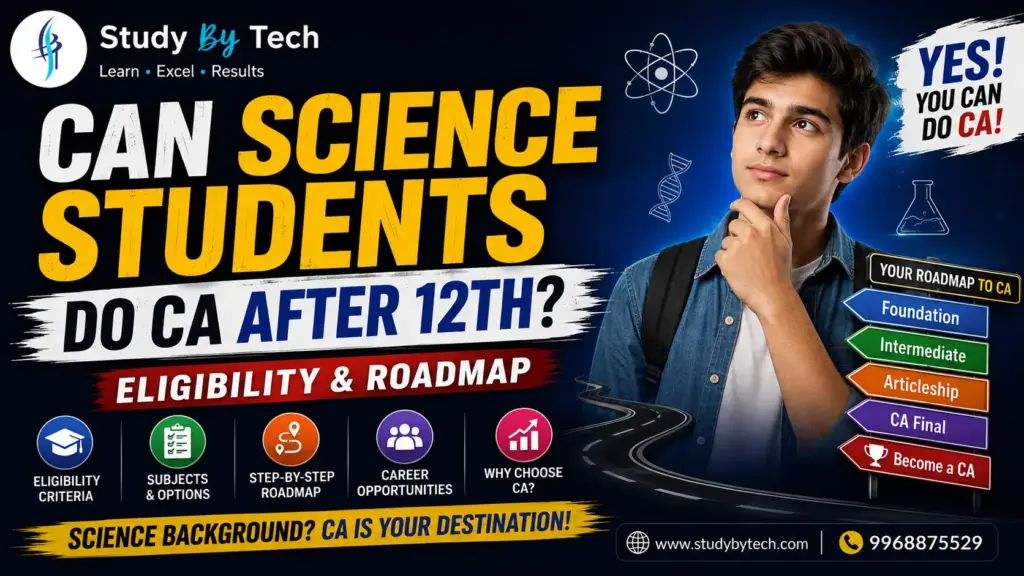
Common challenges faced by Science Students in CA and how to overcome them?

CA Foundation Classes CA Inter Classes CA Final Classes StudyByTech Offers Contact us Many students who finish their high school from a science stream are turning towards Chartered Accountancy (CA) rather than pursuing their career options within the sciences – this increase in interest in the CA profession is warranted due to the value, respect and financial reward associated with being a Chartered Accountant. Students moving from the numeric science based stream into a commerce or business-based environment are faced with unique challenges when adjusting to study, You will most likely feel overwhelmed during your initial transition from numeric science to the field of accounting, law, taxation and business while being required to think outside of the numeric world you are accustomed to. However, with the proper guidance, assistance and a successful learning environment, these challenges can be easily overcome. In this article, we will take an in-depth look at the common challenges faced by science background students in the CA program and how StudyByTech has assisted in overcoming these obstacles. 1. Lack of Commerce Basics Beginning their CA foundation programs, students who have studied science tend to have little to no experience with the fundamental subjects of accounting, business law, economics and/or business math, which can create fears and anxieties. How to Overcome It: StudyByTech provides foundation-level teaching, designed specifically for beginners who have zero commerce background. Faculty break down every concept into simple, relatable examples. Whether it’s debit-credit basics or understanding legal terminologies, StudyByTech ensures students build concepts from scratch—not by memorizing, but by understanding. 2. Struggle With Theoretical Subjects StudyByTech’s foundation-oriented approach supports the development of commerce skills for students from all backgrounds. Faculty use real-world examples to illustrate each of the concepts, from how to use a debit/credit and legal terminology to building a complete understanding of a subject from the ground up rather than through rote memorization. How StudyByTech Helps: At StudyByTech, we provide separate sessions for Science & Humanities students to make the basics of Accounts & Economics strong. These sessions are provided prior to joining the batches. 3. Difficulty in Understanding Commerce Terminology People who have a background in physics, chemistry, or biology will see terms such as liability, amortization, accrual, capital, or GST input vs output, as quite new. So it is important to first make sure that students shall understand the basic terms of Accounts & Economics to get started with thw syllabus. StudyByTech’s Approach: Teachers in StudyByTech break down all of the technical jargon into plain English with the use of visual explanations, flow charts, and analogies from day to day life. This way, students learn the words and understand how they work. 4. Time Management Problems The depth of syllabus that CA covers for students is often overwhelming when compared with the subjects taught during high school. As students complete multiple subjects whilst preparing for the next revision and tests, it can be difficult to juggle the workload of all 5 subjects. How StudyByTech Solves This: The well-organized approach ensures students stay ahead—not stressed. 5. Adjusting to New Exam Patterns CA exams do not focus on learning; they also assess students’ analytical thinking abilities, writing style, and time management when solving problems, which is something that most students from sciences do not encounter. StudyByTech Helps With: This builds confidence and exam temperament gradually. Why Science Students Thrive at StudyByTech A variety of students from a scientific background have benefited from StudyByTech and have successfully completed CA Foundation and have transitioned to CA Inter. With a positive learning environment, enjoyable learning styles, and focus on degree clarity, StudyByTech has become a well-known coaching institute for CA aspirants. With high-quality professors, frequent testing, early course completion, and hybrid availability (offline + online), and personalized mentorship with CA Parag Gupta sir(who is an Ex-examiner and renowned faculty at CA Inter & Final for Costing subject), all science students can determine their own pace and direction at StudyByTech. Final Thoughts So with a right mindset & right approach at StudyByTech, any student be it from Humanities or Science background can easily achieve his dream of becoming Chartered Accountant. Although it requires a dedicated team with a proper mentor who can help you & guide you and check your progress on a timely basis, at StudyByTech, we have seen evolving many non-commerce students emerge as successful CAs too. FAQ’s

CA increased 2L+ in just 4+ years
Blog, CA Course, ICAI news & updates

2+ LAKH NEW CAs IN 4 YEARS: WHAT’S REALLY HAPPENING TO THE CA PROFESSION?

CA Foundation Classes CA Inter Classes CA Final Classes StudyByTech Offers Contact us The landscape of chartered accountancy has drastically changed, according to official statistics. As per The Economic Times dated 19th December, 2025, in less than five years, CAs have grown from 3,27,081 (1 April 2021) to 5,28,224 (1 December 2025), adding over two lakh members. This surge has huge implications for CA students, young chartered accountants, firms, and the long‑term brand value of the Institute of Chartered Accountants of India qualification. The New CA Economy: Security Or Illusion? For decades, “CA” was almost synonymous with financial security and professional respect. That presumption is no longer assured today. Short-term job scarcity is not the only real risk. If the increase in membership is not accompanied by an equivalent improvement in skills, capabilities, and work quality, the deeper concern is a gradual dilution of the CA brand. Key question: Are we creating strategic finance experts or merely inexpensive, easily replaceable compliance executors in an era of automated compliance and tax simplification? Law → SPOM: Are We Weakening Our Legal Edge? Strong exposure to corporate law, insolvency, and regulatory frameworks has historically been one of Indian CAs’ main advantages. Many CAs were able to appear as counsel before RD, NCLT, and NCLAT thanks to this foundation, and they were able to play significant roles in boardroom decision-making, restructuring, and litigation support. By pushing Law in a SPOM basket that is simpler to clear: If the current trend keeps up, should Chartered Accountants still have an automatic right to appear as counsel in complex matters before the MCA and tribunals? Lose that standing and the profession doesn’t just wobble — it takes a long-term hit. Costing → SPOM: Who Will Own Strategic Cost & Performance? Cost and Management Accounting and Strategic Cost Management & Performance Evaluation are not “optional scoring subjects”; they are the backbone of business decision‑making—pricing, profitability analysis, performance dashboards, cost leadership, and strategic planning. Cost and Management Accounting, and Strategic Cost Management & Performance Evaluation, are not optional extras. They are the backbone of business decision-making — pricing, profitability analysis, performance dashboards, cost leadership and long-range strategy. You see their fingerprints everywhere: in boardroom debates, in late-night spreadsheet revisions, in the one slide that can change the CEO’s mind. By shifting Costing/SCMPE into SPOM and making it very easy to clear: The result is a gap. Others are already moving into that space: If CAs stop being the obvious choice for strategic costing, performance management and decision support, CMAs and ACCAs will increasingly own that territory here and overseas. AI, Compliance And The Future Of CA Jobs Technology is pushing the profession in one direction: Now imagine adding lakhs of new members while: The “CA” label alone won’t guarantee the lifestyle or career trajectory many students expect. The sustainable defence is upskilling — analytics, strategic finance, business partnering, and technology‑driven value creation. In short: move from doing to advising. That’s where the fees, and the interesting work, will be. “10L+ CA Students”: Headline vs Reality We often hear that there are more than 10 lakh CA students. But CA registration remains valid for 5 years: So here’s a blunt question: Are we running the ecosystem for real learning and outcomes—or are we chasing headline numbers? Where ICAI Actually Deserves Credit Despite these concerns, the growth in membership is not inherently bad. There are clear upsides: The key issue is how this boom is used. Numbers alone cannot protect the profession; it’s what we do with them that counts. What Should The Profession Do With This Boom? To convert the membership explosion into a genuine long‑term advantage, three things are urgent: Who Is Writing This? This analysis comes from daily experience with CA students who struggle to make sense of the changing landscape. I am CA. Parag Gupta, teaching Cost and Management Accounting at CA Intermediate and Strategic Cost and Performance Management at CA Final. I have served as a CA Final examiner (paper checker) and actively promoted fair examination practices as an ICAI observer. I am a highly sought-after mentor, particularly by top achievers, due to my mastery of subjects like Cost & Management Accounting, Strategic Management, Strategic Cost and Performance Management, Integrated Business Solutions (IBS), and Operations Research. Students and firms looking for structured guidance can explore more detailed resources and courses at: 👉 paraggupta.com and 👉 studybytech.com A Question For Every CA, Student And Employer This isn’t an attack on the Institute. It is a call for course‑correction and honest introspection. If you are a CA, CA student, commerce student, HR head or finance leader, share your views. Would you still recommend CA to a bright Class‑12 student with the same confidence you had ten years ago? Or would you now add caveats — and a stronger push toward new-age skills? Your honest feedback will shape how seriously the ecosystem responds to these challenges.

CA FOUNDATION TIPS & TRICKS SIMPLE STRATEGIES FOR SMART PREPARATION FOR CA FOUNDATION
Blog, CA Foundation, Exams tips

How to Prepare for CA Foundation 2026: The Ultimate Step-by-Step Strategy to Clear in One Attempt

CA Foundation Classes ICAI Registration Process Subjects, Syllabus & Exam Pattern Admit Card Exam Dates Exam Tips About the faculties FAQ “Starting your CA journey is like preparing for a marathon, not a sprint. If you’re wondering how to prepare for CA Foundation without getting overwhelmed, you’re in the right place. We’ve analyzed the toppers’ habits and the ICAI pattern to give you a roadmap that actually works.” The “3-Stage” Success Blueprint for CA Foundation preparation 2026 “Preparing for CA Foundation isn’t about studying 16 hours a day; it’s about studying 6 hours smartly. Here is the roadmap our AIR (All India Rank) holders follow:” 1. Start with the basics: the foundation is crucial! When studying subjects like economics, use your 12th grade economics textbook. A significant amount of the information required to pass the CA Foundation is covered in your school’s syllabus. Certain well-known concepts can be more easily understood and quickly read again. Take a look around you—law permeates every facet of daily existence! Basic legal principles, like the Sale of Goods Act, become much clearer when they are applied to real-world scenarios. Many students find classes like mathematics intimidating, especially if they haven’t done well in them before. But relax! Reviewing the tenth grade math basics should be the first step. The “Gravel Gugger” book is a great resource that explains fundamental mathematical concepts in an understandable and useful way. Building on these principles will provide you confidence and a strong foundation for taking on the CA basic mathematics course. 2. Refer to the ICAI study guide: your complete reference The Institute of Chartered Accountants of India (ICAI) provides official study resources for the CA Foundation course. These are the most trustworthy sources. So how to prepare for CA Foundation starts from here. Start by reading through these books to the end in order to get a fundamental understanding of each subject. Remember to practice with past exam papers. This will help you familiarize yourself with the exam’s structure and highlight the most commonly asked questions. Expert Tip: Why the “24-Hour Revision Rule” is a Game Changer “Our lead mentor, CA Parag Gupta, always says: ‘What you don’t revise in 24 hours, you lose 80% of.’ The Strategy: Spend the last 30 minutes of your day quickly skimming through everything you studied since morning. This moves the information from short-term memory to long-term memory.” “Most students fail because they study everything once but remember nothing during the exam. CA Parag Gupta recommends the ‘Triple-Threat’ revision strategy:” 3. Make your planning simple and handleable Avoid attempting to learn everything at once. Make a study plan that divides the material into digestible portions for each subject. Set aside specified periods of time every day for studying various subjects, and make sure you stick to your study schedule. In this manner, your planning stays consistent and targeted without becoming out of control. The 4-Month Master Plan Don’t just study; plan. Here is how you should divide your time: 4. Subject-Wise Strategy (The “Smart” Way) Paper 1: Accounting (The Scoring Subject) Paper 2: Business Laws (The “Language” Challenge) Paper 3: Quantitative Aptitude (The “Speed” Test) Paper 4: Business Economics Priority Table for CA Foundation subjects Subject Priority 1: The “Must-Dos” (60+ Marks) Priority 2: The “Rank-Builders” Accounts Final Accounts, Partnership, BRS, Depreciation Company Accounts, Consignment, NPO Law Indian Contract Act (Units 1-6) Companies Act, Sale of Goods Act Maths/Stats Logical Reasoning (Full), Central Tendency Time Value of Money, Probability Economics Demand & Supply, Production & Cost National Income, Public Finance Subject-Wise “Hack” Sheet Subject The “Secret Sauce” to Score 60+ Accounts Don’t chase the final total. Focus on ‘Step Marking’. Practice ‘Bank Reconciliation’ and ‘Final Accounts’ daily. Law Use legal keywords like ‘Consensus ad idem’ instead of ‘meeting of minds’. It earns you the extra 1 mark. Maths/Stats Master the ‘Time Value of Money’ chapter. It’s the highest weightage. Learn the GTO and M+ calculator shortcuts. Economics Read the ICAI book like a newspaper. Every line is a potential MCQ. 5. Practice, Practice & Practice……+ Pay attention to past papers The “Revision Triple-Threat” One of the most effective strategies is to analyze and practice using past exam papers. This will help you identify the topics that are tested on a regular basis and understand the structure of the questions. By focusing on subjects that are more likely to be covered on the test, you can make the most of your study time. 6. Remain assured and keep moving forward. The secret is to be confident! You’ve taken the first step in the correct manner if reading this blog makes you feel more at ease about your CA Foundation preparation. Recall that being prepared involves both diligent and intelligent study methods! Checkout our demo lectures for CA foundation classes. Click here to download our CA Foundation syllabus PRIORITY LIST to pass CA exam in 1st Attempt. If you’re ready to take on the CA Foundation with confidence, enroll in our new batch today! We provide all the guidance, support, and resources you need to succeed. FAQ’s

CA Foundation 30 Day Study Schedule
Blog, CA classes, CA Foundation

CA Foundation in 30 Days: A Ranker’s Blueprint to Clear in One Month

CA Foundation Classes ICAI Registration Process Subjects, Syllabus & Exam Pattern Admit Card Exam Dates Exam Tips About the faculties FAQ Is it Really Possible to Clear CA Foundation in 30 Days? Let’s be honest: 30 days is a tight window. However, it is 100% achievable if you stop trying to study everything and start studying right. This isn’t about rote learning anymore; it’s about a “war-room” strategy. If you are a student who has a basic understanding of the 12th-grade syllabus, this 30-day “Sprint” is designed for you. The Golden Rule: The 80/20 Principle 80% of your marks will come from 20% of the most important chapters. Don’t get stuck on a 5-mark chapter for three days. Stick to the ICAI Study Material—it is your Bible. Stage 1: The Foundation Phase (Days 1 to 15) The “Heavyweight” 15 Days (Concept & Coverage) In the first two weeks, we tackle the high-weightage chapters. The goal isn’t to be a perfectionist; it’s to secure your passing marks (40+ per subject). Days Subject Focus Area (Priority) Why? 1 – 4 Accounting Final Accounts, Partnership, & Company Accounts These 3 topics usually carry 35-40 marks. 5 – 8 Business Law Indian Contract Act & Companies Act The Contract Act is the backbone; master it first. Carry approx. 35-40 marks. 9 – 12 Maths & Stats Time Value of Money & Statistics TVM is a goldmine for marks. Stats is easier than Maths. Carry 25-30 marks. 13 – 15 Economics Theory of Demand/Supply & Market Forms High-scoring and easy to finish in 3 days. Carry 30-35 marks. Pro Tip: For Law, don’t just read. Write down one case study every day. Use legal keywords like Quid Pro Quo or Caveat Emptor to impress the examiner. Stage 2: The Intensive Drill (Days 16 to 25) Focus: Solving & Speed Now that you’ve touched the concepts, it’s time to get your hands on with the Scanner and RTPs. Days 16-18 (Accounts & Law): Solve the last 3 attempts’ RTPs. Practice the formats of Journal entries and Balance Sheets. Days 19-21 (Maths & Stats): Calculator tricks are your best friend. Master the GT, M+, and M- buttons to save 15 minutes in the exam. Solve at least 50 MCQs per day. Days 22-25 (All Subjects): Re-visit the “LDR” (Last Day Revision) topics—the ones you marked as “difficult” in Stage 1. Stage 3: The Mock Series (Days 26 to 30) Focus: Exam Temperament Treat these days as the real deal. Sit in a quiet room from 2 PM to 5 PM (exam time) and solve one past year question paper, RTP (Revision Test Paper) per day. Day 26: Accounts MTP Day 27: Law MTP Day 28: Maths/Stats MTP Day 29: Economics MTP Day 30: Formula review and bag packing. Sleep for 8 hours. Your brain needs rest to recall what you’ve learned. Common Mistakes to Avoid (Why Students Fail) Not Practicing on the Calculator: You don’t have time to do manual calculations in the Maths paper. Speed is everything. Ignoring the ICAI Module: Many students buy expensive private books and ignore the official ICAI material. Big mistake. 90% of the paper comes from the Module. Neglecting writing practice: Writing practice includes practicing proper formats which actually helps you pass the exams. Final Thoughts from StudyByTech Preparing for CA Foundation in 30 days is a mental game. There will be days when you feel like quitting—that is exactly when you need to push harder. The “CA” prefix is earned, not given. Download Free 30-Day CA Foundation Revision Tracker (PDF) Need a customized plan? Our mentors at StudyByTech specialize in “Short-Term Success Blueprints.” Contact us at +91 9968875529 or email us at [email protected] to get a personalized schedule based on your strengths. Conclusion At StudyByTech, we help students to create such plans for each student and help them complete the course in 30 days in the best possible manner. One needs to be committed, create a plan, and perform well in order to prepare for the CA Foundation exam in 30 days. Take care to put conceptual understanding ahead of rote memorization. Maintain a positive attitude as you prepare and follow your study schedule because consistency is crucial. FAQ’s

CA Foundation Maths Tips: To Study & Excel In Exam
Blog, CA Foundation, CA Foundation Maths

CA Foundation Maths: Tips to Study & Excel in the Exam

CA Foundation Classes ICAI Registration Process Subjects, Syllabus & Exam Pattern Admit Card Exam Dates Exam Tips About the faculties FAQ Mathematics is among the subjects covered under CA Foundation, which is considered as one of the harder, scoring subjects. For many students, it can be a disadvantage or an opportunity, depending on how well-prepared they are. Yes, you are right, Nitesh Kumar Sir in CA Foundation Maths has come up with Expert Tips for students to tackle the subject of CA Foundation Maths with ease and confidence. Understanding the Importance of CA Foundation Maths CA Foundation’s Mathematics, Logical Reasoning and Statistics paper is meant to evaluate your analytical capability and numerical ability. This subject can be further divided into three sections, namely, Mathematics, Logical Reasoning, and Statistics, which makes the subject an amalgam of theoretical and practical knowledge. It is important to keep in mind that Mathematics is 40 Marks section and scoring better in Mathematics can facilitate boosting your overall score. How to Study for & Ace CA Foundation Maths 1. Focus on Conceptual Clarity Learning mathematics is not about blind memorizing; its about recognizing the logic behind every concept and formula. Nitesh Kumar Sir states that one must first master the basics before the advanced problems. Learn foundational concepts like ratios, percentages, equations, and sequences. 2. Practice is the Key Practice is really important in most subjects, but it is essential in Maths. Next, do as much variety of questions from institute’s study material, past exam papers and mock tests. Spend quality time each day on sums, be sure to get a tight grip on every topic. 3. Time Management Time management in the exam hall is really crucial as well. To improve the speed of answering questions along with the accuracy, Nitesh Kumar Sir says that students should do question-solving practice in a time limit.If you spend too much time in particular areas, consider how to streamline them. 4. Make a Study Plan A systematic study plan is very much required to cover the huge syllabus. Plan the time you would give to each topic and make sure you put more effort in subjects which are given more value in the exam. Make sure that you include regular revisions in your plan so that you can strengthen what you’ve learnt. 5. Understand the Exam Pattern Familiarize yourself with the exam pattern and marking scheme. CA Foundation Maths includes multiple-choice questions (MCQs), so practicing with MCQ-based questions can help you adapt to the format and reduce the chances of errors. 6. Use Shortcut Techniques Mathematics often requires quick calculations. Learn shortcut methods and tricks for topics like percentages, time and work, and probability. Nitesh Kumar Sir shares several time-saving strategies in his classes to help students solve problems efficiently. 7. Focus on Logical Reasoning and Statistics Mathematics is an important part of the paper but you should not realize that Logical Reasoning and Statistics are equally important. These sections are comparatively easier and scoring. Focus equally on all three sections to maximize your total. How Nitesh Kumar Sir’s Teaching Stands Out Conclusion CA Foundation Maths is considered to be jargon heavy but with proper guidance and consistent practice, it can turn out to be your strength. Remember, with the right guidance, like that provided here by Nitesh Kumar Sir, and a dedicated study schedule, there is no reason that chemistry cannot be a strong area for you, improving your overall game. NOTE: in Maths, the keys to success are understanding the concepts, practicing regularly, and managing your time well. Implement these tips and you’ll ace your test! FAQ’s

Is CA Foundation Easy?
Blog, CA Foundation

Is CA Foundation easy? Tips and Strategies for Success

CA Foundation Classes ICAI Registration Process Subjects, Syllabus & Exam Pattern Admit Card Exam Dates Exam Tips About the faculties FAQ In India, becoming a chartered accountant is a highly recognized profession, but the path to this designation is not easy. The CA Foundation exam, the first hurdle in the Chartered Accounting program, is one of the most difficult obstacles students encounter whole ca foundation syllabus in a specific period of time. In this post, we’ll look – Is CA foundation tough or easy and offer some suggestions and methods for success. What is the CA Foundation Exam? In India, this exam serves as the entry-level test for the Chartered Accounting program. It is held twice a year, in May and November, by the Institute of Chartered Accountants of India (ICAI). The exam is divided into four sections: Accounting Principles and Practices, Business Laws and Business Correspondence and Reporting, Business Mathematics, Logical Reasoning, and Statistics, Business Economics, and Business and commercial knowledge. Is CA Foundation easy? The answer is subjective and depends on a number of factors, including your comprehension of the subjects, study habits, and preparation plan. This exam is difficult because it necessitates a thorough comprehension of the material, exceptional problem-solving abilities, and the ability to apply concepts to real-life settings. Furthermore, because the exam covers a wide range of topics, you must have a thorough understanding of each one. Tips and Strategies for Success CA Exam 1. Understand the Syllabus The first step in preparing for the CA Foundation exam is to study the material completely. You must understand the weightage of each topic as well as the number of questions in the exam. You can develop a study plan by downloading the syllabus from the ICAI website. 2. Create a Study Plan Developing a study strategy is essential for exam success, and this exam is no different. Begin by assigning time to each subject, taking into account the importance of each topic. Before the exam, try to cover the full curriculum and leave ample time for revision. 3. Practice The secret to passing this exam is practice. Answer as many problems as you can and take as many mock tests as you can. This can help you comprehend the exam pattern and increase your speed and accuracy. As so many students asks is CA exam tough, so here the key hack is practice. 4. Use Study Material The ICAI study material is thorough and covers all of the syllabus subjects. While studying for the exam, make sure to refer to the study material. You can also use supplementary study materials and reference books to obtain a better understanding of the subjects. 5. Take Mock Tests Taking mock tests is a good approach to measuring your level of preparation and discovering areas for growth. Develop the habit of taking mock tests and analyzing your results. This will assist you in identifying your strengths and shortcomings as well as improving your performance on the actual exam. 6. Stay Focused and Motivated Keeping engaged and motivated is essential for exam performance. Maintain your focus on your objectives and keep yourself motivated during the exam preparation period. Take breaks as needed, and reward yourself for your accomplishments. Preparing for the CA Foundation exam might be intimidating, but with the correct technique, success is achievable. In this article, we’ll walk you through a straightforward but effective way to Plan, Prepare, and Perform for the CA Foundation. Whether you’re just getting started or are already deep into your studies, this guide will help you stay focused, manage your time properly, and do well on exam day. Let’s make your CA trip simple and successful from the start Conclusion  As we already discussed is ca foundation tough, Yes it is, and passing it requires hard work and a solid study strategy. Students must have a thorough comprehension of the curriculum, as well as good problem-solving skills and the capacity to apply principles to real-world scenarios. Students can boost their chances of success in the exam by developing a study strategy, practicing regularly, using study materials, taking mock examinations, and being focused and motivated. Finally, the key to passing the exam is hard work, patience, and a strong desire to succeed. FAQ’s

Is Maths compulsory for CA in 11 and 12 (5)
Blog, CA Foundation

Is Maths compulsory for CA in 11 and 12?

CA Foundation Classes ICAI Registration Process Subjects, Syllabus & Exam Pattern Admit Card Exam Dates Exam Tips About the faculties FAQ In India, Chartered Accounting (CA) is a common career path that requires knowledge of accounting, taxation, auditing, and financial management. Many students want to be chartered accountants but have worries regarding the eligibility requirements so students frequently ask is Maths compulsory for CA in 11 and 12 and what is the importance of maths in CA Foundation and how alternative math takes place. Eligibility Criteria for CA A student must pass the CA Foundation course to become a Chartered Accountant in India. The following are the eligibility requirements for the CA Foundation course: Here’s the Best CA Foundation Classes provider Click Here Maths and CA Let’s discuss whether is maths compulsory for CA No it is not listed as a required subject in the eligibility criteria for the CA Foundation course. The course on the other hand, requires a lot of mathematical computations, and a good understanding of maths can help you understand ideas in accounting and finance. Alternative to Math If a student does not take maths in 11th or 12th grade, there are some alternative for acquiring math skills. One of the best options is to revise the fundamentals from your 10th class books. In CA Foundation, maths is not CORE maths, hence you can consider doing the fundamental maths only. At StudyByTech, we provide you the tips & trick to achieve success in MCQ questions in CA Foundation Maths paper. Benefits of Studying Maths Besides that assisting in the CA course, studying maths offers various other advantages. It enhances analytical and problem-solving abilities, which are necessary for any professional position. It also aids in the comprehension of complex data and the formulation of rational judgments. Even if a student does not want to become a chartered accountant, studying arithmetic is still a wise investment. Conclusion To summarise, while maths is not a required subject for CA in 11th and 12th grades, a solid understanding of the subject is highly recommended. Even if a student does not take math, there are other ways to gain the requisite information. Furthermore, studying maths has various advantages that go beyond the CA course. FAQ’s

Scroll to Top
CA Inter new batch starting
80+ club in last 3 attempts