Author name: Studybytech

Best CA Coaching Centres in Kerala
CA classes

Best CA Coaching Centres in Kerala

India’s No. 1 CA Coaching Classes in Kerela Transforming your CA Journey from Struggle to Success with StudyByTech. Offline Center: Laxmi Nagar, Delhi | Online Live: With 2 way communication | Recorded: for flexible learning From CA Struggle to CA success StudyByTech has helped (in both online & offline modes) thousands of CA students clear their next attempt by offering:1. Focused personal guidance and 2. Result‑oriented mentorship. Our team works with you one‑to‑one, to identify exactly where you are lacking—Be it concepts, practice, or exam strategy—and then gives you a customized study plan and continuous hand‑holding till the exam. Call us at +91‑9968875529 to speak with a mentor and understand how we can specifically help you improve your marks in the coming attempt. StudyByTech is one of the top CA coaching platforms in India that students genuinely love and trust for real results. CA Parag Gupta is seen as one of the absolute best Costing faculties for CA Inter and Final—his simple explanations turn tough topics into something you actually get. He’s put together an amazing, super experienced team covering every subject from Foundation to Final, so you get the exact guidance and smart strategies needed to crack your exams fast. As a former examiner, Parag Gupta sir’s insider tips and tricks have helped lakhs of students boost their scores and shine in exams. Our Specialized CA Programs Why Kerela Students Choose StudyByTech? Ready to clear CA in the first attempt? Call us: +91 9968875529

CA Inter & CA Final
Blog, CA Final, CA Inter

After CA Inter & CA Final Exam Result: Expert Tips and Strategies

CA Foundation Classes CA Inter Classes CA Final Classes StudyByTech Offers Contact us The release of CA Inter and CA Final results is a defining moment. Whether you are celebrating a “PASS” or analyzing a “FAIL,” the strategy you adopt in the next 48 hours will dictate your career trajectory. At StudyByTech, we’ve broken down the path forward into two distinct blueprints. Part 1: The CA Inter Result – What’s Next? Scenario A: You Passed CA Inter! Congratulations! You are now a Semi-Qualified Professional. Here is your immediate 3-step action plan: 1. Complete ICITSS Training (ITT & OC) Immediately Before you can step into an office for your articleship, you must complete the Integrated Course on Information Technology and Soft Skills (ICITSS). What it includes: 15 days of Information Technology Training (ITT) and 15 days of the Orientation Course (OC). Registration: This is done via the ICAI SSP Portal. Pro-Tip: Seats for these batches fill up within minutes of result declaration. Register ASAP to avoid a 3-month delay in starting your articleship. 2. Clear SPOM Exams (Set A, B, C & D) Under the new scheme, you must clear the Self-Paced Online Modules (SPOM) before you are eligible for CA Final. Strategic Advantage: Understanding these 2 subjects- Set A & Set B (SCPM) will save you during your CA Final exams, as this syllabus is heavily tested in the IBS paper. 3. The Articleship Hunt Whether you aim for the Big 4 or a reputed mid-sized firm, ensure your resume highlights your technical proficiency from ITT and the soft skills from your OC training. Scenario B: You Didn’t Pass CA Inter Analyze the “Why”: Request certified copies from ICAI. Was it a lack of conceptual clarity or “Presentation Errors”? Focus on Costing: If you struggled here, consider Parag Gupta Sir’s Costing Booster Batches, designed to convert a 40 into a 70+. This can help you maintain aggregate in groups, hence can help you pass the exam. LDR Strategy: Start creating Last Day Revision notes now. If you can’t revise a subject in 1.5 days, you won’t be able to pass it during the exam cycle. Part 2: The CA Final Result – The Final Leap Scenario A: You Passed CA Final! You are now a Chartered Accountant. The Job Hunt: Register for ICAI Campus Placements. Focus on “Technical Rounds” and your communication skills. Upskilling: The industry demands a “Tech-Savvy Auditor.” Master Advanced Excel, Power BI, and SAP to increase your market value. Scenario B: You Didn’t Pass CA Final The CA Final hurdle is high, but entirely clearable with a tactical shift. 1. The IBS (Paper 6) “Secret Key” The Integrated Business Solutions (IBS) paper is where most students get stuck. The SPOM Connection: Statistics show that 40–42 marks in IBS come from SPOM material. Specifically, 22–24 marks come directly from SCPM (Set B). The Trap: Most students neglect Set B, treating it as a formality. Mastering the SPOM (SCPM) syllabus is the single most effective way to pass IBS. 2. Tactical Subject Tips Audit & IDT: Use the “Keyword Technique” for Audit Standards. For IDT, use Summary Charts to master the GST logic in a single day. FR & AFM: These are your scoring engines. Master Ind AS adjustments in FR and Forex/Derivatives in AFM. Conclusion Receiving your CA Inter or CA Final exam results is a significant milestone, regardless of the outcome. Use this time to reflect, plan, and take proactive steps towards your future. Whether you’re stepping into the professional world or preparing for another attempt, approach this phase with determination and a strategic mindset. Remember, every step, whether forward or a step back, is part of your journey to becoming a successful Chartered Accountant. Stay positive, stay focused, and continue to strive for excellence. FAQs Q1: I just passed CA Inter. Can I start my Articleship tomorrow? Not quite! You must first complete your ICITSS training (15 days of ITT and 15 days of OC). Once you finish these and the certificates are updated on the ICAI SSP Portal, you are eligible to begin your practical training. Don’t forget to register for your batches immediately, as they fill up fast! Q2: Why SPOM Set B (SCPM) is so important for CA Final IBS exam? In the new scheme, the Integrated Business Solutions (IBS) paper is a multidisciplinary case-study exam. Data shows that roughly 22–24 marks in IBS come directly from the Strategic Cost & Performance Management (SCPM) syllabus. ICAI is judging you on overall knowledge out of which all subjects you have already studied recently, being open book you won’t face problem in finding concepts from book. But as SPOM subjects are studied 1-2 years back with a history of sure shot 40-42 marks guarantied , so revising them becomes very crucial to pass the exam. Q.3 Is CA Inter difficult to pass? CA Inter can be challenging, requiring focused study and understanding. Success depends on preparation and a strong grasp of concepts Q.4 How to apply for CA Final after intermediate? After CA Intermediate, apply for CA Final through the official website of the Institute of Chartered Accountants of India (ICAI). Q.5 Which group is easy in CA Inter? The difficulty of CA Inter groups is subjective, but many students find Group II comparatively easier than Group I. Q6: What happens if I don’t get into a Big 4 for Articleship? Don’t panic! While Big 4 firms offer great exposure to massive clients, reputed mid-sized firms often provide a more “hands-on” experience in GST, Tax Audit, and ROC filing. Both paths lead to a successful career; what matters most is your curiosity and willingness to learn on the job. Want to enroll to our Classes? CA Intermediate requires conceptual clarity and application. Parag Gupta’s classes at StudyByTech follow ICAI study material with targeted revision.

Challenges face by Science student in CA
Blog, CA classes, CA Course

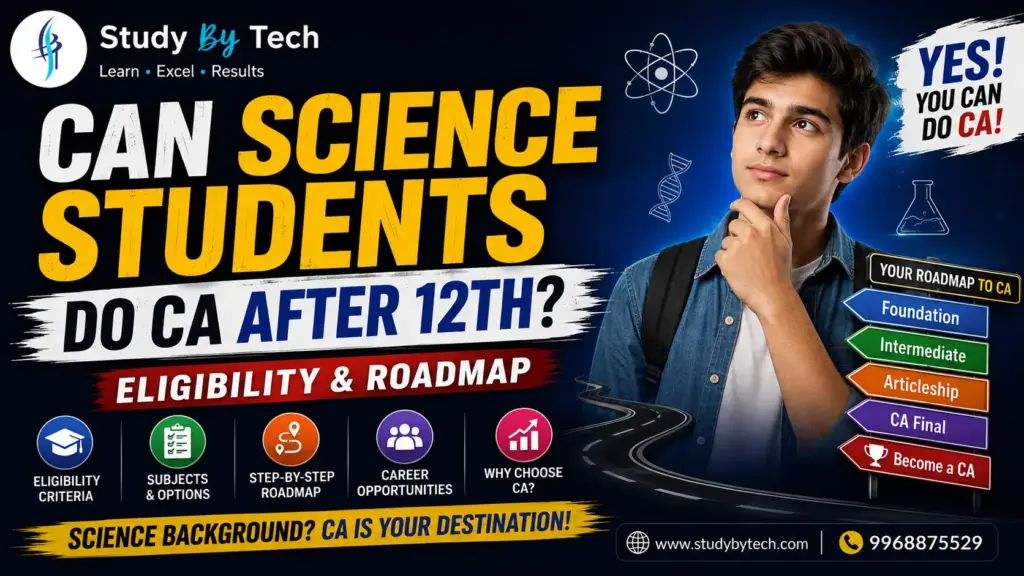
Common challenges faced by Science Students in CA and how to overcome them?

CA Foundation Classes CA Inter Classes CA Final Classes StudyByTech Offers Contact us Many students who finish their high school from a science stream are turning towards Chartered Accountancy (CA) rather than pursuing their career options within the sciences – this increase in interest in the CA profession is warranted due to the value, respect and financial reward associated with being a Chartered Accountant. Students moving from the numeric science based stream into a commerce or business-based environment are faced with unique challenges when adjusting to study, You will most likely feel overwhelmed during your initial transition from numeric science to the field of accounting, law, taxation and business while being required to think outside of the numeric world you are accustomed to. However, with the proper guidance, assistance and a successful learning environment, these challenges can be easily overcome. In this article, we will take an in-depth look at the common challenges faced by science background students in the CA program and how StudyByTech has assisted in overcoming these obstacles. 1. Lack of Commerce Basics Beginning their CA foundation programs, students who have studied science tend to have little to no experience with the fundamental subjects of accounting, business law, economics and/or business math, which can create fears and anxieties. How to Overcome It: StudyByTech provides foundation-level teaching, designed specifically for beginners who have zero commerce background. Faculty break down every concept into simple, relatable examples. Whether it’s debit-credit basics or understanding legal terminologies, StudyByTech ensures students build concepts from scratch—not by memorizing, but by understanding. 2. Struggle With Theoretical Subjects StudyByTech’s foundation-oriented approach supports the development of commerce skills for students from all backgrounds. Faculty use real-world examples to illustrate each of the concepts, from how to use a debit/credit and legal terminology to building a complete understanding of a subject from the ground up rather than through rote memorization. How StudyByTech Helps: At StudyByTech, we provide separate sessions for Science & Humanities students to make the basics of Accounts & Economics strong. These sessions are provided prior to joining the batches. 3. Difficulty in Understanding Commerce Terminology People who have a background in physics, chemistry, or biology will see terms such as liability, amortization, accrual, capital, or GST input vs output, as quite new. So it is important to first make sure that students shall understand the basic terms of Accounts & Economics to get started with thw syllabus. StudyByTech’s Approach: Teachers in StudyByTech break down all of the technical jargon into plain English with the use of visual explanations, flow charts, and analogies from day to day life. This way, students learn the words and understand how they work. 4. Time Management Problems The depth of syllabus that CA covers for students is often overwhelming when compared with the subjects taught during high school. As students complete multiple subjects whilst preparing for the next revision and tests, it can be difficult to juggle the workload of all 5 subjects. How StudyByTech Solves This: The well-organized approach ensures students stay ahead—not stressed. 5. Adjusting to New Exam Patterns CA exams do not focus on learning; they also assess students’ analytical thinking abilities, writing style, and time management when solving problems, which is something that most students from sciences do not encounter. StudyByTech Helps With: This builds confidence and exam temperament gradually. Why Science Students Thrive at StudyByTech A variety of students from a scientific background have benefited from StudyByTech and have successfully completed CA Foundation and have transitioned to CA Inter. With a positive learning environment, enjoyable learning styles, and focus on degree clarity, StudyByTech has become a well-known coaching institute for CA aspirants. With high-quality professors, frequent testing, early course completion, and hybrid availability (offline + online), and personalized mentorship with CA Parag Gupta sir(who is an Ex-examiner and renowned faculty at CA Inter & Final for Costing subject), all science students can determine their own pace and direction at StudyByTech. Final Thoughts So with a right mindset & right approach at StudyByTech, any student be it from Humanities or Science background can easily achieve his dream of becoming Chartered Accountant. Although it requires a dedicated team with a proper mentor who can help you & guide you and check your progress on a timely basis, at StudyByTech, we have seen evolving many non-commerce students emerge as successful CAs too. FAQ’s

CA increased 2L+ in just 4+ years
Blog, CA Course, ICAI news & updates

2+ LAKH NEW CAs IN 4 YEARS: WHAT’S REALLY HAPPENING TO THE CA PROFESSION?

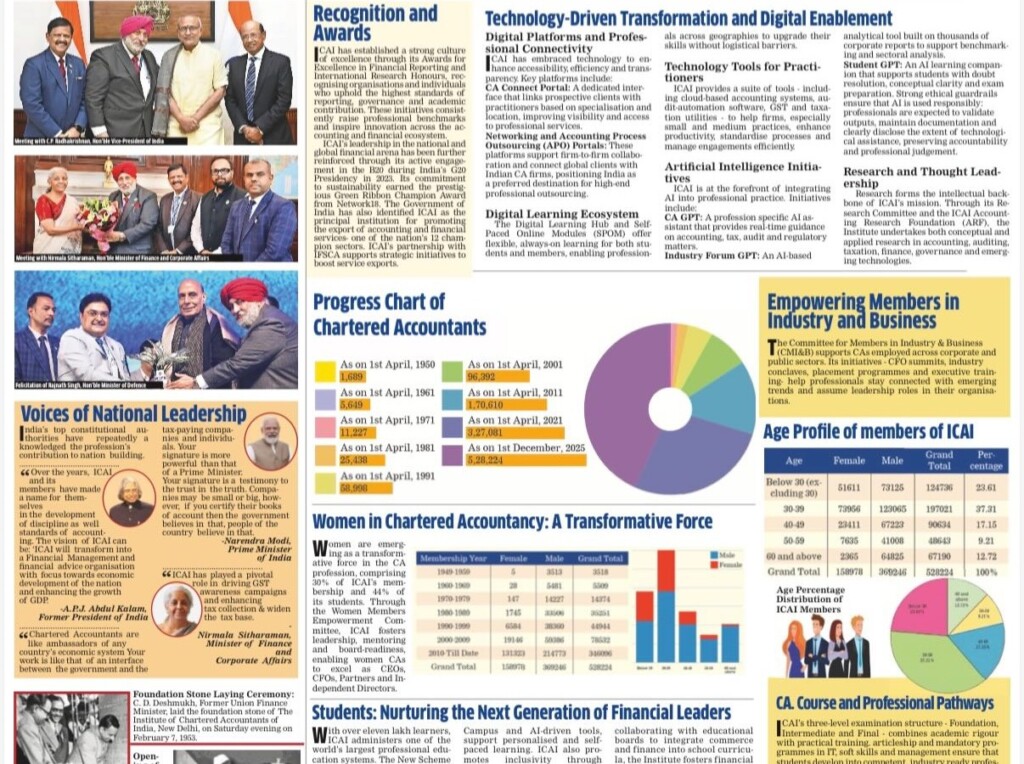
CA Foundation Classes CA Inter Classes CA Final Classes StudyByTech Offers Contact us The landscape of chartered accountancy has drastically changed, according to official statistics. As per The Economic Times dated 19th December, 2025, in less than five years, CAs have grown from 3,27,081 (1 April 2021) to 5,28,224 (1 December 2025), adding over two lakh members. This surge has huge implications for CA students, young chartered accountants, firms, and the long‑term brand value of the Institute of Chartered Accountants of India qualification. The New CA Economy: Security Or Illusion? For decades, “CA” was almost synonymous with financial security and professional respect. That presumption is no longer assured today. Short-term job scarcity is not the only real risk. If the increase in membership is not accompanied by an equivalent improvement in skills, capabilities, and work quality, the deeper concern is a gradual dilution of the CA brand. Key question: Are we creating strategic finance experts or merely inexpensive, easily replaceable compliance executors in an era of automated compliance and tax simplification? Law → SPOM: Are We Weakening Our Legal Edge? Strong exposure to corporate law, insolvency, and regulatory frameworks has historically been one of Indian CAs’ main advantages. Many CAs were able to appear as counsel before RD, NCLT, and NCLAT thanks to this foundation, and they were able to play significant roles in boardroom decision-making, restructuring, and litigation support. By pushing Law in a SPOM basket that is simpler to clear: If the current trend keeps up, should Chartered Accountants still have an automatic right to appear as counsel in complex matters before the MCA and tribunals? Lose that standing and the profession doesn’t just wobble — it takes a long-term hit. Costing → SPOM: Who Will Own Strategic Cost & Performance? Cost and Management Accounting and Strategic Cost Management & Performance Evaluation are not “optional scoring subjects”; they are the backbone of business decision‑making—pricing, profitability analysis, performance dashboards, cost leadership, and strategic planning. Cost and Management Accounting, and Strategic Cost Management & Performance Evaluation, are not optional extras. They are the backbone of business decision-making — pricing, profitability analysis, performance dashboards, cost leadership and long-range strategy. You see their fingerprints everywhere: in boardroom debates, in late-night spreadsheet revisions, in the one slide that can change the CEO’s mind. By shifting Costing/SCMPE into SPOM and making it very easy to clear: The result is a gap. Others are already moving into that space: If CAs stop being the obvious choice for strategic costing, performance management and decision support, CMAs and ACCAs will increasingly own that territory here and overseas. AI, Compliance And The Future Of CA Jobs Technology is pushing the profession in one direction: Now imagine adding lakhs of new members while: The “CA” label alone won’t guarantee the lifestyle or career trajectory many students expect. The sustainable defence is upskilling — analytics, strategic finance, business partnering, and technology‑driven value creation. In short: move from doing to advising. That’s where the fees, and the interesting work, will be. “10L+ CA Students”: Headline vs Reality We often hear that there are more than 10 lakh CA students. But CA registration remains valid for 5 years: So here’s a blunt question: Are we running the ecosystem for real learning and outcomes—or are we chasing headline numbers? Where ICAI Actually Deserves Credit Despite these concerns, the growth in membership is not inherently bad. There are clear upsides: The key issue is how this boom is used. Numbers alone cannot protect the profession; it’s what we do with them that counts. What Should The Profession Do With This Boom? To convert the membership explosion into a genuine long‑term advantage, three things are urgent: Who Is Writing This? This analysis comes from daily experience with CA students who struggle to make sense of the changing landscape. I am CA. Parag Gupta, teaching Cost and Management Accounting at CA Intermediate and Strategic Cost and Performance Management at CA Final. I have served as a CA Final examiner (paper checker) and actively promoted fair examination practices as an ICAI observer. I am a highly sought-after mentor, particularly by top achievers, due to my mastery of subjects like Cost & Management Accounting, Strategic Management, Strategic Cost and Performance Management, Integrated Business Solutions (IBS), and Operations Research. Students and firms looking for structured guidance can explore more detailed resources and courses at: 👉 paraggupta.com and 👉 studybytech.com A Question For Every CA, Student And Employer This isn’t an attack on the Institute. It is a call for course‑correction and honest introspection. If you are a CA, CA student, commerce student, HR head or finance leader, share your views. Would you still recommend CA to a bright Class‑12 student with the same confidence you had ten years ago? Or would you now add caveats — and a stronger push toward new-age skills? Your honest feedback will shape how seriously the ecosystem responds to these challenges.

CA Inter Accounts Self-Study Tips & Tricks
CA Inter, CA Inter Accounts, Exams tips

CA Inter Accounts Self-Study Tips & Tricks

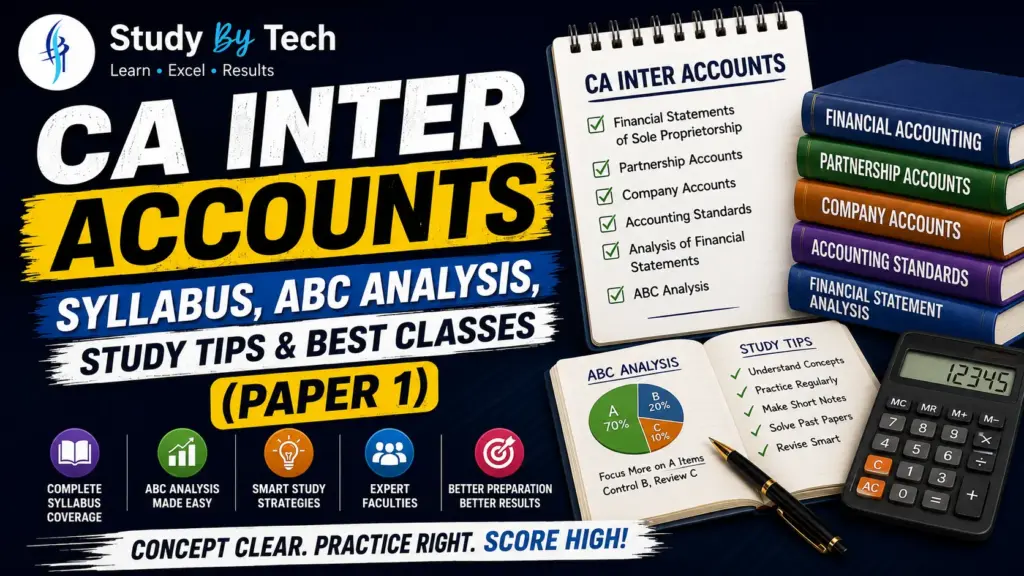
CA Inter Classes ICAI Registration Process, Fees, & Syllabus Admit Card Exam Dates Study Guides & Tips CA Inter faculties FAQ Preparing for CA Inter Accounts through self-study is completely achievable, especially with the right guidance and structured approach. At StudyByTech, many students rely on self-study along with smart resources, and Accounts often becomes their most scoring subject when they follow the right strategy. Start With ICAI Material Always treat ICAI Study Material, RTPs and past papers as your primary base. These reflect the exact pattern, level, and style of questions you will face in the exam. Using them early helps you think in the same language as the examiner and avoid surprises in the paper. Books provided at StudyByTech for CA Inter level are a good combination of questions from ICAI study mat+RTP+MTP+PYQPs. Build Conceptual Clarity First Do not jump directly to big questions without understanding concepts. Focus on: Why a particular concept id made?. Logic behind journal entries, adjustments, and standards. Links between AS/Ind AS and practical questions. If a chapter feels heavy (like Consolidation, Amalgamation, or ESOP), break it into smaller sub-topics and target one concept at a time instead of attempting the whole chapter in a single sitting. Create a Chapter-Wise Study Plan Divide the Accounts syllabus into: Heavy chapters: Consolidation, Amalgamation, ESOP, Buyback, Redemption, Financial Statements. Moderate chapters: Investment, Insurance claims, Branch, Departmental, etc. Quick chapters: Accounting policies, basics, small theory-linked areas. Design a 5 month plan where: First cycle(3 months): Concept building + solving basic to moderate problems. Second cycle(2 months): Advanced questions + past papers + time-bound practice. Practice in Exam Format Accounts is not just about solving questions, it’s about presenting them as per exam standards. While practicing, always: Write full formats (Balance Sheet, P&L, working notes). Show clear workings and label them properly. Practice under timed conditions (e.g., 25–30 minutes per long question or full 3-hour mock). This improves speed, accuracy, and confidence. Use Smart Notes and Formula Sheets Prepare quick revision notes alongside your first reading: List of important formats and proformas. Adjustment-wise treatment (e.g., how to treat proposed dividend, bonus issue, debenture conversion etc.). Key points of AS/Ind AS relevant for Accounts. These short notes will save you hours during the last 7–10 days before the exam. Analyze Past Papers and RTPs Before the exam, solve: At least 3–5 past attempt question papers. Latest 2–3 RTPs and MTPs. This will: Show you the most frequently tested topics. Help you understand the marking pattern and weightage. Train your mind to handle mixed questions under pressure. Focus on Presentation & Working Notes Even if your final answer goes slightly wrong, clear working notes can still earn you marks. So always: Number your workings. Keep steps readable and logical. Use proper headings and totals. Good presentation often makes the difference between 35–38 and 50+. Time Management Strategy in the Exam During the paper: Start with your strongest questions to build confidence. Don’t get stuck on a single adjustment; if confused, mark it and move on. Keep last 10–15 minutes only for review and quick completion. Target at least 80–85 marks worth of attempted questions with reasonable accuracy. Stay Consistent and Avoid Over-Resources One common mistake in self-study is using too many books and too many sources. Stick to: One main book/notes you’re comfortable with. ICAI material, RTPs and past papers as non-negotiable. Depth is more important than variety. Revising one good source multiple times is better than touching five sources once. Final 7–10 Days Revision Plan In the last phase: Revise all formats and key concepts daily. Attempt 1 paper or 2–3 big questions in a timed manner. Focus on weak chapters, but do not ignore your strong ones completely. A good mix of smart planning, concept clarity, consistent practice, and exam-style writing will make CA Inter Accounts one of your highest-scoring subjects, even with pure self-study. Conclusion For CA Inter Accounts, self-study works brilliantly when you follow a clear plan, stick to the right material, and practice in exam conditions. With disciplined preparation and the right guidance from platforms like StudyByTech, you can convert Accounts into a high-scoring subject and build a strong foundation for the rest of your CA journey. FAQs Which group is easy in CA Intermediate? Drawing from our extensive experience at StudyByTech, most students find Group 2 relatively more approachable. With Parag Sir’s specialized coaching in Costing and Strategic Management, and tips 7 tricks as an Ex-examiner(which is helpful in all subjects exams), our students excel in both groups. Each group has its challenges, but our systematic teaching approach makes complex topics manageable. We recommend to tudy both group together and then decide whether you should give both or group wise exam. Can I clear CA Inter by self study? While self-study is possible, at StudyByTech we’ve seen significantly higher success rates with proper guidance. Complex subjects like Cost Accounting and Strategic Management, where Parag Sir specializes, often require expert clarification and structured learning. Our students benefit from his 20 years of teaching experience, regular doubt-clearing sessions, and proven problem-solving techniques. However, if you choose self-study, we offer comprehensive study materials and test series separately. What is the validity of CA Inter? CA Inter registration is valid for 4 years from date of registration. Although CA Inter result is valid for lifetime. Although it is recommended to resume CA Final studies soon after passing CA Inter exams. Which group is harder in CA Inter? At StudyByTech, we’ve observed that most students consider Group 1 slightly more challenging due to technical papers like Advanced Accounting & Taxation. However, with our faculties expertise in all subjects and our structured study approach, our students master all subjects effectively. The key isn’t which group is harder, but how well you prepare – we ensure thorough preparation for both groups through our proven methodology. To ensure, proper studies are going on we often conduct parent teacher meets. CA Intermediate requires conceptual clarity and application. Parag Gupta’s classes at StudyByTech follow ICAI

CAI Self-Paced Module Details, Registration & Process
CA Final, Self paced online module

ICAI Self-Paced Online Module Details, Registration & Process

CA Final classes CA Final IBS classes(SPOM-set B portion) StudyByTech Offers Contact us In the fast-paced world of Chartered Accountancy, staying ahead of the curve is essential. With the advent of self-paced modules by the Institute of Chartered Accountants of India (ICAI), aspiring professionals now have a flexible and personalized way to enhance their skills and knowledge. In this comprehensive guide, we’ll delve into the details, registration process, and benefits of ICAI’s self-paced modules, empowering you to take control of your CA journey like never before. Understanding ICAI Self-Paced Modules: ICAI’s self-paced modules are designed to cater to the diverse learning needs and preferences of CA aspirants. These modules offer a flexible and convenient way to access high-quality study materials, lectures, and assessments at your own pace and convenience. Whether you’re a full-time student, a working professional, or someone with other commitments, self-paced modules provide the flexibility to learn anytime, anywhere, without compromising on the quality of education. Registration Process: The registration process for ICAI’s self-paced modules is simple and straightforward, allowing candidates to enroll with ease. Here’s a step-by-step guide to getting started: step 1– Visit the ICAI Website: Begin by visiting the official website of the Institute of Chartered Accountants of India (ICAI). step 2 – Navigate to Self-Paced Modules Section: Explore the website to locate the section dedicated to self-paced modules. step 3 -Choose Your Module: Browse through the available modules and choose the one that aligns with your learning objectives and career goals. step 4 -Register Online: Fill out the registration form provided on the website, providing accurate personal and contact information. step 5 -Make Payment: Complete the registration process by making the required payment online through secure payment gateways. step 6 -Access Study Materials: Upon successful registration and payment, you’ll gain access to the study materials, lectures, and other resources associated with the module. ICAI Self-Paced Module: What is Remote Proctoring? Basically, remote proctoring helps maintain the integrity of online exams by making sure everyone follows the rules, just like in a traditional exam hall. It gives students peace of mind that their hard work is being evaluated fairly and honestly, even when they’re not in a physical classroom. In ICAI’s self-paced modules, remote proctoring ensures that exams are conducted with the same level of security and credibility as in-person exams, allowing candidates to demonstrate their knowledge and skills confidently from the comfort of their own homes. ICAI Self-Paced Module Registration To register for the ICAI Self-Paced Module, students must visit https://icai.org/. The registration announcement will be available in the Students section of the Institute website and the PT test portal. The ICAI Self-Paced Module is not more accessible or challenging than the Center-Based Test, as it follows the same assessment criteria. Candidates must have a laptop or desktop computer to take the ICAI Self-Paced Module (Home Based Test), as mobile phones or tablets are not supported. Benefits of ICAI Self-Paced Modules: Flexibility: Self-paced modules offer unparalleled flexibility, allowing you to tailor your learning schedule to fit your lifestyle and commitments. Whether you prefer studying in the morning, evening, or during breaks, you have the freedom to learn at your own pace. Personalized Learning Experience: With self-paced modules, you take control of your learning journey. You can revisit challenging topics, skip ahead to areas of interest, or dedicate extra time to concepts that require more attention. This ensures a personalized and effective learning experience that caters to your unique needs. Quality Content: Experienced professionals and subject matter experts develop ICAI’s self-paced modules, guaranteeing high-quality study materials, lectures, and assessments. Cost-effectiveness: Self-paced modules are often more cost-effective compared to traditional classroom-based coaching. Without additional expenses for commuting or accommodation, you can save time and money while still accessing top-notch education. Accessible Anywhere, Anytime: Self-paced modules allow you to access study materials and lectures from anywhere with an internet connection. Whether you’re at home, in the office, or traveling, you have the flexibility to study at your convenience, without being bound by time or location. Conclusion: In conclusion, ICAI’s self-paced modules offer a flexible, convenient, and effective way for CA aspirants to enhance their skills and knowledge. By leveraging these modules, you can take control of your learning journey, access high-quality study materials, and prepare for success in your CA exams with confidence. So, why wait? Register for ICAI’s self-paced modules today and unlock your full potential as a chartered accountant.go through on studybytech for more information. FAQS Q1. How do I register with ICAI? Visit the official website of ICAI: icaiexam.icai.org. Fill in all the required details and click on generate OTP. To complete the validation process, enter the OTP you received. Q2. What are the 4 self-paced modules of ICAI? The ICAI CA New Scheme of Education and Training comprises four self-paced online modules: Set A, Set B, Set C, and Set D. These modules cover various subject areas. Q3. When will the ICAI CA New Scheme of Education come into effect? The ICAI CA New Scheme of Education and Training will be effective July 1, 2023. Q4. What is a self-paced online module in CA? In the context of Chartered Accountancy (CA) education, a “self-paced module” may refer to a learning approach where candidates have the flexibility to study at their own pace. CA programs, such as those offered by professional accounting bodies, often consist of multiple levels or stages of examinations. CA Final SCPM covers Balanced Scorecard, ABC, and Transfer Pricing. Parag Gupta is among the few faculty teaching SCPM with real company data.

Chapter-wise weightage- CA Inter Costing
CA Inter, Costing

CA Inter Costing Chapterwise Weightage 2026-27 | Strategic Planner & Study Tips 📅 Updated for Jan / May / Sep 2026-27 | New Scheme ICAI CA Inter Costing Chapterwise Weightage 2026: Priority Table & Smart Strategy to Score 60+ Target Keyword: CA Inter Costing chapterwise weightage • Paper 4 • Cost & Management Accounting 📊 70% numerical + 30% MCQs. Don’t study all chapters equally. Based on ICAI RTPs, MTPs & past 5 attempts — here’s the exact weightage to secure exemption (60+ marks). 74+Marks from A/A+ chapters 30%Paper is MCQs (no -ve marking) 2Chapters = 30+ marks (Cost Sheet + Cost Accounting System) 🎯 Priority Legend: A+ / A High Priority (must score) B Medium Priority (important) C Low Priority (MCQ / basic concepts) Priority Ch. No. Chapter Name Expected Marks Key Focus Area A+ 6 Cost Sheet 14 – 18 Formats, Reconciliation, Tenders A+ 7 Cost Accounting System 14 – 18 Integrated & Non-Integrated Accounts A 4 Overheads (Absorption Costing) 10 – 12 Machine Hour Rate, Under/Over absorption A 2 Material Cost 8 – 10 EOQ, Pricing (FIFO/LIFO), Stock Levels A 13 Standard Costing 8 – 10 Variance Analysis (Material & Labour) A 12 Service Costing 6 – 8 Transport, Hospital, Canteen costing B 3 Employee Cost & Direct Expenses 5 – 6 Bonus, Halsey/Rowan schemes B 5 Activity Based Costing (ABC) 5 – 6 Cost drivers vs traditional costing B 9 Contract & Job Costing 5 – 6 Work certified, notional profit B 10 Operation & Process Costing 5 – 6 Normal/abnormal loss, inter-process profit C 14 Marginal Costing 4 – 5 BEP, P/V ratio, decision making C 15 Budget & Budgetary Control 4 – 5 Flexible budget, cash budget basics C 1 Introduction to Costing 3 – 4 MCQ only — definitions, objectives C 8 Unit & Batch Costing 3 – 4 EBQ (Economic Batch Quantity) C 11 Joint Products & By Products 2 – 3 Methods of apportionment 📌 Strategic 90-Hour Study Planner (Based on Weightage) 🔷 Phase 1: Foundation Weeks 1-4 | Focus A+ & A chapters.Master Cost Sheet, Cost Accounting System, Overheads, Material Cost. Solve ICAI illustrations twice.✅ Target: 45/50 from high-weight topics. 🔄 Phase 2: The Buffer Weeks 5-7 | B chapters (Process, Contract, ABC). Start “Formula Diary” – write EOQ, variance, loss formulas. Revise daily 5 min.🎯 Boost speed with RTPs. ⚡ Phase 3: The Killer Weeks 8-12 | C chapters (MCQ prep) + Full Mock Tests. Solve 10-mark Q in ≤15 min.📈 Present formats cleanly = 40% marks ready. 🧠 Expert Edge: How to Score 60+ in Costing (CA Parag Gupta) “Students fail Costing not because it’s tough, but because they waste months on Process Costing (8 marks) while ignoring Cost Sheet (18 marks). Start with Unit 6 & 7. Master formats. Practice 1 Standard Costing variance sum daily — that’s your exemption formula.” ✅ CA Parag Gupta | ICAI Examiner & Observer | 20+ years experience 💡 3 Hacks that Outrank Generic Guides 📐 Hack 1: The Format Rule Cost Sheet, Operating Cost Sheet, Reconciliation Statement – memorize their standard formats. Even if calculation goes wrong, you grab 4-5 marks for structure. 📘 Hack 2: Reverse Engineering Stuck in Variance or Process Loss? Look at the answer first, retrace the logic, then close & reattempt. Builds neural pathways faster. 🧠 Hack 3: 5 Formulas Daily “Remember 5 formulas daily & remind for 7 days”. Keep a pocket formula diary. This helps long-term retention for Standard Costing, Budgeting & Marginal Costing. 🎯 Access 50+ Practice Questions to score 60+ marks in CA Inter Costing Handpicked by CA Parag Gupta — covers all A, B priority chapters with solutions. 📚 Get 50+ Practice Questions → Boost numerical speed & conceptual clarity ⏱️ Monthly & Daily Revision Schedule 🗓️ Monthly Milestones Month 1-2: A & A+ chapters (Cost Sheet, System, Material, Overheads, Standard Costing)Month 3: B chapters + MCQs for C chapters.Month 4: Mock tests & formula marathon. ⏲️ Daily Routine (3 hrs) 70% numericals + 30% theory/MCQs. Spend first 1 hour revising previous day’s formulas. Sunday = full-length mock test & analysis. 📋 Exam Day Strategy Attempt high-weightage questions first (Section II & III). Allocate 1.5 min per mark. Present working notes clearly — never skip formats. ❓ Frequently Asked Questions (CA Inter Costing Weightage) 📌 Is this chapter-wise weightage officially released by ICAI? ICAI does not release official chapter-wise marks. This data is compiled from ICAI past papers, RTPs, MTPs, and the New Scheme study material — most reliable estimate for 2026 attempts (Jan/May/Sep). ⚡ Can I skip Priority C chapters entirely? No. 30% of the paper consists of MCQs, and low-weight chapters (C) mostly appear as MCQs. Read them once & solve MCQ compilation. Don’t invest deep time, but don’t skip. 🏆 Which chapter guarantees an exemption (60+ marks)? Standard Costing (Priority A) – fully mechanical. Master 4 variances (Material, Labour, Variable, Fixed) and you secure 10/10 easily. Also Cost Sheet is high-scoring if formats are perfect. 📅 Is weightage different for Jan vs May/Sep 2026? Under the ICAI New Scheme, syllabus & pattern are consistent across 2026. The weightage table above remains valid for all 2026 attempts. Minor fluctuations possible but priority levels remain same. 🏅 Why CA Parag Gupta is India’s most trusted faculty for CA Inter Costing 📌 ICAI Examiner & ObserverDirect insight into exam patterns & marking schemes. 🎓 20+ Years ExperienceTop-rated faculty for Costing & Strategic Management. 📘 Comprehensive Course130+ hours, bilingual, doubt sessions & handwritten notes. 📈 Proven ResultsThousands of students scored exemption using weightage-based strategy. Start your smart preparation today — don’t rely on guesswork, rely on weightage. 📖 Explore Full CA Inter Costing Course Chapter-wise lectures + Practice manuals + Test series © CA Parag Gupta | Study By Tech. All rights reserved. | CA Intermediate requires conceptual clarity and application. Parag Gupta’s classes at StudyByTech follow ICAI study material with targeted revision.

CA Inter Costing With Parag Gupta Sir
CA Inter, Blogs, Costing

CA Inter Costing Exam 2026: Ultimate Guide to Syllabus, Weightage & Exemption Strategy | Parag Gupta CA Inter Costing Exam: A Real-World Guide to Syllabus, Weightage & That Coveted Exemption Master Paper 4: Cost and Management Accounting with expert insights, chapter-wise marks distribution, and a proven step-by-step strategy to score 70+ By Parag Gupta, CA | Updated June 2026 Table of Contents 1. What Does the CA Inter Costing Paper Actually Look Like? 2. Where Do the 100 Marks Actually Come From? 3. The 4-Step Strategy to Aim for an Exemption 4. Small Mistakes That Can Cost You Big 5. A Final Thought & Next Steps 1. What Does the CA Inter Costing Paper Actually Look Like? Before we talk about studying, let’s talk about what you’ll face on exam day. Knowing the structure in advance removes the shock factor. The CA Inter Costing exam (Paper 4) is a mix of descriptive numerical problems and case-based MCQs, totaling 100 marks over 3 hours, plus 15 minutes of reading time. Exam Parameter Details & What It Means for You Total Marks 100 Marks Duration 3 Hours (+15 minutes reading time) Format Descriptive numerical problems & Case-based MCQs Negative Marking None Language English / Hindi (as per your registration) The paper contains six questions. Question 1 is compulsory and usually consists of four sub-parts of 5 marks each. From the remaining five questions, you must answer any four. That choice is powerful. Use those 15 minutes of reading time wisely to decide which question to skip and to plan your sequence. It sets the tone for your entire three hours. 2. Where Do the 100 Marks Actually Come From? Not all chapters are equal. Some consistently command 10–12 marks, while others hover around 4–6. Treating them all with the same intensity leads to burnout. Here’s the realistic, trend-based CA Inter Costing weightage you need to guide your study. Module 1: Elements of Cost & Cost Ascertainment Chapter Approx. Weightage Key Focus Areas Introduction to Cost & Management Accounting ~4 Marks Pure theory; definitions, objectives, classifications Material Cost ~4–6 Marks EOQ, stock levels, inventory valuation Employee Cost (Labour) ~4–8 Marks Halsey, Rowan, labour turnover ratios Overheads ~4–6 Marks Primary/secondary distribution, machine hour rate Activity-Based Costing (ABC) ~8 Marks Cost drivers, cost pools; often a standalone question Cost Sheet ~10–12 Marks Format-driven, highly scoring, foundational Cost Accounting Systems ~4–6 Marks Integral & non-integral accounts Module 2: Costing Methods & Decision-Making Tools Chapter Approx. Weightage Key Focus Areas Job, Batch & Contract Costing ~6–8 Marks EBQ, profit on incomplete contracts Process & Operation Costing ~4–6 Marks Equivalent production, normal/abnormal loss Joint Products & By-Products ~4–8 Marks NRV method, physical unit method Service Costing (Operating Costing) ~6–8 Marks Transport, hospital, hotel; data organization Standard Costing ~10–12 Marks Material, labour, overhead variances Marginal Costing ~8–10 Marks P/V ratio, BEP, MOS, make-or-buy decisions Budgetary Control ~6–8 Marks Flexible budgets, cash budgets Pro Tip: Standard Costing, Cost Sheet, Marginal Costing, and Process Costing together contribute well over 40 marks. Make these chapters your fortress. 3. The 4-Step Strategy to Aim for an Exemption Most students prepare by passively watching lectures and solving a few module sums. That’s why the pass percentage remains stubbornly low. Here’s a battle-tested approach to score 70+ in the CA Inter Costing exam. Step 1: Build Concepts, Don’t Just Collect Formulas When you memorize a variance formula without understanding why the components sit that way, you’re building on sand. For every formula, ask yourself: what exactly is this comparing? Once the logic clicks, even tricky ICAI adjustments won’t shake you. This upfront investment pays off exponentially later. Step 2: Make the ICAI Module Your Best Friend Over 70% of practical exam questions are structural adaptations of illustrations and back-exercise problems from the official ICAI Study Material. Solve every illustration—not once, but until the process feels natural. Maintain a separate practice notebook. Physical writing reinforces memory in a way that scanning a screen never will. Step 3: Filter & Log Critical Questions (The L1-L2-L3 Method) While solving problems, categorize each one: L1 (Easy): You can solve quickly and accurately. These go into maintenance mode. L2 (Tricky Adjustments): Solvable but with a specific twist you need to watch for. L3 (Must-Revise): Gave you trouble. Conceptual error or time trap. These become your revision priority list. When the final week arrives, you’ll laser-focus on L2 and L3 problems instead of drowning in familiar material. Step 4: Simulated 3-Hour Mock Examinations Costing papers are notoriously long. The most common post-exam regret is “I knew everything but could only attempt 75 marks.” The antidote: take at least two RTPs, two MTPs, and the past three years’ question papers under a strict 3‑hour timer. No pausing, no peeking. The discomfort builds speed and mental stamina. 4. Small Mistakes That Can Cost You Big (And How to Avoid Them) I’ve seen bright students lose marks they didn’t need to lose. Here are the four points that break my heart every time. Skipping working notes: ICAI awards step marks generously. Even if your final answer is right, missing cross-referenced workings can lose you up to 30-40% of a question’s marks. Show your logic clearly. Mismanaging the 15-minute reading time: Don’t read the paper line by line. Use this window to identify the optional question you’ll drop and to sequence your first three answers. Start with a confidence-building question. Writing theory answers like essays: About 20-30% of the paper is theoretical. Use bullet points, be concise, and include ICAI technical keywords. The examiner wants precision, not paragraphs. Leaving questions unattempted: A blank page guarantees zero. Even writing the relevant formula and a partial attempt can fetch 2-3 crucial marks that make the difference between 58 and 63. 5. A Final Thought I’m not going to tell you the CA Inter Costing exam is easy. It isn’t. But here’s what I know after years of sitting across the table from students just like you: it’s coachable. The concepts don’t change. The patterns repeat. And

CA Inter Costing Best Faculty: 5 Qualities That Make Parag Gupta Sir Stand Out
CA Inter, Costing

CA Parag Gupta | Best CA Inter Costing Faculty CA Inter Costing best faculty | CA Parag Gupta So you’re trying to pick a CA Inter Costing faculty? Let me help you. Honestly, I know how confusing it gets. You want someone who helps you understand Costing — not just finish the syllabus. At ParagGupta.com, most rank holders & top scorers have studied with us. Here’s why. Explore Costing Batches What makes us different? Test series included Full test series — no extra fee, no hidden charges. Designed exactly like ICAI pattern to build speed & exam confidence. Real 1-on-1 doubt sessions Parag sir personally takes your doubts. Weekly sessions for online students. No Telegram bots, no assistants — just clarity. “59 Questions” – revision lifeline Last-day panic? Our 59 selected questions help you score 60+ marks even when you feel underprepared. Student favourite. Click here to get the list. Book + 20 hours video access Buy our Costing book & get 20 hours of full course videos FREE. Textbook & videos together, learn your way. Click here to get the book. Ex-ICAI examiner edge Parag sir used to check CA papers. He teaches you how to write answers examiners love. Plus difficulty-based in-class tests that actually show where you stand. Student said: “The 59 questions are a lifesaver for last-minute revision.” — CA Inter topper (May 2024) What our students share(real words, not edited) “Proper concepts understanding, regular tests and then mock tests. Itni mehnat koi teacher nai kerta apne students k saath. And best thing is online students k liye 1 to 1 weekly sessions bhi hain.” — Surya (Zeroinfy Review) “If you want to experience regular tests and regular doubt sessions that too for online students, go for Parag sir costing classes.” — Firoz (Zeroinfy) “I took Parag Gupta Sir’s classes and never regretted it. His 130-hour course is well-paced, and the 59 important questions really help in last-minute revision.” — Quora user One last thing from our team If you’re preparing for CA Inter Group 2 and you’re tired of teachers who just “cover the syllabus” – try us once. We don’t promise magic. But we do promise clarity, personal attention, and a teacher who actually cares whether you understand or not. Costing can feel scary. But with the right mentor? It becomes manageable. Even enjoyable. That’s what we believe. Join a Free Demo FAQs – answered simply How many attempts do I get for CA? No limit. Exams happen three times a year – Jan, May, Sep. At StudyByTech (our learning platform), we support you across attempts and help you improve based on your past performance. Can I clear CA Inter with self-study? Possible, but tougher. Subjects like Costing often need someone to clear your doubts and give structure. Parag sir has 20+ years of experience, and students under him tend to do better. That said, if you still prefer self-study, we do sell study material and test series separately. What’s a realistic 3-month strategy? Here’s what we follow: Month 1 – concepts (focus on high-weightage topics). Month 2 – practice and mocks. Month 3 – revision and exam simulation. But honestly, we recommend 4-5 months for deeper understanding. Can I clear Group 2 in 2 months? Technically yes, but I won’t lie – it’s rushed. We have crash courses for urgent situations. But for proper learning and good marks, give yourself at least 4-5 months. Ready to finally feel confident about Costing? Come say hi at paraggupta.com – we’d love to have you. Explore Courses → © CA Parag Gupta – ParagGupta.com | Best CA Inter Costing Faculty | Rankholders’ Choice Built for students, by educators who care. CA Intermediate requires conceptual clarity and application. Parag Gupta’s classes at StudyByTech follow ICAI study material with targeted revision.

best CA Inter classes in Laxmi nagar - new batch stating from 12th july
CA Inter

Best CA Inter Coaching in Laxmi Nagar – Why StudyByTech is Students’ 1st Choice!

CA Inter Classes ICAI Registration Process, Fees, & Syllabus Admit Card Exam Dates Study Guides & Tips CA Inter faculties FAQ Looking for the best CA Inter coaching in Laxmi Nagar?Here’s why StudyBytech is the most trusted name among CA aspirants. 20+ Years of Trust & Excellence Established CA coaching institute in Laxmi Nagar since 2008. Trained thousands of successful CA Inter students Trusted by students across Delhi NCR & India with our Offline & Online classes.  All Star CA Inter Faculty Panel Only well-experienced and qualified faculties. Teachers focus on concept clarity + exam presentation with regular tests.  Personalised Coaching Approach Limited batch size to ensure personal attention. Weekly performance tracking & progress reports. 1-on-1 doubt-solving sessions with faculties — our most loved feature! Online, Offline & Recorded – Study as You Like Offline classroom coaching at Laxmi Nagar. Live online classes with real-time interaction. Recorded classes available for flexible learning. Backup & revision access anytime.  FREE Test Series for Costing & SM With Group 1 & Group 2 combo, get free test series. Papers created & checked by Parag Gupta Sir himself. Regular testing builds confidence & ensures ICAI exam-readiness. Consistent Toppers & High Success Ratio Our students consistently score exemptions inCA Inter subjects. Many clear both groups in first attempt with our full support. 1:1 guidance sessions help students stay focused & exam-ready. Best Infrastructure & Study Environment Modern classrooms in Laxmi Nagar with digital tools. Comfortable seating, full AC, and clean environment. Peaceful atmosphere designed for focused study. Affordable Fee Structure + EMI Options Most value-for-money CA Inter coaching in Laxmi Nagar. Combo packages & easy EMI options available.  Why CA Students Prefer StudyByTech? Centrally located in Laxmi Nagar – CA Coaching Hub.. Well connected via metro & public transport. Known for student-first culture and personal mentoring. Real Success. Real Students. Real Results“StudyBytech is not just a coaching centre, it’s a mentorship space. The 1-on-1 sessions with Parag Sir helped me overcome my Costing fears!” — Ritika, CA Inter Student (2024) Join StudyByTech Today – Your CA Inter Success Begins Here! Call now or visit us for a FREE counselling session. Limited seats per batch – book your seat early! FAQ’S Can I do CA Inter without coaching? Yes, you can complete the CA course without coaching. Which city is best for CA Inter? Delhi – Known for top institutes like StudyByTech, experienced faculty, and vibrant student community.Mumbai – Offers quality coaching centers and opportunities to connect with professionals and firms.Kolkata – Affordable living, reputed faculties, and growing CA student base.Chennai – Good infrastructure, disciplined learning environment, and supportive CA ecosystem.Bangalore – Ideal for students who want to balance tech exposure with CA studies, with quality classes available. Is CA Inter very difficult? CA Inter is challenging but not impossible. With proper guidance, consistent study, and practice, it can be cleared successfully. CA Intermediate requires conceptual clarity and application. Parag Gupta’s classes at StudyByTech follow ICAI study material with targeted revision.

Scroll to Top