Author name: Shilpa Gupta

Shivani Gupta, is one of the author on our website. She is writing blogs and articles related to education since last 10 years. Her blogs & articles are considered very informational out to all students.

CA increased 2L+ in just 4+ years
Uncategorized

2+ LAKH NEW CAs IN 4 YEARS: WHAT’S REALLY HAPPENING TO THE CA PROFESSION?

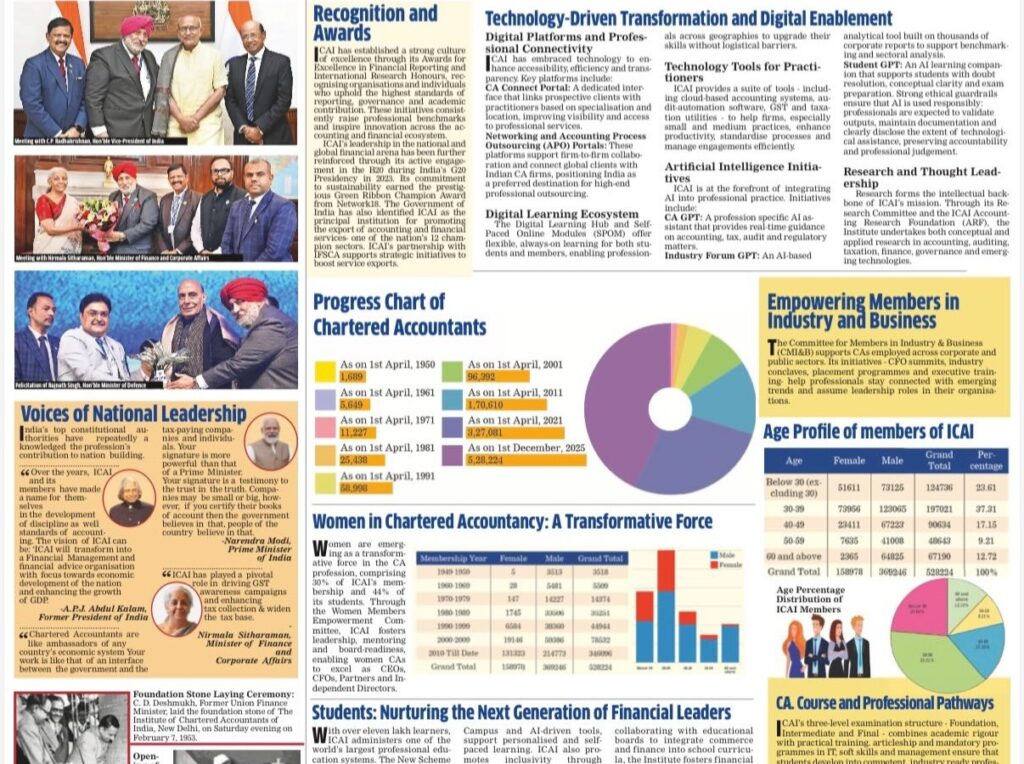
The landscape of chartered accountancy has drastically changed, according to official statistics. As per The Economic Times dated 19th December, 2025, in less than five years, CAs have grown from 3,27,081 (1 April 2021) to 5,28,224 (1 December 2025), adding over two lakh members. This surge has huge implications for CA students, young chartered accountants, firms, and the long‑term brand value of the Institute of Chartered Accountants of India qualification. The New CA Economy: Security Or Illusion? For decades, “CA” was almost synonymous with financial security and professional respect. That presumption is no longer assured today. Short-term job scarcity is not the only real risk. If the increase in membership is not accompanied by an equivalent improvement in skills, capabilities, and work quality, the deeper concern is a gradual dilution of the CA brand. Key question: Are we creating strategic finance experts or merely inexpensive, easily replaceable compliance executors in an era of automated compliance and tax simplification? Law → SPOM: Are We Weakening Our Legal Edge? Strong exposure to corporate law, insolvency, and regulatory frameworks has historically been one of Indian CAs’ main advantages. Many CAs were able to appear as counsel before RD, NCLT, and NCLAT thanks to this foundation, and they were able to play significant roles in boardroom decision-making, restructuring, and litigation support. By pushing Law in a SPOM basket that is simpler to clear: If the current trend keeps up, should Chartered Accountants still have an automatic right to appear as counsel in complex matters before the MCA and tribunals? Lose that standing and the profession doesn’t just wobble — it takes a long-term hit. Costing → SPOM: Who Will Own Strategic Cost & Performance? Cost and Management Accounting and Strategic Cost Management & Performance Evaluation are not “optional scoring subjects”; they are the backbone of business decision‑making—pricing, profitability analysis, performance dashboards, cost leadership, and strategic planning. Cost and Management Accounting, and Strategic Cost Management & Performance Evaluation, are not optional extras. They are the backbone of business decision-making — pricing, profitability analysis, performance dashboards, cost leadership and long-range strategy. You see their fingerprints everywhere: in boardroom debates, in late-night spreadsheet revisions, in the one slide that can change the CEO’s mind. By shifting Costing/SCMPE into SPOM and making it very easy to clear: The result is a gap. Others are already moving into that space: If CAs stop being the obvious choice for strategic costing, performance management and decision support, CMAs and ACCAs will increasingly own that territory here and overseas. AI, Compliance And The Future Of CA Jobs Technology is pushing the profession in one direction: Now imagine adding lakhs of new members while: The “CA” label alone won’t guarantee the lifestyle or career trajectory many students expect. The sustainable defence is upskilling — analytics, strategic finance, business partnering, and technology‑driven value creation. In short: move from doing to advising. That’s where the fees, and the interesting work, will be. “10L+ CA Students”: Headline vs Reality We often hear that there are more than 10 lakh CA students. But CA registration remains valid for 5 years: So here’s a blunt question: Are we running the ecosystem for real learning and outcomes—or are we chasing headline numbers? Where ICAI Actually Deserves Credit Despite these concerns, the growth in membership is not inherently bad. There are clear upsides: The key issue is how this boom is used. Numbers alone cannot protect the profession; it’s what we do with them that counts. What Should The Profession Do With This Boom? To convert the membership explosion into a genuine long‑term advantage, three things are urgent: Who Is Writing This? This analysis comes from daily experience with CA students who struggle to make sense of the changing landscape. I am CA. Parag Gupta, teaching Cost and Management Accounting at CA Intermediate and Strategic Cost and Performance Management at CA Final. I have served as a CA Final examiner (paper checker) and actively promoted fair examination practices as an ICAI observer. I am a highly sought-after mentor, particularly by top achievers, due to my mastery of subjects like Cost & Management Accounting, Strategic Management, Strategic Cost and Performance Management, Integrated Business Solutions (IBS), and Operations Research. Students and firms looking for structured guidance can explore more detailed resources and courses at: 👉 paraggupta.com and 👉 studybytech.com A Question For Every CA, Student And Employer This isn’t an attack on the Institute. It is a call for course‑correction and honest introspection. If you are a CA, CA student, commerce student, HR head or finance leader, share your views. Would you still recommend CA to a bright Class‑12 student with the same confidence you had ten years ago? Or would you now add caveats — and a stronger push toward new-age skills? Your honest feedback will shape how seriously the ecosystem responds to these challenges. The landscape of chartered accountancy has drastically changed, according to official statistics. As per The Economic Times dated 19th December, 2025, in less than five years, CAs have grown from 3,27,081 (1 April 2021) to 5,28,224 (1 December 2025), adding over two lakh members. This surge has huge implications for CA students, young chartered accountants, firms, and the long‑term brand value of the Institute of Chartered Accountants of India qualification. The New CA Economy: Security Or Illusion? For decades, “CA” was almost synonymous with financial security and professional respect. That presumption is no longer assured today. Short-term job scarcity is not the only real risk. If the increase in membership is not accompanied by an equivalent improvement in skills, capabilities, and work quality, the deeper concern is a gradual dilution of the CA brand. Key question: Are we creating strategic finance experts or merely inexpensive, easily replaceable compliance executors in an era of automated compliance and tax simplification? Law → SPOM: Are We Weakening Our Legal Edge? Strong exposure to corporate law, insolvency, and regulatory frameworks has historically been one of Indian CAs’ main advantages. Many CAs were able to appear as counsel before RD,
CA increased 2L+ in just 4+ years
Blogs, CA

2+ LAKH NEW CAs IN 4 YEARS: WHAT’S REALLY HAPPENING TO THE CA PROFESSION?

The landscape of chartered accountancy has drastically changed, according to official statistics. As per The Economic Times dated 19th December, 2025, in less than five years, CAs have grown from 3,27,081 (1 April 2021) to 5,28,224 (1 December 2025), adding over two lakh members. This surge has huge implications for CA students, young chartered accountants, firms, and the long‑term brand value of the Institute of Chartered Accountants of India qualification. The New CA Economy: Security Or Illusion? For decades, “CA” was almost synonymous with financial security and professional respect. That presumption is no longer assured today. Short-term job scarcity is not the only real risk. If the increase in membership is not accompanied by an equivalent improvement in skills, capabilities, and work quality, the deeper concern is a gradual dilution of the CA brand. Key question: Are we creating strategic finance experts or merely inexpensive, easily replaceable compliance executors in an era of automated compliance and tax simplification? Law → SPOM: Are We Weakening Our Legal Edge? Strong exposure to corporate law, insolvency, and regulatory frameworks has historically been one of Indian CAs’ main advantages. Many CAs were able to appear as counsel before RD, NCLT, and NCLAT thanks to this foundation, and they were able to play significant roles in boardroom decision-making, restructuring, and litigation support. By pushing Law in a SPOM basket that is simpler to clear: If the current trend keeps up, should Chartered Accountants still have an automatic right to appear as counsel in complex matters before the MCA and tribunals? Lose that standing and the profession doesn’t just wobble — it takes a long-term hit. Costing → SPOM: Who Will Own Strategic Cost & Performance? Cost and Management Accounting and Strategic Cost Management & Performance Evaluation are not “optional scoring subjects”; they are the backbone of business decision‑making—pricing, profitability analysis, performance dashboards, cost leadership, and strategic planning. Cost and Management Accounting, and Strategic Cost Management & Performance Evaluation, are not optional extras. They are the backbone of business decision-making — pricing, profitability analysis, performance dashboards, cost leadership and long-range strategy. You see their fingerprints everywhere: in boardroom debates, in late-night spreadsheet revisions, in the one slide that can change the CEO’s mind. By shifting Costing/SCMPE into SPOM and making it very easy to clear: The result is a gap. Others are already moving into that space: If CAs stop being the obvious choice for strategic costing, performance management and decision support, CMAs and ACCAs will increasingly own that territory here and overseas. AI, Compliance And The Future Of CA Jobs Technology is pushing the profession in one direction: Now imagine adding lakhs of new members while: The “CA” label alone won’t guarantee the lifestyle or career trajectory many students expect. The sustainable defence is upskilling — analytics, strategic finance, business partnering, and technology‑driven value creation. In short: move from doing to advising. That’s where the fees, and the interesting work, will be. “10L+ CA Students”: Headline vs Reality We often hear that there are more than 10 lakh CA students. But CA registration remains valid for 5 years: So here’s a blunt question: Are we running the ecosystem for real learning and outcomes—or are we chasing headline numbers? Where ICAI Actually Deserves Credit Despite these concerns, the growth in membership is not inherently bad. There are clear upsides: The key issue is how this boom is used. Numbers alone cannot protect the profession; it’s what we do with them that counts. What Should The Profession Do With This Boom? To convert the membership explosion into a genuine long‑term advantage, three things are urgent:
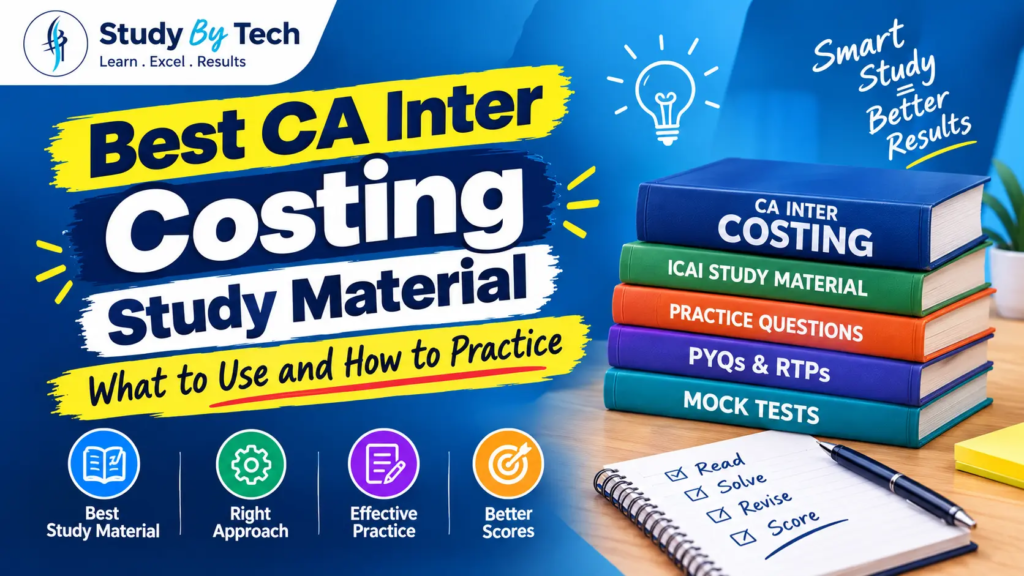
Best CA Inter Costing Study Material
Blogs, CA Inter, Costing

The Power of Practice – Best CA Inter Costing Study Material

CA Inter Classes ICAI Registration Process, Fees, & Syllabus Admit Card Exam Dates Study Guides & Tips CA Inter faculties FAQ The Secret to Success in CA Inter Costing Exam: Practice, Practice, Practice CA Inter Costing can appear complicated; let’s face it! It involves more than just comprehending the concepts; it also entails successfully applying them to diverse situations. And how can we accomplish that? Via diligent practice. The awful ‘P’ word, indeed! But trust me when I say that the greatest way to ace CA Inter Costing is by practice. And that too from ICAI’s CA Inter Costing Study Material. But the only way to truly gain the confidence you require is by reading supplemental books. The Significance of Practice Strengthens Concepts: By trying to solve difficulties, you comprehend each concept’s subtleties and learn how to use them. Enhances Problem-Solving Ability: Costing issues can be challenging. You can create effective approaches and solutions by practicing. Discovers Weaknesses: You can’t work on your shortcomings until you face them. Develops Confidence: Your confidence in the subject increases as you practice and improve. Your CA Inter Costing Study Material for Practice: ICAI Content—The Foundation: It should go without saying that you NEED to practice every single question. The 7th edition Book of Costing by Parag Gupta : Because of the wide range of questions and their simple answers, many students follow his book. It is essential to your gear. His book frequently challenges your ideas and offers an alternative viewpoint on the topic. Previous Mocks and Papers: Complete previous assignments and try out practice exams. They aid in time management and provide you with a solid grasp of the exam format. How to Practice Well: First start with the fundamentals: After finishing the ICAI curriculum, proceed to the further resources. Always remember do theory from ICAI study material and proceed to practice more question use supplementary books of Parag Gupta sir. Change things up: Practice a range of questions, including theory, practical, complex, and basic ones. Examine errors: Recognize your mistakes. Don’t simply ignore your errors. Take Your Own Time: Try to finish the questions in the allotted time. Continue Practicing: Review difficult topics/important topics on a regular basis and work through previous & new challenges, to become a PRO on the topic. Conclusion: Gaining proficiency in CA Inter Costing is a process that takes time and effort. Thus, begin practicing frequently. And this can be done only by following CA Inter Costing study material discussed in the above blog in a proper way.Add a range of books to the ICAI study materials like 7th edition CA Inter Costing book by Parag Gupta sir. Recall that the secret to success is constant practice. All the best for your exams! FAQ’s

Altman’s Z, H Score, and Argenti’s A Score by CA Parag Gupta
Blogs, CA Final, SCPM

Understanding Financial Health: Altman’s Z, H Score, and Argenti’s A Score

In the field of financial analysis, evaluating a company’s stability and health is essential. Altman’s Z-Score, H Score, and Argenti’s A Score are three well-known models that are employed in this context. With the aid of these models, stakeholders can make well-informed judgements regarding a company’s financial situation. Each model provides distinct insights. Click here to learn Financial health & similar topic of SPOM-set B by Parag Gupta sir. ALTMAN’S Z score H Score The formula is: H = \frac{D_0 (1 + g_L) + D_0 H (g_S – g_L)}{r – g_L}H=r−gL​D0​(1+gL​)+D0​H(gS​−gL​)​ Where: Argenti’s A Score Argenti’s A Score is a diagnostic tool used to identify the risk of corporate failure. It was developed by John Argenti in the 1970s and focuses on three main areas: defects, mistakes, and symptoms. The A Score is calculated by assessing various factors within these areas, such as management quality, financial structure, and operational efficiency. The scoring system is: Each factor is scored, and the total score indicates the likelihood of corporate failure. Conclusion Altman’s Z-Score, H Score, and Argenti’s A Score are powerful tools for assessing the financial health of a company. While the Z-Score focuses on bankruptcy prediction, the H Score evaluates growth potential, and Argenti’s A Score diagnoses the risk of failure. Together, these models provide a comprehensive view of a company’s financial stability, aiding stakeholders in making well-informed decisions. FAQ’s

Mastering the McKinsey 7S Framework: Insights from Parag Gupta Sir
CA, CA Final, SCPM

Mastering the McKinsey 7S Framework: Insights from Parag Gupta Sir

In the ever-evolving landscape of business management, understanding and optimizing organizational performance is crucial. One of the most effective tools for this purpose is the McKinsey 7S Framework, a model that has stood the test of time in helping organizations achieve strategic alignment and operational excellence. In this blog, we will explore the McKinsey 7S Framework, guided by the expertise of Parag Gupta Sir, a renowned faculty for SPOM- Strategic Cost & Performance management (SCPM). What is the McKinsey 7S Framework? The McKinsey 7S Framework is a management model developed by consultants at McKinsey & Company in the 1980s. It is designed to assess and align seven critical elements within an organization to ensure they work harmoniously towards achieving strategic goals. These seven elements are: Check out Parag sir’s video on Mckinsey 7S: The 7S Model: An Integrated Approach Parag Gupta Sir emphasizes that the power of the 7S Framework lies in its holistic approach. Unlike other models that focus on individual components in isolation, the 7S Framework interlinks all seven elements, ensuring that any change in one area is harmonized with the others. This interconnectedness is vital for achieving strategic coherence and operational efficiency. 1. Strategy Strategy is the cornerstone of the 7S Framework. It involves setting long-term goals and determining the best course of action to achieve them. Parag Gupta Sir highlights that a well-defined strategy provides direction and sets the stage for aligning the other six elements. 2. Structure The structure of an organization refers to its hierarchical setup. It defines roles, responsibilities, and the flow of information. An optimal structure supports efficient decision-making and enhances communication across various levels of the organization. 3. Systems Systems encompass the daily processes and procedures that govern organizational activities. Effective systems streamline operations, reduce redundancies, and ensure that tasks are performed consistently and efficiently. 4. Shared Values At the heart of the 7S Framework are the shared values. These are the fundamental beliefs and guiding principles that shape the organization’s culture. Shared values influence employee behavior, organizational ethos, and the overall work environment. 5. Style Style refers to the leadership approach adopted by management. Leadership style affects organizational morale, employee engagement, and the overall effectiveness of management. Parag Gupta Sir emphasizes that adaptive leadership styles that resonate with the organization’s values and culture are crucial for success. 6. Staff The staff element focuses on the organization’s human resources. It involves recruiting, training, and developing employees to ensure they possess the necessary skills and competencies. A talented and motivated workforce is key to executing the organization’s strategy effectively. 7. Skills Skills refer to the specific capabilities and expertise of the organization’s employees. Identifying and nurturing these skills ensures that the organization can meet its strategic objectives and adapt to changing market demands. Applying the McKinsey 7S Framework Parag Gupta Sir provides practical insights into applying the McKinsey 7S Framework in real-world scenarios. Here’s a step-by-step approach: Real-World Examples Parag Gupta Sir enriches his teachings with real-world examples that illustrate the practical application of the 7S Framework. For instance, he discusses how a leading tech company restructured its organization to foster innovation, aligning its strategy, structure, and systems to support a culture of creativity and rapid development. Conclusion The McKinsey 7S Framework is a timeless tool that provides a comprehensive approach to organizational analysis and improvement. By understanding and aligning the seven elements—Strategy, Structure, Systems, Shared Values, Style, Staff, and Skills—organizations can achieve greater coherence, efficiency, and success. Under the guidance of Parag Gupta Sir, mastering the 7S Framework becomes an invaluable asset for students, professionals, and business leaders alike. His expert insights and practical applications make this complex model accessible and actionable, empowering organizations to navigate the challenges of today’s dynamic business environment. For more in-depth learning, insights, and practical strategies, stay tuned to Parag Gupta Sir’s sessions on Strategic Planning and Operations Management. Want to enroll to SPOM-SCPM classes?

CA Final SCPM
Blogs, CA Final, SCPM

Mastering CA Final SPOM-set B exam (2025 onwards): A Guide by Parag Gupta Sir

Introduction There are many obstacles to overcome on the path to becoming a Chartered Accountant, and the CA Final test is one of the most important checkpoints along the way. Among the various subjects you’ll encounter in the CA Final course, CA Final SPOM-set B exam holds a prominent place. Formerly known as CA Final Costing(SCMPE), this subject has evolved and now comes with a new name and a modern twist—it’s now offered as a self-paced online module. One name that sticks out in the CA community to assist you in successfully navigating this subject of SPOM-set B is Parag Gupta Sir. Parag Gupta Sir: A Trusted Mentor Parag Gupta Sir is a renowned educator in the field of Chartered Accountancy. To help you effectively navigate this subject, one name that stands out in the CA world is Parag Gupta Sir. His expertise in SCPM makes him an invaluable resource for those preparing for the CA Final examination. So, if you’re wondering how to prepare for in the CA Final SPOM-set B exam effectively, here are some insights and tips inspired by the teachings and guidance of Parag Gupta Sir: Conclusion Preparing for in the CA Final SPOM-set B exam, now offered as a self-paced online module, may seem challenging, but with the right guidance from educators like Parag Gupta Sir, it becomes an achievable goal. By following the tips and strategies mentioned above and leveraging the resources provided by Parag Gupta Sir, you can navigate this subject with confidence and emerge victorious in your CA Final examination. Remember that passing the exam is only one component of SCPM success. You must also have the information and abilities necessary to function effectively as a Chartered Accountant in the real world. FAQ’s

CA Intemediate GST Classes
CA, ICAI

CA Intermediate GST Classes For CA Student

CA Intermediate GST (IPCC) Classes The objective of this document is to summarize all the updates of CA Intermediate GST Classes (CA IPCC) (Notifications, Circulars, other amendments, and updates) in one place.2 Central tax notifications,1 Integrated tax notification,And also the council has approved the new GST rates for the real estate sector in the 33rd meeting. CA Intermediate GST (CA IPCC) Important Notices 1.0 Notifications:Objective:I. Notification No. 8/2019_Central tax dated 08th Feb.2019:GSTR-7 (Return for TDS) for Jan’19 from 10th Feb’19 to 28th Feb’19 to 28th Feb’19.filing GSTR-3B for Jan’19 from 20th Feb to Feb.19 for Jammu & Kashmir Feb.19 for the remaining states III. Notification No. 2/2019_Integrated tax (Rate) dated 04.Feb.2019:Since the definition of exports and the Sec 54 of the CGST act have been amended to include the supplies to Nepal and Bhutan under definition of Exports, the Notification No.02/2019 was issued to rescind the exemption entry 10D (the exemption of IGST, for the supplies made to Nepal & Bhutan) of the Notification no.9/2017 dated 28th Jun’17. 2.0 CA Inter GST Classes CA Intermediate GST Circulars (CA IPCC): I. Circular No. 88/07/2019 Central Tax dated 01.02.2019:Circular No. 8/8/2017_04.10.2017_”Master circular relevant for the export procedures and refunds” was amended in view of the amendment allowing realization of export proceeds in INR, wherever allowed by the RBI (CA Intermediate/ IPCC). [2(6) of IGST act].Circular No. 38/12/2018_26.03.2018_”Clarification on issues related to Job Work” was amended to in view of the (IPCC) amendment carried empowering the Commissioner to extend the period for return of inputs and capital goods from the job worker and also the RCM on services received from un-registered job workers. [9(4) and 143 of CGST act.]Circular No. 41/15/2018_13.04.2018_” Procedure for interception of conveyances for inspection of goods in movement…………” was amended to in view of the amendment carried out extending the time limit from 7days to 14 days for owner/transporter to pay tax/penalty for seized goods. [Sec 129 of the CGST act]. CA Intermediate GST Updates (IPCC) After observing that the majority of taxpayers are not reporting details in Table 3.2 of GSTR-3B,III. Circular No. 90/09/2019 Central Tax dated 18.02.2019:IV. Circular No. 91/10/2019 Central Tax dated 18.02.2019:In Circular 46/2017_Customs_Dated 24.Nov.17, it was clarified that,In Circular 3/2018_IGST(CA Intermediate)_Dated 25.May.18, it was clarified that, considering the amendments in the Customs Tariff Act (IPCC),This shall be applicable w.e.f. 01.Apr.18.There was no provision in GSTR-1 for changing POS for such B2B supplies. If the supplier and recipient are in the same state, it was considered as Intra-state sales.3.0 33rd GST Council meeting updates (IPCC):I. GST on Residential properties The proposed GST rate for the residential flats are as followed: 1% for the Affordable housing5% for the othersFor qualifying as “affordable housing” below 2 conditions should be satisfied:Carpet area of up to 90 Sqm in non-metropolitan cities/towns and 60 Sqm in metropolitan cities andThe value < 45Laks in both Metro/Nonmetropolitan citiesThe effective date shall be 01.Apr.19.II. Others (IPCC)The existing rates shall continue for the commercial projectsThe taxation on betting and lotteries shall be taken up in the future council meetings. Click Here: CA Intermdiate New Course Also Read- CA Intermediate Courses CA Final Result 2019 CA Final Exam Date Sheet

ICAI Exams
ICAI

ICAI Exam

ICAI Exam – The Institute of Chartered Accountants The Institute of Chartered Accountants of India (ICAI) is the national professional accounting body of India. It was established on July 1, 1949, as a statutory body under the Chartered Accountants Act, 1949, enacted by the Parliament (acting as the provisional Parliament of India) to regulate the profession of chartered accounting in India. ICAI is the second largest professional accounting & finance body in the world. Candidates who wish to take up Chartered Accountancy as a career, are required to enroll for the program at ICAI and qualify all the levels of exams within a stipulated period of time to be certified as a Chartered Accountant. Image – ICAI Exam Dashboard ICAI Exams Level 2019 ICAI Exam level for the new course 2019 Foundation Course (CPT) Intermediate Course (Inter) Final Course (CA Final) ICAI Exam About Features & Details Exam Name – ICAI Exam, CA CPT, CA IPCC, CA Final ICAI Name – Institute of Chartered Accountants of India ICAI Exam Level – National Level Exam Exam Frequency – Twice a year ICAI Exam Mode – Online (CPT) & Offline (Inter & Final) ICAI Exam Duration – Three hours Language – English & Hindi Exam Helpdesk No. – 1800-200-2501 Exam Website – visit ICAI Exam Eligibility 2019 ICAI Exam CPT Eligibility Criteria CA CPT Course is the entry level for Chartered Accountancy Course. Students who have appeared in the 12th class examination conducted by an examining body constituted by law in India or an examination recognized by the Central Government as equivalent thereto can register for the Foundation Course. A candidate who registered for CPT 60 days prior to the first day of the month in which the CPT examination is to be held, i.e., on or before April 1 and October 1, can appear in the CPT examinations to be held in June and December, respectively. Candidates who are Graduate or Post Graduate in Commerce with a minimum of 55% of total marks or its equivalent grade in the examination conducted by any recognized University (including Open University) with certain subjects OR Graduates or Post Graduates in any other stream having secured a minimum of 60% of the total marks or its equivalent grade in the examination conducted by any recognized University (including Open University) are exempted from passing CPT. Read More ICAI Exam Intermediate (IPC) Eligibility A student who has passed the Foundation Examination is eligible for registration to Intermediate Course. A student who is Graduate/ Post Graduate in Commerce having secured in aggregate a minimum of 55% of the total marks or its equivalent grade in the examination conducted by any recognized University (including Open University) by studying any three papers carrying a minimum of 50 marks in a semester/year and cumulatively 100 or more marks over the entire duration of the concerned course out of Accounting, Auditing, Mercantile Laws, .Corporate Laws, Economics, Management (including Financial Management), Taxation (including Direct Tax Laws and Indirect Tax Laws), Costing, Business Administration or Management Accounting or similar to the title of these papers with different nomenclatures or other than those falling under Commerce stream having secured in aggregate a minimum of 60% of the total marks or its equivalent grade in the examination conducted by any recognized University (including Open University)and candidates. defibulators.orgimp source> who have passed the Intermediate level examination conducted by The Institute of Cost Accountants of India or by The Institute of Company Secretaries of India are exempted from qualifying Foundation Examination and can join the Intermediate Course. ICAI Exam Final Eligibility The candidate who have passed the Intermediate examination or Professional Education Examination – II./PCC/IPCC, are eligible to apply for the Final exam. The candidate must also have completed 3 years or 3½ years or must be due to complete, as the case may be, of articled training as on the date of filling the form. The candidate must be serving the last twelve months of articled training including excess leave if any, and due to complete 3 years on or before 31st October 2017. (for PE-II stream student and PE-II stream students converted to IPCC). Read More. CA Final ICAI Exam 2019 Exam Center The ICAI exams are conducted at 197 exam centers across India and abroad. Moreover, ICAI has facilitated CA exam centers in five test cities abroad: Abu Dhabi Dubai Kathmandu Muscat Doha List of Test Cities for CA Exam. Agra Ahmedabad Ahmednagar Ajmer Akola Alappuzha . Aligarh Allahabad Alwar Ambala Amravati Amritsar Anand Anantapur Asansol Aurangabad Badlapur Banswara Bareilly Bathinda Beawar Belgaum Bellary Bengaluru Berhampore Bhagalpur Bharatpur Bharuch Bhavnagar Bhilwara Bhiwandi Bhiwani Bhopal Bhubaneswar Bhuj Bikaner Bilaspur Bundi Burhanpur Chandigarh Chandrapur Chennai Chhindwara Chittorgarh Churu Coimbatore Cuttack Dehradun Delhi Dhanbad Dhule Durg Durgapur Eluru Ernakulam Erode Faridabad Fatehabad Firozabad Gandhidham Gandhinagar Ghaziabad Gondia Gorakhpur Guntur Gurugram Guwahati Gwalior Haldwani Haridwar Hisar Hubli Hyderabad Ichalkaranji Indore Jabalpur Jaipur Jalandhar Jalgaon Jalna Jammu Jamnagar Jamshedpur Jhansi Jhunjhunu Jind Jodhpur Junagadh Kaithal Kakinada Kannur Kanpur Karimnagar Karnal Kishangarh Kolhapur Kolkata Kollam Kota Kottayam Kozhikode Kumbakonam Kurnool Latur Lucknow Ludhiana Madurai Malappuram Mandsaur Mangalore Mapusa Margao Mathura Meerut Moradabad . Mumbai Muzaffarnagar Muzaffarpur Mysore Nagpur Nanded Nashik Navi Mumbai Navsari Neemuch Nellore Nizamabad Noida Ongole Palakkad Palgarh Pali Marwar Panipat Panvel Parbhani Patiala Patna Pimpri-Chinchwad Pondicherry Pune Raipur Rajamahendravaram Rajkot Ranchi Ratlam Ratnagiri Rewa Rewari Rohtak Rourkela Saharangpur Salem Sambalpur Sangli Sangrur Satara Satna Shimla Shimoga Sikar Silliguri Sirohi Sirsa Sivakasi Solapur Sonepat Sri Ganganagar Srinagar Surat . Surendranagar Thane Thiruvananthapuram Thrissur Tinsukia Tiruchirapalli Tirunelveli Tirupati Tirupur Tuticorin Udaipur Udupi Ujjain Vadodara Vapi Varanasi Vasai Vellore Vijaywada Visakhapatnam Warangal Yamuna Nagar Yavatmal ICAI Exam 2019 Contact Information Website – http://www.icai.org.in/ The Institute of Chartered Accountants of India (Set up by an Act of Parliament) A-29, First Floor, Administrative Block, ICAI Bhawan Sector-62, Noida(U.P.), P.C.-201301 E-mail: [email protected] Phone No. : 0120-3045994 (Direct) ICAI Exam 2019 The Institute of Chartered Accountancy of India (ICAI) released an official notice regarding the changes introduced in the CA exam pattern from the May

Indian Accounting Standards
ICAI

ICAI releases e-version of a compendium of revised Indian Accounting Standards

Chartered accountants’ body ICAI Thursday said it has released the e-version of a compendium of revised Indian Accounting Standards that incorporate new ICAI standard on leases among other amendments. As part of annual improvements, the Ind AS (Indian Accounting Standards), which is based on International Financial Reporting Standards (IFRS), undergo regular upgradation due to the issuance of new standards or amendments in existing standards by IFRS, the accounting body said in a release. The e-version of the compendium of Ind AS includes amendments that were made in Companies (Indian Accounting Standards) Amendment Rules and became effective on April 1. “During the previous year, there have been certain amendments to Ind AS which have all been incorporated in appropriate places and relevant standards in this updated a version of the compendium,” the release said. The existing standard on leases has been replaced in the new accounting standards (Ind AS 116). “In the new lease accounting model for lessees, leases will be recognized on balance sheet by recognizing a lease liability with a corresponding ‘right-of-use’ asset,” it said. Ind AS 116 will have an impact on the financial statements of the firms. The extent of the impact would vary across industries depending on the financing and leasing structures prevalent in an industry, the release added. Similarly, the compendium also includes changes that provide guidance as to how uncertainty about a tax treatment should be reflected in the accounting for income tax. Learn More:- ICAI CA Exam 2019 “The compendium of Ind AS will be highly useful to all stakeholders in particular prepares and auditors of financial statements. ICAI will also continue to engage in disseminating knowledge of these standards and the changes through a series of initiatives including webcasts, workshops, training programmes, and certificate courses,” Institute of Chartered Accountants (ICAI) President Prafulla P Chhajed said. Source:- Download Here

Scroll to Top