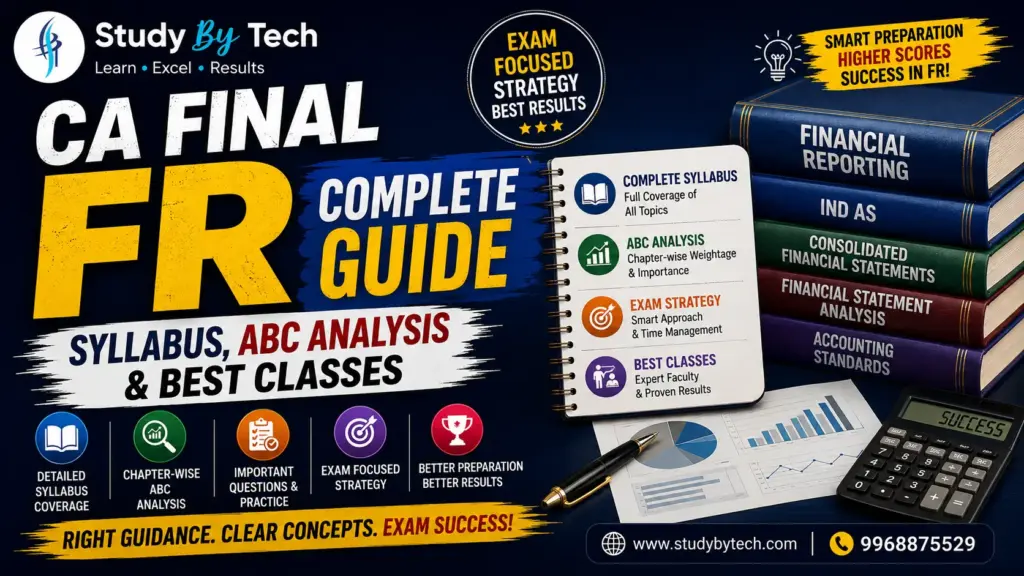
Ultimate Guide to CA Final FR (Financial Reporting): Syllabus, Strategy & Best Classes 🎯 Your complete roadmap to CA Final FR (Paper 1) — From Ind AS syllabus to exam strategy and best faculty. Everything you need to score 70+ or get an exemption. 📑 Table of Contents Overview & Syllabus 1. What Is CA Final FR? 2. Key Content Pillars of CA Final Accounts 3. High-Yield Ind AS Chapters Strategy & Coaching 4. Proven Strategy for First Attempt 5. Importance of Choosing the Right FR Classes 6. Best Option for CA Final FR Classes: StudyByTech 7. Comparing CA Final FR Learning Options FAQ Frequently Asked Questions ⭐ Key Takeaways Paper 1: Financial Reporting (FR) — 100 Marks, the bedrock of the CA Final course. Core Pillars: Business Combinations & Consolidation (25-35%), Financial Instruments (15-20%), Revenue & Leases (15-20%). High-Yield Ind AS: Ind AS 103, 110, 109, 115, 116 are frequently tested with 14-20 mark problems. Proven Strategy: Conceptual understanding → Practice ICAI material → Step-marking in answers → Time-bound writing. Best FR Faculty: CA Akash Malhotra Sir is highly recommended for his ex-examiner insights and small batch teaching. Key Class Features: Look for small batches (10 students), 100% ICAI coverage, and multiple learning modes (Offline/Live/Recorded). StudyByTech Advantage: Personal attention, step-marking focus, and flexible learning options. ICAI Material is Gold: Solve all questions from Study Material, RTP, MTP, and past 5 attempts’ papers. 1. What Is CA Final FR? (Course Overview and Syllabus Structure) CA Final Financial Reporting (FR) assesses your skill in comprehending, applying, and reporting Indian Accounting Standards (Ind AS) in the practical world of business. Unlike bookkeeping at intermediate levels, fr ca final requires you to have good business judgment skills in several areas such as business combinations. 2. Key Content Pillars of CA Final Accounts Module Category Core Coverage & Key Ind AS Approx. Exam Weightage Business Combinations & Consolidation Ind AS 103 (Business Combinations), Ind AS 110 (CFS), Ind AS 28, Ind AS 31 25% – 35% Financial Instruments Ind AS 32 (Presentation), Ind AS 109 (Recognition & Measurement), Ind AS 107 15% – 20% Revenue, Leases & Core Standards Ind AS 115 (Revenue from Contracts), Ind AS 116 (Leases), Ind AS 16 (PPE) 15% – 20% Presentation & Disclosures Ind AS 1 (Financial Statements), Ind AS 8, Ind AS 10, Ind AS 33 (EPS) 10% – 15% Assets & Liabilities Standards Ind AS 2, Ind AS 19, Ind AS 20, Ind AS 36 (Impairment), Ind AS 37 10% – 15% Other Advanced Topics Professional & Ethical Duty, CSR Reporting, Integrated Reporting 5% – 10% 3. High-Yield Ind AS Chapters That You Should Not Miss In order to get marks over 70 in CA Final FR, concentrate your efforts on high weightage chapters, which are always there in ICAI question papers: Ind AS 103 & 110 (Business Combinations & Consolidated Financial Statements): A 14-20 mark problem is almost always present in the question paper on the above topics involving acquisition accounting, NCI, goodwill calculations, and step acquisitions. Ind AS 109 & 32 (Financial Instruments): Topics related to amortized cost, FVTOCI, compound financial instrument, and hedge accounting are complex and need analytical practice. Ind AS 115 (Revenue from Contracts with Customers): The 5 steps of revenue recognition model give rise to many scenarios for practical problems. Ind AS 116 (Leases): Concentrate on ROU asset calculations, lease modification, and sale and lease back. 4. Proven Strategy for Passing CA Final Financial Reporting in First Attempt To become expert in FR of ca final requires conceptual knowledge, thorough study of ICAI Study Material, and time-bound writing. Step 1: 100 Percent Conceptual Understanding Do not blindly memorize accounting entries. Try to learn the reason behind each accounting entry because that will make it easy to answer twisted questions in the exam. Step 2: Practice Illustrations and Question Papers by ICAI The ICAI repeats its questions from Study Material, RTP, MTP and 5 previous attempts’ question papers. Solve all numerical questions by writing on paper with proper working notes. Step 3: Perfect Your Writing and Working Notes In ca final accounts classes, it is highly recommended that emphasis should be laid on step marking. Write: Name and number of the related Ind AS. Short explanation of the requirement of provision or standard. Evaluation and working notes for numerical. A concluding sentence. 5. Importance of Choosing the Right FR Classes for CA Final With CA Final FR being so extensive, self-study will take double the time with an increased risk of not understanding minor aspects of standard interpretations. Quality FR Classes CA Final enable you to understand all the important concepts contained in the 1,000+ page syllabus through a focused approach using the question banks. Points to Consider While Selecting CA Final Accounts Classes: Expert Faculty: Understand the meaning and objective of accounting standards from the point of view of experienced professionals. Batch Size & Individual Attention: A large batch size with more than 500 students does not allow queries and doubts. A small batch size ensures individual attention by the faculty. ICAI Study Material Offered: All Ind AS, RTPs, MTPs, and questions covered Option to Choose Method of Learning: Choice between live class and streamed online class. 6. Best Option for CA Final FR Classes: StudyByTech with CA Akash Malhotra Sir For the search of best CA Final FR classes, StudyByTech is a choice among students because of CA Akash Malhotra Sir. 10-Student BatchesPersonal Attention 100% ICAI CoverageAll Ind AS + Past Papers CA Akash MalhotraEx-Examiner Insights Flexible ModesOffline, Live & Recorded CA Akash Malhotra Sir Best Faculty for CA Final FR Expert in Financial Reporting & Ind AS Highlights of FR Classes by CA Akash Malhotra Sir Small Micro Batch (Maximum 10 Students): Unlike other coaching institutes where hall is over crowded, StudyByTech has kept the batch size limited to 10 only such that all your doubts are cleared instantly. Ind AS Explanations in Detail: Ind AS is explained in detail from its basic understanding to complex corporate
Uncategorized
Uncategorized
Uncategorized
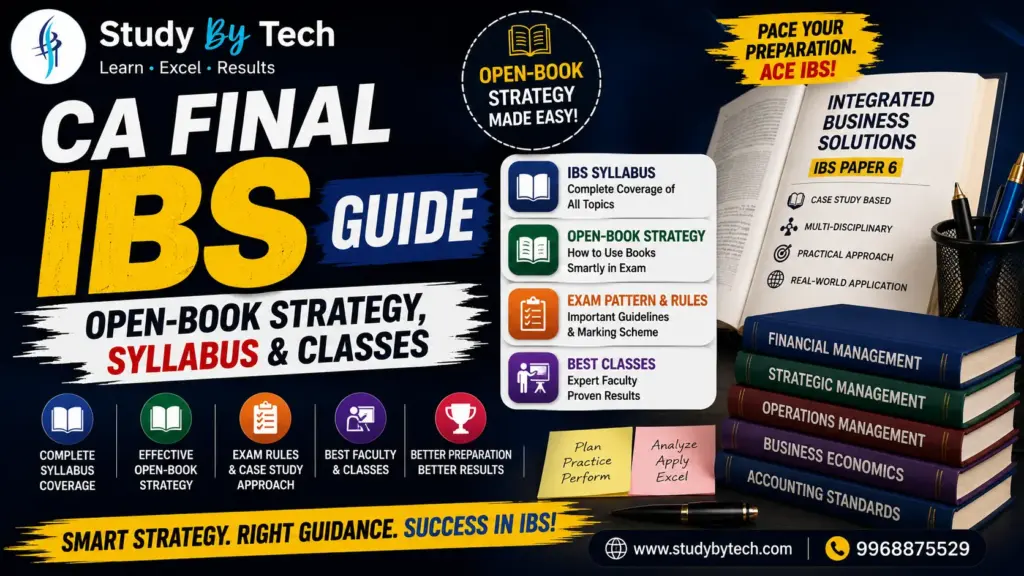
Complete Master Guide to CA Final IBS: Open-Book Strategy, Syllabus Integration & Best Classes 🎯 Your complete roadmap to CA Final IBS (Paper 6) — From open-book strategy to subject integration and best faculty. Everything you need to score 60+ on your first attempt. 📑 Table of Contents Overview & Strategy 1. What is CA Final IBS (Paper 6)? 2. Reality Check – Why Open Book is Not Easy? Syllabus & Execution 3. Subject Weightage & Important Topics 4. Why SCPM is Important for IBS 5. Proven 4-Hour Exam Execution Plan Preparation & Best Faculty 6. Open-Book Study Material Preparation Tips 7. Why Attending Online Classes Helps 8. Best Classes for CA Final IBS: CA Parag Gupta Sir FAQ Frequently Asked Questions ⭐ Key Takeaways Paper 6: Integrated Business Solutions (IBS) — A 100-mark multidisciplinary case study paper, 100% open book. Exam Structure: 4 hours (15 min reading). 5 case studies (25 marks each), attempt any 4. Question Design: Each case = 10 Marks MCQs + 15 Marks Scenario Questions. Open Book is NOT Easy: It tests Retrieval Speed and Analytical Synthesis, not searching. Follow the 2-Minute Retrieval Rule. High-Priority Subjects: FR (Ind AS 103, 110, 109, 115), AFM (Forex, Valuation), and SCPM/SPOM Set B are core drivers. Answer Structure: Use “Issue-Rule-Apply-Conclude” format for logical, high-scoring answers. Best Faculty for SCPM Portion: CA Parag Gupta Sir is India’s leading expert for the SCPM part of IBS. Preparation Strategy: Master indices → Practice case studies → Follow the 4-hour execution plan → Clear SPOM Set B. 1. What is CA Final IBS (Paper 6)? CA Final IBS means Integrated Business Solutions. It is an obligatory 100 mark multidisciplinary case study paper belonging to Group 2 of the New Scheme of ICAI. While in conventional papers like Taxation and Financial Reporting the topic is tested in its own context, CA Final IBS involves complicated cases in which one decision affects aspects such as financial reporting, tax planning, cost minimization, legal compliance and strategic management. Highlights of Paper 6: CA Final IBS Exam Pattern: 100% open book examination (ICAI modules, handwritten notes, indexes and summaries). Time Allowed: 4 hours (15 minutes reading time). Mark Allocation: 5 case studies of 25 marks each, attempt 4. Question Design: In each case study of 25 marks: 10 Marks: Integrated Multiple Choice Questions (5 MCQs × 2 marks). 15 Marks: Scenario questions. Marking Pattern: Mind Application, Cross Referring Legal Provisions, Calculation Workings, Business Reporting. 2. CA Final IBS Reality Check – Why Open Book is Not Easy? One of the most common mistakes made by CA Final students is thinking that an open-book examination means minimal preparation. The reality is that CA Final IBS is a test of Retrieval Speed and Analytical Synthesis, and not searching. ⏱️ 2-Minute Retrieval Rule You get roughly 55 minutes for each case study. If it takes more than 2 minutes to find a formula, Ind AS, or Tax Provisions, you won’t have time left to write full answers. Integration Across Subjects A single case study could cover: Determination of purchase consideration according to Ind AS 103 (FR). Hedging techniques using currency options (AFM). Pricing strategies and Make Or Buy decisions (SCPM / SPOM Set B). Tax aspects of Transfer Pricing and GST (DT & IDT). 3. Weightage of Individual Subject & Important Topics of CA Final IBS From the latest exam trends, it can be seen that ICAI assesses its students on the basis of a selected set of subjects. Considering CA Final IBS as an integration of your CA Final subjects: CA Final Subject Trend / Priority in IBS High-Yield Topics to Master & Index Financial Reporting (FR) High Priority (Surging) Ind AS 103 (Business Combinations), Ind AS 110 (Consolidation), Ind AS 109 (Financial Instruments), Ind AS 115. Advanced Financial Management (AFM) High Priority Forex Hedging, Portfolio Evaluation, Capital Budgeting, Business Valuation. Strategic Cost & Performance Management (SCPM / SPOM Set B) Core Driver (Must-Master) Life Cycle Costing, Transfer Pricing, Target Costing, Balanced Scorecard, EVA, Decision-Making Models. Direct Tax & International Tax (DT) Constant Presence Transfer Pricing, DTAA, Equalisation Levy, Capital Gains, Grossing-Up Adjustments. Indirect Tax Laws (IDT) High Application Place of Supply, Input Tax Credit (ITC) Restrictions, Customs Valuation. Corporate Laws & Audit Case-Law Driven Director Disqualifications, SEBI LODR, Audit Reporting (SA 700/705/706), CARO 2020. 4. Why SCPM (SPOM Set B) Is Important For Clear CA Final IBS While reviewing CA Final IBS past question papers, it is seen that a large number of questions related to description are based on Strategic Cost & Performance Management (SCPM/SPOM Set B). In business cases, there is a requirement of numerical analysis such as break-even point calculation, make/buy decision, sensitivity analysis, and strategic cost reduction model. Students find it hard to justify logically and numerically because of lack of clarity in SCPM. Attending classes specifically related to SCPM gives you not only eligibility for SPOM Set B but also helps you get good marks in CA Final IBS. 5. Proven 4-Hour Exam Execution Plan for CA Final IBS To score 60+ in CA Final IBS, adopt this structured execution plan used by rankers: Reading Time 15 Mins Scan & Omit Weakest Case Case 1 55 Mins MCQs (10) + Descriptive (45) Case 2 55 Mins MCQs (10) + Descriptive (45) Case 3 55 Mins MCQs (10) + Descriptive (45) Case 4 55 Mins MCQs (10) + Descriptive (45) Step 1: Make Optimum Use of 15 Minutes of Reading Time You should not read the 5-page case studies word-to-word in the reading time period. Instead, follow the below steps: Go to the descriptive questions that are at the bottom of the case studies. Write down in which subjects (Law, AFM, SCPM) is the examination conducted. Choose the case study to omit – choose that case study which contains calculation in complicated subjects. Step 2: Use “Issue-Rule-Apply-Conclude” Structure in Answer The examiners look for the logical structure of answers: Issue: Write the issue/problem in 1-2 lines. Rule: Directly quote the appropriate section, Ind
Uncategorized
Complete Guide to CA Final SPOM Set B: Syllabus, Study Material, Exam Strategy & Best Classes 🎯 Your complete roadmap to CA Final SPOM Set B (Strategic Cost & Performance Management) — From syllabus to exam strategy and best faculty. Everything you need to clear SPOM Set B on your first attempt. 📑 Table of Contents Overview & Syllabus 1. What is SPOM Set B in CA Final? 2. CA Final SPOM Set B Syllabus Breakdown Study Material & Coaching 3. How to Access Study Material 4. Why Join Specialized SPOM Classes? 5. Best Faculty: CA Parag Gupta Sir 6. Course Comparison: Finding the Right Batch Registration & Exam Strategy 7. How to Register & Schedule Your Exams FAQ Frequently Asked Questions ⭐ Key Takeaways SPOM Set B = Strategic Cost & Performance Management (SCPM): A mandatory 100-mark online module under the CA Final New Scheme. Mandatory Learning Hours: 40 hours of video lectures on the ICAI Digital Learning Campus portal. Exam Format: 3-hour Computer Based Test (CBT) with 100% MCQs and case scenarios. No negative marking. Passing Criteria: 50% marks (50 out of 100). Unlimited attempts (₹500 per attempt in India). Critical for IBS: SCPM concepts form a significant portion of CA Final Paper 6 (Integrated Business Solutions). Best Faculty: CA Parag Gupta Sir is unanimously recommended for SPOM Set B due to his experience and case-study approach. Course Features: Look for 90-hour comprehensive coverage, IBS inclusion, 3-year validity, and direct doubt resolution with faculty. Preparation Strategy: Complete portal hours → Join SPOM batches → Practice case studies → Book exam slot → Attempt CBT. 1. What is SPOM Set B in CA Final? SPOM Set B is a mandatory 100 marks online module under the CA Final New Scheme syllabus. It replaces the traditional lengthy written examination paper Strategic Cost Management & Performance Evaluation (SCMPE) with an online test based on case scenarios. Important Highlights of CA Final SPOM Set B Subject Name: Strategic Cost and Performance Management (SCPM). Minimum Hours Required for Study on Portal: 40 hours of viewing the video lectures on ICAI Digital Learning Campus Website. Type of Examination: 3-hour Computer Based Test (CBT), which comprises all MCQs and Case Scenarios Passing Marks: Minimum passing marks are 50% out of 100 marks Negative Marking: There is no negative marking Number of Attempts: Unlimited number of attempts (₹500 per attempt in India) 📌 Important Point for Paper 6 (IBS): The content of CA Final SPOM Set B forms a significant portion of Paper 6 – Integrated Business Solutions (IBS) – the multi-disciplinary open book examination in Group 2. Know the concepts of Set B to make Paper 6 also simple! 2. CA Final SPOM Set B Syllabus Breakdown The CA Final SPOM Set B curriculum is structured around modern business strategy, cost optimization models, performance measurement frameworks, and quantitative techniques: Module Domain Key Topics Covered Strategic Cost Management Life Cycle Costing, Target Costing, Kaizen Costing, Lean System & Innovation (JIT, 5S, TPM). Modern Business Environment Supply Chain Management (SCM), Total Quality Management (TQM), Cost of Quality, Gain Sharing. Decision Making & Pricing CVP Analysis, Relevant Costing, Transfer Pricing, Strategic Pricing Models. Performance Evaluation Responsibility Accounting, Divisional Performance Measurement, Balanced Scorecard, EVA. Strategic Analysis & Value Chain Porter’s Five Forces, Value Chain Analysis, Business Process Re-engineering (BPR). 3. How To Access CA Final SPOM Set B Study Material? In order to perform well in Set B, it is necessary to have access to quality study material. 1. ICAI Study Material The CA Final new course students can get the official CA Final SPOM Set B study material (Modules 1 & 2) from the ICAI Board of Studies (BoS) Knowledge Portal. The books are available in physical form and are distributed via the ICAI Centralized Distribution System (CDS). 2. Practice Books & Hand Written Notes Since the CA Final Set B paper involves scenarios of various accounting institutions like ACCA, CIMA, and CPA, the standard books might be insufficient. Therefore, high-yield CA Final SPOM classes offer: Index and Case Study Sheets: For easy navigation through the complicated structure of the scenario. Hand Written Notes: For quick review of formulas/theory. Specifically designed Multiple Choice Question Bank: For solving past RTPs and MTPs, as well as case studies from other accounting institutions. 4. Why Should You Join Specialized CA Final SPOM Classes/Batches? Although ICAI has set a target of 40 hours of tracking through the portal, from the latest trends of examination, it is apparent that CA Final SPOM Set B MCQs focus more on higher-level conceptual understanding rather than memorization. Students attempting the CBT without taking any classes find it difficult to do complex calculations within time constraints. 📖 Conceptual Understanding From mere memorization to understanding the concept behind the use of cost models in particular business situations. ⚡ Short-cut Techniques Learning techniques for eliminating wrong answers from a multi-layered case situation. 📝 Preparation for IBS Preparation of the SCPM part which is needed for CA Final Paper 6 (Integrated Business Solutions). 📱 Flexible Learning Styles Video Lectures on Laptop (via Google Drive or Pendrive) or Mobile Application with 1.2x/1.5x viewing options. 5. Best Faculty for CA Final SPOM Set B: CA Parag Gupta Sir If you need to choose the best faculty for CA final SPOM set B then you can only get unanimous recommendation for Parag Gupta sir. CA Parag Gupta Sir Best Faculty for SPOM Set B Ex-ICAI Examiner | 20+ Years Experience Expert in Strategic Cost & Performance Management (SCPM) Why Should You Choose Parag Gupta Sir? More Than 20 Years of Teaching Experience: Over 20 years of experience in guiding toppers in CA intermediate/final costing & strategic management. Former ICAI Examiner & Observer: Has unique knowledge regarding framing of questions by the ICAI examiners. Complete 90 Hour Course: Contains complete coverage of SPOM Set B (SCPM) as well as the SCPM section of paper 6 (IBS). International Case Study Coverage: Cases covered from ACCA, CIMA and CPA so that there is nothing in
Uncategorized
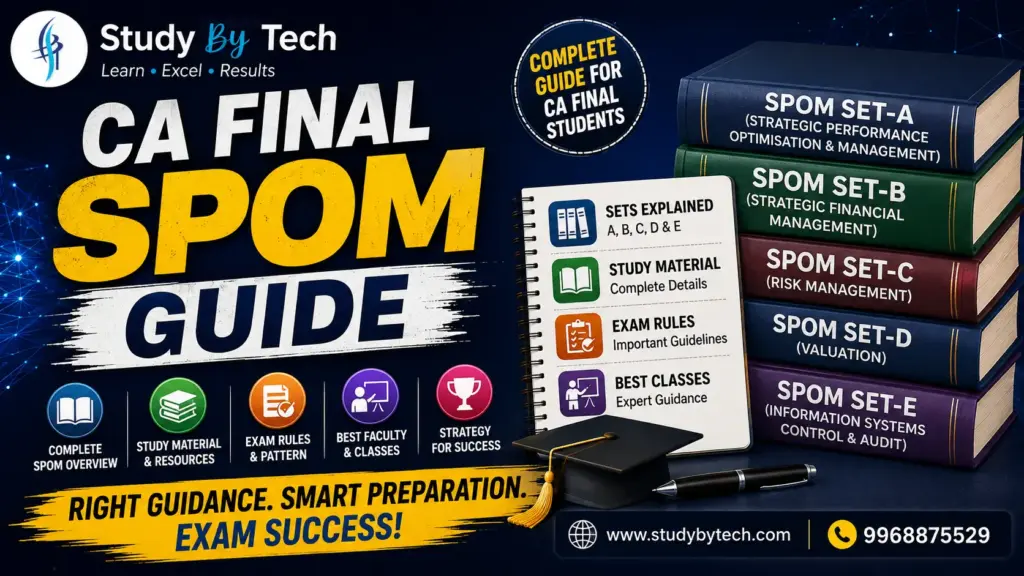
Complete Guide to SPOM in CA Final: Sets, Syllabus, Study Material, Exam Rules & Best Classes 🎯 Your complete roadmap to CA Final SPOM — From Set A & B structure to exam rules and best faculty. Everything you need to clear SPOM on your first attempt. 📑 Table of Contents Overview & Structure 1. What is SPOM in CA Final? 2. SPOM Structure (Set A, B, C, & D) Set A & B Details 3. CA Final SPOM Set A: Corporate and Economic Laws 4. CA Final SPOM Set B: Strategic Cost and Performance Management 5. Choice of Electives: Set C & Set D Study Material, Exams & Coaching 6. Study Material and ICAI LMS Portal 7. Exam Pattern, Passing Criteria & Fees 8. Exemptions for Transition Students 9. Why You Require SPOM Classes 10. Best Teachers for SPOM Set A & B 11. Steps to Successfully Clear SPOM FAQ Frequently Asked Questions ⭐ Key Takeaways SPOM = Self-Paced Online Modules: ICAI’s new learning format for CA Final, replacing traditional written papers. 4 Sets: Set A (Corporate & Economic Laws) and Set B (SCPM) are mandatory. Set C (Elective) and Set D (Multidisciplinary) require choosing one each. 100% MCQ Format: Computer-based tests (CBT) with case-scenario based MCQs. No negative marking. Passing Criteria: 50% marks in each module separately. Unlimited attempts until qualifying. Mandatory Learning Hours: 40 hours for Set A & B each on the ICAI portal. Completion is required before the CA Final exams. Examination Fee: ₹500 per module in India, with higher fees for international centers. Best Faculty: CA Parag Gupta Sir is highly recommended for Set B (SCPM), and CA Amit Popli for Set A (Law). IBS is Open Book: CA Final Paper 6 (Integrated Business Solutions) is an open-book exam, but it is rated “High to Very High” difficulty. 1. What is SPOM in CA Final? Self-Paced Online Modules, abbreviated as SPOM, was brought to the revised syllabus for the CA Final course. These modules enable the students to cover the required number of learning hours and clear the assessment process in their own time through ICAI Digital Learning Campus Portal. In accordance with ICAI New Scheme, the CA Final Course examination papers have been reduced to 6 subjects in total, divided into 2 groups. Subjects which used to be traditional written papers, like Corporate and Economic Laws, and Strategic Cost Management & Performance Evaluation (SCMPE), have been changed to mandatory SPOM subjects. CA Final SPOM Key Objectives E-Learning Flexibility: Study through video lessons and digital content available online at any time from anywhere. Case-Based Analytical Skills: Master skills through practice of case-based scenario MCQs. Eligibility/Exemptions: Completion of particular CA Final SPOM series prior to writing the CA Final exams. 2. CA Final SPOM (Set A, B, C, & D): Complete Structure The course structure for CA Final SPOM consists of four different sets (Set A, Set B, Set C, & Set D). Set A and Set B are compulsory for all students of CA Final, whereas Set C & Set D consist of elective courses. Set Module Type Subject Name Learning Hours Exam Marks Passing Marks A Mandatory Corporate and Economic Laws 40 Hours 100 50% B Mandatory Strategic Cost and Performance Management (SCPM) 40 Hours 100 50% C Elective (Choose 1) Specialization (Risk Mgmt, Forex, IBC, Int’l Tax, etc.) 20 Hours 100 50% D Multidisciplinary (Choose 1) Broader Perspective (Constitution, Psychology, Startups, etc.) 20 Hours 100 50% 3. In Detail: CA Final SPOM – Set A & Set B 1. CA Final SPOM Set A: Corporate and Economic Laws CA final SPOM set a is a compulsorily required 100 marks paper dealing with all important laws relating to corporations in India. Compulsory Study Period Required: 40 hours on ICAI Website Important Areas of Study Covered: Company Law (Law Relating to Directors, Compromise and Arrangement, Inspection and Investigation) Security Laws (SEBI Rules, ICDR and LODR) Economic Laws (FEMA, Prevention of Money Laundering Act, Foreign Contributions Regulation Act) Examination Format: Computer Based Test (3-Hour CBT – Case Scenario Based MCQs) 2. CA Final SPOM Set B: Strategic Cost and Performance Management (SCPM) All topics in CA Final SPOM Set B relate to management accounting, decision-making techniques, cost control techniques, and strategic analysis. Time Allotted for Learning: 40 Hours from ICAI Portal Key Topics in the Course Include: Strategic Cost Management (Life Cycle Costing, Target Costing, Lean Systems & Innovation) Performance Evaluation and Operation Control Strategic Decision Making & Transfer Pricing Analysis of Case Studies & Numerical Analysis Test Pattern: 3 Hour CBT Test (case studies + MCQs) 5. Choice of Electives: Set C & Set D Set C (Electives – Any 1): Risk Management, Sustainable Development and Sustainability Reporting, Public Finance and Government Accounting, Insolvency and Bankruptcy Code (IBC), International Taxation, Forensic Accounting, Valuation, Financial Services and Capital Markets, Forex and Treasury Management. Set D (Multidisciplinary – Any 1): Constitution of India and Art of Advocacy, Psychology and Philosophy, Entrepreneurship and Start-up Ecosystem, Digital Ecosystem and Controls. 6. CA Final SPOM Study Material and ICAI LMS Portal Login In order to complete your learning hours and download the CA Final SPOM study material, you must access ICAI’s online digital platform. ICAI’s Digital Learning Campus Portal: Use the login credentials on the ICAI’s official portal (spmt.icai.org or icai.org). OTP-based Access: Login via SSO by using the credentials of ICAI’s Self-Service Portal (SSP). ICAI’s Physical and Digital Study Material: ICAI offers digital study material in e-book form and modules on the ICAI’s BoS Knowledge Portal while physical study material is dispatched from the ICAI’s CDS portal. Technical & System Requirements for SPOM Learning For ensuring that the recording of your learning time is not disturbed in any way: Device: A desktop/laptop having an HD webcam in working condition. Internet connection: At least a minimum speed of 2 to 5 MBPS internet connection. Lighting & Monitoring: Good lighting in the room as the portal uses the face recognition feature of the system. 7. Pattern of Exam, Criteria
Uncategorized
CA Inter Law: Syllabus, ABC Analysis, Exam Strategy & Best Classes (Paper 2) 🎯 Your complete guide to Corporate and Other Laws — From syllabus to legal answer writing. Everything you need to score 60+ or get an exemption. 📑 Table of Contents Overview & Syllabus 1. What is CA Inter Corporate and Other Laws? 2. ICAI CA Inter Law Syllabus & Weightage Strategy & Timetable 3. ABC Analysis for CA Inter Law 4. How to Write Answers in CA Inter Law Exam 5. Master Plan to Cover “CA Inter Other Law” 6. Proven 3-Month Study & Revision Timetable Coaching & Final Push 7. Selecting the Correct CA Inter Law Classes FAQ Frequently Asked Questions ⭐ Key Takeaways Paper 2: Corporate and Other Laws — 100 Marks (70 Marks Company Law + 30 Marks Other Laws). Exam Pattern: 30% Case-based MCQs (30 Marks) + 70% Descriptive (70 Marks). 4-Step Legal Answer Format: Provision → Analysis → Application → Conclusion. ABC Analysis: Focus on Category A topics (Management, Accounts, Audit, FEMA) for 50-55 Marks. Other Laws is Scoring: General Clauses Act, Interpretation, and FEMA (30 Marks) — master them. 3-Month Plan: Month 1: Concept Building → Month 2: Writing Practice → Month 3: Mocks & Revisions. Use ICAI Language: Avoid casual answers — use “As per Section X of the Companies Act, 2013…” Section Numbers: Use only when 100% sure, otherwise say “relevant provisions of the Act.” 1. What is CA Inter Corporate and Other Laws? CA Inter Law (also known as Paper 2: Corporate and Other Laws according to the new scheme of ICAI) is an important core subject under the Chartered Accountancy Group 1 examination. With total marks of 100, this paper tests the aspirant’s capability to interpret the language used in statutes, analyze corporate situations, and apply legal provisions to business situations. Exam Pattern & Scheme Breakdown PAPER 2: CORPORATE AND OTHER LAWS (100 MARKS) PART I: COMPANY LAW & LLP PART II: OTHER LAWS • Total Weightage: 70 Marks• Companies Act, 2013 (Ch I–XI) & LLP Act, 2008 • Total Weightage: 30 Marks• General Clauses Act, Interpretation, FEMA 30% Integrated Case-scenario Objective Type Questions (30 Marks): Definitions of Laws, Limitations, Period, Penalties, etc. (Negative marking will not be applicable for such questions). 70% Descriptive Problem Cases (70 Marks): Legal case-scenario questions and questions of Statutes (Legal Format to be followed). 2. ICAI CA Inter Law Syllabus & Chapter Weightage The syllabus for ca inter corporate and other laws is divided into two distinct parts: Module / Part Coverage & Key Statutes ICAI Marks Weightage Part I: Corporate Law (Companies Act, 2013) Preliminary, Incorporation, Prospectus & Allotment, Share Capital & Debentures, Deposits, Charges, Management & Administration, Dividends, Accounts of Companies, Audit & Auditors, Companies Incorporated Outside India. 60 Marks Part I: LLP Law (LLP Act, 2008) Nature & Formation of LLP, Partner Relations, Financial Disclosures, Conversions & Winding Up. 10 Marks Part II: Other Laws General Clauses Act, 1897 (Definitions, Rules of Construction)Interpretation of Statutes (Primary & Secondary Rules, Internal/External Aids)FEMA, 1999 (Current/Capital Account Transactions, Foreign Exchange rules). 30 Marks 3. ABC Analysis for CA Inter Law Choosing topics which score well guarantees that you are putting your efforts into subjects which offer maximum marks: Category Topics Weightage Category A(Must Know) Corporate Law: Management & Administration of Companies (General Meetings, Resolutions), Accounts of Companies, Audit and Auditors, Declaration and Payment of Dividend, Share Capital and Debentures. Other Laws: Foreign Exchange Management Act (FEMA 1999) – Transactions Under Current Account and Capital Account. 50 – 55 Marks Category B(High Yields) Corporate Law: Registration of Charges, Acceptance of Deposits by Companies, Companies incorporated outside India. Other Laws: General Clauses Act, 1897 and Interpretation of Statutes, Deeds and Documents. 30 – 35 Marks Category C(Quick Revise) Corporate Law: Preliminary and Incorporation of Company & Matter incidental thereto. LLP Law: The Limited Liability Partnership Act, 2008. 15 – 20 Marks 4. How to Write Answers in CA Inter Law Exam (Legal Blueprint in 4 Steps) Informal or conversational answer writing is the major cause behind students’ failure in securing exemption in CA inter corporate law. Examiners at ICAI are looking for a precise and legal approach while analyzing case study based questions. In case of answering any case-study based descriptive question, ensure that your answer is divided in 4 clear sections: 1. Provision of Law State the relevant Section Number and Act name accurately. (e.g., “As per Section 135 of the Companies Act, 2013…”) 2. Analysis of Facts Summarize the key facts given in the exam scenario and highlight the core legal issue without repeating the whole question. 3. Application & Comparison Connect the statutory provision with the specific facts of the case. Analyze whether conditions, limits, or compliance duties were met. 4. Clear & Direct Conclusion Provide a definitive answer to the specific question asked in 1–2 sentences. 💡 Tip for Section Numbers: Use section numbers only when you are 100% sure. An incorrect section number will cost you dearly in terms of marks. Elsewise use “As per the relevant provisions of Companies Act, 2013” 5. Master Plan to Cover “CA Inter Other Law” Easily While many students tend to focus a lot more on company law, they ignore “CA Inter Other Law.” But, the good thing is that Part II has 30 marks to be scored in a comparatively smaller syllabus than Corporate Law, which is the highest scoring section of the paper. 📜 General Clauses Act, 1897 Study statutory definitions (e.g., Person, Document, Government, Good Faith, Shall & May). Provisions about computation of time and service by post. 📖 Interpretation of Statutes Memorize all the important rules of interpretation such as Mischief Rule, Golden Rule, Literal Construction, etc. Understand their aids (Internal & External). 🌍 FEMA, 1999 Clear distinction between Current Account Transactions (Schedule I, II, III) and Capital Account Transactions. Focus on key definitions and provisions. 6. Proven 3-Month Study & Revision Timetable Phase Activity Phase 1 (Month 1) Complete Concept Building & Notes Creation• Dedicate 2.5
Uncategorized
2+ LAKH NEW CAs IN 4 YEARS: WHAT’S REALLY HAPPENING TO THE CA PROFESSION?
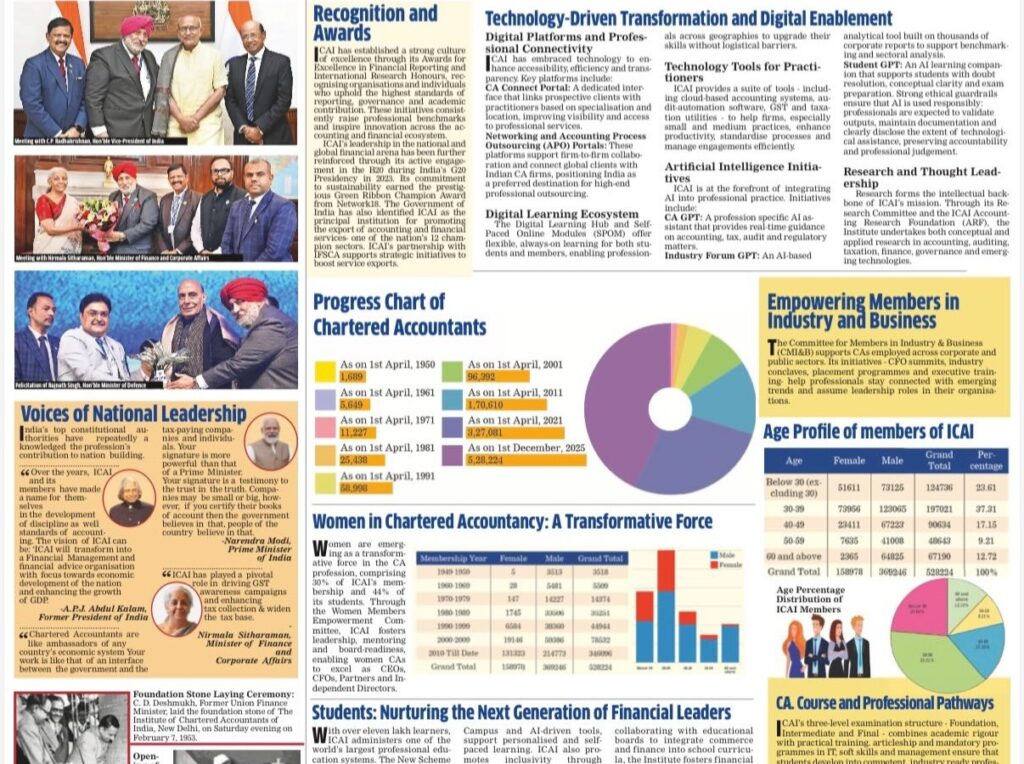
The landscape of chartered accountancy has drastically changed, according to official statistics. As per The Economic Times dated 19th December, 2025, in less than five years, CAs have grown from 3,27,081 (1 April 2021) to 5,28,224 (1 December 2025), adding over two lakh members. This surge has huge implications for CA students, young chartered accountants, firms, and the long‑term brand value of the Institute of Chartered Accountants of India qualification. The New CA Economy: Security Or Illusion? For decades, “CA” was almost synonymous with financial security and professional respect. That presumption is no longer assured today. Short-term job scarcity is not the only real risk. If the increase in membership is not accompanied by an equivalent improvement in skills, capabilities, and work quality, the deeper concern is a gradual dilution of the CA brand. Key question: Are we creating strategic finance experts or merely inexpensive, easily replaceable compliance executors in an era of automated compliance and tax simplification? Law → SPOM: Are We Weakening Our Legal Edge? Strong exposure to corporate law, insolvency, and regulatory frameworks has historically been one of Indian CAs’ main advantages. Many CAs were able to appear as counsel before RD, NCLT, and NCLAT thanks to this foundation, and they were able to play significant roles in boardroom decision-making, restructuring, and litigation support. By pushing Law in a SPOM basket that is simpler to clear: If the current trend keeps up, should Chartered Accountants still have an automatic right to appear as counsel in complex matters before the MCA and tribunals? Lose that standing and the profession doesn’t just wobble — it takes a long-term hit. Costing → SPOM: Who Will Own Strategic Cost & Performance? Cost and Management Accounting and Strategic Cost Management & Performance Evaluation are not “optional scoring subjects”; they are the backbone of business decision‑making—pricing, profitability analysis, performance dashboards, cost leadership, and strategic planning. Cost and Management Accounting, and Strategic Cost Management & Performance Evaluation, are not optional extras. They are the backbone of business decision-making — pricing, profitability analysis, performance dashboards, cost leadership and long-range strategy. You see their fingerprints everywhere: in boardroom debates, in late-night spreadsheet revisions, in the one slide that can change the CEO’s mind. By shifting Costing/SCMPE into SPOM and making it very easy to clear: The result is a gap. Others are already moving into that space: If CAs stop being the obvious choice for strategic costing, performance management and decision support, CMAs and ACCAs will increasingly own that territory here and overseas. AI, Compliance And The Future Of CA Jobs Technology is pushing the profession in one direction: Now imagine adding lakhs of new members while: The “CA” label alone won’t guarantee the lifestyle or career trajectory many students expect. The sustainable defence is upskilling — analytics, strategic finance, business partnering, and technology‑driven value creation. In short: move from doing to advising. That’s where the fees, and the interesting work, will be. “10L+ CA Students”: Headline vs Reality We often hear that there are more than 10 lakh CA students. But CA registration remains valid for 5 years: So here’s a blunt question: Are we running the ecosystem for real learning and outcomes—or are we chasing headline numbers? Where ICAI Actually Deserves Credit Despite these concerns, the growth in membership is not inherently bad. There are clear upsides: The key issue is how this boom is used. Numbers alone cannot protect the profession; it’s what we do with them that counts. What Should The Profession Do With This Boom? To convert the membership explosion into a genuine long‑term advantage, three things are urgent: Who Is Writing This? This analysis comes from daily experience with CA students who struggle to make sense of the changing landscape. I am CA. Parag Gupta, teaching Cost and Management Accounting at CA Intermediate and Strategic Cost and Performance Management at CA Final. I have served as a CA Final examiner (paper checker) and actively promoted fair examination practices as an ICAI observer. I am a highly sought-after mentor, particularly by top achievers, due to my mastery of subjects like Cost & Management Accounting, Strategic Management, Strategic Cost and Performance Management, Integrated Business Solutions (IBS), and Operations Research. Students and firms looking for structured guidance can explore more detailed resources and courses at: 👉 paraggupta.com and 👉 studybytech.com A Question For Every CA, Student And Employer This isn’t an attack on the Institute. It is a call for course‑correction and honest introspection. If you are a CA, CA student, commerce student, HR head or finance leader, share your views. Would you still recommend CA to a bright Class‑12 student with the same confidence you had ten years ago? Or would you now add caveats — and a stronger push toward new-age skills? Your honest feedback will shape how seriously the ecosystem responds to these challenges. The landscape of chartered accountancy has drastically changed, according to official statistics. As per The Economic Times dated 19th December, 2025, in less than five years, CAs have grown from 3,27,081 (1 April 2021) to 5,28,224 (1 December 2025), adding over two lakh members. This surge has huge implications for CA students, young chartered accountants, firms, and the long‑term brand value of the Institute of Chartered Accountants of India qualification. The New CA Economy: Security Or Illusion? For decades, “CA” was almost synonymous with financial security and professional respect. That presumption is no longer assured today. Short-term job scarcity is not the only real risk. If the increase in membership is not accompanied by an equivalent improvement in skills, capabilities, and work quality, the deeper concern is a gradual dilution of the CA brand. Key question: Are we creating strategic finance experts or merely inexpensive, easily replaceable compliance executors in an era of automated compliance and tax simplification? Law → SPOM: Are We Weakening Our Legal Edge? Strong exposure to corporate law, insolvency, and regulatory frameworks has historically been one of Indian CAs’ main advantages. Many CAs were able to appear as counsel before RD,
CA, Uncategorized
Best CA Coaching in India | Parag Gupta Classes
Parag Gupta Classes delivers elite CA coaching across CA Foundation, CA Intermediate, and CA Final with a results-driven, mentorship-first approach built over 20+ years of teaching and examination experience. According to ICAI’s most recent plan, our programs are offered offline (in Delhi and Laxmi Nagar), live online, and on recorded. They include a demanding exam series, individualized question-answering. Why Parag Gupta Classes Courses we offer All batches are aligned to the ICAI New Scheme with the latest amendments and exam pattern focus. Teaching Methodology Modes of Learning Batches, Validity, and Materials About Parag Gupta Locations and Contact Ready to start with Parag Gupta Classes? Explore current batches and secure a seat for the next exam cycle with structured guidance, consistent testing, and exam-smart preparation. FAQ’s
Uncategorized
CA Classes in Aligarh
CA classes in Aligarh Given that the CA Foundation course is the prerequisite exam for the CA course, it is clear that there is a growing demand for CA and CA Foundation course coaching classes and institutes throughout India. You must enroll in the top coaching classes and institutes for the CA Foundation course if you want to pass this exam. Don’t worry, ‘Classes at Parag Gupta’ offers CA Foundation Course classes with a qualified team. Here, we take care that our students shall get a good environment to study & shall flourish well in future. For this, we try to also develop students’ overall personality through these courses so that they won’t struggle in life. Which are the best CA classes? ‘Classes at Parag Gupta’ started in December 2010, and have built their coaching empire up to the sky levels in the CA world. Being the best CA coaching class, ‘Classes at Parag Gupta’ has been serving CA students for the last 2 decades now. Also, we ensure that all doubts of students are taken up properly by our faculties. This is the only reason that mostly all rank holders & top scorers are our students. The primary intention of ‘Classes at Parag Gupta’ is to help the students to make their dream come true for becoming CA. ‘Classes at Parag Gupta’ aim at providing exemplary quality study material curated by professionals. ‘Classes at Parag Gupta’ provides quality education with Live Classes having a chat section for students to interact with the teachers. Apart from these live classes, recorded sessions are also available for the students. Classes are available in FACE TO FACE MODE in Delhi and ONLINE MODE is available all over INDIA in the form of laptop software as well mobile app. FROM WHERE TO STUDY? It’s very difficult for a student to pass the CA Foundation course without any coaching institute and an experienced counselor, but the ICAI will send you study materials after you sign up for the course so you can get ready for exams on your own as well. ‘Classes at Parag Gupta’ is considered India’s best coaching institute for CA Classes. Our instructors can provide you with both theoretical and practical knowledge because they are highly qualified and experienced in both the corporate and teaching worlds. About the CA Foundation course WHAT IS CA FOUNDATION COURSE EXAM? : Under the CA Foundation Scheme, the ICAI administers the exam for the CA foundation course. To enroll in the course of study for chartered accountants, this is an entrance exam which can be given after the Class 12 exams. Twice a year, this CA Foundation exam is offered. WHO CAN PURSUE THE CA FOUNDATION COURSE? Whether or not students are from the commerce stream, candidates can enroll in the CA Foundation course after completing their 12th-grade education. HOW TO APPEAR FOR THE CA FOUNDATION EXAM? The exam for the CA foundation course is offered twice a year, in May and November. Candidates must register themselves with the ICAI (Institute of Chartered Accountants of India) four months prior to the exams, i.e., if you want to appear in the May exam, you must do so by the end of December; or if you want to appear in the November exam, you must do so by the end of June. After taking the 12th-grade exams, a candidate can sign up for the CA foundation exam, but they are only qualified to take the test once they have passed the 12th grade. Therefore, you may register provisionally before receiving your 12th-grade results. Subjects and marking scheme in CA Foundation Course Exams? PAPER NO. Subject Marks Exam Type Min. Marks 1 PRINCIPALS AND PRACTICES OF ACCOUNTING 100 WRITTEN 40 2 A. BUSINESS LAW 60 WRITTEN 40 B. BUSINESS CORRESPONDENCE AND REPORTING 40 WRITTEN 3 A. BUSINESS MATHEMATICS AND LOGICAL REASONING 60 OBJECTIVE 40 B. STATISTICS 40 STATISTICS 4 A. BUSINESS ECONOMICS 60 OBJECTIVE 40 B. BUSINESS AND COMMERCIAL KNOWLEDGE 40 STATISTICS In order to pass the CA Foundation course, a candidate must receive at least 40% on each exam, with a minimum 50% overall score. FAQ Q. 1- What courses are available in ‘Classes at Parag Gupta’? A-1 ‘Classes at Parag Gupta’ currently has a vast number of CA, CS, and CUET, CLAT exam preparatory courses for students to choose from, along with a learning platform of their own choice. Students can learn from the CA training institute located in Laxmi Nagar in Delhi or choose from Pen Drive/Google Drive CA lectures, online video lectures, or Mobile apps. Students get a quality education here with the best facilities for CA in Agra. Team ‘Classes at Parag Gupta’ includes one of India’s best CA faculty panels that has successfully trained numerous All India Rankers & Top scorers of CA. Courses available at ‘Classes at Parag Gupta’ are:(Make a table of this info)CA- CA Foundation full course & CA Final CostingCSEETCUETCLATAILET Q.3- Can we do CA after the 12th? A.3- Yes, after Class 12th, you can give CA Foundation exam after the registration through ICAI official website() Q.4- Can I learn CA on my own? A.4- The majority of students are confused about whether they can pass the CA without coaching or not. In actuality, according to our experience, you can pass the CA exam if you commit to CA and dedicate your study time religiously. Otherwise, taking coaching classes in offline or online mode can maintain your study schedule and regular tests & doubt sessions can help you on a proper path to get success in exams. Also Read About Other Courses [wpforms id=”240″]