CA Foundation

CA Foundation Syllabus & Subjects 2026
Blog, CA Foundation, Exams tips

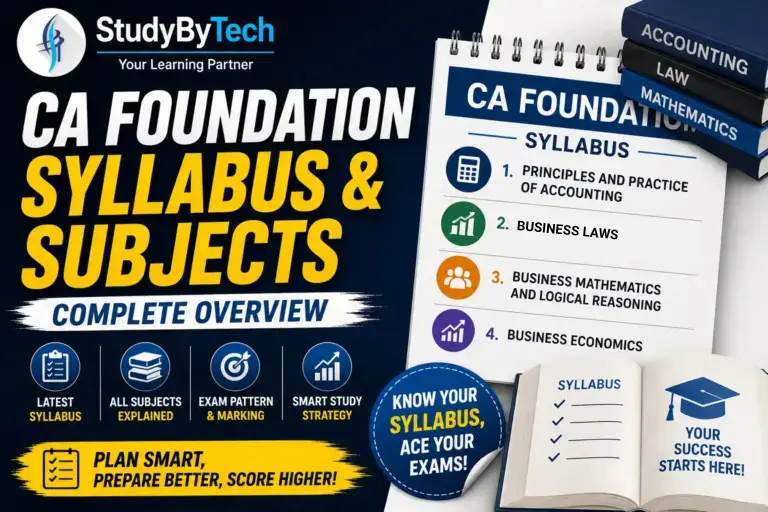
CA Foundation Syllabus & Subjects 2026 – Complete Updated Guide for Students

CA Foundation Classes ICAI Registration Process Subjects, Syllabus & Exam Pattern Admit Card Exam Dates Exam Tips About the faculties FAQ’s 📌 Key Takeaways – CA Foundation Syllabus 2026 What every CA aspirant must know before starting preparation 1 4 Papers, 400 Marks – Updated ICAI Scheme 2026CA Foundation now has 4 papers: Accounting (100), Business Laws (100), Quantitative Aptitude (100 – includes Maths, LR & Stats), and Business Economics (100). 2 subjects removed (BCR & BCK) – syllabus is now more focused. 2 Passing Requirement + Negative MarkingNeed 40% in each paper and 50% aggregate overall. Paper 3 (Quantitative Aptitude) and Paper 4 (Economics) are objective type with negative marking – accuracy matters as much as speed. 3 6–8 Months Preparation + Smart StrategySerious preparation requires 6–8 months with daily study, concept clarity (not rote learning), ICAI question practice, and regular mock tests. Revision and consistency matter more than long study hours. 📚 Total Papers: 4 🎯 Total Marks: 400 ✅ Passing: 40% each + 50% aggregate ⏱️ Prep Time: 6–8 months 📖 Eligibility: After Class 12 🎓 Ready to start your CA Foundation journey? View StudyByTech CA Foundation Batches → | 📞 Counseling: +91 9968875529 If you are planning to start your Chartered Accountancy journey, understanding the CA Foundation syllabus is the first and most important step. Many students begin preparation without knowing the exact subjects, chapter weightage, exam pattern, or the changes introduced under the latest ICAI scheme. Because of this, they often waste time studying less important topics while missing scoring areas. In this updated guide, we will cover the complete CA Foundation Syllabus & Subjects 2026, including paper-wise topics, exam pattern, marking scheme, preparation tips, and important updates every student should know before starting preparation. According to the latest ICAI structure, the CA Foundation course now consists of 4 papers covering Accounting, Law, Quantitative Aptitude, and Economics. CA Foundation Course Overview The CA Foundation exam is conducted by the Institute of Chartered Accountants of India and acts as the entry-level examination for students who want to become Chartered Accountants. Students can register after Class 10, but they become eligible to appear for the exam only after passing Class 12. CA Foundation Subjects 2026 The latest CA Foundation syllabus contains 4 papers: Paper Subject Marks Type Paper 1 Accounting 100 Subjective Paper 2 Business Laws 100 Subjective Paper 3 Quantitative Aptitude 100 Objective Paper 4 Business Economics 100 Objective The syllabus focuses more on conceptual clarity and practical understanding rather than rote learning. Paper 1 – Accounting Syllabus Accounting is considered one of the most important scoring subjects in CA Foundation. It builds the base for CA Intermediate and future professional studies. Important Topics in Accounting Students who practice regularly usually score very well in this paper because most questions are concept and format based. Paper 2 – Business Laws Syllabus Business Law is a theory subject, but it becomes easy when students understand concepts instead of memorising everything blindly. Important Topics in Business Laws One common mistake students make is ignoring writing practice. In Law, presentation and keywords matter a lot. Paper 3 – Quantitative Aptitude Syllabus This paper is divided into three parts: Part Topic Marks Part A Business Mathematics 40 Part B Logical Reasoning 20 Part C Statistics 40 Important Mathematics Topics Ratio & Proportion Equations Linear Inequalities Time Value of Money Permutation & Combination Sequence & Series Basic Calculus Important Logical Reasoning Topics Seating Arrangement Coding-Decoding Blood Relations Direction Test Important Topics in Statistics Topics Students usually find this subject difficult initially, but daily practice improves speed and accuracy significantly. Paper 4 – Business Economics Syllabus Economics helps students understand business environments and market behaviour. Important Topics in Economics Topics Economics is considered one of the highest-scoring papers if concepts are clear and revision is done properly. CA Foundation Exam Pattern 2026 Before starting preparation, students should understand the latest exam pattern. Key Highlights The updated scheme focuses more on conceptual understanding and analytical skills. Important Changes in CA Foundation Syllabus Under the new scheme: This change has made the syllabus more focused and manageable for students. Best Preparation Strategy for CA Foundation Common Mistakes Students Make Many students on Reddit also mention that self-practice and consistency matter more than just watching lectures. How Much Time is Required for CA Foundation Preparation? For most students, 6–8 months of serious preparation is enough if studies are consistent. Students who study daily with proper revision and mock tests generally perform much better than those who study irregularly for long hours. Is CA Foundation Difficult? CA Foundation is not impossible, but it definitely requires discipline and consistency. Students often feel overwhelmed because they try to complete everything quickly instead of building concepts step-by-step. With the right strategy, regular practice, and smart revision, clearing CA Foundation in the first attempt becomes achievable. Final Words The CA Foundation syllabus is designed to build a strong base for your Chartered Accountancy journey. Instead of getting scared by the syllabus size, focus on completing topics gradually with consistency. Remember, students who succeed in CA Foundation are usually not the ones studying 15 hours daily. They are the ones who revise regularly, practice questions properly, and stay disciplined throughout preparation. If you start early and follow a structured study plan, scoring well in CA Foundation becomes much easier. FAQ’s
CA Foundation Admit Card 2026
Blog, CA Foundation, ICAI news & updates

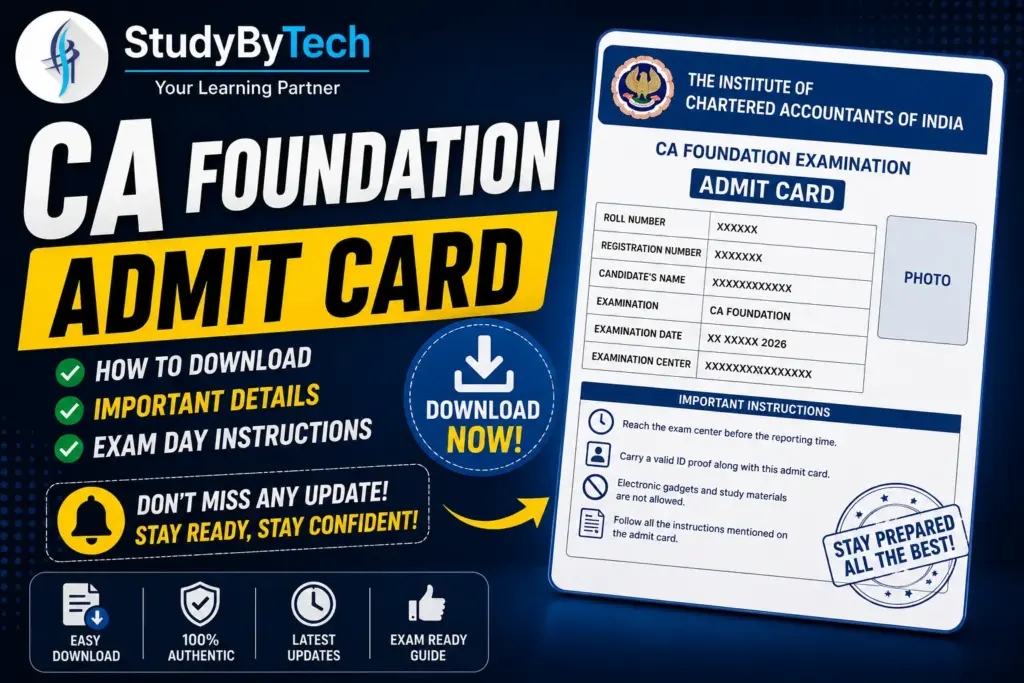
CA Foundation Admit Card Sept 2026: Things You Should Not Miss!

📌 Key Takeaways – CA Foundation Admit Card 2026 Important dates, download steps, and error correction for ICAI Sept 2026 exam 1 📅 Important Dates – CA Foundation Sept 2026Admit Card Release: August 2026 (two weeks before exam)Exam Dates: September 2, 5, 7, and 9, 2026 2 ⬇️ How to Download – Step-by-StepVisit ICAI official website → Login with Registration ID & Password → Click on ‘CA Foundation Admit Card’ link → Download & save. Forgot password? Use ‘Forgot Password’ link with email or registration number. 3 ✅ What to Check & How to Fix ErrorsVerify: Name, photo, signature, registration number, exam center, medium.Corrections allowed for: Exam city, group, medium, syllabus – no fee charged. Contact ICAI helpdesk or use SSP portal. 🏛️ Official Website: icai.org / eservices.icai.org 📄 Subjects: Accounts, Law, Maths, Economics ⚠️ Required at Exam: Admit Card + Valid ID Proof ICAI will release the CA Foundation Sept 2026 admit card online on its official website. Candidates would be able to download the CA Foundation admit card for Sept 2026 session from the official websiteCandidates must login with their registration number and password in order to download the CA Foundation Sept 2026 admit card. Important Things To Take Care About Your Admit Card CA Foundation 2026 Admit Card – Important Dates EVENTS Dates (2026 Session ) CA Foundation admit card release date 2026 August 2026, Two weeks before exam date CA Foundation 2026 exam date Sept 2, 5, 7, and 9, 2026 How To Download CA Foundation Sept 2026 Admit Card? Candidates can follow the steps given below to download the admit card for CA Foundation 2026: Important Details To Check In ICAI Admit Card Candidates should carefully check the following details mentioned in the admit card of CA Foundation 2026: How to Retrieve the ICAI password? In case a candidate forgets the login credentials and password, they have the option to create a new password. Candidates can then download the admit card of CA Foundation by following the steps given below: Option 1 – Set login credentials using email, enter email ID, registration number, mobile number, security question and answer and click on submit. Option 2 – Login using credentials such as CA Foundation registration number, Date of birth, security question and answer and click on the submit button. Option 3 – Candidates can also choose the option to find their login credentials using (SRN + Barcode + PIN), enter the registration number, exam application barcode number and personal identification number and click on submit. Steps to Rectify Errors in CA Foundation Admit Card In case of any error in the CA Foundation hall ticket, candidates should follow the steps given below: Important Instructions: Tips for success Conclusion Your admit card is not just a piece of paper; it is a symbol of your resilience and ambition. It is a reflection of your unwavering commitment to your dreams and aspirations. So, as you step into the examination hall, carry your admit card with pride and confidence, knowing that you have what it takes to succeed. Enroll in Our CA Foundation Classes FAQ’s

ca foundation subjects
Blog, CA Foundation

Subjects in CA Foundation 2026- Marks & weightage

📌 Key Takeaways – CA Foundation 2026 Subjects What you need to know about the new ICAI scheme 1 4 Papers, 400 MarksCA Foundation 2026 includes Paper 1: Accounting (Subjective, 3 hrs), Paper 2: Business Law (Subjective, 3 hrs), Paper 3: Quantitative Aptitude (Objective, 2 hrs), and Paper 4: Business Economics (Objective, 2 hrs). 2 Paper-wise Weightage HighlightsAccounting: Partnership & Final Accounts (30-40%) | Law: Contract Act (25-30%) | Maths: Time Value & Calculus (30-50%) | Economics: Production, Demand & Markets (35-40%) 3 Exam Pattern & MarkingSubjective papers (1 & 2): No negative marking | Objective papers (3 & 4): 1/4 mark deducted per wrong answer. First CA Foundation exam under new scheme: September 2025. 📚 Total Papers: 4 🎯 Total Marks: 400 ⏱️ Paper 1&2 Duration: 3 hours each ⏱️ Paper 3&4 Duration: 2 hours each 📅 First New Exam: Sep 2025 CA Foundation Exam 2026 The CA Foundation exam is a gateway to the prestigious Chartered Accountancy profession in India. The exam is conducted by the Institute of Chartered Accountants of India (ICAI) for students who have completed Class 12th and are aspiring to become Chartered Accountants.Embarking on the journey to become a Chartered Accountant (CA) the CA Foundation exam marks the beginning of this path. In the year 2026, aspiring CAs will delve into a range of subjects, laying the foundation for their future success. Let’s explore the subjects offered in CA Foundation 2026 and how StudyByTech , led by Parag Gupta sir who has an experience of more than 20 years in teaching CA students, full guidence of subjects in CA Foundation 2026 Detailed CA Foundation September 2026 Syllabus – Under New Scheme The CA Foundation exam, conducted by the Institute of Chartered Accountants of India (ICAI), covers a wide range of subjects to test the knowledge and skills of aspiring Chartered Accountants. The subjects included in the CA Foundation exam 2026 are: These subjects are designed to provide a strong foundation in accounting, law, mathematics, statistics, economics, and business knowledge to the candidates. It is important for candidates to thoroughly study and understand these subjects to pass the CA Foundation exam Paper 1 – Accounting subjective: TOPICS SUB TOPICS THEORETICAL FRAMEWORK 1 Meaning and Scope of Accounting.2 Accounting concepts, principles and conventions.3 Capital and revenue expenditure, capital and revenue receipts, contingent 4 assets and contingent liabilities.5 Accounting Policies.6 Accounting as a measurement discipline – valuation principles, accounting 7 estimates. Accounting Standards-concepts and objectives. ACCOUNTING PROCESS 1 Recording accounting transactions: principles of double entrybook-keeping, books of original entry-journal,subsidiary books,cash book, ledger-format,posting from journals and subsidiary books,balancing accounts.2 Preparation Of Trial Balance.3 Rectification Of Errors Depreciation and Amortisation Tangible and intangible assets- meaning & difference, concepts,methods of computation and accounting treatment of depreciation/amortisation,change in depreciation method Bills of Exchange and Promissory Notes Meaning of bills of exchange and promissory notes and their accounting treatment; accommodation bills. Preparation of Final accounts of Sole Proprietors Elements of financial statements, closing adjustment entries, trading account,profit and loss account and balance sheet of manufacturing and non- manufacturing entities Financial Statements of Not-for-Profit Organizations Significance and preparation of receipt and payment account, income and expenditure account and balance sheet, difference between profit and loss account and income and expenditure account Accounts from Incomplete Records (excluding preparation of accounts based on ratios). – Partnership And LLP Accounts 1 Final accounts of partnership firms and LLP.2 Admission, retirement and death of a partner including treatment of goodwill.3 Dissolution of partnership firms and LLPs including piecemeal distribution of assets Bank Reconciliation Statement Introduction, reasons and preparation of bank reconciliation statement Inventories Meaning, basis and technique of inventory valuation, cost of inventory, net realisable value and record system Company Accounts 1 Definition Of Shares And Debentures. 2 Issue Shares And Debentures,forfeiture of shares,reissue of forfeited shares. 3 Redemption of preference shares and debentures(excluding purchase and redemption of own debentures sinking fund method). 4 Accounting For Bonus Issue And Right Issue. Paper 2: Business Laws subjective TOPICS SUB TOPICS Indian Regulatory Framework Major Regulatory Bodies such as the Ministry of Finance, Ministry of Corporate Affairs, SEBI, RBI, IBBI, Ministry of Law and Justice, etc. The Indian Contract Act, 1872 General Nature Of Contract, Consideration, Other essential elements of a valid contract,Performance Contract,Breach Of Contract, Contingent and Quasi Contract, Contract of Indemnity and Guarantee, Contract of Bailment and Pledge, Contract of Agency The Sale of Goods Act, 1930 Formation of the contract of sale, Conditions and Warranties,Transfer of ownership and Delivery of goods,Unpaid seller and his rights. The Indian Partnership Act, 1932 General Nature of Partnership, Rights and Duties of partners, Reconstitution of firms, Registration and Dissolution of a firm The Limited Liability Partnership Act, 2008 Introduction-covering nature and scope, Essential features, Characteristics of LLP, Incorporation and Differences with other forms of organisations The Companies Act, 2013 Essential features of company, Corporate veil theory, Classes of companies,Types of share capital, Incorporation of company, Memorandum of Association, Articles of Association, Doctrine of Indoor Management The Negotiable Instruments Act, 1881 Meaning of Negotiable Instruments, Characteristics, Classification of Instruments, Different provisions relating to Negotiation, Presentment of Instruments, Rules of Compensation Paper 3: Business Mathematics Objective: TOPICS SUB TOPICS Part A: Business Mathematics Ratio and proportion, Indices and Logarithms Ratio and proportion, Indices and Logarithms Equations Linear Equations Upto Three Variables, Quadratic and Cubic equations in one variable. Applications in Business Related Problems. Linear Inequalities Linear Inequalities in one and two variables and the solution space Mathematics of Finance ◦ Simple Interest◦ Compound Interest◦ Nominal and Effective Rate of Interest◦ Present Value◦ Net Present Value◦ Future Value◦ Perpetuity◦ Annuities◦ SinkingFunds◦ Calculating EMICalculations of Returns:Nominal and Effective rate of ReturnCompound Annual Growth Rate(CAGR) Permutations and Combinations Basic concepts of Permutations and combinations: Introduction, the factorial, permutations, results, circular permutations, permutations with restrictions, Combinations With standard results Sequence and Series Introduction Sequences, Series, Arithmetic and Geometric progression,RelationshipbetweenAMandGMandSumofntermsofspecialseriesand BusinessApplications Sets, Relations, and Functions. Basics of Limits and Continuity Functions Basic applications of Differential and Integral calculus in Business and Economics (Excluding the trigonometric applications)

CA Foundation Accounts 2026_ Complete Guide for Beginners
Blog, CA Foundation, CA Foundation Accounts

Ultimate Guide to CA Foundation Accounts: Syllabus, Chapter Weightage, Preparation Strategy & Best Coaching 🎯 Your complete roadmap to CA Foundation Accounts (Paper 1) — From syllabus to exam strategy and best coaching. Everything you need to score 60+ or get an exemption. 📑 Table of Contents Overview & Syllabus 1. What is CA Foundation Accounts? 2. Syllabus & Marks Allocation 3. Chapter Analysis in Detail Strategy & Revision 4. Proven Preparation Strategy 5. 7-Day Revision Strategy 6. Common Errors to Avoid 7. Best Recommended Books Coaching & Final Push 8. Learn From the Best Faculty FAQ Frequently Asked Questions ⭐ Key Takeaways Paper 1: Accounting — 100 Marks, Descriptive/Subjective exam. Exam Duration: 3 hours + 15 minutes reading time. No negative marking. Passing Requirement: Minimum 40 marks in Accounts & 50% aggregate overall. High-Weightage Modules: Special Entities & Final Accounts (35-40%), Theoretical & Basic Process (25-30%). Key to Success: Conceptual understanding + Step-wise working notes + Time management. Common Mistakes: Skipping reasons for True/False, ignoring narrations, not covering theory. Best Faculty: CA Sonika Jain Ma’am is highly recommended for her concept clarity and answer writing guidance. Study Resources: ICAI Study Material, RTPs, MTPs, and Past 5 Years’ Suggested Answers are gold. 1. What is CA Foundation Accounts? CA Foundation Accounts is Paper 1 of the CA Foundation exams. It is a 100 marks descriptive or subjective exam that assesses your knowledge regarding accounting basics, double entry system, financial statements, and entity accounting. Feature Details Exam Format Descriptive (Subjective / Written) Total Marks 100 Marks Duration 3 Hours (+15 Minutes Reading Time) Negative Marking None (Descriptive paper) Passing Requirement Minimum 40 Marks (50% aggregate overall) Primary Focus Conceptual understanding + Step-wise working notes 2. CA Foundation Accounting Syllabus and Marks Allocation per Chapter According to the ICAI New Scheme, the ca foundation accounts syllabus includes concept and numerically correct framework. Module / Topic Covered Chapters Expected Weightage Module 1: Theoretical & Basic Process Theoretical Framework, Accounting Process, BRS, Inventories, Depreciation 25% – 30% (25 – 30 Marks) Module 2: Accounting for Special Transactions Bills of Exchange, Consignment, Average Due Date, Account Current 15% – 20% (15 – 20 Marks) Module 3: Special Entities & Final Accounts Final Accounts of Sole Proprietors, NPO, Partnership & LLP Accounts 35% – 40% (35 – 40 Marks) Module 4: Corporate Accounting Issue, Forfeiture & Re-issue of Shares, Issue of Debentures 15% – 20% (15 – 20 Marks) 3. Chapter Analysis in Detail: What to Expect in the Exam 1. Theory and Accounting Process True/False Question (12 Marks): The very first question in your test paper would be 6 True/False questions of 2 marks each. Some reasoning would be required to get full marks in this question. Accounting Concepts and Accounting Convention: The most important topics under this would be Accounting Principle, Capital or Reward Expenditures and Contingent Assets and Liabilities. 2. Bank Reconciliation Statement and Inventories Statement of Bank Reconciliation: Understand the concept of the Preparation of the Statement of Bank Reconciliation with the help of the Cash Book and Passbook using the Normal and Modified Cash Book Method. Inventory and Depreciation: FIFO, Weighted Average Valuation, Straight Line and Diminishing Balance Methods. 3. Special Entries (Partnership, NPO, Final Accounts) Partnership Accounts: Partners’ admission, retirement, death and calculation of goodwill. Non-Profit Organizations (NPO): Preparation of Income and Expenditure account and Balance sheet from Receipts and Payments Account. Final Accounts: Adjustment to outstanding and prepaid expenses, provision for bad debts and Manager’s Commission. 4. Company Accounts There is a lot of emphasis on forfeiting and issuing of shares, pro rata calculations and journal entries for debenture issuance. 4. Proven Preparation Strategy for CA Foundation Accounts Whether you are starting from scratch or doing a final review, following a structured preparation plan guarantees top performance. 📚 Phase 1: Conceptual Building ICAI Study Material & Formats ✍️ Phase 2: Master Working Notes Focus on Presentation Standards 📝 Phase 3: Practice Past Papers Solve Last 5 Years’ RTPs, MTPs & Past Exam Papers 🎯 Phase 4: Final Revision Follow the 7-Day Final Revision Strategy 📊 1. Concentrate on Working Notes & Format ICAI provides step marks for descriptive accounting answers. Proper journal entries, narrations, T-accounts in ledgers and working notes numbered at the end of each numerical answer should always be included. ⏱️ 2. Time Management within the 3-hour Exam First 15 Minutes – Reading: Read the whole paper and select the questions which you are able to answer perfectly. Start answering either with Question 1 (True/False & Theory) or any other numerical question which you find easy. 1.8 Minutes Rule: 1.8 minutes per mark (A 10-mark question takes 18 minutes to solve). 🧮 3. Be Fast with Your Calculator Be fast in using your memory keys (M+, M-, MRC) to solve inventory and partnership questions to save time. 5. Ultimate 7-Day Revision Strategy for CA Foundation Accounts If you have one week left before your exam, use this targeted daily revision roadmap to maximize your score: Day Focus Area / Topics Key Action Items Day 1 Company Accounts & NPO Solve 5 complex pro-rata share forfeiture & NPO questions Day 2 Partnership Accounts Practice admission, retirement, and death adjustments Day 3 Final Accounts & BRS Review key adjustments & amended cash book BRS methods Day 4 Inventories, Depreciation & Special Transactions Revise Bills of Exchange, Consignment & Valuation formulas Day 5 Theoretical Framework & True/False Statements Revise all past 5 years’ True/False statements with reasons Day 6 ICAI RTP & MTP Practice Solve latest Revision Test Paper and 1 Mock Test Paper Day 7 Formula Sheet & Format Quick Review Light revision of working note formats and calculator tricks 6. CA Foundation Accounts – Common Errors to Be Avoided Be careful of the following mistakes which can lead to losing important marks: ❌ Not Giving Reasons for True/False Statements ✅ Writing “True” or “False” without providing reasons will fetch zero marks. ❌ Ignoring Journal Narrations ✅ Not including journal narrations (Being…) can lead to a loss of

ca foundation full course for sept & jan attempt 2026- 2027
Blog, CA Foundation

CA Foundation: Full Course 2026

CA Foundation Full Course– Complete Guide for Students Preparing for Sept 26 & Jan27 Attempts <figure> <img width="1536" height="1024" src="https://www.paraggupta.com/wp-content/uploads/chatgpt-image-may-14-2026-04_44_05-pm.webp" alt="ca foundation full course for sept &amp; jan attempt 2026- 2027" srcset="https://www.paraggupta.com/wp-content/uploads/chatgpt-image-may-14-2026-04_44_05-pm.webp 1536w, https://www.paraggupta.com/wp-content/uploads/2023/11/chatgpt-image-may-14-2026-04_44_05-pm-300×200.webp 300w, https://www.paraggupta.com/wp-content/uploads/2023/11/chatgpt-image-may-14-2026-04_44_05-pm-1024×683.webp 1024w, https://www.paraggupta.com/wp-content/uploads/2023/11/chatgpt-image-may-14-2026-04_44_05-pm-768×512.webp 768w, https://www.paraggupta.com/wp-content/uploads/2023/11/chatgpt-image-may-14-2026-04_44_05-pm-600×400.webp 600w" sizes="(max-width: 1536px) 100vw, 1536px" /> <figcaption></figcaption> </figure> <!– KEY TAKEAWAYS SECTION – CA FOUNDATION FULL COURSE 2026 –></p><h3 style="margin: 0 0 8px 0; color: #1a2a6c; font-size: 24px;">📌 Key Takeaways – CA Foundation Full Course 2026</h3><p style="margin: 0 0 20px 0; color: #555; border-bottom: 2px solid #fdbb4d; display: inline-block; padding-bottom: 5px;">What you get when you enroll with StudyByTech 1Complete 4-Subject CoverageAll subjects from basic to advanced: Principles & Practice of Accounting, Business Laws, Quantitative Aptitude (Maths, LR & Statistics), and Business Economics. 100% aligned with ICAI pattern.2Live + Recorded Classes with Test SeriesAttend live interactive classes and watch recorded lectures for revision. Includes weekly tests, subject-wise tests, full syllabus mock tests, and performance tracking.3Beginner-Friendly + Exam-Oriented ApproachStep-by-step teaching for beginners (including students weak in Maths/Accounts). Focus on concept application, PYQ practice, ICAI pattern MCQs, time management, and writing practice for Law. 🎯 Target Exams: Sept 2026 & Jan 2027📅 Best Time to Join: Immediately after Class 12📞 Contact: +91 9968875529 💡 Recommended Study Plan: Daily 4-6 focused hours | One practical + one theory subject daily | Weekly revision | Monthly mock tests Preparing for the CA Foundation exam is not just about studying hard — it’s about studying smart with the right guidance, strategy, and consistency. Whether you are starting your CA journey after Class 12 or switching from self-study to structured preparation, choosing the right CA Foundation full course can make a huge difference in your results. At StudyByTech, we understand what CA students actually struggle with — backlog, confusion in Law, fear of Maths, lack of revision, and not knowing how to manage all four subjects together. That’s why our CA Foundation Full Course 2026 is designed for complete beginners as well as repeaters who want proper conceptual clarity, regular practice, mentorship, and exam-oriented preparation. Unlike many platforms that focus only on completing lectures, our focus is on helping students stay consistent till the final ICAI exam. Why Students Choose a CA Foundation Full Course Instead of Individual Subjects Many students start preparing subject-wise from YouTube or different faculties. Initially, it feels manageable, but after a few weeks, most students face: Lecture backlog No proper study routine Lack of revision planning Confusion between multiple teachers No accountability Weak test practice A structured CA Foundation full course solves these problems because everything is planned in one place. According to Physics Wallah CA Foundation Batches, students commonly struggle with choosing the right batch, managing multiple subjects, and staying consistent throughout preparation. What You Get in StudyByTech CA Foundation Full Course 2026 Complete Coverage of All 4 Subjects The course includes complete preparation for: Principles & Practice of Accounting Business Laws Quantitative Aptitude (Maths, LR & Statistics) Business Economics Every subject is taught from basic to advanced level so even beginners can understand concepts easily. Live + Recorded Classes Students can attend live interactive classes and also watch recorded lectures for revision or backlog coverage. This helps students who: Go to school/college Miss live classes Need extra revision before exams Demo Classes- Click Here Concept Clarity + Exam-Oriented Preparation The CA Foundation exam is not just theoretical. ICAI focuses heavily on: Concept application Presentation MCQs Time management Our teaching approach focuses on: Practical understanding PYQ practice ICAI pattern questions Mock tests Writing practice for Law Regular Tests & Performance Tracking Consistency is one of the biggest reasons students fail CA Foundation. That’s why regular: Weekly tests Subject-wise tests Full syllabus mock tests Performance analysis are included in the course. Even top coaching platforms emphasize weekly practice tests and continuous evaluation because they help students identify weak areas early. Best Time to Join CA Foundation Full Course 2026 The earlier you start, the better your preparation becomes. If You Are Targeting September 2026 Attempt Start immediately after Class 12 boards or as early as possible. If You Are Targeting January 2027 Attempt You can prepare comfortably with proper revision cycles and mock test practice. Students who start early usually get: Better revision time Less stress Stronger concepts More mock test exposure Online vs Offline CA Foundation Coaching – Which Is Better? Today, most CA students prefer online coaching because of flexibility and affordability. Benefits of Online CA Foundation Classes Learn from home Save travel time Watch recordings anytime Affordable fees Access from any city However, success in online coaching depends heavily on: Discipline Proper mentorship Test practice Doubt solving That’s why StudyByTech combines online flexibility with structured guidance. Common Mistakes CA Foundation Students Make 1. Ignoring Revision Students keep watching lectures but never revise properly. 2. Studying Without Tests Mock tests are extremely important for ICAI exams. 3. Fear of Maths & Law Most students avoid difficult subjects instead of improving gradually. 4. Depending Only on Free Content Free content helps initially, but structured preparation becomes necessary later.On Reddit, many CA students discussing online batches mention that backlog management and consistency become major issues during preparation. How to Prepare for CA Foundation Along with School or College Many students preparing for CA Foundation are also handling: Class 12 studies B.Com Regular college Here’s a simple strategy: Daily 4–6 focused study hours One practical + one theory subject daily Weekly revision day Monthly mock tests Avoid lecture backlog Consistency matters more than studying 14 hours randomly. Why StudyByTech for CA Foundation Full Course 2026? Student-Focused Learning We focus on: Concept clarity Doubt solving Exam strategy Revision planning Student mentorship Beginner-Friendly Teaching Even students weak in Maths or Accounts can understand concepts easily with step-by-step explanation. Affordable & Accessible Our aim is to provide quality CA coaching accessible to students across India. Regular Motivation & Guidance CA preparation is a long journey. Proper guidance and accountability help students stay consistent. Final Thoughts CA Foundation is the first step toward becoming a Chartered

Blog, CA Foundation

Objectives of Accounting Simplified I CA Foundation Accounts

Objective Of Accounting Simplified Introduction Accounting is a crucial aspect of the business world, often seen as the “language of business.” As you prepare for the CA Foundation Accounts exam in May 2024, understanding the objectives of accounting is essential. ICAI study material is one of the most important resources of knowledge that no CA Foundation student should ignore. Let’s break down these objectives in simple terms to help you grasp the fundamentals, Simplified I CA Foundation accounts I May 24. Objective 1: Systematic Recording of Transactions The primary goal of accounting is to keep a well-organized record of all financial transactions that occur in a business. This process, often called bookkeeping, involves writing down every money-related activity. Later, these records are sorted and summarized logically to create financial statements, which help in understanding the financial health of the business. Objective 2: Knowing Business Profits and Losses Accounting helps us figure out if a business is making money or losing it. Accountants prepare something called a profit and loss account. If the money earned (revenue) is more than the money spent (expenses), the business is making a profit. But if expenses exceed revenue, it’s running at a loss. This account helps the management and stakeholders make wise decisions. For example, if a business isn’t profitable, they can investigate the reasons and take corrective actions. Objective 3: Understanding the Financial Position Business owners don’t just want to know if they’re making money; they also want to know what they owe (liabilities) and what they own (assets) at a specific point in time. To get this information, accountants create a financial statement called a Balance Sheet. It’s like a snapshot of the business’s financial health at a particular moment. Objective 4: Providing Information for Decision-Making Accounting is often called the “language of business” because it communicates a company’s financial results to various people, such as investors and managers, through financial statements. These financial statements help decision-makers make informed choices based on the company’s financial performance. Objective 5: Assessing Solvency By preparing the balance sheet, management not only reveals what the company owns and owes but also assesses the business’s ability to meet its short-term (liquidity) and long-term (solvency) obligations when they become due. This helps in understanding whether the company can pay its bills now and in the future. Conclusion These simplified explanations of the objectives of accounting are essential not only for the CA Foundation Accounts exam but for your understanding of accounting in the real world. Remember, accounting is not just about numbers; it’s a powerful tool for making informed decisions and ensuring the financial well-being of a business. Mastering these objectives will set you on the right path to becoming a proficient accountant or finance professional, Simplified I CA Foundation Accounts I May 24. We sincerely hope you enjoy reading our blog. To help CA students from all over India, we offer BOTH ONLINE & OFFLINE classes. Enrol in our latest CA Foundation course, where all of our faculty members have the greatest professional qualifications & extensive experience, to learn more about the topics or to attend additional classes about CA Foundation Accounts under the New course valid from June 2024 exams onwards, join for more daily information on the WhatsApp channel

Blog, CA classes, CA Foundation

Understanding the Indian Contract Act, 1872: Meaning, Nature, and Scope

Introduction The Indian Contract Act, 1872 is a foundational piece of legislation that governs contracts and agreements in India. It provides a legal framework for individuals and entities to enter into agreements, which are crucial in everyday life, business, and commerce. ICAI study material is one of the most important resources of knowledge that no CA Foundation student should ignore. In this blog, we will delve into the meaning, nature, and scope of the Indian Contract Act, as outlined in the ICAI book used by students, while also providing additional insights and explanations. What is Indian Contract Law, 1872? The Indian Contract Act, 1872, is a significant piece of legislation in India that defines the rules and principles governing contracts, serving as the cornerstone of contract law in the country. The Indian Contract Act, 1872, defines and outlines the rules and principles that govern contracts. It addresses various elements of a valid contract, such as offer and acceptance, consideration, free consent, lawful object, and the capacity of parties to contract. It also deals with different types of contracts, including contracts of sale, contracts of agency, and contracts for services. The Basics of a Contract The Indian Contract Act, as stated in Section 10, defines a contract as an agreement made by free consent between parties competent to contract, for lawful consideration, with a lawful object, and not expressly declared to be void. This definition encapsulates the fundamental elements that must be present for an agreement to be legally binding. However, it’s important to note that the Act contains other requirements and principles that further refine the scope of a valid contract. 1. Two Parties One of the fundamental requirements for a contract is the involvement of at least two parties, where one party makes an offer, and the other party accepts it. This principle ensures that contracts involve distinct individuals or entities. For example, in a contract of sale, there must be a seller and a buyer, as a person cannot buy their own goods. This principle helps maintain the integrity and legality of contracts. 2. Intention to Create Legal Obligations For an agreement to qualify as a contract, both parties must have the intention to create a legal relationship. Social or domestic agreements, that lack this intention, are not enforceable in a court of law and, therefore, do not constitute contracts. For instance, an agreement between a husband and wife for maintenance may not be legally enforceable because the parties did not intend to create a legal relationship. 3. Other Formalities While contracts can be either written or spoken, certain contracts require specific formalities to be legally enforceable. For example, insurance contracts are generally valid only in writing. Additionally, some agreements, such as those involving immovable property, may need to be registered in compliance with relevant laws. These formalities ensure that certain types of agreements are executed with the appropriate level of documentation and oversight. 4. Certainty of Meaning A valid contract requires that the terms of the agreement be clear and definite. Vague or indefinite agreements are not legally binding. For example, an agreement to sell “a hundred tons of oil” without specifying the type of oil lacks the necessary certainty to be considered a valid contract. This requirement helps prevent disputes arising from ambiguities in contract terms. 5. Possibility of Performance The terms of an agreement should be capable of being performed. Agreements that involve actions that are impossible to perform are not enforceable as contracts. For instance, an agreement to find treasure using magic cannot be enforced because it is impossible to perform. This principle ensures that contracts are rooted in practicality and reason. SCOPE OF CONTRACT LAW: The entirety of the agreement is covered by the contract’s extension. Contracts might be little or large in value, and they can take many different forms. While some contracts have lengthy terms, some have shorter ones. Contractual content also varies according to how it is intended to be used. There are many facets to commercial law, and it might be difficult to define each one in detail. Commercial law generally requires a great deal of research, mostly on contracts, sales of goods, taxes, insurance, and leasing, among other topics. The basic parameters of the contract are established during the identification phase. Certain projects may fall under different contract scopes and have unique developmental and managerial linkages. As a result, other parties engaged may receive additional duties or services. For example, a hospital-related project can involve offering clinical services. In addition to deciding whether to offer extra services like cleaning and catering, in addition to its maintenance services, the hospital must also consider whether to assign clinical services to a commercial partner. The services that fall under the purview of the contract must also be specified by the hospital. Additionally, expertise in contracts encompasses a number of areas, such as- Club membership agreements Domestic or marriage agreements Unformed contractsfully executed contracts Conclusion The Indian Contract Act of 1872 plays a pivotal role in regulating agreements and contracts in India, providing a legal framework that upholds the principles of free consent, lawful consideration, lawful object, and the absence of express voidness. Additionally, it incorporates the essential elements discussed in the ICAI study material: the involvement of two parties, the intention to create legal obligations, the observance of required formalities, the certainty of terms, and the possibility of performance. These principles collectively define the meaning, nature, and scope of contracts under the Act, ensuring that agreements in India adhere to legal standards and maintain the integrity of commerce and relationships. We sincerely hope you enjoy reading our blog. To help CA students from all over India, we offer both online and offline classes. Enroll in our latest CA Foundation course, where all of our faculty members have the greatest professional qualifications & extensive experience, to learn more about the topics or to attend additional classes about CA Foundation Law under the New course valid from June 2025 exams onwards.

ca foundation fees for sept & jan 2025 -26
Blog, CA Foundation

CA Foundation Fees 2026

CA Foundation Fees 2026 In our quest to provide you with the most accurate and up-to-date information, we are proud to present a comprehensive guide on the CA Foundation Fees for the year 2026. If you’re considering pursuing a career in chartered accounting, it’s crucial to be well-informed about the financial aspects involved. In this article, we break down the CA Foundation fee structure, helping you plan your educational journey effectively.  Introduction to CA Foundation The CA Foundation program is the first step in your journey to becoming a chartered accountant. Before we delve into the details of the fees, let’s briefly understand what the CA Foundation is all about. This program comprises four papers that test your knowledge in various subjects like accounting, business law, business economics, and quantitative aptitude.  CA Foundation Course Fees  When it comes to pursuing a professional course like CA Foundation, understanding the fee structure is of utmost importance. For the year 2026, we at StudyByTech are providing great discounts for the CA Foundation course. Our fees are as follows: Mode Fees Offer Fees CA Foundation All subjects: Face-to-Face (Sept & Jan 2025-26 attempt) Rs 3̶5̶,0̶0̶0̶/-̶ Rs. 28,000/- CA Foundation All Subjects: Online Batch Rs. 2̶5̶,0̶0̶0̶/-̶ Rs. 20,000/- Per Subject Rs. 1̶0̶,0̶0̶0̶/-̶ Rs. 7,000/- For any further discounts, kindly contact us at +91 9968875529 and get the details about the further discounts and possibilities for the discount. Cost of Study Materials To excel in the CA Foundation examinations, you will require high-quality study materials. The cost of study materials can vary depending on your choice of coaching institute or self-study route. On average, candidates can expect to spend around Rs. 7,000 on each subject. Although ICAI provides his own study material, which is included in CA Foundation registration fees, these books are delivered to the student’s shipping address or correspondence address once the registration is confirmed. Merit Scholarships The Institute of Chartered Accountants of India (ICAI) offers merit scholarships to deserving candidates. If you meet the eligibility criteria, you could be eligible for a scholarship that covers a significant portion of your CA Foundation fees. Studybytech: Your Partner in CA Foundation Preparation For those seeking high-quality CA Foundation classes and resources, Studybytech is your go-to solution. Studybytech is a renowned institute specializing in CA exam preparation. They offer comprehensive classes, study materials, and expert guidance to help you excel in your CA Foundation journey, followed by CA Inter and Final levels. All faculties here are well-deserved and well-experienced. Conclusion In conclusion, understanding the CA Foundation fees for 2026 is essential for anyone considering this prestigious profession. It’s crucial to plan your finances effectively to ensure a smooth journey through the CA Foundation program. Remember that while fees are a significant factor, the rewards of becoming a chartered accountant far outweigh the investment. We hope this article has provided you with the detailed information you were seeking. To stay updated on any changes or updates to the fee structure, it’s advisable to visit the official website of the ICAI or consult with Studybytech, a registered coaching institute. If you’re committed to your goals, the CA Foundation is a worthwhile investment in your future as a chartered accountant.

 CA Foundation New Syllabus
CA Foundation

 CA Foundation New Syllabus

CA Foundation Classes ICAI Registration Process Subjects, Syllabus & Exam Pattern Admit Card Exam Dates Exam Tips About the faculties FAQ Aspiring Chartered Accountants need more than just academic expertise to succeed in the constantly changing financial industry; they also need a curriculum that is up-to-date. The CA Foundation course material is applicable here. In this blog post, we’ll go over the key components of the CA Foundation course outline and introduce you to StudyByTech, a business that specializes in offering excellent CA training. We are also excited to announce that StudyByTech is already accepting applications for its class of 2026 CA Foundation students!  CA Foundation New Syllabus The following papers have been added to the CA Foundation 2026 syllabus under the New ICAI Scheme:  Detailed CA Foundation Syllabus Under New Scheme 2026 Paper 1 Accounting Objective: To develop an understanding of the basic concepts and principles of accounting and apply the same in preparing financial statements and simple problem-solving. Topics Sub Topics Theoretical Framework Recording accounting transactions: principles of double entry bookkeeping, books of original entry journal, subsidiary books, cash book, ledger format, posting from journals and subsidiary books, balancing accounts.Preparation of the Trial BalanceRectification Of Errors Accounting Process Recording accounting transactions: principles of double entry bookkeeping, books of original entry journal, subsidiary books, cash book, ledger format, posting from journals and subsidiary books, balancing accounts.Preparation of the Trial BalanceRectification Of Errors Bank Reconciliation Statement introduction, reasons, and preparation of bank reconciliation statement Inventories Meaning and Scope of Accounting concepts, principles, and conventions.Capital and revenue expenditure, capital and revenue receipts, contingent assets, and contingent liabilities accounting Policies.Accounting as a measurement discipline – valuation principles, accounting estimates. Accounting Standards-concepts and objectives. Depreciation and amortization Tangible and intangible assets: meaning & difference, concepts, methods of computation and accounting treatment of depreciation and amortization, change in depreciation method Bills of Exchange and Promissory Notes Meaning of bills of exchange and promissory notes and their accounting treatment; accommodation bills Preparation of Final accounts of Sole Proprietors Elements of financial statements, closing adjustment entries, trading account, profit and loss account, and balance sheet of manufacturing and non-manufacturing entities Financial Statements of Not-for-Profit Organizations Meaning, basis and technique of inventory valuation, cost of inventory, net realisable value, and record system Accounts from Incomplete Records (excluding preparation of accounts based on ratios) Partnership And LLP Accounts Significance and preparation of receipt and payment account, income and expenditure account, and balance sheet; difference between profit and loss account, and income and expenditure account Company Accounts (definition of shares and debts)Issue shares And debts; forfeiture of shares, reissue of forfeited sharesRedemption of preference shares and debentures (excluding the purchase and redemption of own debentures by the sinking fund method)Accounting for Bonus Issue and Right Issue Paper 2 Business Law Objective: To develop general legal knowledge of the law of Contracts and sales and an understanding of various forms of businesses and their functioning to regulate the business environment and the ability to address basic application-oriented issues Topics Sub-Topics Indian Regulatory Framework Major Regulatory Bodies such as the Ministry of Finance, Ministry of Corporate Affairs, SEBI, RBI, IBBI, Ministry of Law and Justice, etc. The Indian Contract Act, 1872 General Nature Of Contract, Consideration, Other essential elements of a valid Contract Performance Contract, Breach Of Contract, Contingent and Quasi Contract, Contract of Indemnity and Guarantee Contract of Bailment and Pledge, Contract of Agency The Sale of Goods Act, 1930 Formation of the contract of sale, conditions and warranties, transfer of ownership and delivery of goods, unpaid seller and his rights The Indian Partnership Act, 1932 General Nature of Partnership, Rights and Duties of partners, Reconstitution of firms, Registration and Dissolution of a firm The Limited Liability Partnership Act, 2008 Introduction: covering nature and scope, Essential features, Characteristics of LLP, Incorporation, and Differences with other forms of organizations The Companies Act, 2013 Essential features of company, Corporate veil theory, Classes of companies,  Types of share capital, Incorporation of company, Memorandum of Association, Articles of Association, Doctrine of Indoor Management The Negotiable Instruments Act, 1881 Meaning of Negotiable Instruments, Characteristics, Classification of Instruments, Different provisions relating to Negotiation, Presentation of Instruments, Rules of Compensation Paper 3 Mathematics Objective: To develop an understanding of the basic mathematical and statistical tools and apply the same in business, finance, and economic situations. To develop logical reasoning skills. Topics Sub-Topics Part A: Business Mathematics Ratio and proportion, Indices and Logarithms Ratio and proportion, and Time and work-related problems, Laws of inequalities, Exponents and antilogarithms Equations Ratio and proportion, Time and work-related problems, Laws of inequalities, Exponents and antilogarithms Linear Inequalities Linear Inequalities in one and two variables and the solution space Mathematics of Finance Ratio and proportion, Time and work-related problems, Laws of inequalities, Exponents and antilogarithms Permutations and Combinations Basic concepts of Permutations and combinations: Introduction, factorial, permutations, results, circular permutations, permutations with restrictions, and combinations With standard results Sequence and Series Introduction: Sequences, Series, Arithmetic and Geometric Progression Relationship between AM and GM and Sum of terms of special series and Business Applications Sets, relations, and functions Basics of Limits and Continuity Functions Basic applications of Differential and Integral calculus in Business and Economics (Excluding the trigonometric applications) Part B: Logical Reasoning Number series coding and decoding, odd man out, Direction Tests, Seating Arrangements, Blood Relations Part C: Statistics Statistical Representation of Data Diagrammatic representation of data, Frequency Distribution, Graphical representation of Frequency Distribution—Histogram, Frequency Polygon, Ogive, Pie-chart Sampling Basic principles of sampling theory, Comparison between sample surveys and complete enumerations, some important terms associated with sampling types, sampling errors,  and non-sampling errors Measures of Central tendency and Dispersion Mean Median, Mode, Mean Deviation, Quartiles and Quartile Deviation Standard Deviation, Coefficient of Variation, and Coefficient of Quartile Deviation Probability Independent and dependent events; mutually exclusive events  Total and Compound Probability and Bayes Theorem Theoretical Distributions Measures of Central Tendency and Dispersion Correlation and Regression Scatter diagram, Karl Pearson’s Coefficient of Correlation Rank Correlation, Regression lines, Regression equations, and regression coefficients Index Numbers

Blog, CA Foundation

Mastering the CA Foundation Exam Jan 2025: A Comprehensive Guide

Introduction Welcome to our in-depth guide on mastering the CA Foundation Exam. At StudyByTech, we understand the importance of this critical examination in your journey toward becoming a chartered accountant. Our mission is to equip you with the knowledge, strategies, and resources necessary to excel in the CA Foundation Exam and secure your future in the world of finance. Understanding the CA Foundation Exam The CA Foundation Exam, conducted by the Institute of Chartered Accountants of India (ICAI), is the first stepping stone on your path to becoming a Chartered Accountant. It’s a comprehensive examination designed to assess your understanding of four core subjects: CA Foundation Exam Syllabus Let’s delve deeper into the syllabus to ensure you have a clear understanding of what’s expected in each subject. Principles and Practice of Accounting This section is the cornerstone of the CA Foundation Exam and includes topics such as: Business Laws and Business Correspondence In this part, you’ll need to master the following: Business Mathematics and Logical Reasoning This segment evaluates your mathematical and logical reasoning skills, including: Business Economics The final section covers: Eligibility Criteria to give CA Foundation exams Applicants may apply for the CA Foundation exam if they are enrolled in Class 12 or if they have already passed the exams from any of the 3 streams, i.e. Commerce, Science, or Arts. To know more, read our blog on REGISTRATION PROCESS & ELIGIBILITY CRITERIA for CA Foundation. Passing criteria for CA Foundation exams If a candidate receives at least 40% in each paper in a single sitting and at least 50% overall, the candidate is said to have passed the CA Foundation exam. The Road to Success Now that you have a comprehensive overview of the CA Foundation Exam, let’s outline the roadmap to your success. 1. Thorough Preparation Master each subject by studying from authoritative sources, like ICAI’s study materials and reference books. Practice regularly to reinforce your knowledge. 2. Mock Tests Take advantage of mock tests to assess your progress. Our faculty at StudyByTech offer a collection of sample papers to help you simulate exam conditions and track your performance. Each of your answer sheets is analysed by our experienced faculties and they will provide you with a breakdown of the things 3. Expert Guidance Consider seeking guidance from experienced mentors or enrolling in a coaching program. This can provide valuable insights and strategies to tackle the exam effectively. 4. Time Management Effective time management is crucial. Create a study schedule and stick to it. Allocate sufficient time to each subject based on your strengths and weaknesses. Our faculties at StudyByTech provide a proper study plan to students after analyzing your mock test so that you can maximize your self-study time. 5. Stay Updated Stay informed about the latest updates and changes in the CA Foundation Exam syllabus. Continuous learning is key to success. Conclusion Becoming a chartered accountant is a prestigious achievement that opens doors to a successful career in finance. At StudyByTech, we are committed to helping you excel in the CA Foundation Exam with our experienced faculties. You can enroll in our online as well as offline courses through this link: CA Foundation Course, June 2024 Our detailed guide, combined with your dedication and hard work, will undoubtedly propel you toward your goal. Good luck on your journey to becoming a chartered accountant!

Scroll to Top