CA classes

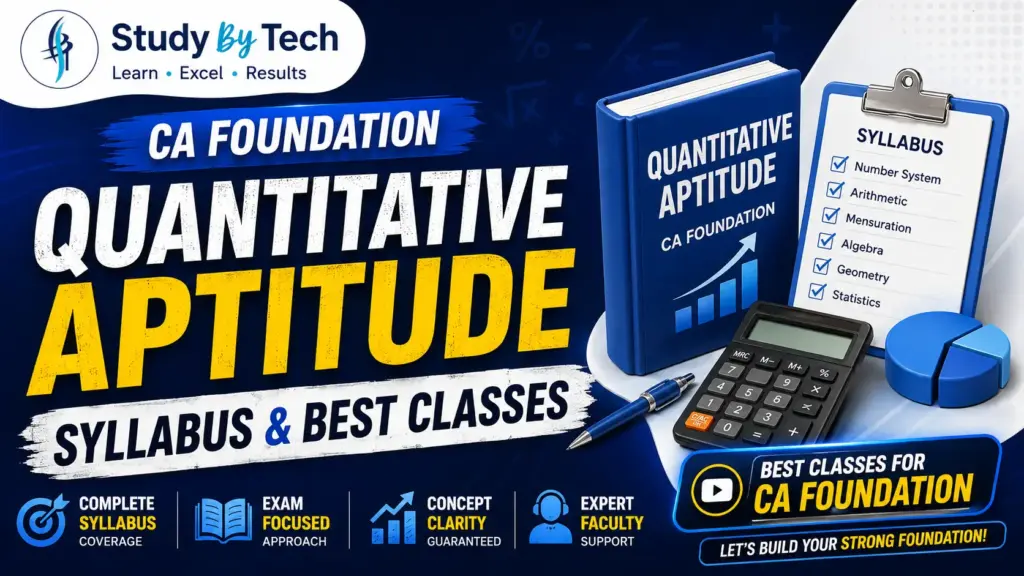
CA Foundation Quantitative Aptitude: Syllabus & Best Classes
Blog, CA classes, CA Foundation

CA Foundation Quantitative Aptitude: Syllabus, Chapter Weightage, Preparation Strategy & Best Coaching 🎯 Your complete roadmap to CA Foundation Quantitative Aptitude (Paper 3) — From syllabus to exam strategy and best coaching. Everything you need to score 60+ or get an exemption. 📑 Table of Contents Overview & Syllabus 1. What is Quantitative Aptitude? 2. Syllabus & Weightage Strategy & Analysis 3. High-Yield Scoring Chapters 4. Step-by-Step Preparation Guide 5. 30-Day Study Plan 6. Handling Negative Marking 7. Best Books & Resources Coaching & Final Push 8. Best CA Foundation Mathematics Classes FAQ Frequently Asked Questions ⭐ Key Takeaways Paper 3: Quantitative Aptitude — 100 Marks, 100 MCQs, 2 Hours. Sections: Business Mathematics (40 Marks), Logical Reasoning (20 Marks), Statistics (40 Marks). Negative Marking: 0.25 mark deducted for every wrong answer. Passing Requirement: Minimum 40% in Paper 3 & 50% aggregate overall. High-Weightage Topics: Time Value of Money (12-16 Marks), Central Tendency & Dispersion (12-14 Marks). Key to Success: Conceptual clarity + Calculator shortcuts + MCQ practice + Smart negative marking strategy. Best Faculty: Nitesh Kumar Sir is highly recommended for his shortcut methods and non-math student-friendly approach. ICAI Material is Gold: Over 80% of questions come from ICAI study modules. 1. What is Quantitative Aptitude of CA Foundation? Quantitative aptitude of CA Foundation is Paper 3 of the CA Foundation exam which is taken out by the Institute of Chartered Accountants of India (ICAI). It tests the mathematical reasoning, logic and analysis ability of the candidate. Parameter Exam Details Paper Title Paper 3: Quantitative Aptitude Exam Mode Objective (Multiple-Choice Questions – MCQs) Total Marks 100 Marks (100 MCQs of 1 Mark Each) Exam Duration 2 Hours (120 Minutes) Negative Marking Yes (0.25 Mark Deducted per Incorrect Answer) Passing Standard Minimum 40% in Paper 3 & 50% Aggregate Overall Calculator Policy Non-Programmable Basic Financial Calculator Allowed 2. CA Foundation Quantitative Aptitude Syllabus and Weight Age in Sections Under the new scheme of ICAI, the ca foundation quantitative aptitude test will be divided into three different sections: Section A: Business Mathematics (40 Marks) Section B: Logical Reasoning (20 Marks) Section C: Statistics (40 Marks) Section Topic / Module Name Sub-Topics & Concepts Covered ICAI Weightage Part A: Business Maths (40 Marks) Ratio, Proportion, Indices & Logarithms Simplification, laws of indices, log properties, ratio applications 8 – 12 Marks Equations & Matrices Linear & quadratic equations, simultaneous equations, matrix operations 8 – 12 Marks Linear Inequalities Inequalities in one and two variables, feasible region solutions 3 – 5 Marks Time Value of Money Simple Interest, Compound Interest, Annuity Future/Present Value, Depreciation, Effective Rate 12 – 16 Marks Permutations & Combinations Factorial notation, fundamental counting principles, arrangements, selections 6 – 8 Marks Sequence & Series Arithmetic Progression (AP) and Geometric Progression (GP) properties and sum terms 6 – 8 Marks Sets, Relations & Functions Set operations, Venn diagrams, domain, range, composite functions 4 – 6 Marks Basic Calculus (Differential & Integral) Basic derivative applications, marginal cost/revenue, standard integration 4 – 6 Marks Part B: Logical Reasoning (20 Marks) Number Series, Coding & Decoding Finding missing terms, odd man out, alphanumeric pattern rules 5 – 6 Marks Direction Tests Spatial awareness, cardinal directions, shortest distance determination 4 – 5 Marks Seating Arrangements Linear and circular seating arrangements, facing inside vs outside 5 – 6 Marks Blood Relations Family tree diagrams, relation decoding, coded relations 4 – 5 Marks Part C: Statistics (40 Marks) Statistical Representation of Data Frequency distribution, histograms, ogives, pie charts, discrete vs continuous data 6 – 8 Marks Measures of Central Tendency & Dispersion Mean, Median, Mode, Standard Deviation, Mean Deviation, Quartile Deviation 12 – 14 Marks Probability Classical, empirical, and axiomatic probability, Bayes theorem, independent events 6 – 8 Marks Theoretical Distributions Binomial, Poisson, and Normal distributions and their properties 6 – 8 Marks Correlation & Regression Karl Pearson coefficient, Spearman rank correlation, regression lines and coefficients 6 – 8 Marks Index Numbers Laspeyres, Paasche, Fisher index numbers, time reversal & factor reversal tests 4 – 6 Marks 3. CA Foundation Quantitative Aptitude High-Yield Scoring Chapters To pass ca foundation quantitative aptitude with a score of 60+ and get exemption marks, study the following weight-age topics first: 1. Time Value of Money (12–16 Marks) Time Value of Money is the only important topic under Business Mathematics. Learn compound interest formula, annuity present value, annuity future value, net present value, perpetual annuity, and sinking fund. Using some calculator tips in compound growth reduces the time to solve questions from 3 minutes to just 15 seconds! 2. Logical Reasoning (20 Marks) Logical Reasoning is one of the easiest chapters for all the students, especially those without a maths background. As it doesn’t require any complicated algebraic formula, solving 200-300 problems of Direction Test, Seating Arrangements, and Blood Relations would easily fetch you 16-18 marks out of 20. 3. Measures of Central Tendency & Dispersion (12–14 Marks) The topics of central tendency (Mean, Median, Mode) and dispersion (Standard Deviation, Quartile Deviation, Variance) are highly weighted in Statistics. Be especially careful with theoretical properties such as the effect of change of origin and scale in central tendency and dispersion. 4. Sequences & Series (AP & GP) Be aware of the nth term and sum of n terms of AP and GP. Option elimination is a very quick method to solve difficult sequence problems. 4. CA Foundation Quantitative Aptitude Preparation Guide – Step by Step Approach Regardless of whether you have an aptitude for maths or even if you didn’t study maths at all in class 12, you are assured success in ca foundation maths by following this approach. Step 1: Conceptual Foundation Develop Sound Conceptual Foundation and Formulae Note Step 2: Calculator Tricks Learn Memory Keys and Exponent Shortcuts Step 3: MCQ Practice Topic-Wise Multiple Choice Questions Practice with Timing Step 4: Mock Tests Full Mock Tests and Negative Marks Management 🧮 1. Learn Calculator Shortcuts and Tricks to Use Memory Keys With 2 hours for 100 questions on the paper, one only
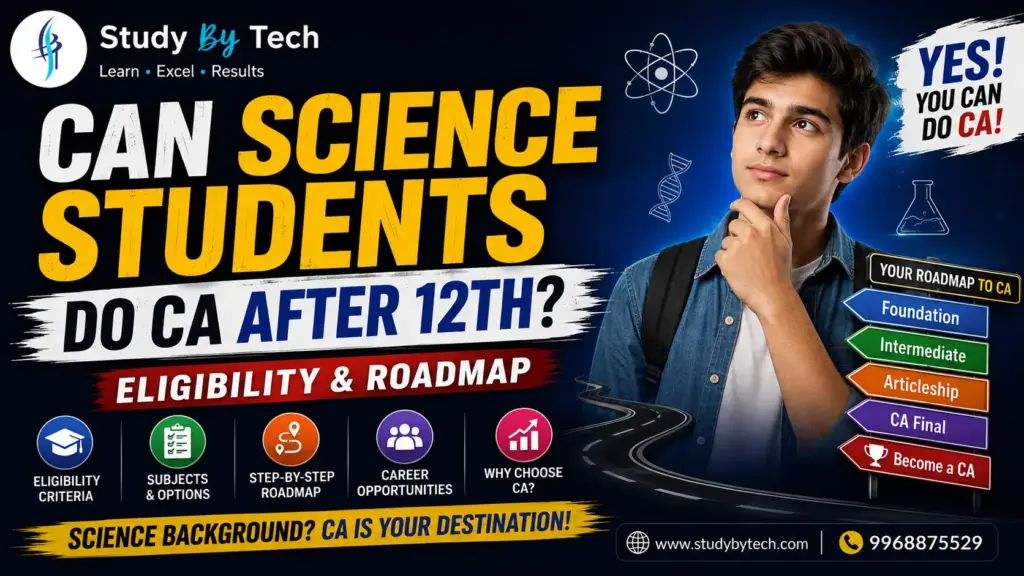
Can Science Students Do CA
Blog, CA classes, CA Course

Can Science Students Do CA After 12th? Complete Guide, Eligibility & Strategy 🎯 Your complete roadmap to CA for Science Students — From eligibility to exam strategy. Everything you need to know about pursuing CA after 12th Science or Graduation. 📑 Table of Contents Eligibility & Roadmap 1. ICAI Eligibility Criteria for Science Students 2. Step-by-Step Roadmap: Becoming a CA Direct Entry & Advantages 3. Can I do CA after B.Tech or B.Sc? 4. Strengths & Hidden Advantages of Science Students Challenges, Strategy & Comparison 5. Common Issues & Solutions 6. Strategy for CA Foundation Papers 7. Science vs Commerce Students FAQ Frequently Asked Questions ⭐ Key Takeaways Yes, Science Students Can Do CA: ICAI allows students from any stream (PCM/PCB/PCMB) to pursue CA. Two Entry Routes: CA Foundation after 12th (no minimum %) or Direct Entry after B.Sc/B.Tech (≥60%). CA Foundation Papers: Accounting, Business Laws, Quantitative Aptitude, Business Economics. Science Students’ Advantages: Strong quantitative aptitude, analytical thinking, problem-solving stamina, and study discipline. Key Challenges: Understanding accounting terminology, adjusting to subjective law papers, and overcoming the commerce student mental block. Foundation Strategy: Master fundamentals, practice ICAI material, use PFAC format for law, and leverage graph theory for economics. Level Playing Field: By Month 3 of preparation, science and commerce students are on equal footing. Direct Entry Advantage: B.Sc/B.Tech graduates can skip CA Foundation and directly register for CA Inter (if ≥60%). 1. ICAI Eligibility Criteria for Science Students All the candidates are evaluated equally irrespective of the streams opted during high school education. No special quota system based on the streams and extra certificates needed to be acquired by students opting for science are there in ICAI. Entry Channels for Students with a Science Background CA Foundation Course Path (Post 12th Science): Educational Requirement: Candidate must have either passed or appeared in class 12 board examinations (PCM/PCB/PCMB). Percentage Requirement: There is no minimum percentage restriction in class 12 to apply for the CA Foundation examination. Provisional Membership: Candidate can get provisional membership with ICAI BoS (Board of Studies) after passing class 10 examinations. Study Period Requirement: A compulsory 4 months study period is to be completed between ICAI membership and exam date. Direct Entry Route (After B.Sc or B.Tech Graduation): Educational Qualification: Science graduates who have passed a 3-year B.Sc or 4-year B.Tech/B.E. graduation degree do not need to appear for CA Foundation at all. Minimum Marks Criteria: Those who graduate in non-commerce field require an aggregate score of 60% to be eligible for direct entry to CA Inter. Know more about Direct Entry in CA → 2. Step-by-Step Roadmap: Becoming a CA After 12th Science The CA qualification framework under ICAI’s New Scheme of Education and Training consists of three main exam stages along with practical articleship training: Step Stage STEP 1 CA FOUNDATION EXAM(4 Papers: Accounts, Law, Maths/Stats, Economics) STEP 2 CA INTERMEDIATE(6 Papers split across Group 1 & Group 2) STEP 3 ICITSS & ARTICLESHIP(4-week Soft Skills/IT Training + 2-Year Practical Training) STEP 4 SPOM MODULES & AICITSS(Self-Paced Online Modules + Advanced IT) STEP 5 CA FINAL EXAM(6 Advanced Papers + Qualified CA Designation) Stage 1: CA Foundation After completing the board examinations of class 12th, join ICAI and pass 4 basic papers: Paper 1: Accounting (100 Marks – Subjective) Paper 2: Business Laws (100 Marks – Subjective) Paper 3: Quantitative Aptitude (Business Mathematics, Logical Reasoning & Statistics) (100 Marks – Objective) Paper 4: Business Economics (100 Marks – Objective) Stage 2: CA Intermediate Passing the CA Foundation will pave way for the next step i.e., joining the CA Intermediate which comprises of 6 papers split up into Group 1 and Group 2. Stage 3: ICITSS & 2 Years Articleship Before moving to the practical training of 2 years, it is required to complete the ICITSS which lasts for 4 weeks. Stage 4: Self-Paced Online Modules (SPOM) & CA Final During the process of articleship, clear SPOM Sets A, B, C, D and Advanced ICITSS and after fulfilling all requirements of articleship as well as study, appear in CA Final examination. 3. Can I do CA after B.Tech or B.Sc? (Direct Entry Guide) There are many engineering and science students who discover during or after their studies that they want to switch to career paths like corporate finance, investment banking, management consultancy or auditing. Eligibility: Science or Engineering graduates with ≥ 60% marks in aggregate are eligible to directly register for CA Intermediate. Advantage: Saves you from taking the 4 paper CA Foundation, which takes 6 to 12 months. Strategy: As direct entry students join CA Intermediate course straight away, the science students will have to study for 4 to 6 weeks about the basics of double entry book keeping, debit/credit system and basic accounting. 4. Strengths & Hidden Advantages of Science Students in CA While commerce students enter CA with prior exposure to basic accounting terms, science students possess cognitive habits that prove to be major assets: Advantage Why Science Background Helps Direct CA Application Quantitative Aptitude In-depth familiarity with calculus, algebra, and statistics. High scores in CA Foundation Quantitative Aptitude & CA Inter Costing / FM. Logical & Analytical Thinking Practice with complex scientific proofs and physical laws. Analyzing complex case studies in Business Law, Tax Planning, and Audit. Problem-Solving Stamina Used to solving multi-step mathematical and physics problems. Tackling lengthy numerical problems in Costing and Advanced Accounting. Study Discipline Habitual focus required for competitive entrance exams (JEE/NEET). Managing the 8-10 hour daily study schedule required during CA revision. 5. Common Issues Encountered By Science Stream Students Along With Their Solutions The switch from equations to accounts can be tricky for science students in the beginning. Understanding the issues before an exam saves time. 📌 Challenge 1: Inability To Comprehend Common Terms Used In Accounting The Issue: Debits, Credits, Trial Balance, Depreciation, Balance Sheet, Provision, Capital Expenditure are all Greek and Latin in the first few weeks. ✅ Solution: Devote 15-20 days to learn basic terminology of accounting which is covered in NCERT Accountancy

CA Inter Audit
CA classes

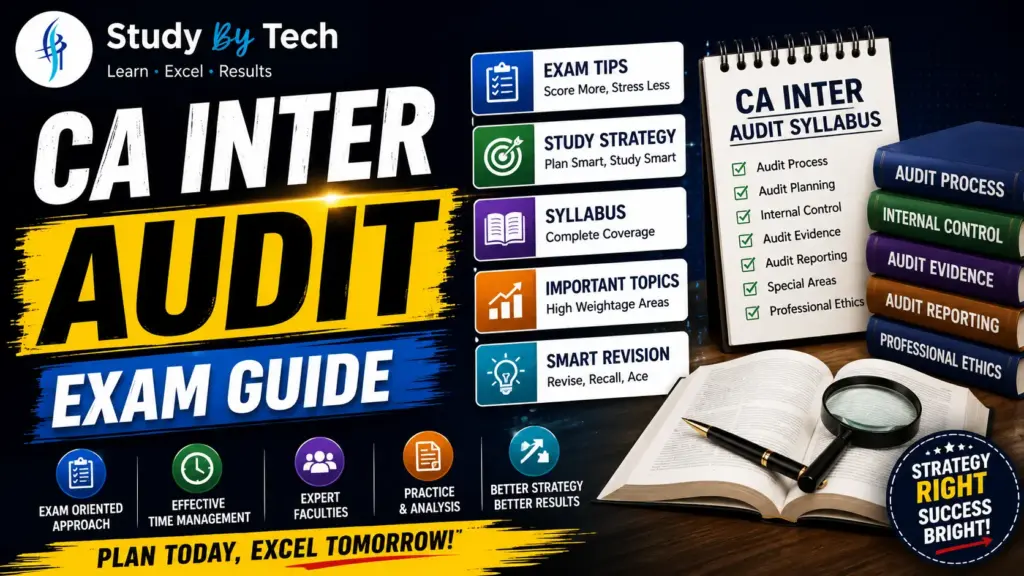
CA Inter Audit Exam Tips: Top 10 Secrets to Score Exemption (Updated Syllabus) 🎯 By CA Palki Lamba — Best Faculty For CA Inter Audit “Achieving anything—especially success—does not come easy. Just as a little plant takes months to grow into a tree, one has to do the same while preparing for CA Inter Audit.” 📑 Table of Contents Syllabus & Strategy 1. CA Inter Audit Syllabus & Chapter Weightage Top 10 Exam Secrets 1. Know What You Are Studying 2. Master the Logic Behind SAs 3. Master the “Language of Audit” 4. Focus Heavily on Standards on Auditing 5. Practice Case-Based Questions 6. Follow a Strict Multi-Revision Cycle 7. Create Concise Summary Notes 8. Develop Professional Answer Writing 9. Master Exam-Day Time Management 10. Treat Audit as a Daily Discipline Faculty & Final Push Learn from the Best Faculty Ready to Master in First Attempt? FAQ Frequently Asked Questions ⭐ Key Takeaways Concept over Rote: ICAI tests application of concepts, not memorization. Master SAs: Standards on Auditing (SAs) carry 20–25 marks — know the logic. Use Audit Language: Professional terminology like “verify supporting documentary evidence” fetches more marks. 5 Revisions Minimum: Audit syllabus is vast — plan at least 5 revision cycles. 4-Step Answer Format: Statute → Explanation → Application → Conclusion. Time Management: 15 min reading → 20 min MCQs → then structured answers. Never Leave Blank: Partial attempts with relevant points fetch step marks. Daily Practice: Treat Audit as a practical discipline, not a last-month subject. CA Inter Audit Syllabus & Chapter Weightage To score 60+ marks in CA Inter Audit, you must prioritize topics based on their historical exam weightage and complexity. Priority Chapter / Topic Area Expected Marks Key Focus Areas A Standards on Auditing (SAs) 20 – 25 Marks SA 200, 240, 300, 315, 500, 505, 700 series (Objectives, documentation & key principles). A Audit of Items of Financial Statements 12 – 15 Marks Assertions, verification of income, expenditure, assets, liabilities, and disclosures. A Audit Report & Completion 10 – 12 Marks SA 700, 705, 706, Key Audit Matters (SA 701), CARO 2020 compliance. B Ethics & Professional Conduct 8 – 10 Marks Fundamental principles of ethics, independence of auditors, threats to independence. B Internal Control & Automated Environment 8 – 10 Marks Internal check vs. internal audit, IT risks, application controls, testing controls. C Audit Documentation, Evidence & Sampling 6 – 8 Marks SA 230, SA 500, SA 530 (Audit trail, working papers, sampling techniques). C Specialised Audits (Banks, Non-Profits, etc.) 6 – 8 Marks Audit of Banks, Educational Institutions, Hospitals, and Hotels. Note for Aspirants: Ensure you follow the latest study material issued by ICAI for Paper 5: Auditing and Ethics, updated with the latest statutory amendments and ethical guidelines. Top 10 Exam Secrets for CA Inter Audit 🔑 1. Know What You Are Studying (Concept over Rote Learning) The knowledge of audit is not only based just on rote learning. The ICAI assesses knowledge of concepts, principles, and logic. If you try to absorb information through memorizing data, you will have issues when applying your concepts in practical cases. 🔑 2. Master the Logic Behind Auditing Standards (SAs) Instead of mechanically studying SAs, understand the rationale for the standards. After reading the regulation, try to explain the content using your own words. 🔑 3. Master the “Language of Audit” (Keywords Matter) Presentation plays a massive role in scoring high marks. Examiners look for professional terminology used in the ICAI study material 🔑 4. Focus Heavily on Standards on Auditing (SAs) SAs are the core concepts for Paper 5. Know the purpose of each standard in addition to its points of application. Pro Tip: If you are familiar with the number of the SA, you can use it. If not, you need to refer to it as an applicable standard of audit and explain it precisely. 🔑 5. Practice Case-Based & Practical Scenario Questions CA Inter Audit exams increasingly feature scenario-based case studies. To prepare: Solve the last 5–10 attempts of RTPs, MTPs, and Past Year Questions (PYQs). Learn to quickly identify the core legal/auditing issue in a complex narrative question. 🔑 6. Follow a Strict Multi-Revision Cycle The audit syllabus covers a lot of material making it difficult to retain what one has learned. It’s important to use this effective revision technique: Conduct at least five revision cycles before taking the exam. Set aside at least 45 minutes each day to revise the audit material. Use flow charts, mind maps, and summary notes to help memorize the information. 🔑 7. Create Concise Summary Revision Notes Draft short notes focusing on: The core Audit Process & Assertions. Key summary points of Standards on Auditing (SAs). Company Audit provisions & CARO 2020 checklists. 🔑 8. Develop Professional Answer Writing Skills Practicing written answers under timed conditions is non-negotiable. Structure your practical/case-law answers into four clear zones: 1. The auditing standard / relevant provision of law 2. An explanation of the requirement/rule 3. How is it applicable to the given case at hand? 4. Conclude your answer and provide your opinion as an auditor 🔑 9. Master Exam-Day Time Management First 15 Minutes: Go through the question paper carefully to identify the optional question you will not attempt. Also mark the questions which you can solve with high confidence. First 20 Minutes: Solve the easy and straightforward questions of MCQ with a weightage of 30 marks while your mind is still fresh. Execution: Never leave a question blank! Write relevant points, standards, or formulas — partial attempts fetch crucial step marks. 🔑 10. Treat Audit as a Daily Practical Discipline The biggest mistake students make is treating Audit as a “last-month theoretical subject.” Approach it like a practical discipline — understand it, apply it, and revise it continuously. Learn from the Best Faculty For CA Inter Audit In the matter of constructing a perfect understanding of concepts and obtaining mastery over the audit language, CA Palki Lamba Ma’am is considered the foremost faculty

Best CA Coaching Centres in Madhya Pradesh
CA classes

Best CA Coaching Centres in Madhya Pradesh

India’s No. 1 CA Coaching Classes in Madhya Pradesh Transforming your CA Journey from Struggle to Success with StudyByTech. Offline Center: Laxmi Nagar, Delhi | Online Live: With 2 way communication | Recorded: for flexible learning From CA Struggle to CA success StudyByTech has helped (in both online & offline modes) thousands of CA students clear their next attempt by offering:1. Focused personal guidance and 2. Result‑oriented mentorship. Our team works with you one‑to‑one, to identify exactly where you are lacking—Be it concepts, practice, or exam strategy—and then gives you a customized study plan and continuous hand‑holding till the exam. Call us at +91‑9968875529 to speak with a mentor and understand how we can specifically help you improve your marks in the coming attempt. StudyByTech is one of the top CA coaching platforms in India that students genuinely love and trust for real results. CA Parag Gupta is seen as one of the absolute best Costing faculties for CA Inter and Final—his simple explanations turn tough topics into something you actually get. He’s put together an amazing, super experienced team covering every subject from Foundation to Final, so you get the exact guidance and smart strategies needed to crack your exams fast. As a former examiner, Parag Gupta sir’s insider tips and tricks have helped lakhs of students boost their scores and shine in exams. Our Specialized CA Programs Why Madhya Pradesh Students Choose StudyByTech? Ready to clear CA in the first attempt? Call us: +91 9968875529

CA Coaching Classes in Dehradun
CA classes

Best CA Coaching Centres in Dehradun

India’s No. 1 CA Coaching Classes in Dehradun Transforming your CA Journey from Struggle to Success with StudyByTech. Offline Center: Laxmi Nagar, Delhi | Online Live: With 2 way communication | Recorded: for flexible learning From CA Struggle to CA success StudyByTech has helped (in both online & offline modes) thousands of CA students clear their next attempt by offering:1. Focused personal guidance and 2. Result‑oriented mentorship. Our team works with you one‑to‑one, to identify exactly where you are lacking—Be it concepts, practice, or exam strategy—and then gives you a customized study plan and continuous hand‑holding till the exam. Call us at +91‑9968875529 to speak with a mentor and understand how we can specifically help you improve your marks in the coming attempt. StudyByTech is one of the top CA coaching platforms in India that students genuinely love and trust for real results. CA Parag Gupta is seen as one of the absolute best Costing faculties for CA Inter and Final—his simple explanations turn tough topics into something you actually get. He’s put together an amazing, super experienced team covering every subject from Foundation to Final, so you get the exact guidance and smart strategies needed to crack your exams fast. As a former examiner, Parag Gupta sir’s insider tips and tricks have helped lakhs of students boost their scores and shine in exams. Our Specialized CA Programs Why Dehradun Students Choose StudyByTech? Ready to clear CA in the first attempt? Call us: +91 9968875529

Best CA Coaching Centres in Kerala
CA classes

Best CA Coaching Centres in Kerala

India’s No. 1 CA Coaching Classes in Kerela Transforming your CA Journey from Struggle to Success with StudyByTech. Offline Center: Laxmi Nagar, Delhi | Online Live: With 2 way communication | Recorded: for flexible learning From CA Struggle to CA success StudyByTech has helped (in both online & offline modes) thousands of CA students clear their next attempt by offering:1. Focused personal guidance and 2. Result‑oriented mentorship. Our team works with you one‑to‑one, to identify exactly where you are lacking—Be it concepts, practice, or exam strategy—and then gives you a customized study plan and continuous hand‑holding till the exam. Call us at +91‑9968875529 to speak with a mentor and understand how we can specifically help you improve your marks in the coming attempt. StudyByTech is one of the top CA coaching platforms in India that students genuinely love and trust for real results. CA Parag Gupta is seen as one of the absolute best Costing faculties for CA Inter and Final—his simple explanations turn tough topics into something you actually get. He’s put together an amazing, super experienced team covering every subject from Foundation to Final, so you get the exact guidance and smart strategies needed to crack your exams fast. As a former examiner, Parag Gupta sir’s insider tips and tricks have helped lakhs of students boost their scores and shine in exams. Our Specialized CA Programs Why Kerela Students Choose StudyByTech? Ready to clear CA in the first attempt? Call us: +91 9968875529

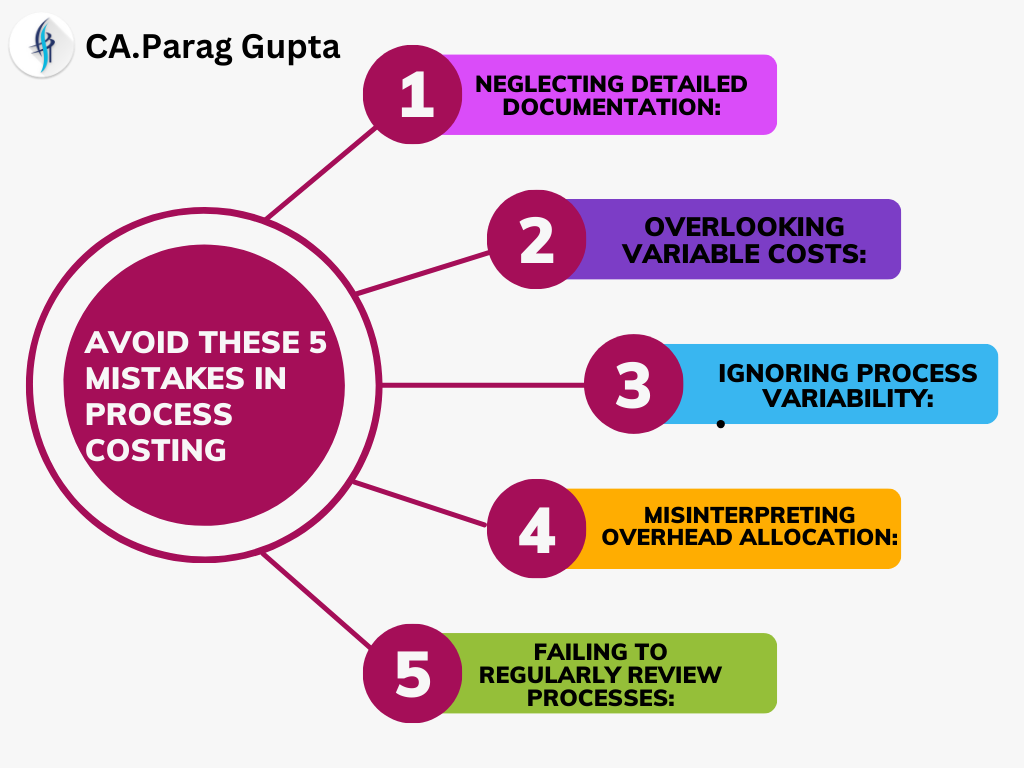
Avoid These 5 Mistakes in Process Costing by Parag Gupta
CA classes

Avoid these 5 Mistakes in CA Inter Process Costing I By Parag Gupta sir

CA Inter Classes ICAI Registration Process, Fees, & Syllabus Admit Card Exam Dates Study Guides & Tips CA Inter faculties FAQ Introduction Process costing is a vital aspect of cost accounting, enabling businesses to allocate costs accurately and make informed decisions. However, mastering process costing can be challenging, and even small mistakes can lead to significant errors in financial data. In this blog post, we’ll delve into five common mistakes in process costing, drawing insights from the expertise of Parag Gupta, a renowned authority in the field of accounting and finance. Want to understand more about Process Costing in depth, read this. 5 mistakes to avoid in Process Costing at CA Inter level are: https://youtu.be/aApMURGSlNA 5 tips to avoid mistakes in Process Costing by Parag Gupta sir: Tips Description 1. Detailed Documentation Maintain thorough records of production costs incurred at each stage to ensure accurate cost allocations and financial reporting. 2. Consider Variable Costs Identify and account for fluctuating costs associated with production processes to avoid skewed cost calculations and inaccurate profitability assessments. 3. Address Process Variability Recognize variations in production processes and adjust cost allocation methods accordingly to ensure accurate cost estimations. 4. Accurate Overhead Allocation Allocate overhead costs correctly to prevent distorted product costs and ensure reliable profitability analysis. 5. Regular Process Review Periodically review and update process costing methods to adapt to changing business dynamics and optimize cost allocation for improved performance. These tips provide actionable advice to help businesses avoid common mistakes and enhance the accuracy of process costing. Conclusion Process costing is a critical tool for businesses to determine product costs and make informed decisions. By avoiding these five mistakes outlined by Parag Gupta, organizations can enhance the accuracy of their process costing data and improve overall financial performance. Remember to prioritize detailed documentation, account for variable costs, address process variability, allocate overhead costs accurately, and regularly review and refine costing processes for optimal results. FAQ’S Want to Enroll to our classes?

Best CA coaching classes in Delhi
Blog, CA classes, CA Foundation

Best CA Coaching Classes in Delhi – Best Coaching for Real Results

Facebook Twitter Youtube Telegram Youtube Whatsapp Instagram Pinterest Linkedin StudyByTech – Best CA Coaching in Delhi Best CA Coaching Classes in Delhi StudyByTech — where conceptual clarity meets examiner-level insight Table of Contents Why StudyByTech Mentor: CA Parag Gupta Course Offerings Comparison Preparation Roadmap Demo Lectures FAQs Book Your Demo Key Takeaways Small batches · personal attention Offline + Live online hybrid Direct doubt resolution (phone/WhatsApp) 1-on-1 sessions for tough topics Mentored by ex-ICAI examiner Exam-focused · first‑attempt mindset What makes StudyByTech different 📞 Direct Faculty Access Get your doubts resolved over phone & WhatsApp — no waiting for the next class. 🏫 Interactive Classroom Small batch sizes mean every question is answered instantly, and mock tests are reviewed one‑by‑one. 💻 Hybrid Learning Offline face‑to‑face + live online classes with real‑time Q&A and recorded backups. 🎯 1‑on‑1 Topic Sessions Book dedicated sessions for challenging modules and polish your preparation before the test. Why StudyByTech is the Top Choice in Delhi Many coaching institutes use a large‑scale model — filling halls with hundreds of students — making it difficult to track each learner’s progress. At StudyByTech (also known as Parag Gupta Classes), we focus on the student and have built our approach around four main pillars: 1. Small Batch Sizes for Personal Attention StudyByTech keeps each batch small in Laxmi Nagar. Every question you ask in class is answered immediately, mock tests are reviewed one by one, and our teachers watch your progress closely. 2. Flexible Learning Modes: Offline & Online Hybrid Located near Metro Pillar 30 in Laxmi Nagar, our face‑to‑face classroom gives a focused setting. For students who live away or prefer home study, we offer Live Online interactive classes that stream in real time with Q&A plus recorded lectures for later review. 3. Dedicated Post‑Class Doubt Resolution You should not wait for the next class to clear doubts. Our experienced teachers give help over phone and WhatsApp so your study flow stays steady — even during late‑night revision. 4. Custom 1‑on‑1 Topic‑Specific Sessions If a particular topic or module feels hard, you can book a one‑on‑one session with our teachers to clarify concepts and polish your preparation before the test day. Mentored by an Examiner: The Advantage of CA Parag Gupta Sir The core of StudyByTech’s teaching methodology is shaped by CA Parag Gupta Sir, who brings over 20 years of experience in teaching CA Intermediate and CA Final levels. 20+ years teaching & mentorship Former ICAI Examiner & Official Observer CA Inter Costing · CA Final Costing (SCPM) Founder, StudyByTech (DPIIT‑recognized startup) Because Parag Sir has evaluated ICAI examination answer sheets, he teaches with an understanding of how papers are evaluated. At StudyByTech, every teacher — for CA Foundation, CA Intermediate and CA Final — is picked by Parag Sir himself. He makes sure they teach in a way that matches what ICAI looks for. This way students get the prep they need for their exams. It’s about making learning effective and exam‑focused. Detailed Course Offerings 1. Best CA Foundation Classes in Delhi The CA Foundation level is the base for your professional journey. With the ICAI syllabus scheme, memorising facts alone does not help. Exam papers look at how you use knowledge in situations and how well you grasp ideas. Principles & Practice of Accounting: Step‑by‑step notes, how balance sheets work and how to present working papers. Business Laws: Methods for analysing case studies, practice in drafting documents and the key words that ICAI examiners expect. Business Mathematics, Logical Reasoning & Statistics: Quick shortcut methods, calculator tricks and step‑by‑step problem‑solving strategies. Business Economics: Models that show real‑world economics, analysis of markets and clear ideas instead of memorising facts. 2. Best CA Inter Classes in Delhi CA Intermediate moves students from entry‑level topics to the main professional application. All subjects from Group 1 & Group 2: Learn Learn from best experienced faculties for all subjects. Comprehensive Syllabus Coverage: Advanced Accounting, Taxation, Corporate Laws, Cost & Management Accounting, Auditing & Ethics and Financial Management & Strategic Management (FM‑SM). ICAI Pattern Focus: Tests that use ICAI past papers, Revision Test Papers (RTPs) and Mock Test Papers (MTPs). 3. Best CA Final Classes in Delhi CA Final demands high‑level decision‑making, case‑study analysis and strategic use of knowledge. All subjects of Group 1 & Group 2: We have offline as well online live sessions available. Integrated Business Solutions (IBS): Training that mixes subjects so you can tackle complex scenario‑based exam questions. Exam Paper Presentation: Guidance on how to structure answers so they fit the ICAI marking scheme and earn maximum marks by CA. Parag Gupta sir & his team. Comparison: Traditional Mass Coaching vs. StudyByTech 🏛️ Traditional Large Institutes vs 200–500+ students per batch Queues after class or delayed forum replies Frequently changing guest lecturers Formula memorisation & speed lectures Rigid offline or pre‑recorded online ⭐ StudyByTech (Parag Gupta Classes) advantage Controlled small batches Direct faculty access, WhatsApp & 1‑on‑1 sessions Fixed expert faculties selected by CA Parag Gupta Sir Deep conceptual clarity with examiner‑level insights Hybrid: Offline, Live Interactive & Recorded Backup Step‑by‑Step “First Attempt” Preparation Roadmap If you want to pass CA exams without confusion, StudyByTech uses a four‑step plan: Step 1: Conceptual Foundation Cover all ICAI study material and use everyday examples to learn. Step 2: Format & Presentation Mastery Master how to mark steps, write notes and draft documents correctly. Step 3: Clear Doubts After Class & One‑on‑One Sessions Arrange sessions for difficult topics so that no gaps remain before practice tests. Step 4: Simulate Real Exams Practice with papers, real test papers and mock exams while a tutor gives you feedback. Demo Lectures – CA Foundation, Inter & Final Get a feel of our teaching style before you commit. Schedule a free demo session for any level. Course Level Subjects Covered in Demo Mode Duration CA Foundation Principles of Accounting · Business Laws · Business Maths · Economics Offline / Live Online 🔗 Click here for CA Foundation Demo CA Intermediate Group 1 & Group

Blog, CA classes, CA Foundation

Understanding the Indian Contract Act, 1872: Meaning, Nature, and Scope

Introduction The Indian Contract Act, 1872 is a foundational piece of legislation that governs contracts and agreements in India. It provides a legal framework for individuals and entities to enter into agreements, which are crucial in everyday life, business, and commerce. ICAI study material is one of the most important resources of knowledge that no CA Foundation student should ignore. In this blog, we will delve into the meaning, nature, and scope of the Indian Contract Act, as outlined in the ICAI book used by students, while also providing additional insights and explanations. What is Indian Contract Law, 1872? The Indian Contract Act, 1872, is a significant piece of legislation in India that defines the rules and principles governing contracts, serving as the cornerstone of contract law in the country. The Indian Contract Act, 1872, defines and outlines the rules and principles that govern contracts. It addresses various elements of a valid contract, such as offer and acceptance, consideration, free consent, lawful object, and the capacity of parties to contract. It also deals with different types of contracts, including contracts of sale, contracts of agency, and contracts for services. The Basics of a Contract The Indian Contract Act, as stated in Section 10, defines a contract as an agreement made by free consent between parties competent to contract, for lawful consideration, with a lawful object, and not expressly declared to be void. This definition encapsulates the fundamental elements that must be present for an agreement to be legally binding. However, it’s important to note that the Act contains other requirements and principles that further refine the scope of a valid contract. 1. Two Parties One of the fundamental requirements for a contract is the involvement of at least two parties, where one party makes an offer, and the other party accepts it. This principle ensures that contracts involve distinct individuals or entities. For example, in a contract of sale, there must be a seller and a buyer, as a person cannot buy their own goods. This principle helps maintain the integrity and legality of contracts. 2. Intention to Create Legal Obligations For an agreement to qualify as a contract, both parties must have the intention to create a legal relationship. Social or domestic agreements, that lack this intention, are not enforceable in a court of law and, therefore, do not constitute contracts. For instance, an agreement between a husband and wife for maintenance may not be legally enforceable because the parties did not intend to create a legal relationship. 3. Other Formalities While contracts can be either written or spoken, certain contracts require specific formalities to be legally enforceable. For example, insurance contracts are generally valid only in writing. Additionally, some agreements, such as those involving immovable property, may need to be registered in compliance with relevant laws. These formalities ensure that certain types of agreements are executed with the appropriate level of documentation and oversight. 4. Certainty of Meaning A valid contract requires that the terms of the agreement be clear and definite. Vague or indefinite agreements are not legally binding. For example, an agreement to sell “a hundred tons of oil” without specifying the type of oil lacks the necessary certainty to be considered a valid contract. This requirement helps prevent disputes arising from ambiguities in contract terms. 5. Possibility of Performance The terms of an agreement should be capable of being performed. Agreements that involve actions that are impossible to perform are not enforceable as contracts. For instance, an agreement to find treasure using magic cannot be enforced because it is impossible to perform. This principle ensures that contracts are rooted in practicality and reason. SCOPE OF CONTRACT LAW: The entirety of the agreement is covered by the contract’s extension. Contracts might be little or large in value, and they can take many different forms. While some contracts have lengthy terms, some have shorter ones. Contractual content also varies according to how it is intended to be used. There are many facets to commercial law, and it might be difficult to define each one in detail. Commercial law generally requires a great deal of research, mostly on contracts, sales of goods, taxes, insurance, and leasing, among other topics. The basic parameters of the contract are established during the identification phase. Certain projects may fall under different contract scopes and have unique developmental and managerial linkages. As a result, other parties engaged may receive additional duties or services. For example, a hospital-related project can involve offering clinical services. In addition to deciding whether to offer extra services like cleaning and catering, in addition to its maintenance services, the hospital must also consider whether to assign clinical services to a commercial partner. The services that fall under the purview of the contract must also be specified by the hospital. Additionally, expertise in contracts encompasses a number of areas, such as- Club membership agreements Domestic or marriage agreements Unformed contractsfully executed contracts Conclusion The Indian Contract Act of 1872 plays a pivotal role in regulating agreements and contracts in India, providing a legal framework that upholds the principles of free consent, lawful consideration, lawful object, and the absence of express voidness. Additionally, it incorporates the essential elements discussed in the ICAI study material: the involvement of two parties, the intention to create legal obligations, the observance of required formalities, the certainty of terms, and the possibility of performance. These principles collectively define the meaning, nature, and scope of contracts under the Act, ensuring that agreements in India adhere to legal standards and maintain the integrity of commerce and relationships. We sincerely hope you enjoy reading our blog. To help CA students from all over India, we offer both online and offline classes. Enroll in our latest CA Foundation course, where all of our faculty members have the greatest professional qualifications & extensive experience, to learn more about the topics or to attend additional classes about CA Foundation Law under the New course valid from June 2025 exams onwards.

Best CA Coaching Classes in Mumbai
CA classes

CA Coaching Classes in Mumbai

India’s No. 1 CA Coaching Classes in Mumbai Transforming your CA Journey from Struggle to Success with StudyByTech. Offline Center: Laxmi Nagar, Delhi | Online Live: With 2 way communication | Recorded: for flexible learning From CA Struggle to CA success StudyByTech has helped (in both online & offline modes) thousands of CA students clear their next attempt by offering:1. Focused personal guidance and 2. Result‑oriented mentorship. Our team works with you one‑to‑one, to identify exactly where you are lacking—Be it concepts, practice, or exam strategy—and then gives you a customized study plan and continuous hand‑holding till the exam. Call us at +91‑9968875529 to speak with a mentor and understand how we can specifically help you improve your marks in the coming attempt. StudyByTech is one of the top CA coaching platforms in India that students genuinely love and trust for real results. CA Parag Gupta is seen as one of the absolute best Costing faculties for CA Inter and Final—his simple explanations turn tough topics into something you actually get. He’s put together an amazing, super experienced team covering every subject from Foundation to Final, so you get the exact guidance and smart strategies needed to crack your exams fast. As a former examiner, Parag Gupta sir’s insider tips and tricks have helped lakhs of students boost their scores and shine in exams. Our Specialized CA Programs Why Mumbai Students Choose StudyByTech? Ready to clear CA in the first attempt? Call us: +91 9968875529

Scroll to Top