CA Inter Master Guide: Syllabus, Registration, Online & Offline Classes, Exam Strategy & Coaching CA Inter is the second stage of the Chartered Accountancy course, and this guide covers everything you need to start it. It’s for CA Foundation passers and eligible graduates. You’ll learn the two entry routes, the six-paper syllabus, the ₹18,000 registration fee, the passing rules, the 8-month study period, and a five-phase study plan. Your key takeaway: stay close to ICAI material, because over 80% of exam questions come from it. Your complete roadmapFrom eligibility to exam day9 minute read Enroll NowWatch Demo LecturesDirect Entry in CA Table of Contents 1. What is CA Intermediate? Overview & Routes 2. Syllabus & Exam Pattern (New Scheme) 3. Registration Process & Fee Breakdown 4. Exam Pattern, Admit Card & Timetable 5. Coaching Options: Online vs Offline 6. Best Faculty at StudyByTech 7. Proven Study Plan & Exam Strategies 8. What to Do After CA Foundation Enroll in the Best CA Intermediate Coaching Frequently Asked Questions Key Takeaways Two entry routes Foundation Route (pass CA Foundation) or Direct Entry (graduates with min %). 6 subjects, 2 groups The new scheme has 6 papers (3 per group), 300 marks each. Passing criteria 40% in each paper and 50% aggregate in a group. Score 60+ for exemption. Registration fee ₹18,000 for both groups. ₹14,000 for a single group. 8-month study period Mandatory between registration and exam month. Exam cycle Conducted three times a year: January, May, September. 5-phase prep Concept coverage, revisions, PYQs, mocks, final revision. ICAI material is gold Over 80% of exam questions come from ICAI’s certified content. 1. What is CA Intermediate? Overview & Eligibility Routes The CA Intermediate course is the second stage of the Chartered Accountancy qualification. It forms a link between theory and practice. This course comprises 6 compulsory subjects that can be divided into 2 groups of 3 subjects each. Eligibility Routes to Register for ICAI Intermediate Candidates can enter the CA Inter course through two primary routes: Foundation Route Pass the CA Foundation exam ➜ CA Intermediate Register on the ICAI SSP portal ➜ Direct Entry Route Commerce Graduates/PG (≥ 55%), Other Graduates/PG (≥ 60%), CS Executive / CMA Inter The CA Foundation Route The CA Foundation exams of ICAI must be cleared. Direct Entry Route The CA Foundation exam can be skipped if you satisfy any of these conditions: Commerce Graduates or Post-Graduates with 55% marks. Non-Commerce Graduates or Post-Graduates with 60% marks. Candidates who have completed the Intermediate level exams from ICSI (CS Executive) or ICMAI (CMA Intermediate). 2. CA Intermediate Syllabus & Exam Pattern (New Scheme) According to the ICAI updated scheme, the curriculum comprises six relevant subjects with 600 total marks for the examination. Each exam paper contains 30 percent objective questions (case scenario MCQs) and 70 percent descriptive questions. Group-Wise Subjects & Marks Distribution Group 1 (300 Marks) Paper Subject Marks Key Topics Paper 1 Advanced Accounting 100 Accounting Standards (AS), Preparation of Financial Statements, Amalgamation, Consolidation. Paper 2 Corporate & Other Laws 100 (70+30) Part A: Companies Act & LLP Act (70 Marks)Part B: FEMA, General Clauses Act, Interpretation of Statutes (30 Marks) Paper 3 Taxation 100 (50+50) Section A: Income Tax (Direct Tax – Sources of Income, TDS/TCS, PGBP)Section B: GST (Indirect Tax – Supply, ITC, Time and Value of Supply) Group 2 (300 Marks) Paper Subject Marks Key Topics Paper 4 Cost & Management Accounting 100 Marginal Costing, Standard Costing, Process Costing, Budgeting & Variance Analysis, Material & Labour Cost. Paper 5 Auditing & Ethics 100 Standards on Auditing (SA), Ethical Aspect of Auditing, CARO 2020, Internal Control and Audit Reporting. Paper 6 Financial Management & Strategic Management 100 (50+50) Section A: FM (Capital Budgeting, Cost of Capital, Capital Structure, Ratios)Section B: SM (Strategic Analysis, Competitor Analysis, Strategy Implementation) Criteria for Passing and Exemptions Criteria for Each Subject A subject must obtain at least 40% marks in order to qualify. Criteria for Aggregate The overall passing percentage is required to be a minimum of 50% marks in total, 150/300 subjects. Exemption Criteria If any subject has been passed with an overall score of 60%, you won’t need to give a paper test for that subject again, but the aggregate percentage needs to be maintained. Want the full paper-wise list with ICAI study material links? Read our CA Intermediate syllabus guide. 3. CA Intermediate Registration Process & Fee Breakdown To enroll for ICAI CA Inter, you’ll have to submit the application form online through the ICAI Self Service Portal (SSP). Guide for Registration Process Step 1 Login to ICAI official portal SSP ➜ Step 2 Choose Student Cycle, then CA Intermediate Registration ➜ Step 3 Submit scanned documents (CA Foundation Marksheet/Graduation Certificate, 10th and 12th Marksheet, ID, Passport size Photo) ➜ Step 4 Choose your route (Foundation or Direct Entry) and group (both or one) ➜ Step 5 Pay the fee online and take a printout of the receipt Official ICAI CA Inter Fee Structure Fee Head Both Groups (INR) Single Group (INR) Registration Fee ₹ 15,000 ₹ 11,000 Student Activity Fee ₹ 2,000 ₹ 2,000 Articles Registration Fee (if applicable) ₹ 1,000 ₹ 1,000 Total Official ICAI Fee ₹ 18,000 ₹ 14,000 ⏳ Mandatory Study Period: ICAI mandates an 8-month study period between the registration date and the exam month. 4. CA Inter Exam Pattern, Admit Card & Exam Timetable ICAI conducts CA Intermediate examinations 3 times a year: in January, May, and September. Exam Pattern & Duration 100 marksPer paper (30 MCQ + 70 Descriptive) 3 hoursPer paper, plus 15 minutes of reading time CA Inter Exam Schedule Exams are scheduled across an 11-day window with a 1-day gap between consecutive papers: Group Day 1 Day 3 Day 5 Day 7 Day 9 Day 11 Group I Paper 1: Adv. Accounts Paper 2: Law Paper 3: Taxation — — — Group II — — — Paper 4: Costing Paper 5: Audit Paper 6: FM-SM Download CA Inter Admit Card ICAI releases the CA
CA Inter SM: Syllabus, Study Tips, Best Faculty & Online vs Offline Classes 🎯 Your complete guide to Strategic Management (Paper 6B). From syllabus to scoring 40+ out of 50, here’s everything you need to master SM. CA Inter SM is Strategic Management, Section B of Paper 6 in the ICAI CA Intermediate course, and it carries 50 marks. This guide is for CA students who want the syllabus, key models, case-study answer format and online vs offline class options. The key takeaway: master Ansoff, BCG and Porter’s models, use ICAI terminology, practise case-based MCQs, and answer case studies in four steps to aim for 40+ out of 50. 📑 Table of Contents What is CA Inter Strategic Management? Is SM Easy in CA Inter? ICAI CA Inter SM Syllabus & Weightage Key Strategic Models You Must Master CA Inter SM Strategy that Works Online vs Offline Classes Best Faculty at StudyByTech Frequently Asked Questions ⭐ Key Takeaways SM = Paper 6B: 50 marks (30% MCQs + 70% descriptive). Highly scoring. 5 chapters: Introduction, External and Internal Analysis, Strategic Choices, Implementation. Key models: Ansoff Matrix, BCG Matrix and Porter’s Five Forces are tested often. ICAI terminology: “core competencies” and “sustainable competitive advantage” score more. 4-step case format: Problem → Framework → Facts → Conclusion. Case-based MCQs: 15 marks come from them, so practise them. What is CA Inter Strategic Management? Strategic Management in CA Intermediate teaches you to think like a business strategist. It tests how well you can analyse market opportunities, build corporate strategy, assess competitive advantage and handle organisational change. You can check the latest scheme on the ICAI website. Overview of Paper 6 Section B Subject name: Strategic Management (SM) Total weightage: 50 marks Exam pattern: 30% integrated case-scenario MCQs (15 marks) + 70% descriptive practical questions (35 marks) Exam time: 3-hour integrated exam along with Financial Management (FM) Is SM Easy in CA Inter? Many students who cleared CA Foundation ask: is SM easy in CA Inter? The short answer is yes, with a big caveat. SM has fewer concepts than numerical subjects like Costing or Advanced Accounts. But students struggle to score high because they treat SM like an English essay-writing subject. ❌ Why Students Lose Marks in SM Writing general/casual answers Ignoring heading titles in modules Skipping case study practice Lack of strategic diagrams ✅ How to Score 40+ Out of 50 in SM Using official ICAI technical terms Memorising standard framework titles Structuring answers into 4 clear zones Drawing matrices (Ansoff, BCG, SWOT) If you master the core concepts, retain ICAI terminology and practise case studies, SM becomes one of the easiest subjects to score an exemption in. ICAI CA Inter SM Syllabus & Weightage Breakdown The updated CA Inter SM syllabus under the ICAI New Scheme has 5 chapters: Chapter Number & Title Expected Marks Key Focus Areas Chapter 1: Introduction to Strategic Management 8–10 Marks Concept of Strategy, Strategic Management Process, Strategic Leadership, Vision, Mission and Objectives. Chapter 2: Strategic Analysis: External Environment 10–12 Marks Competitive Landscape, Porter’s Five Forces Model, PESTLE Analysis, Industry Driving Forces, Strategic Groups. Chapter 3: Strategic Analysis: Internal Environment 8–10 Marks Value Chain Analysis, Core Competencies, Competitive Advantage, Portfolio Analysis (BCG Matrix, Ansoff Matrix, ADL, General Electric). Chapter 4: Strategic Choices 10–12 Marks Corporate Level Strategies (Growth, Stability, Retrenchment), Business Level Strategies (Porter’s Generic Strategies), Directional Growth. Chapter 5: Strategy Implementation & Evaluation 8–10 Marks Strategic Control, Operations & Resource Allocation, Digital Transformation, Organisational Structure & Change Management. Key Strategic Models You Must Master for Exams ICAI often tests practical applications through a few key models. Make sure you know these: 1. Ansoff’s Product-Market Growth Matrix How companies grow through products and markets: Market Penetration: present products in present market. Market Development: present products in new market. Product Development: new products in present market. Diversification: new products in new market. 2. BCG Growth-Share Matrix Classification of business units: Stars: high growth, high market share. Cash Cows: low growth, high market share. Question Marks: high growth, low market share. Dogs: low growth, low market share. 3. Porter’s Five Forces & Generic Strategies Five Forces: New Entrants, Buyers, Suppliers, Substitutes, Rivalry. Generic Strategies: Cost Leadership, Differentiation, Focus. Question MarksHigh growth, low share StarsHigh growth, high share DogsLow growth, low share Cash CowsLow growth, high share Relative market share: Low → High Market growth: Low → High CA Inter SM Strategy that Works 📘 1. Keep an SM Terminology Dictionary Handy Keep a small notepad of SM terms. Instead of writing “the company is better than its rivals,” write “the enterprise is using core competencies to build a sustainable competitive advantage.” 📝 2. Follow the 4-Point Structure for Case Studies When you solve case questions in the exam: 1. Highlight theCore Problem 2. FrameworkDefine the model 3. FactsLink to framework 4. ConclusionStrategic solution 🧠 3. Solve Case-Based MCQs Since 15 marks go to case-based MCQs, practise reading the case and picking the right strategic option without wasting time. CA Inter SM Classes: Online vs Offline Classes Your daily schedule and location decide which learning mode suits you best: Feature CA Inter SM Online Classes CA Inter SM Offline Classes Flexibility & Convenience Learn from anywhere with HD recorded or live interactive lectures. Requires daily commuting to offline coaching centres. Speed Control & Revisions Re-watch lectures at 1.2x/1.5x speed during revision rounds. Single-pass live lecture experience. Doubt Support Direct mentor chat, Telegram community and call support. In-person, face-to-face doubt clearance after class. Cost & Time Savings Highly affordable. Saves 2 hours of daily travel time for self-study. Involves higher tuition fees and travel costs. CA Inter SM Best Faculty at StudyByTech When choosing the best CA Inter SM faculty, look for someone who does more than read from books. You need a guide who shows how real-life corporate cases, market situations and ICAI presentation criteria work. What StudyByTech Offers ICAI module-wise coverage, 100% based on past year questions and revision test papers. Summary charts for all 5 chapters, plus
CA Foundation Economics: New Syllabus, Chapter Weightage, Preparation Strategy & Best Coaching CA Foundation Economics is Paper 4 of the CA Foundation exam: 100 MCQs in 2 hours, with 0.25 negative marking. This guide is for CA Foundation students aiming for a high score in Economics. You’ll get the 10-chapter syllabus with weightage, high-yield topics, a plan to score 90+, MCQ and negative marking strategies, and recommended books. Key takeaway: over 80% of questions come from ICAI study material, so read it line by line. 🎯 Your complete roadmap to CA Foundation Economics (Paper 4)From syllabus to exam strategy7 minute read Enroll NowWatch Demo Lectures 📑 Table of Contents 1. Introduction to CA Foundation Economics 2. New Syllabus & Weightage 3. High-Yield Topics 4. How to Score 90+ Marks 5. Effective MCQ Strategies 6. Best Books & Materials 7. Best CA Foundation Economics Coaching Frequently Asked Questions ⭐ Key Takeaways Paper 4: Business Economics 100 marks, 100 MCQs, 2 hours. Negative marking 0.25 mark deducted for every wrong answer. Passing requirement Minimum 40% in Paper 4 and 50% aggregate overall. High-weightage chapters National Income (10–15%), Demand & Supply (10–12%), Production (10–12%). Key to success Conceptual clarity + MCQ practice + smart negative marking strategy. ICAI material is gold Over 80% of questions come from ICAI study modules. Best faculty Rahul Singh Sir is highly recommended for his 12+ years of teaching experience and concept-based approach. Practice strategy Master graphs, schedules and theoretical assumptions for high scores. 1. Introduction to CA Foundation Economics CA Foundation Economics is Paper 4 in the official CA Foundation syllabus provided by the Institute of Chartered Accountants of India (ICAI). The subject tests how well you apply your understanding of economics to real-world business problems. Parameter Details Exam Format Objective Type (Multiple Choice Questions – MCQs) Total Marks 100 Marks (100 MCQs of 1 Mark Each) Exam Duration 2 Hours Negative Marking Yes (0.25 mark deducted for every wrong answer) Passing Requirement Minimum 40% in Paper 4 & 50% Aggregate across all 4 Papers Syllabus Scheme ICAI New Scheme (10 Comprehensive Chapters) Part of the full course: see our CA Foundation guide. 2. New Syllabus for Business Economics CA Foundation As per ICAI’s scheme, the Business Economics syllabus includes macroeconomics, public finance, national income and international trade. Chapter / Topic Coverage & Sub-Topics Expected Weightage Chapter 1: Nature & Scope of Business Economics Micro vs. Macro Economics, Central Problems of an Economy, Role of Price Mechanism 5% – 10% (5-10 Marks) Chapter 2: Theory of Demand and Supply Law of Demand, Elasticity of Demand, Consumer Behaviour (Indifference Curves, Utility), Supply & Elasticity of Supply 10% – 12% (10-12 Marks) Chapter 3: Theory of Production and Cost Production Function, Laws of Returns to Scale, Short-run & Long-run Cost Concepts, Economies of Scale 10% – 12% (10-12 Marks) Chapter 4: Price Determination in Different Markets Market Structures (Perfect Competition, Monopoly, Monopolistic Competition, Oligopoly), Price-Output Equilibrium 10% – 12% (10-12 Marks) Chapter 5: Business Cycles Phases of Business Cycles (Expansion, Peak, Contraction, Trough), Indicators & Causes 5% – 8% (5-8 Marks) Chapter 6: Determination of National Income Concepts of GDP, GNP, NNP, Circular Flow of Income, Keynesian Theory, Measurement Methods 10% – 15% (10-15 Marks) Chapter 7: Public Finance Fiscal Functions, Market Failure, Public Goods, Government Revenue, Expenditure & Fiscal Policy 8% – 12% (8-12 Marks) Chapter 8: Money Market Concept of Money Supply, Monetary Policy, Central Bank Instruments (Repo, CRR, SLR), Demand for Money 8% – 12% (8-12 Marks) Chapter 9: International Trade Theories of International Trade, Trade Barriers, Exchange Rates, Capital Flows 8% – 10% (8-10 Marks) Chapter 10: Indian Economy Overview Basic Features, Development Issues, Economic Reforms (LPG), Contemporary Economic Challenges 5% – 8% (5-8 Marks) National Income: up to 15 marks Demand & Supply, Production, Markets, Public Finance, Money Market: up to 12 marks each Nature & Scope, International Trade: up to 10 marks each Business Cycles, Indian Economy: up to 8 marks each 3. Analysis of the Chapters: High-Yield Topics 1. Microeconomics Basics (Chapters 1 to 5) Calculation of elasticities: Expect questions on calculating Price, Income and Cross Elasticity of Demand. Cost curves: Study the relationship between AC, MC, AVC and MR thoroughly. Nature of markets: Give special emphasis to the kinked demand curve model in oligopoly and price discrimination in monopoly. 2. Macroeconomics & Public Policy (Chapters 6 to 10) National income accounting: Master all the formulas for GDP at Market Price/Factor Cost, the Keynesian Multiplier and Real/Nominal GDP. Monetary and fiscal policy instruments: Learn the quantitative tools like CRR, SLR and Open Market Operations, and their effects on inflation and liquidity in the money market. 4. How to Score 90+ Marks in CA Foundation Economics A high score in an objective paper needs a mix of conceptual clarity and test-taking strategy. 📚 Phase 1 Conceptual Building. Line-by-line ICAI Study Material reading. ➜ 📊 Phase 2 Master Graphs & Theory. Focus on graphs, schedules and theoretical assumptions. ➜ 🎯 Phase 3 MCQ Practice. Practise elimination and a negative marking strategy. ➜ ⏱️ Phase 4 Mock Tests. Full-length speed and accuracy mock tests. 📖 1. Cover Concepts from the Official ICAI Study Modules More than 80 percent of the questions come from the concepts, definitions and examples explained in ICAI’s study modules. Take extra care with the names of economists, books and assumptions (for example Ceteris Paribus). 📈 2. Understand the Economics Graphs & Diagrams Draw and practise demand and supply curves, short-run and long-run cost curves, and indifference curve shifts. Graph-based questions come up often in MCQs. 🧠 3. Effective Methods of Answering MCQs Obvious elimination: Cut the options from 4 to 2 and improve your chances of picking the right answer. Absolute elimination: Be cautious of absolute words in statements such as Always, Never or Only. 5. Handling the Negative Marking Wisely ✅ 100% sure questions Go for these first, in your first attempt at the paper. ⚖️ Calculated risks Attempt a question you have some knowledge of, but only after
CA Final FR (Financial Reporting): Syllabus, Strategy & Best Classes 🎯 Your complete roadmap to CA Final FR (Paper 1) — From Ind AS syllabus to exam strategy and best faculty. Everything you need to score 70+ or get an exemption. 📑 Table of Contents Overview & Syllabus 1. What Is CA Final FR? 2. Key Content Pillars of CA Final Accounts 3. High-Yield Ind AS Chapters Strategy & Coaching 4. Proven Strategy for First Attempt 5. Importance of Choosing the Right FR Classes 6. Best Option for CA Final FR Classes: StudyByTech 7. Comparing CA Final FR Learning Options FAQ Frequently Asked Questions ⭐ Key Takeaways Paper 1: Financial Reporting (FR) — 100 Marks, the bedrock of the CA Final course. Core Pillars: Business Combinations & Consolidation (25-35%), Financial Instruments (15-20%), Revenue & Leases (15-20%). High-Yield Ind AS: Ind AS 103, 110, 109, 115, 116 are frequently tested with 14-20 mark problems. Proven Strategy: Conceptual understanding → Practice ICAI material → Step-marking in answers → Time-bound writing. Best FR Faculty: CA Akash Malhotra Sir is highly recommended for his ex-examiner insights and small batch teaching. Key Class Features: Look for small batches (10 students), 100% ICAI coverage, and multiple learning modes (Offline/Live/Recorded). StudyByTech Advantage: Personal attention, step-marking focus, and flexible learning options. ICAI Material is Gold: Solve all questions from Study Material, RTP, MTP, and past 5 attempts’ papers. 1. What Is CA Final FR? (Course Overview and Syllabus Structure) CA Final Financial Reporting (FR) assesses your skill in comprehending, applying, and reporting Indian Accounting Standards (Ind AS) in the practical world of business. Unlike bookkeeping at intermediate levels, fr ca final requires you to have good business judgment skills in several areas such as business combinations. 2. Key Content Pillars of CA Final Accounts Module Category Core Coverage & Key Ind AS Approx. Exam Weightage Business Combinations & Consolidation Ind AS 103 (Business Combinations), Ind AS 110 (CFS), Ind AS 28, Ind AS 31 25% – 35% Financial Instruments Ind AS 32 (Presentation), Ind AS 109 (Recognition & Measurement), Ind AS 107 15% – 20% Revenue, Leases & Core Standards Ind AS 115 (Revenue from Contracts), Ind AS 116 (Leases), Ind AS 16 (PPE) 15% – 20% Presentation & Disclosures Ind AS 1 (Financial Statements), Ind AS 8, Ind AS 10, Ind AS 33 (EPS) 10% – 15% Assets & Liabilities Standards Ind AS 2, Ind AS 19, Ind AS 20, Ind AS 36 (Impairment), Ind AS 37 10% – 15% Other Advanced Topics Professional & Ethical Duty, CSR Reporting, Integrated Reporting 5% – 10% 3. High-Yield Ind AS Chapters That You Should Not Miss In order to get marks over 70 in CA Final FR, concentrate your efforts on high weightage chapters, which are always there in ICAI question papers: Ind AS 103 & 110 (Business Combinations & Consolidated Financial Statements): A 14-20 mark problem is almost always present in the question paper on the above topics involving acquisition accounting, NCI, goodwill calculations, and step acquisitions. Ind AS 109 & 32 (Financial Instruments): Topics related to amortized cost, FVTOCI, compound financial instrument, and hedge accounting are complex and need analytical practice. Ind AS 115 (Revenue from Contracts with Customers): The 5 steps of revenue recognition model give rise to many scenarios for practical problems. Ind AS 116 (Leases): Concentrate on ROU asset calculations, lease modification, and sale and lease back. 4. Proven Strategy for Passing CA Final Financial Reporting in First Attempt To become expert in FR of ca final requires conceptual knowledge, thorough study of ICAI Study Material, and time-bound writing. Step 1: 100 Percent Conceptual Understanding Do not blindly memorize accounting entries. Try to learn the reason behind each accounting entry because that will make it easy to answer twisted questions in the exam. Step 2: Practice Illustrations and Question Papers by ICAI The ICAI repeats its questions from Study Material, RTP, MTP and 5 previous attempts’ question papers. Solve all numerical questions by writing on paper with proper working notes. Step 3: Perfect Your Writing and Working Notes In ca final accounts classes, it is highly recommended that emphasis should be laid on step marking. Write: Name and number of the related Ind AS. Short explanation of the requirement of provision or standard. Evaluation and working notes for numerical. A concluding sentence. 5. Importance of Choosing the Right FR Classes for CA Final With CA Final FR being so extensive, self-study will take double the time with an increased risk of not understanding minor aspects of standard interpretations. Quality FR Classes CA Final enable you to understand all the important concepts contained in the 1,000+ page syllabus through a focused approach using the question banks. Points to Consider While Selecting CA Final Accounts Classes: Expert Faculty: Understand the meaning and objective of accounting standards from the point of view of experienced professionals. Batch Size & Individual Attention: A large batch size with more than 500 students does not allow queries and doubts. A small batch size ensures individual attention by the faculty. ICAI Study Material Offered: All Ind AS, RTPs, MTPs, and questions covered Option to Choose Method of Learning: Choice between live class and streamed online class. 6. Best Option for CA Final FR Classes: StudyByTech with CA Akash Malhotra Sir For the search of best CA Final FR classes, StudyByTech is a choice among students because of CA Akash Malhotra Sir. 10-Student BatchesPersonal Attention 100% ICAI CoverageAll Ind AS + Past Papers CA Akash MalhotraEx-Examiner Insights Flexible ModesOffline, Live & Recorded CA Akash Malhotra Sir Best Faculty for CA Final FR Expert in Financial Reporting & Ind AS Highlights of FR Classes by CA Akash Malhotra Sir Small Micro Batch (Maximum 10 Students): Unlike other coaching institutes where hall is over crowded, StudyByTech has kept the batch size limited to 10 only such that all your doubts are cleared instantly. Ind AS Explanations in Detail: Ind AS is explained in detail from its basic understanding to complex corporate applications without any
CA Final SPOM Set B: Syllabus, Study Material, Exam Strategy & Best Classes 🎯 Your complete roadmap to CA Final SPOM Set B (Strategic Cost & Performance Management) — From syllabus to exam strategy and best faculty. Everything you need to clear SPOM Set B on your first attempt. 📑 Table of Contents Overview & Syllabus 1. What is SPOM Set B in CA Final? 2. CA Final SPOM Set B Syllabus Breakdown Study Material & Coaching 3. How to Access Study Material 4. Why Join Specialized SPOM Classes? 5. Best Faculty: CA Parag Gupta Sir 6. Course Comparison: Finding the Right Batch Registration & Exam Strategy 7. How to Register & Schedule Your Exams FAQ Frequently Asked Questions ⭐ Key Takeaways SPOM Set B = Strategic Cost & Performance Management (SCPM): A mandatory 100-mark online module under the CA Final New Scheme. Mandatory Learning Hours: 40 hours of video lectures on the ICAI Digital Learning Campus portal. Exam Format: 3-hour Computer Based Test (CBT) with 100% MCQs and case scenarios. No negative marking. Passing Criteria: 50% marks (50 out of 100). Unlimited attempts (₹500 per attempt in India). Critical for IBS: SCPM concepts form a significant portion of CA Final Paper 6 (Integrated Business Solutions). Best Faculty: CA Parag Gupta Sir is unanimously recommended for SPOM Set B due to his experience and case-study approach. Course Features: Look for 90-hour comprehensive coverage, IBS inclusion, 3-year validity, and direct doubt resolution with faculty. Preparation Strategy: Complete portal hours → Join SPOM batches → Practice case studies → Book exam slot → Attempt CBT. 1. What is SPOM Set B in CA Final? SPOM Set B is a mandatory 100 marks online module under the CA Final New Scheme syllabus. It replaces the traditional lengthy written examination paper Strategic Cost Management & Performance Evaluation (SCMPE) with an online test based on case scenarios. Important Highlights of CA Final SPOM Set B Subject Name: Strategic Cost and Performance Management (SCPM). Minimum Hours Required for Study on Portal: 40 hours of viewing the video lectures on ICAI Digital Learning Campus Website. Type of Examination: 3-hour Computer Based Test (CBT), which comprises all MCQs and Case Scenarios Passing Marks: Minimum passing marks are 50% out of 100 marks Negative Marking: There is no negative marking Number of Attempts: Unlimited number of attempts (₹500 per attempt in India) 📌 Important Point for Paper 6 (IBS): The content of CA Final SPOM Set B forms a significant portion of Paper 6 – Integrated Business Solutions (IBS) – the multi-disciplinary open book examination in Group 2. Know the concepts of Set B to make Paper 6 also simple! 2. CA Final SPOM Set B Syllabus Breakdown The CA Final SPOM Set B curriculum is structured around modern business strategy, cost optimization models, performance measurement frameworks, and quantitative techniques: Module Domain Key Topics Covered Strategic Cost Management Life Cycle Costing, Target Costing, Kaizen Costing, Lean System & Innovation (JIT, 5S, TPM). Modern Business Environment Supply Chain Management (SCM), Total Quality Management (TQM), Cost of Quality, Gain Sharing. Decision Making & Pricing CVP Analysis, Relevant Costing, Transfer Pricing, Strategic Pricing Models. Performance Evaluation Responsibility Accounting, Divisional Performance Measurement, Balanced Scorecard, EVA. Strategic Analysis & Value Chain Porter’s Five Forces, Value Chain Analysis, Business Process Re-engineering (BPR). 3. How To Access CA Final SPOM Set B Study Material? In order to perform well in Set B, it is necessary to have access to quality study material. 1. ICAI Study Material The CA Final new course students can get the official CA Final SPOM Set B study material (Modules 1 & 2) from the ICAI Board of Studies (BoS) Knowledge Portal. The books are available in physical form and are distributed via the ICAI Centralized Distribution System (CDS). 2. Practice Books & Hand Written Notes Since the CA Final Set B paper involves scenarios of various accounting institutions like ACCA, CIMA, and CPA, the standard books might be insufficient. Therefore, high-yield CA Final SPOM classes offer: Index and Case Study Sheets: For easy navigation through the complicated structure of the scenario. Hand Written Notes: For quick review of formulas/theory. Specifically designed Multiple Choice Question Bank: For solving past RTPs and MTPs, as well as case studies from other accounting institutions. 4. Why Should You Join Specialized CA Final SPOM Classes/Batches? Although ICAI has set a target of 40 hours of tracking through the portal, from the latest trends of examination, it is apparent that CA Final SPOM Set B MCQs focus more on higher-level conceptual understanding rather than memorization. Students attempting the CBT without taking any classes find it difficult to do complex calculations within time constraints. 📖 Conceptual Understanding From mere memorization to understanding the concept behind the use of cost models in particular business situations. ⚡ Short-cut Techniques Learning techniques for eliminating wrong answers from a multi-layered case situation. 📝 Preparation for IBS Preparation of the SCPM part which is needed for CA Final Paper 6 (Integrated Business Solutions). 📱 Flexible Learning Styles Video Lectures on Laptop (via Google Drive or Pendrive) or Mobile Application with 1.2x/1.5x viewing options. 5. Best Faculty for CA Final SPOM Set B: CA Parag Gupta Sir If you need to choose the best faculty for CA final SPOM set B then you can only get unanimous recommendation for Parag Gupta sir. CA Parag Gupta Sir Best Faculty for SPOM Set B Ex-ICAI Examiner | 20+ Years Experience Expert in Strategic Cost & Performance Management (SCPM) Why Should You Choose Parag Gupta Sir? More Than 20 Years of Teaching Experience: Over 20 years of experience in guiding toppers in CA intermediate/final costing & strategic management. Former ICAI Examiner & Observer: Has unique knowledge regarding framing of questions by the ICAI examiners. Complete 90 Hour Course: Contains complete coverage of SPOM Set B (SCPM) as well as the SCPM section of paper 6 (IBS). International Case Study Coverage: Cases covered from ACCA, CIMA and CPA so that there is nothing in your exam that
CA Final SPOM: Sets, Syllabus, Study Material, Exam Rules & Best Classes 🎯 Your complete roadmap to CA Final SPOM — From Set A & B structure to exam rules and best faculty. Everything you need to clear SPOM on your first attempt. 📑 Table of Contents Overview & Structure 1. What is SPOM in CA Final? 2. SPOM Structure (Set A, B, C, & D) Set A & B Details 3. CA Final SPOM Set A: Corporate and Economic Laws 4. CA Final SPOM Set B: Strategic Cost and Performance Management 5. Choice of Electives: Set C & Set D Study Material, Exams & Coaching 6. Study Material and ICAI LMS Portal 7. Exam Pattern, Passing Criteria & Fees 8. Exemptions for Transition Students 9. Why You Require SPOM Classes 10. Best Teachers for SPOM Set A & B 11. Steps to Successfully Clear SPOM FAQ Frequently Asked Questions ⭐ Key Takeaways SPOM = Self-Paced Online Modules: ICAI’s new learning format for CA Final, replacing traditional written papers. 4 Sets: Set A (Corporate & Economic Laws) and Set B (SCPM) are mandatory. Set C (Elective) and Set D (Multidisciplinary) require choosing one each. 100% MCQ Format: Computer-based tests (CBT) with case-scenario based MCQs. No negative marking. Passing Criteria: 50% marks in each module separately. Unlimited attempts until qualifying. Mandatory Learning Hours: 40 hours for Set A & B each on the ICAI portal. Completion is required before the CA Final exams. Examination Fee: ₹500 per module in India, with higher fees for international centers. Best Faculty: CA Parag Gupta Sir is highly recommended for Set B (SCPM), and CA Amit Popli for Set A (Law). IBS is Open Book: CA Final Paper 6 (Integrated Business Solutions) is an open-book exam, but it is rated “High to Very High” difficulty. 1. What is SPOM in CA Final? Self-Paced Online Modules, abbreviated as SPOM, was brought to the revised syllabus for the CA Final course. These modules enable the students to cover the required number of learning hours and clear the assessment process in their own time through ICAI Digital Learning Campus Portal. In accordance with ICAI New Scheme, the CA Final Course examination papers have been reduced to 6 subjects in total, divided into 2 groups. Subjects which used to be traditional written papers, like Corporate and Economic Laws, and Strategic Cost Management & Performance Evaluation (SCMPE), have been changed to mandatory SPOM subjects. CA Final SPOM Key Objectives E-Learning Flexibility: Study through video lessons and digital content available online at any time from anywhere. Case-Based Analytical Skills: Master skills through practice of case-based scenario MCQs. Eligibility/Exemptions: Completion of particular CA Final SPOM series prior to writing the CA Final exams. 2. CA Final SPOM (Set A, B, C, & D): Complete Structure The course structure for CA Final SPOM consists of four different sets (Set A, Set B, Set C, & Set D). Set A and Set B are compulsory for all students of CA Final, whereas Set C & Set D consist of elective courses. Set Module Type Subject Name Learning Hours Exam Marks Passing Marks A Mandatory Corporate and Economic Laws 40 Hours 100 50% B Mandatory Strategic Cost and Performance Management (SCPM) 40 Hours 100 50% C Elective (Choose 1) Specialization (Risk Mgmt, Forex, IBC, Int’l Tax, etc.) 20 Hours 100 50% D Multidisciplinary (Choose 1) Broader Perspective (Constitution, Psychology, Startups, etc.) 20 Hours 100 50% 3. In Detail: CA Final SPOM – Set A & Set B 1. CA Final SPOM Set A: Corporate and Economic Laws CA final SPOM set a is a compulsorily required 100 marks paper dealing with all important laws relating to corporations in India. Compulsory Study Period Required: 40 hours on ICAI Website Important Areas of Study Covered: Company Law (Law Relating to Directors, Compromise and Arrangement, Inspection and Investigation) Security Laws (SEBI Rules, ICDR and LODR) Economic Laws (FEMA, Prevention of Money Laundering Act, Foreign Contributions Regulation Act) Examination Format: Computer Based Test (3-Hour CBT – Case Scenario Based MCQs) 2. CA Final SPOM Set B: Strategic Cost and Performance Management (SCPM) All topics in CA Final SPOM Set B relate to management accounting, decision-making techniques, cost control techniques, and strategic analysis. Time Allotted for Learning: 40 Hours from ICAI Portal Key Topics in the Course Include: Strategic Cost Management (Life Cycle Costing, Target Costing, Lean Systems & Innovation) Performance Evaluation and Operation Control Strategic Decision Making & Transfer Pricing Analysis of Case Studies & Numerical Analysis Test Pattern: 3 Hour CBT Test (case studies + MCQs) 5. Choice of Electives: Set C & Set D Set C (Electives – Any 1): Risk Management, Sustainable Development and Sustainability Reporting, Public Finance and Government Accounting, Insolvency and Bankruptcy Code (IBC), International Taxation, Forensic Accounting, Valuation, Financial Services and Capital Markets, Forex and Treasury Management. Set D (Multidisciplinary – Any 1): Constitution of India and Art of Advocacy, Psychology and Philosophy, Entrepreneurship and Start-up Ecosystem, Digital Ecosystem and Controls. 6. CA Final SPOM Study Material and ICAI LMS Portal Login In order to complete your learning hours and download the CA Final SPOM study material, you must access ICAI’s online digital platform. ICAI’s Digital Learning Campus Portal: Use the login credentials on the ICAI’s official portal (spmt.icai.org or icai.org). OTP-based Access: Login via SSO by using the credentials of ICAI’s Self-Service Portal (SSP). ICAI’s Physical and Digital Study Material: ICAI offers digital study material in e-book form and modules on the ICAI’s BoS Knowledge Portal while physical study material is dispatched from the ICAI’s CDS portal. Technical & System Requirements for SPOM Learning For ensuring that the recording of your learning time is not disturbed in any way: Device: A desktop/laptop having an HD webcam in working condition. Internet connection: At least a minimum speed of 2 to 5 MBPS internet connection. Lighting & Monitoring: Good lighting in the room as the portal uses the face recognition feature of the system. 7. Pattern of Exam, Criteria to Pass and Fee
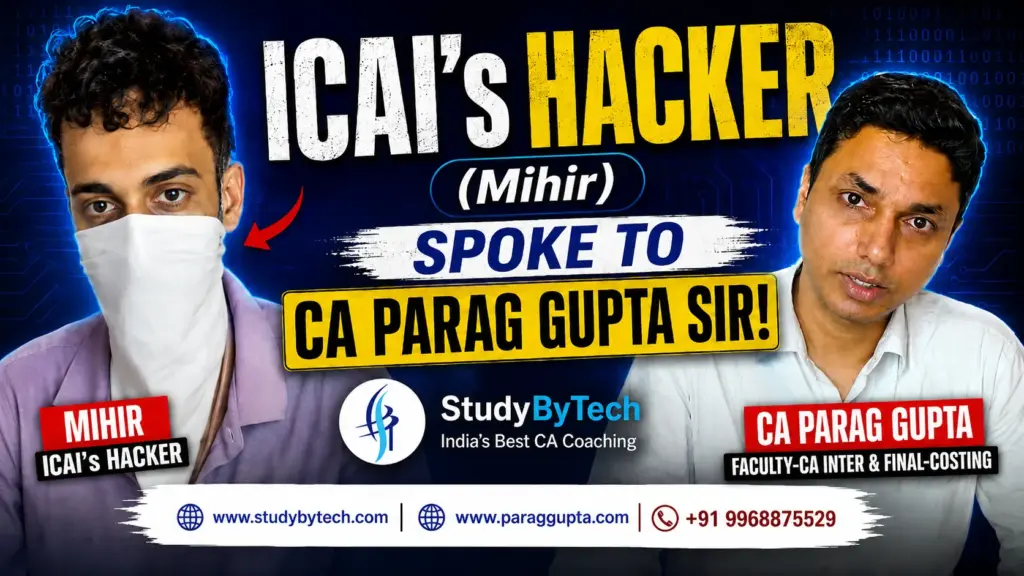
The ICAI Portal “Hack”: Ethical Intention or Malicious Act? CA. Parag Gupta and hacker, Mihir Shishulkar clarify the Controversy
The ICAI student’s body was also panicked out over the results of the CA Final Exams being released only one day from now. Not only that but allegations concerning data breaches also began circulating on various social media sites, resulting in panic and anxiety for many students waiting for their CA Final results. In an effort to get to the bottom of this, CA Parag Gupta, who is a very well known Costing faculty member, conducted an exclusive video conversation with a man named Mihir, (watch the full discussion here) who was at the heart of this controversy. The Initial Claim and the Atmosphere of Panic Around this time, Mihir came forward with information on serious security flaws at the ICAI’s examination site and informed the ICAI about them. After disclosing these issues, the conversation turned negative very quickly. On the dark web, Mihir’s name was reportedly misused and manipulated to suggest that he hacked into the ICAI’s exam site to manipulate students’ results when in actually he acted ethically in reporting the issues. CA Parag Gupta opened the discussion by emphasizing the seriousness of the matter. He clarified that his primary goal was to address the panic among students and that he had no way to independently verify the technical details of the claims . “I am not very proficient in ethical hacking… my purpose was only to talk to Mehur ji to bring students out of a panic situation,” he stated . He acknowledged that while he was giving Mihir the benefit of the doubt, if any malicious intent was proven, the law would take its course. Mihir’s Defense: An Ethical Disclosure Mihir presented his side of the story, maintaining that his actions were strictly for ethical reasons. The individual also claimed he found the weaknesses at 5:56 pm on June 12th 2026 and reported them to ICAI by 6:00pm, one hour later. He walked CA Parag Gupta through the alleged flaws, which he said included: Mihir emphasized that he did not modify any data and that the students’ answer sheets and marks were safe. “I have not leaked any data… your data is not modified,” he assured the students . He also showed screenshots from outside the database tables as proof of his access, stating he had over 200,000 records available . The Core Concern: Is the Data Safe? The most crucial question for students remains: Is their data compromised? Online reports suggest that the situation is likely a rumor. TCS, which maintains the data for ICAI, has reportedly confirmed that no data has been compromised . A chartered accountant, Dr. Rohit Ruwatia Agarwal, shared on social media that TCS had confirmed to him that there was “no substance” to the rumors of a data leak . Mihir’s own claims support this. He repeatedly stated that his access was for reporting vulnerabilities and that he did not steal or modify any data. CA Parag Gupta’s Final Appeal to Students After the interaction, CA Parag Gupta made a heartfelt appeal to the students. He emphasized the importance of not falling prey to panic, especially with results around the corner. He advised students to: Conclusion According to the video, the vulnerability that was found by the individual is now getting their chance to be heard (represented) as an impartial mediator, CA Parag Gupta, calms the worried students. While it is felt that the ICAI and other cybersecurity professionals have the true technical details of the situation, from Mihir’s account there is no reason to believe that his actions that disclosed this vulnerability were not ethically motivated nor that the student’s data had been compromised. Students are asked to remain calm, patient as they await the results and rely upon the official communication from the Institute of Chartered Accountants of India.
CA Inter Audit Exam Tips: Top 10 Secrets to Score Exemption (Updated Syllabus) 🎯 By CA Palki Lamba, Best Faculty for CA Inter Audit.“Achieving anything, especially success, does not come easy. Just as a little plant takes months to grow into a tree, you have to do the same while preparing for CA Inter Audit.” CA Inter Audit is Paper 5 of the ICAI CA Intermediate course, officially Auditing and Ethics, and a strong audit score can earn you an exemption. This guide is for CA Inter students who want the chapter-wise weightage and 10 practical exam tips from CA Palki Lamba. The key takeaway: understand the logic behind Standards on Auditing, use proper audit language, revise at least five times, and write answers in a four-step format. 📑 Table of Contents CA Inter Audit Syllabus & Chapter Weightage Top 10 Exam Secrets for CA Inter Audit Answer Writing Format (Tip 8) Exam-Day Time Management (Tip 9) Learn from the Best Faculty for CA Inter Audit Ready to Master Audit in Your First Attempt? Frequently Asked Questions ⭐ Key Takeaways Concept over rote: ICAI tests how you apply concepts, not how you memorise. Master SAs: Standards on Auditing carry 20–25 marks. Know the logic behind each. Use audit language: terms like “verify supporting documentary evidence” fetch more marks. 5 revisions minimum: the syllabus is vast, so plan at least 5 revision cycles. 4-step answers: Provision → Explanation → Application → Conclusion. Never leave blanks: partial answers with relevant points still fetch step marks. CA Inter Audit Syllabus & Chapter Weightage To score 60+ in CA Inter Audit, prioritise topics by their past exam weightage and difficulty: Priority Chapter / Topic Area Expected Marks Key Focus Areas A Standards on Auditing (SAs) 20–25 Marks SA 200, 240, 300, 315, 500, 505, 700 series (objectives, documentation & key principles). A Audit of Items of Financial Statements 12–15 Marks Assertions, verification of income, expenditure, assets, liabilities and disclosures. A Audit Report & Completion 10–12 Marks SA 700, 705, 706, Key Audit Matters (SA 701), CARO 2020 compliance. B Ethics & Professional Conduct 8–10 Marks Fundamental principles of ethics, independence of auditors, threats to independence. B Internal Control & Automated Environment 8–10 Marks Internal check vs internal audit, IT risks, application controls, testing controls. C Audit Documentation, Evidence & Sampling 6–8 Marks SA 230, SA 500, SA 530 (audit trail, working papers, sampling techniques). C Specialised Audits (Banks, Non-Profits, etc.) 6–8 Marks Audit of Banks, Educational Institutions, Hospitals and Hotels. Note for aspirants: follow the latest study material issued by ICAI for Paper 5: Auditing and Ethics, updated with the latest statutory amendments and ethical guidelines. Top 10 Exam Secrets for CA Inter Audit 🔑 1. Know What You Are Studying (Concept over Rote Learning) Audit isn’t just rote learning. ICAI tests concepts, principles and logic. If you memorise data, you’ll struggle to apply concepts in practical cases. 🔑 2. Master the Logic Behind Auditing Standards (SAs) Don’t study SAs mechanically. Understand why each standard exists. After reading one, try to explain it in your own words. 🔑 3. Master the “Language of Audit” (Keywords Matter) Presentation plays a massive role in scoring high. Examiners look for the professional terminology used in the ICAI study material. 🔑 4. Focus Heavily on Standards on Auditing (SAs) SAs are the core of Paper 5. Know the purpose of each standard as well as where it applies. Pro tip: if you remember the SA number, use it. If not, refer to it as the applicable standard on auditing and explain it precisely. 🔑 5. Practice Case-Based & Practical Scenario Questions CA Inter Audit increasingly features scenario-based case studies. To prepare: Solve the last 5–10 attempts of RTPs, MTPs and Past Year Questions (PYQs). Learn to spot the core legal/auditing issue quickly in a long narrative question. 🔑 6. Follow a Strict Multi-Revision Cycle The audit syllabus is huge, so it’s hard to retain. Use this revision technique: Do at least five revision cycles before the exam. Set aside at least 45 minutes every day to revise audit. Use flow charts, mind maps and summary notes to remember better. 🔑 7. Create Concise Summary Revision Notes Draft short notes on: The core Audit Process & Assertions. Key summary points of Standards on Auditing (SAs). Company Audit provisions & CARO 2020 checklists. 🔑 8. Develop Professional Answer Writing Skills Practising written answers under timed conditions is non-negotiable. Split every practical or case answer into four zones: 1. Standard /Provision 2. Explainthe Requirement 3. Apply tothe Given Case 4. Conclude asan Auditor The auditing standard / relevant provision of law. An explanation of the requirement or rule. How it applies to the case at hand. Conclude your answer and give your opinion as an auditor. 🔑 9. Master Exam-Day Time Management First 15 minutes: read the paper carefully, pick the optional question you won’t attempt, and mark the questions you can solve with high confidence. Next 20 minutes: solve the easy, straightforward 30-mark MCQs while your mind is fresh. Execution: never leave a question blank. Write relevant points, standards or formulas. Partial attempts fetch crucial step marks. 🔑 10. Treat Audit as a Daily Practical Discipline The biggest mistake is treating Audit as a “last-month theory subject.” Treat it like a practical discipline: understand it, apply it and revise it continuously. Learn from the Best Faculty for CA Inter Audit To build a solid understanding of concepts and master the language of audit, CA Palki Lamba Ma’am is considered the foremost faculty for CA Inter Audit. Why Palki Lamba Ma’am? Her interactive approach helps students learn tough auditing norms in a way that connects to daily life, through: Interactive classroom discussions where no doubt is too small. Exhaustive coverage of ICAI Study Material, past papers, RTPs and MTPs. Special presentation workshops for writing ICAI-compliant technical answers. Comprehensive doubt support via direct phone calls and discussion forums. Course Highlights Price₹8,000 to ₹12,000 EMI0% EMI Available Batch sizeSmall batch, big benefits
CA Final IBS September 2025: Complete Exam Review & Future Strategy
Let’s dive into a comprehensive analysis of the CA Final IBS September 2025 examination. After all, it’s essential to understand exactly what the examiner asked from each subject and how the paper’s structure has evolved. This analysis will help both current students and future aspirants strategize effectively. Take a look on Parag sir’s review on CA Final IBS Sept 2025 exam: CA Parag Gupta Major Shift: CA Final May 2025 CA Final Sept 2025 Group 1 weightage was 40 marks FR was of 12 marks Group 1 weightage was of 53 marksFR was of 22 marks Group 2 weightage was 43 marks Group 2 weightage was of 37 marks SPOM- 42 marksOut of which SPOM-set B was of 24 marks & SPOM-set A was of 18 marks SPOM- 35 marksOut of which SPOM-set B was of 22 marks & SPOM-set A was of 13 marks Group 1 Takes Center Stage The most significant observation from September 2025 is the substantial increase in Group 1 weightage. Group 1 weightage increased from 40 marks to 53 marks, a staggering 32.5% increase which shows evidence of a purposeful change on the part of the examiner, signaling an increase in the emphasis placed on foundational subjects. Financial Reporting (FR) has seen the most substantial level of change, from 12 marks to 22 marks. This is significant enough that students will no longer be able to treat FR as an afterthought. Group 2 Sees Strategic Reduction In contrast, Group 2 has seen a substantial reduction in its weightage. The weightage has decreased from 43 to 37 marks. This adjustment validates the examiner’s rebalancing approach. While this group, made up of Direct Tax (DT) and Indirect Tax (IDT), holds a smaller mark weightage as part of the total than before, it is still a notable part to achieve overall success. The SPOM Reality Check: Your Make-or-Break Subject Now, let’s discuss the elephant in the room – Self Paced Online Module(SPOM). Many students ask, “Which subjects of SPOM are most important for CA Final IBS exam?” Here is the full story: Current Attempt (September 2025): Total SPOM: 35 marks SPOM-set A(SCPM): 22 marks Law: 13 marks Previous Attempt: Total SPM: 42 marks SCPM: 24 marks Law: 18 marks While SPOM has slightly decreased from 42 to 35 marks, here’s the critical insight: if you want to clear IBS, you must give maximum attention on SCPM. Why? Because SCPM has emerged as the most important subject for CA Final IBS exam. Why SCPM is Your Gateway to Success Look at the pattern: while other subjects’ figures keep fluctuating up and down, SCPM’s figures are almost consistent. This consistency makes one thing absolutely clear – you cannot ignore SCPM, and you certainly cannot take it lightly. If you approach it casually, your entire paper will suffer. For future aspirants, juniors, or those who haven’t appeared this time, here’s what you need to focus on: treat SCPM preparation exactly like you prepared for Group 1 and Group 2. Don’t fall into the trap thinking that “SCPM can be managed with a limited set of MCQs.” This mindset is fundamentally wrong. The Study Strategy That Actually Works You need to study systematically and wholeheartedly. Check which topics are located where. As students face problem in exam despite having an open-book examination lasting 4 hours, students fail to locate which topic is where and what has been asked from which section. They get stuck and waste precious time. Revise the gist of the concepts, to make it possible to complete th exam. Conclusion: Your Path Forward At the September 2025 CA Final IBS exam, it has been clearly demonstrated that consistency beats erraticism. While the weightages of either Group 1 or Group 2 may change, SCPM remains your constant stable parameter that can facilitate or hamper your IBS results. Do not take a chance with your CA Final journey. Respect the importance of SCPM and prepare for it accordingly, and SCPM will become your greatest asset in giving you the ability to pass the IBS paper. Consistency with preparation leads to consistent results in CA Final. Parag Gupta sir’s SCPM classes have special emphasis on IBS portion of SCPM syllabus, helping CA final students to study & revise the course as per IBS(Paper 6) exam. Want to enroll to CA Final SPOM-set B + IBS(SCPM portion) classes? FAQ’s Which subject to choose for SPOM? SPOM comprises four sets – Set A (Corporate and Economic Laws) and Set B (Strategic Cost & Performance Management) are compulsory for all students. Set C provides 10 elective subjects such as Risk Management, Sustainable Development, International Taxation. Set D comprises 4 multidisciplinary courses such as Constitution of India, Entrepreneurship, Psychology, and Digital Ecosystem. Parag sir’s lectures of Set B (Strategic Cost & Performance Management) are thorough in nature, explaining difficult costing & Strategic management principles simple manner. What is IBS in CA final? IBS is Paper 6: Integrated Business Solutions – a mandatory multidisciplinary case study paper for CA Final Group 2. It integrates all seven subjects of the earlier CA syllabus into integrated business situations. The paper tests students’ skills in analyzing intricate business situations and offering complete solutions. Is the spom exam easy? SPOM papers are relatively simpler than CA Final exams. These comprise MCQs with no negative marking and unlimited attempts. Yet, recent trends indicate Set B(Costing) becoming tough for most students, so adequate preparation is required. Is IBS an open book exam? Yes, IBS Paper 6 is an open book exam. As per ICAI’s official notification, Final Paper 6: Integrated Business Solutions is an open book and case study-based examination. You are allowed to bring all your subject materials, ICAI modules, concept notes, and question banks to the exam. CA Final preparation demands advanced understanding. Parag Gupta mentors students through mock tests and doubt-clearing at StudyByTech.
Best faculty for CA Inter Costing: 5 qualities that make Parag Gupta Sir stand out
CA Inter Costing Best Faculty: Why Parag Sir is the Best? | StudyByTech 📞 +91 99688 75529 • StudyByTech — Learn · Excel · Results STUDY BY TECH CA INTER · COST & MANAGEMENT ACCOUNTING Best Costing Faculty for CA Inter Costing: 5 Qualities That Make Parag Gupta Sir Stand Out Parag Gupta Sir is the best CA Inter Costing faculty for five reasons: ex-examiner insight, included test series, same-day 1-on-1 doubt resolution, the 59-question revision list, and 20 hours of bonus course access with his book. By StudyByTech Team · Cost & Management Accounting Choosing a faculty for CA Inter Costing can be challenging. There are so many different teachers and options available online and offline that picking one who will actually help you understand this subject — not just finish the syllabus — is tough. CA Parag Gupta Sir is considered students’ most recommended faculty for Costing at CA Inter & Final level. He does not just teach costing; his way of concept clarity, combined with his approach to taking doubts from each student, is admirable. Let’s find out what makes Parag Gupta Sir different from other faculties. Related resources CA Inter Classes Registration, Fees & Syllabus Admit Card Exam Dates Study Guides & Tips CA Inter Faculties FAQ Table of Contents 1. Insights from an ex-examiner + in-class difficulty-based tests 2. Test series included with the course enrollment 3. 1-on-1 doubt sessions that are actually accessible 4. The magical 59 questions to score 60+ marks 5. Bonus 20 hours of full course access with his book Final thoughts Key takeaways FAQs About Parag Gupta Sir Here are 5 standout qualities that truly make Parag Gupta Sir the best CA Inter Costing faculty 1 Insights from an Ex-Examiner + In-Class Difficulty-Based Tests Parag Sir’s background as an ex-examiner is a huge advantage. He teaches you how to write answers the way examiners want to see them. In his classes, he breaks down how papers are checked, common mistakes students make, and how to present your answer properly. He also conducts in-class tests that are difficulty-based — not just a formality. These tests actually help you measure your real understanding of a topic. They’re an eye-opener and guide your preparation in the right direction. 2 Test Series Included With the Course Enrollment One of the first things that impresses students is that Parag Sir provides a full-fledged test series as part of the course itself — no extra payment, no separate registration. And these aren’t just any random tests. They’re curated to ensure that every important topic gets covered. The questions are structured to reflect real exam patterns, helping you build both confidence and speed as you prepare. 3 1-on-1 Doubt Sessions That Are Actually Accessible Doubt-solving is often where many faculties fail. They either redirect you to Telegram groups or assistants, or may take a week or so to solve your doubts. But Parag Sir personally attends to students’ doubts, usually the same day they are asked. Whether it’s a small confusion or a concept you completely missed, his 1-on-1 sessions are easily accessible and super helpful. You feel like you’re actually being guided by someone who cares about your learning — and he assures you that he’s with you till you reach your exam hall. This kind of guidance and approach is really very much appreciated by his students. 4 The Magical 59 Questions to Score 60+ Marks for Last-Day Revision Every CA student feels under pressure to revise the whole course before their exams. That’s why Parag Sir’s list of 59 selected questions is a blessed handout. These questions ensure your revision covers the most exam-relevant topics and concepts. Simply using this list will help improve your confidence and your chances of scoring 60+ marks in Costing — even if you haven’t prepared perfectly. 5 Bonus 20 Hours of Full Course Access With His Book Another thoughtful feature: when you get Parag Sir’s book, you also get 20 hours of access to his full course videos. This means if you’re stuck on a topic or just want to revisit something in detail, you can simply log in and watch that portion again. It’s a perfect blend of textbook and video learning, giving you the flexibility to revise as needed. Subscribe to the 8th Edition Book → Final Thoughts If you’re preparing for CA Inter Group 2 and looking for someone who doesn’t just cover the syllabus but helps you master it — Parag Gupta Sir is the name to trust. From personalized doubt support to deep insights from an examiner’s point of view, his classes offer a complete learning experience. Costing may seem like a tough subject, but with the right mentor, it becomes manageable — even enjoyable. Parag Sir proves that the right teacher makes all the difference. Key Takeaways Parag Sir is an ex-examiner, so he teaches you to write answers the way examiners actually check them. In-class difficulty-based tests give an honest, eye-opening measure of your real preparation. A full test series is included with enrollment — no extra cost, exam-pattern questions. 1-on-1 doubt sessions are personally handled by Parag Sir, usually resolved the same day. The curated list of 59 questions is built to help you score 60+ marks even in last-day revision. His book comes with a bonus of 20 hours of full course video access for self-study learners. Overall, students get concept clarity, exam-ready practice, and mentorship that lasts till exam day. Ready to start your CA Inter Costing preparation? Learn Costing the way examiners expect it — with India’s most recommended faculty. Explore Costing Classes → FAQs Is Parag Gupta good for CA Inter Costing? Absolutely! CA Parag Gupta Sir is widely regarded as one of the best faculties for CA Inter Cost & Management Accounting. What sets him apart is his concept-first teaching approach—instead of asking students to memorize complex formulas, he breaks down the logic behind every concept so it actually sticks. CA Parag Gupta sir