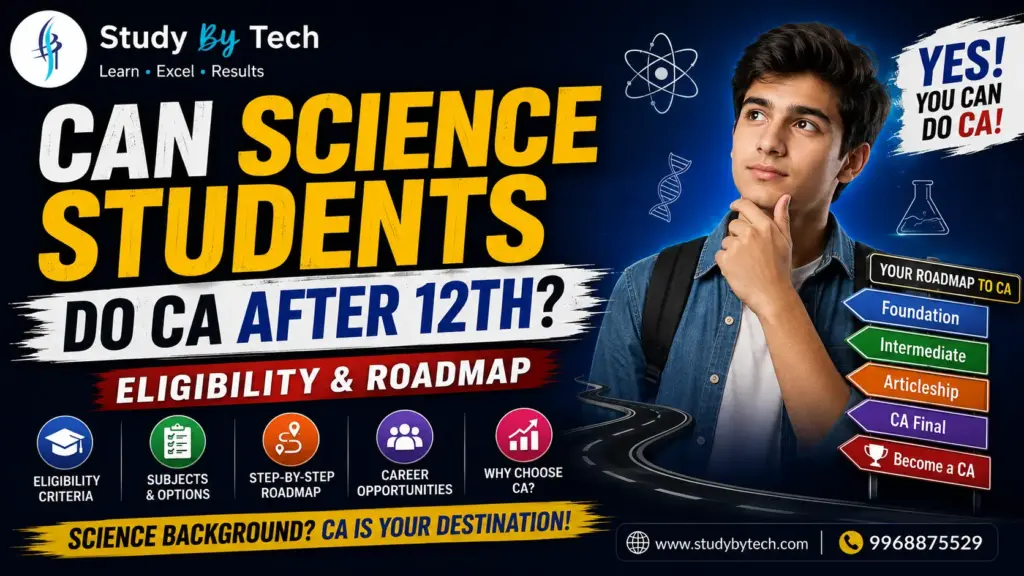
Can Science Students Do CA After 12th? Complete Guide, Eligibility & Strategy Yes, science students can do CA after 12th. ICAI accepts students from any stream, with no minimum percentage for CA Foundation. This guide is for Class 12 science students and B.Sc or B.Tech graduates considering CA. You’ll get the two entry routes, the step-by-step CA roadmap, science students’ strengths, common challenges and fixes, a CA Foundation strategy and a science-vs-commerce comparison. Key takeaway: by month three, you’re on a level playing field. 🎯 Your complete roadmap to CA for science studentsFrom eligibility to exam strategy7 minute read Enroll NowDirect Entry in CA 📑 Table of Contents 1. ICAI Eligibility Criteria for Science Students 2. Step-by-Step Roadmap: Becoming a CA 3. Can I Do CA After B.Tech or B.Sc? 4. Strengths & Hidden Advantages of Science Students 5. Common Issues & Solutions 6. Strategy for CA Foundation Papers 7. Science vs Commerce Students Frequently Asked Questions ⭐ Key Takeaways Yes, you can ICAI allows students from any stream (PCM/PCB/PCMB) to pursue CA. Two entry routes CA Foundation after 12th (no minimum %) or Direct Entry after B.Sc/B.Tech (≥60%). CA Foundation papers Accounting, Business Laws, Quantitative Aptitude, Business Economics. Science students’ advantages Strong quantitative aptitude, analytical thinking, problem-solving stamina and study discipline. Key challenges Understanding accounting terminology, adjusting to subjective law papers, and overcoming the commerce-student mental block. Foundation strategy Master fundamentals, practise ICAI material, use the PFAC format for law, and use graph skills for economics. Level playing field By month 3 of preparation, science and commerce students are on equal footing. Direct Entry advantage B.Sc/B.Tech graduates can skip CA Foundation and register directly for CA Inter (if ≥60%). 1. ICAI Eligibility Criteria for Science Students ICAI treats all candidates equally, whichever stream they chose in high school. There’s no special quota based on stream, and science students don’t need any extra certificates. Entry Channels for Students with a Science Background CA Foundation Course Path (After 12th Science) Educational requirement: You must have passed or appeared in your Class 12 board exams (PCM/PCB/PCMB). Percentage requirement: There’s no minimum percentage in Class 12 to apply for the CA Foundation exam. Provisional membership: You can get provisional membership with ICAI’s Board of Studies after passing Class 10. Study period: A compulsory 4-month study period must be completed between ICAI membership and the exam date. Direct Entry Route (After B.Sc or B.Tech) Educational qualification: Science graduates with a 3-year B.Sc or 4-year B.Tech/B.E. degree don’t need to appear for CA Foundation at all. Minimum marks: Graduates from a non-commerce field need an aggregate score of 60% to be eligible for direct entry to CA Inter. Know more about Direct Entry in CA 2. Step-by-Step Roadmap: Becoming a CA After 12th Science Under ICAI’s New Scheme of Education and Training, the CA qualification has three main exam stages along with practical articleship training: Step 1 CA Foundation Exam. 4 papers: Accounts, Law, Maths/Stats, Economics. ➜ Step 2 CA Intermediate. 6 papers split across Group 1 & Group 2. ➜ Step 3 ICITSS & Articleship. 4-week soft skills/IT training + 2-year practical training. ➜ Step 4 SPOM Modules & AICITSS. Self-Paced Online Modules + Advanced IT. ➜ Step 5 CA Final Exam. 6 advanced papers + qualified CA designation. Stage 1: CA Foundation After your Class 12 board exams, join ICAI and pass 4 basic papers: Paper 1: Accounting (100 marks, subjective) Paper 2: Business Laws (100 marks, subjective) Paper 3: Quantitative Aptitude: Business Mathematics, Logical Reasoning & Statistics (100 marks, objective) Paper 4: Business Economics (100 marks, objective) Stage 2: CA Intermediate Passing CA Foundation paves the way for CA Intermediate, which has 6 papers split into Group 1 and Group 2. Stage 3: ICITSS & 2 Years Articleship Before the 2-year practical training, you need to complete ICITSS, which lasts 4 weeks. Stage 4: SPOM & CA Final During articleship, clear SPOM Sets A, B, C, D and Advanced ICITSS. After fulfilling all articleship and study requirements, appear for the CA Final exam. 3. Can I Do CA After B.Tech or B.Sc? (Direct Entry Guide) Many engineering and science students find, during or after their studies, that they want to switch to careers like corporate finance, investment banking, management consultancy or auditing. Eligibility Science or Engineering graduates with ≥60% marks in aggregate can register directly for CA Intermediate. Advantage It saves you from taking the 4-paper CA Foundation, which takes 6 to 12 months. Strategy Since direct entry students join CA Intermediate straight away, science students should spend 4 to 6 weeks on the basics of double-entry bookkeeping, the debit/credit system and basic accounting. 4. Strengths & Hidden Advantages of Science Students in CA Commerce students enter CA with some exposure to basic accounting terms, but science students have thinking habits that turn out to be major assets: Advantage Why Science Background Helps Direct CA Application Quantitative Aptitude In-depth familiarity with calculus, algebra, and statistics. High scores in CA Foundation Quantitative Aptitude & CA Inter Costing / FM. Logical & Analytical Thinking Practice with complex scientific proofs and physical laws. Analysing complex case studies in Business Law, Tax Planning, and Audit. Problem-Solving Stamina Used to solving multi-step mathematical and physics problems. Tackling lengthy numerical problems in Costing and Advanced Accounting. Study Discipline Habitual focus required for competitive entrance exams (JEE/NEET). Managing the 8-10 hour daily study schedule required during CA revision. 5. Common Issues Faced by Science Stream Students, and Their Solutions The switch from equations to accounts can be tricky for science students at the beginning. Knowing the issues before the exam saves time. 📌 Challenge 1: Understanding common accounting terms The issue: Debits, Credits, Trial Balance, Depreciation, Balance Sheet, Provision and Capital Expenditure sound like a foreign language in the first few weeks. ✅ Solution: Spend 15-20 days learning the basic accounting terminology covered in the NCERT Accountancy books of Class 11 and 12 (Golden Rules of Accounts, Journalising and Ledgers). Don’t mug up accounting. See it as a
Blog
CA Foundation Coaching Classes Near me
Would you like to learn how to become CA-certified? Are you eager to advance your job by traveling or attending classes in other cities? There are many things that you need to do for your career, and one of the most important is to get CA foundation coaching classes near me. The purpose of this article is to give you some tips on how you can choose the best CA foundation coaching brand in your city. When it comes to choosing a course, can seem like a daunting task, but don’t worry—we’ve done all the hard work for you by going through all the options with you and bringing our top three contenders into focus. What exactly is the CA Foundation? CA Foundation is an entry-level exam for students interested in chasing a career in CA. It is administered by the Institute of Chartered Accountants of India (ICAI) and is the first step towards becoming a CA in India. Students who have finished their 10+2 or equivalent examination from a recognized board or university are good candidates for the CA Foundation program. The course divides into four papers that include topics such as accounting principles and practices, business laws, business communication and reporting, business mathematics and logical reasoning, and statistics. The CA Foundation examination use to give twice a year, in May and November, and take online. Students who pass the CA Foundation examination are able to participate in the CA Intermediate course, which is the next level in the CA course. Here’s the short intro about CA Foundation Syllabus The CA Foundation course contains four papers, each carrying a weightage of 100 marks. The papers are as follows: The CA Foundation syllabus use to design to provide students with a strong foundation in the basics of accounting, business law, mathematics, statistics, and logical reasoning. It aims to equip students with the knowledge and skills required to pursue a career in chartered accounting. Join India’s Best CA Foundation Classes – StudyByTech: Click Here Who should take the CA Foundation Classes? CA Foundation classes are ideally suited for students who have completed their 10+2 or equivalent examination and are interested in pursuing a career in chartered accounting. The classes use to design to provide students with a strong foundation in the basics of business laws, mathematics, statistics, and logical reasoning, which are crucial for pursuing a career in chartered accountancy. In addition to students who want to become chartered accountants, CA Foundation classes may also be beneficial for students who want to pursue a career in finance, accounting, or business. The knowledge and skills gained through the CA Foundation course can apply in a variety of business and finance-related roles, making it a valuable qualification for anyone interested in these fields. Furthermore, students who have a strong aptitude for numbers, an analytical mind, and an interest in pursuing a career in finance or accounting may find the CA Foundation course particularly well-suited to their interests and abilities. Overall, anyone who wants to pursue a career in finance, accounting, or business, and has the requisite educational qualifications, may benefit from taking CA Foundation classes. How to find CA foundation classes near you? There are many ways to find the best coaching classes for CA Foundation near your area. One of the most effective ways is through the website. Which has almost all good institutes listed for CA classes in India, i.e., list.studybytech.com. Although if you are from Delhi, then our coaching center, Parag Gupta Classes in Laxmi Nagar, is said to be the most efficient coaching center in Delhi and provides both online and offline classes for CA. Since the last 10 years, Parag Gupta Classes has created so many efficient CAs in the industry that now students. First recommendation is PARAG GUPTA CLASSES. Don’t worry; if you are living in another city, you can join Parag Gupta classes through their online mode. Don’t worry about your doubts. Each and every doubt will be discuss through video calling by your teachers. FAQs Q. Which coaching is best for CA Foundation? A. Some factors that you should consider while choosing a coaching institute for the CA Foundation include:Faculty: Parag Gupta Classes has the best-experienced faculties in this industry.Location- The classes should situate at a place where students will not face any problem commuting to coaching.Fees: The fees for coaching shall be affordable so that average students can also use the facilities of good institutes.Student Teacher Ratio- This is one of the important factors for Students for comprehending & getting the goal at the earliest. At Parag Gupta Classes, the student-teacher ratio is always consider low to maintain student-teacher interactions at a high level. This is the reason why every year, the maximum passing percentage is from this institute. Q. What are the CA Foundation coaching fees? A. The CA Foundation coaching fees may vary depending on the coaching institute or the individual tutor you choose. Generally, the fees range from Rs. 15,000 to Rs. 35,000 in India. Some of the good institutes, like Parag Gupta Classes, offer quality education to CA students with very good scholarship programs for needy and eligible students so that each student can get the best for his or her education. Q. Is CA Foundation very easy? A. CA Foundation is the entry-level exam for the Chartered Accountancy (CA) course in India. While it may not consider an extremely difficult exam, it is also not very easy. It requires a good understanding of fundamental accounting principles, mathematics, and legal aspects related to business and finance. To pass the CA Foundation exam, one needs to study and prepare diligently, have a good grasp of the concepts and principles, and practice solving questions regularly. The exam use to design to test the candidates’ knowledge and understanding of the subjects, and it is not uncommon for students to attempt the exam multiple times before passing. Therefore, while it may not be impossible to clear the CA Foundation exam, it requires dedication,
सीए डायरेक्ट एंट्री: CA Inter & CA Final की सम्पूर्ण मार्गदर्शिका (हिंदी में) ग्रेजुएशन के बाद सीए बनने का सबसे तेज़ रास्ता | फाउंडेशन स्किप करें सीए डायरेक्ट एंट्री ICAI की वह योजना है जिससे ग्रेजुएट सीधे CA Inter में प्रवेश लेते हैं और फाउंडेशन स्किप कर देते हैं। यह गाइड CA Inter & CA Final का सपना देखने वाले ग्रेजुएट और CA छात्रों के लिए है। कॉमर्स ग्रेजुएट के लिए 55% और नॉन-कॉमर्स के लिए 60% अंक चाहिए। इस रास्ते से CA 4–4.5 साल में बन सकते हैं, रजिस्ट्रेशन फीस ₹18,000 है (ICITSS फीस अलग) और आर्टिकलशिप 2 साल की है। StudyByTech | India’s No. 1 CA Classesहिंदी में पूरी जानकारी डायरेक्ट एंट्री स्पेशल क्लासेस – डेमो लेंCA Inter ClassesCA Final Classes विषय सूची (Table of Contents) डायरेक्ट एंट्री, फाउंडेशन और नॉन-कॉमर्स रूट सीए डायरेक्ट एंट्री क्या है? पात्रता (Eligibility) स्टेप बाय स्टेप रजिस्ट्रेशन प्रोसेस डायरेक्ट एंट्री बनाम फाउंडेशन – तुलना तालिका स्टडीबायटेक का विशेष मार्गदर्शन क्या डायरेक्ट एंट्री मुश्किल है? अक्सर पूछे जाने वाले सवाल (FAQs) CA Inter क्लासेस में एडमिशन मुख्य बातें (Key Takeaways) सीधा प्रवेश सीधे CA Inter में प्रवेश, फाउंडेशन नहीं। पात्रता कॉमर्स ग्रेजुएट: 55% | नॉन-कॉमर्स: 60%। CS या CMA इंटर पास भी पात्र। समय बचत डायरेक्ट एंट्री से 4–4.5 साल में CA, जबकि फाउंडेशन रूट में 5–5.5 साल। फीस ₹18,000 (रजिस्ट्रेशन + एक्टिविटी + आर्टिकलशिप) + ICITSS कोर्स फीस अलग। आर्टिकलशिप नई योजना में 2 साल, और इंटर के दोनों ग्रुप पास करने के बाद ही शुरू। डायरेक्ट एंट्री, फाउंडेशन और नॉन-कॉमर्स रूट डायरेक्ट एंट्री सीधे CA इंटर में प्रवेश, फाउंडेशन नहीं कॉमर्स ग्रेजुएट: 55% | नॉन-कॉमर्स: 60% समय बचत: 4-4.5 साल में CA नई योजना: आर्टिकलशिप 2 साल प्रोविजनल रजिस्ट्रेशन (फाइनल ईयर) फाउंडेशन रूट 12वीं के बाद फाउंडेशन पास करना ज़रूरी कुल 5-5.5 साल लगते हैं बेसिक अकाउंटिंग सीखने का मौका ग्रेजुएट्स के लिए अनावश्यक देरी नॉन-कॉमर्स ग्रेजुएट बी.एससी / बी.ए / इंजीनियरिंग: 60% → डायरेक्ट एंट्री स्टडीबायटेक ब्रिज कोर्स एक्स्ट्रा सहायता ICAI की ओर से स्पेशल छूट एक्स्ट्रा मेहनत से बेहतरीन करियर सीए डायरेक्ट एंट्री क्या है? (पूरी जानकारी) इंस्टीट्यूट ऑफ चार्टर्ड अकाउंटेंट्स ऑफ इंडिया (ICAI) हर साल हजारों स्नातकों को Direct Entry Scheme के तहत सीए कोर्स में फाउंडेशन स्तर छोड़ने की सुविधा देता है। यह मार्ग विशेष रूप से B.Com, BBA, BMS, M.Com, MBA Finance, BAF और अन्य स्ट्रीम (साइंस/आर्ट्स) के ग्रेजुएट्स के लिए है। ग्रेजुएशन के बाद सीए बनने का यह सबसे प्रभावी और समय बचाने वाला विकल्प है। समय बचत फाउंडेशन स्किप से 8-12 महीने बचते हैं, डायरेक्ट एंट्री से 4-4.5 साल में सीए संभव। फीस संरचना CA Inter रजि: ₹15,000 + ₹2,000 (स्टूडेंट एक्टिविटी) + ₹1,000 (आर्टिकलशिप) = ₹18,000 + ICITSS कोर्स फीस अलग। आर्टिकलशिप नियम (नई योजना) 2 वर्ष की प्रैक्टिकल ट्रेनिंग। अब 9 महीने की पुरानी शर्त खत्म, सीधे 2 साल। इंटर के दोनों ग्रुप पास करने के बाद ही आर्टिकलशिप शुरू। पात्रता (Eligibility) – कौन कर सकता है डायरेक्ट एंट्री? कॉमर्स ग्रेजुएट/पोस्ट ग्रेजुएट (B.Com, BBA, BMS, M.Com, MBA Finance) – न्यूनतम 55% अंक नॉन-कॉमर्स ग्रेजुएट (B.Sc, B.A, B.Tech, BCA आदि) – न्यूनतम 60% अंक ICSI (CS) इंटरमीडिएट या ICMAI (CMA) इंटर पास छात्र सीधे CA इंटर में प्रवेश पाते हैं। अंतिम वर्ष के छात्र: प्रोविजनल रजिस्ट्रेशन कर सकते हैं, लेकिन ग्रेजुएशन प्रमाणपत्र 6 महीने के भीतर ICAI को जमा करना अनिवार्य, नहीं तो रजिस्ट्रेशन रद्द और फीस ज़ब्त। स्टेप बाय स्टेप रजिस्ट्रेशन प्रोसेस Step 1 ICAI के SSP पोर्टल पर जाएं और नया अकाउंट बनाएं। ➜ Step 2 “Direct Entry Route” का चयन करें, CA इंटर के लिए आवेदन करें। ➜ Step 3 10वीं, 12वीं, ग्रेजुएशन की मार्कशीट, फोटो, सिग्नेचर, ID प्रूफ अपलोड करें। Step 4 ऑनलाइन फीस जमा करें – ₹18,000 (रजिस्ट्रेशन + एक्टिविटी + आर्टिकलशिप रजिस्ट्रेशन)। ➜ Step 5 कन्फर्मेशन मिलने के बाद आपकी 8 महीने की स्टडी पीरियड शुरू। अब CA इंटर की तैयारी करें। ➜ Step 6 ICITSS (Orientation Course + IT) कोर्स प्रोविजनल पीरियड के दौरान कर सकते हैं, लेकिन आर्टिकलशिप केवल इंटर क्लियर करने के बाद शुरू होगी। डायरेक्ट एंट्री बनाम फाउंडेशन – तुलना तालिका पैरामीटर डायरेक्ट एंट्री (ग्रेजुएट्स) फाउंडेशन रूट प्रवेश स्तर सीधे CA इंटर CA Foundation → Inter न्यूनतम अवधि 4 – 4.5 साल 5 – 5.5 साल योग्यता % कॉमर्स 55% / अन्य 60% 12वीं में 50% आर्टिकलशिप अवधि 2 साल (नई योजना) 2 साल फाउंडेशन एग्ज़ाम नहीं देना पड़ता देना अनिवार्य स्टडीबायटेक का विशेष मार्गदर्शन – डायरेक्ट एंट्री छात्रों के लिए बेस्ट रणनीति 1 सबसे पहले ICAI मॉड्यूल, RTP, MTP को प्राथमिकता दें – परीक्षा में अधिकतम प्रश्न इन्हीं पर आधारित होते हैं। 2 कांसेप्ट क्लियर करने के लिए StudyByTech की LIVE इंटरैक्टिव क्लासेस ज्वाइन करें – ऑनलाइन/ऑफलाइन दोनों माध्यम उपलब्ध। 3 समय प्रबंधन: आर्टिकलशिप के चक्कर में पढ़ाई को न टालें – पहले इंटर क्लियर करने पर फोकस करें। 4 रिवीजन प्लान: हर विषय का कम से कम 3 बार रिवीजन करें। मॉक टेस्ट नियमित रूप से दें। 5 ग्रेजुएट्स को फायदा: आप अकाउंटिंग, बिजनेस लॉ की बेसिक समझ रखते हैं – इसका लाभ उठाएं। डायरेक्ट एंट्री स्पेशल क्लासेस – डेमो लें क्या डायरेक्ट एंट्री मुश्किल है? चुनौतियाँ और समाधान CA इंटर सिलेबस ग्रेजुएशन से काफी एडवांस है, लेकिन ग्रेजुएट्स में मैच्योरिटी और डिसिप्लिन होता है। आम गलतियाँ जल्दी आर्टिकलशिप शुरू करके पढ़ाई पर ध्यान न देना ICAI स्टडी मटीरियल को नज़रअंदाज़ करना टाइम मैनेजमेंट में कमी समाधान एक रोज़ का 6-7 घंटे का रूटीन बनाएं हर हफ्ते टेस्ट दें StudyByTech के अनुभवी फैकल्टी से मार्गदर्शन लें लाखों छात्र पहले यह रास्ता अपना चुके हैं – आप भी कर सकते हैं! अक्सर पूछे जाने वाले सवाल (FAQs) – हिंदी में Q1. क्या मैं ग्रेजुएशन के फाइनल ईयर में डायरेक्ट एंट्री के लिए अप्लाई कर सकता हूँ? हाँ, ICAI प्रोविजनल रजिस्ट्रेशन की सुविधा देता है। लेकिन ग्रेजुएशन पूरा होने के 6 महीने के अंदर 55% (कॉमर्स) या 60% (अन्य) की मार्कशीट जमा करना अनिवार्य है। Q2. बिग 4 (Deloitte, PwC, EY, KPMG) डायरेक्ट एंट्री वालों को आर्टिकलशिप देते हैं? बिल्कुल! Big4 उन छात्रों को प्राथमिकता देती हैं जिन्होंने CA इंटर पहले या दूसरे प्रयास में डिस्टिंक्शन के साथ पास किया हो। संचार कौशल और आत्मविश्वास भी ज़रूरी है। Q3. सीए डायरेक्ट एंट्री
After CA Inter & CA Final Exam Result: Expert Tips and Strategies
After CA Inter & CA Final Exam Result: Expert Tips and Strategies Your CA Inter & CA Final result sets your next move, and the first 48 hours matter most. This guide is for CA students and covers all four outcomes. Passed CA Intermediate? Finish ICITSS training, clear SPOM, then hunt for articleship. Missed it? Study your certified copies and fix Costing. Cleared CA Final? Go for ICAI campus placements and upskill. Missed it? Master SPOM Set B (SCPM), because it feeds the IBS paper. For CA Inter & CA Final students48-hour action plan5–7 minute read CA Foundation ClassesCA Inter ClassesCA Final ClassesStudyByTech OffersContact us Table of Contents Part 1: The CA Inter Result – What’s Next? Part 2: The CA Final Result – The Final Leap Result Cheat Sheet: All Four Outcomes Conclusion FAQs on CA Inter & CA Final Results Want to Enroll in Our Classes? Key Takeaways Passed CA Inter? Do this in order: ICITSS training, SPOM exams (Set A, B, C, D), then your articleship hunt at a Big 4 or mid-sized firm. Failed CA Inter? Analyze your certified copies, focus on Costing (40 to 70), and build LDR revision notes. Passed CA Final? Register for ICAI Campus Placements, then upskill in Excel, Power BI and SAP. Failed CA Final? Master SPOM Set B (SCPM) for the IBS paper, use the keyword technique for Audit, and summary charts for IDT. The release of CA Inter and CA Final results is a defining moment. Whether you’re celebrating a pass or figuring out a fail, what you do in the next 48 hours shapes your career. At StudyByTech, we’ve split the path forward into two clear blueprints. Part 1: The CA Inter Result – What’s Next? Scenario A: You Passed CA Inter! Congratulations! You’re now a semi-qualified professional. Here’s your 3-step plan for what comes after CA Intermediate: Step 1 Complete ICITSS (ITT & OC) ➜ Step 2 Clear SPOM exams (Set A, B, C & D) ➜ Step 3 Start your articleship hunt 1. Complete ICITSS training (ITT & OC) immediately Before you step into an office for articleship, you need to finish the Integrated Course on Information Technology and Soft Skills (ICITSS). What it includes: 15 days of Information Technology Training (ITT) and 15 days of the Orientation Course (OC). Registration: You do it through the ICAI SSP Portal. Pro tip: Seats fill up within minutes of result declaration. Register ASAP to avoid a 3-month delay in starting your articleship. 2. Clear SPOM exams (Set A, B, C & D) Under the new scheme, you must clear the Self-Paced Online Modules (SPOM) before you’re eligible for CA Final. Strategic advantage: Understanding Set A and Set B (SCPM) will save you in CA Final, because this syllabus is heavily tested in the IBS paper. 3. The articleship hunt Aiming for the Big 4 or a reputed mid-sized firm? Make sure your resume shows the technical skills from ITT and the soft skills from your OC training. Scenario B: You Didn’t Pass CA Inter Analyze the “why” Request certified copies from ICAI. Was it a lack of conceptual clarity or presentation errors? Focus on Costing Struggled here? Try Parag Gupta Sir’s Costing Booster Batch, built to turn a 40 into a 70+. It can help you maintain aggregate in groups, which can help you pass. LDR strategy Start building Last Day Revision notes now. If you can’t revise a subject in 1.5 days, you won’t pass it in the exam cycle. Part 2: The CA Final Result – The Final Leap Scenario A: You Passed CA Final! You’re now a Chartered Accountant. The job hunt: Register for ICAI Campus Placements. Focus on technical rounds and your communication skills. Upskilling: Industry wants a tech-savvy auditor. Master Advanced Excel, Power BI and SAP to raise your market value. Scenario B: You Didn’t Pass CA Final The CA Final hurdle is high, but you can clear it with a tactical shift. 1. The IBS (Paper 6) “secret key” The Integrated Business Solutions (IBS) paper is where most students get stuck. Here’s where its marks come from: Marks from SPOM material: 40–42 Of which from SCPM (Set B): 22–24 The trap: Most students neglect Set B and treat it as a formality. Mastering the SPOM (SCPM) syllabus is the single most effective way to pass IBS. Explore CA Final SCPM classes. 2. Tactical subject tips Audit & IDT: Use the “keyword technique” for Audit Standards. For IDT, use summary charts to master the GST logic in a single day. FR & AFM: These are your scoring engines. Master Ind AS adjustments in FR and Forex/Derivatives in AFM. Result Cheat Sheet: All Four Outcomes Your result First move Focus areas Don’t miss Passed CA Inter ICITSS (15 days ITT + 15 days OC) via the ICAI SSP Portal SPOM Set A–D, articleship at a Big 4 or mid-sized firm Register fast. Batches fill within minutes. Failed CA Inter Request certified copies from ICAI Costing (40 to 70), LDR notes Separate conceptual gaps from presentation errors. Passed CA Final ICAI Campus Placements Advanced Excel, Power BI, SAP Technical rounds and communication skills. Failed CA Final Master SPOM Set B (SCPM) Audit keywords, IDT summary charts, Ind AS in FR, Forex/Derivatives in AFM Don’t treat Set B as a formality. Conclusion Getting your CA Inter or CA Final result is a big milestone, whatever the outcome. Use this time to reflect, plan and take proactive steps. Whether you’re stepping into the professional world or preparing for another attempt, bring determination and a strategic mindset. Every step, forward or back, is part of your journey to becoming a successful Chartered Accountant. Stay positive, stay focused, and keep striving for excellence. FAQs on CA Inter & CA Final Results Q1: I just passed CA Inter. Can I start my articleship tomorrow? Not quite. You must first complete your ICITSS training (15 days of ITT and 15 days of OC). Once you finish and the certificates are
The ICAI Portal “Hack”: Ethical Intention or Malicious Act? CA. Parag Gupta and hacker, Mihir Shishulkar clarify the Controversy
The ICAI student’s body was also panicked out over the results of the CA Final Exams being released only one day from now. Not only that but allegations concerning data breaches also began circulating on various social media sites, resulting in panic and anxiety for many students waiting for their CA Final results. In an effort to get to the bottom of this, CA Parag Gupta, who is a very well known Costing faculty member, conducted an exclusive video conversation with a man named Mihir, (watch the full discussion here) who was at the heart of this controversy. The Initial Claim and the Atmosphere of Panic Around this time, Mihir came forward with information on serious security flaws at the ICAI’s examination site and informed the ICAI about them. After disclosing these issues, the conversation turned negative very quickly. On the dark web, Mihir’s name was reportedly misused and manipulated to suggest that he hacked into the ICAI’s exam site to manipulate students’ results when in actually he acted ethically in reporting the issues. CA Parag Gupta opened the discussion by emphasizing the seriousness of the matter. He clarified that his primary goal was to address the panic among students and that he had no way to independently verify the technical details of the claims . “I am not very proficient in ethical hacking… my purpose was only to talk to Mehur ji to bring students out of a panic situation,” he stated . He acknowledged that while he was giving Mihir the benefit of the doubt, if any malicious intent was proven, the law would take its course. Mihir’s Defense: An Ethical Disclosure Mihir presented his side of the story, maintaining that his actions were strictly for ethical reasons. The individual also claimed he found the weaknesses at 5:56 pm on June 12th 2026 and reported them to ICAI by 6:00pm, one hour later. He walked CA Parag Gupta through the alleged flaws, which he said included: Mihir emphasized that he did not modify any data and that the students’ answer sheets and marks were safe. “I have not leaked any data… your data is not modified,” he assured the students . He also showed screenshots from outside the database tables as proof of his access, stating he had over 200,000 records available . The Core Concern: Is the Data Safe? The most crucial question for students remains: Is their data compromised? Online reports suggest that the situation is likely a rumor. TCS, which maintains the data for ICAI, has reportedly confirmed that no data has been compromised . A chartered accountant, Dr. Rohit Ruwatia Agarwal, shared on social media that TCS had confirmed to him that there was “no substance” to the rumors of a data leak . Mihir’s own claims support this. He repeatedly stated that his access was for reporting vulnerabilities and that he did not steal or modify any data. CA Parag Gupta’s Final Appeal to Students After the interaction, CA Parag Gupta made a heartfelt appeal to the students. He emphasized the importance of not falling prey to panic, especially with results around the corner. He advised students to: Conclusion According to the video, the vulnerability that was found by the individual is now getting their chance to be heard (represented) as an impartial mediator, CA Parag Gupta, calms the worried students. While it is felt that the ICAI and other cybersecurity professionals have the true technical details of the situation, from Mihir’s account there is no reason to believe that his actions that disclosed this vulnerability were not ethically motivated nor that the student’s data had been compromised. Students are asked to remain calm, patient as they await the results and rely upon the official communication from the Institute of Chartered Accountants of India.
How to Prepare for CA Foundation 2026: The Ultimate Step-by-Step Strategy to Clear in One Attempt
CA Foundation Classes ICAI Registration Process Subjects, Syllabus & Exam Pattern Admit Card Exam Dates Exam Tips About the faculties FAQ “Starting your CA journey is like preparing for a marathon, not a sprint. If you’re wondering how to prepare for CA Foundation without getting overwhelmed, you’re in the right place. We’ve analyzed the toppers’ habits and the ICAI pattern to give you a roadmap that actually works.” The “3-Stage” Success Blueprint for CA Foundation preparation 2026 “Preparing for CA Foundation isn’t about studying 16 hours a day; it’s about studying 6 hours smartly. Here is the roadmap our AIR (All India Rank) holders follow:” 1. Start with the basics: the foundation is crucial! When studying subjects like economics, use your 12th grade economics textbook. A significant amount of the information required to pass the CA Foundation is covered in your school’s syllabus. Certain well-known concepts can be more easily understood and quickly read again. Take a look around you—law permeates every facet of daily existence! Basic legal principles, like the Sale of Goods Act, become much clearer when they are applied to real-world scenarios. Many students find classes like mathematics intimidating, especially if they haven’t done well in them before. But relax! Reviewing the tenth grade math basics should be the first step. The “Gravel Gugger” book is a great resource that explains fundamental mathematical concepts in an understandable and useful way. Building on these principles will provide you confidence and a strong foundation for taking on the CA basic mathematics course. 2. Refer to the ICAI study guide: your complete reference The Institute of Chartered Accountants of India (ICAI) provides official study resources for the CA Foundation course. These are the most trustworthy sources. So how to prepare for CA Foundation starts from here. Start by reading through these books to the end in order to get a fundamental understanding of each subject. Remember to practice with past exam papers. This will help you familiarize yourself with the exam’s structure and highlight the most commonly asked questions. Expert Tip: Why the “24-Hour Revision Rule” is a Game Changer “Our lead mentor, CA Parag Gupta, always says: ‘What you don’t revise in 24 hours, you lose 80% of.’ The Strategy: Spend the last 30 minutes of your day quickly skimming through everything you studied since morning. This moves the information from short-term memory to long-term memory.” “Most students fail because they study everything once but remember nothing during the exam. CA Parag Gupta recommends the ‘Triple-Threat’ revision strategy:” 3. Make your planning simple and handleable Avoid attempting to learn everything at once. Make a study plan that divides the material into digestible portions for each subject. Set aside specified periods of time every day for studying various subjects, and make sure you stick to your study schedule. In this manner, your planning stays consistent and targeted without becoming out of control. The 4-Month Master Plan Don’t just study; plan. Here is how you should divide your time: 4. Subject-Wise Strategy (The “Smart” Way) Paper 1: Accounting (The Scoring Subject) Paper 2: Business Laws (The “Language” Challenge) Paper 3: Quantitative Aptitude (The “Speed” Test) Paper 4: Business Economics Priority Table for CA Foundation subjects Subject Priority 1: The “Must-Dos” (60+ Marks) Priority 2: The “Rank-Builders” Accounts Final Accounts, Partnership, BRS, Depreciation Company Accounts, Consignment, NPO Law Indian Contract Act (Units 1-6) Companies Act, Sale of Goods Act Maths/Stats Logical Reasoning (Full), Central Tendency Time Value of Money, Probability Economics Demand & Supply, Production & Cost National Income, Public Finance Subject-Wise “Hack” Sheet Subject The “Secret Sauce” to Score 60+ Accounts Don’t chase the final total. Focus on ‘Step Marking’. Practice ‘Bank Reconciliation’ and ‘Final Accounts’ daily. Law Use legal keywords like ‘Consensus ad idem’ instead of ‘meeting of minds’. It earns you the extra 1 mark. Maths/Stats Master the ‘Time Value of Money’ chapter. It’s the highest weightage. Learn the GTO and M+ calculator shortcuts. Economics Read the ICAI book like a newspaper. Every line is a potential MCQ. 5. Practice, Practice & Practice……+ Pay attention to past papers The “Revision Triple-Threat” One of the most effective strategies is to analyze and practice using past exam papers. This will help you identify the topics that are tested on a regular basis and understand the structure of the questions. By focusing on subjects that are more likely to be covered on the test, you can make the most of your study time. 6. Remain assured and keep moving forward. The secret is to be confident! You’ve taken the first step in the correct manner if reading this blog makes you feel more at ease about your CA Foundation preparation. Recall that being prepared involves both diligent and intelligent study methods! Checkout our demo lectures for CA foundation classes. Click here to download our CA Foundation syllabus PRIORITY LIST to pass CA exam in 1st Attempt. If you’re ready to take on the CA Foundation with confidence, enroll in our new batch today! We provide all the guidance, support, and resources you need to succeed. FAQ’s
Is Maths compulsory for CA in 11 and 12?
CA Foundation Classes ICAI Registration Process Subjects, Syllabus & Exam Pattern Admit Card Exam Dates Exam Tips About the faculties FAQ In India, Chartered Accounting (CA) is a common career path that requires knowledge of accounting, taxation, auditing, and financial management. Many students want to be chartered accountants but have worries regarding the eligibility requirements so students frequently ask is Maths compulsory for CA in 11 and 12 and what is the importance of maths in CA Foundation and how alternative math takes place. Eligibility Criteria for CA A student must pass the CA Foundation course to become a Chartered Accountant in India. The following are the eligibility requirements for the CA Foundation course: Here’s the Best CA Foundation Classes provider Click Here Maths and CA Let’s discuss whether is maths compulsory for CA No it is not listed as a required subject in the eligibility criteria for the CA Foundation course. The course on the other hand, requires a lot of mathematical computations, and a good understanding of maths can help you understand ideas in accounting and finance. Alternative to Math If a student does not take maths in 11th or 12th grade, there are some alternative for acquiring math skills. One of the best options is to revise the fundamentals from your 10th class books. In CA Foundation, maths is not CORE maths, hence you can consider doing the fundamental maths only. At StudyByTech, we provide you the tips & trick to achieve success in MCQ questions in CA Foundation Maths paper. Benefits of Studying Maths Besides that assisting in the CA course, studying maths offers various other advantages. It enhances analytical and problem-solving abilities, which are necessary for any professional position. It also aids in the comprehension of complex data and the formulation of rational judgments. Even if a student does not want to become a chartered accountant, studying arithmetic is still a wise investment. Conclusion To summarise, while maths is not a required subject for CA in 11th and 12th grades, a solid understanding of the subject is highly recommended. Even if a student does not take math, there are other ways to gain the requisite information. Furthermore, studying maths has various advantages that go beyond the CA course. FAQ’s
CA Inter costing Exam: Last minute hacks to ace your exams | CA Parag Gupta Sir
CA Inter costing Exam: Last minute hack by CA Parag Gupta Sir <table style=”width: 100%;”> CA Inter Classes ICAI Registration Process, Fees, & Syllabus Admit Card Exam Dates Study Guides & Tips CA Inter faculties FAQ The CA Intermediate Costing paper can be truly intimidating, to say the least, especially as the exam date draws nigh. Numerous students frequently ask themselves, “What exactly should I concentrate on? Which chapters should I focus on more?” This blog aims to assist you in being fully prepared for the CA Inter Costing exam paper by outlining the chapters that you need to know, the strategies, and some tips for getting a good grade. https://www.youtube.com/watch?v=f96jVqKef8k 1. Focus on key chapters first When you are studying for the CA Intermediate Costing paper, certain chapters carry more weight and are indispensable for a good score. Let us begin with the most important ones: Activity-based costing (ABC): This chapter is very significant. Be ready to answer the questions, as this is one of the most common topics that come out in the exam. Marginal costing: A central chapter, Marginal Costing, would be the best concept to tackle the questions that want your deeper analysis and calculations. Once you’re comfortable with these two, move on to the following chapters: Material costing Labor costing Cost Sheet Service sector costing Standard costing These chapters are also important but should be tackled after mastering activity-based and marginal costing. <h2>2. Revise formulas in advance.</h2> <p>One of the simplest yet effective techniques for the CA Intermediate Costing paper is to focus on formula <b>revision</b>. The evening before your examination, attempt to write and remember all the vital formulas from your work. This is a final guarantee that you experience the pride of preparedness and eliminate the hectic practice of last-minute cramming. As a result of this step, the probability of last-minute mistakes or confusion is reduced during the test. The purpose is to reach a point where you have become so competent that you would be able to recall all the formulas from memory on the night before the exam without looking at your notes. This recurring exercise will make the formulas preponderant in your mind, in turn, making you more competitive in the exam. 3. Stay hydrated and manage stress Studies have shown that students who sit for the CA Intermediate Costing paper are usually under mental stress however, one of the best ways to recover is to stay well-hydrated and to effectively manage stress. Drink as much water as you can, get enough rest, and avoid stress. It will be an added bonus if your body is fresh and your mind is sharp during the test. This will help you do better. 4. Avoid last-minute cramming There is a habit of students, which is to learn the whole of the CA Intermediate Costing paper in the last minute, which is the most important neglected point. It is the evening of the examination that you should overcome it by taking easy revisions, doing several workouts, and quickly reading through your notes. Do not attempt to pick up new ideas or chapters of a book at the examination night, rather, this will increase stress. 5. Believe in your preparation. Ultimately, hark back to the diligence you have steeped in while studying for the CA Intermediate Costing examination. However, the well-organized, systematic approach, along with a focus on such key chapters, will enable you to face the exam with confidence. The deeper, peaceful, positive,, and motivating self-talk is what is being referred to when you say, “Stay calm, believe in yourself, and maintain a positive mindset!” Need help? StudyByTech is here for you! If you feel like you are lost or you have no idea what you are doing, do not worry because we are available at StudyByTech. StudyByTech is a new educational venture of CA Parag Gupta, a professional with 20 years of CA tutorship at both the intermediate and final levels. Being an ex-examiner, he provides information on exams that have helped hordes of students who went through them perfectly with flying colors. Moreover, apart from access to the course’s video archives, the possibility of having the practice questions, and the opportunity to receive expert information for the CA Intermediate Costing examination, StudyByTech is the best option for students who desire clear, concise, and properly arranged study materials. Conclusion Although the CA Intermediate Costing paper would be quite a hard nut to crack, it will be a cinch if you adopt a smart approach. First, concentrate on the major sections like Activity-Based costing and marginal costing, and ensure to make the last memories of many of the important formulas the night before the exam. Keep hydrated, relax yourself, and do not cram the last minute. And it is to be kept in your mind that StudyByTech is standing by to lend you high-quality learning materials and expert advice. Armed with quality preparation and the proper attitude, you will no doubt nail the CA Intermediate Costing paper! Please do your best!
Just Passed 12th? Ready to Become a CA? Start with CA Foundation Coaching Just passed 12th and want to become a CA? Start with CA Foundation, the first level of ICAI’s Chartered Accountancy course. This guide is for new 12th pass students and covers eligibility, the four-paper CA Foundation syllabus, how to register with ICAI, what StudyByTech’s CA Foundation coaching includes, fees from ₹7,000 to ₹28,500, and study material. Key takeaway: register with ICAI first, then try a free demo class. Congrats on clearing your 12th! 🎉Your first step to becoming a CA8 minute read Subscribe TodayTry a Free DemoCall +91 9968875529 📑 Table of Contents 1. Why StudyByTech? 2. Free Demo Classes: Try Before You Buy 3. Can You Join CA Foundation Coaching? 4. What’s the CA Foundation Coaching Like? 5. CA Foundation Course Syllabus 6. How to Register & Fees 7. Study Material That’s Always There for You 8. Ready to Start? Subscribe Today 9. Student Testimonials CA Foundation FAQ ⭐ Key Takeaways First step The CA Foundation exam is your first step to becoming a CA. Eligibility Pass (or appear in) your 12th from a recognised board, then register with ICAI. 4 subjects Accounting, Business Laws, Business Maths/Logical Reasoning/Statistics, Business Economics. Course format 4–6 months, offline/online through the app, flexible timings, 24/7 doubt resolution. Fees ₹7,000–₹28,500 depending on the plan you choose. Try first Free demo classes let you see the teaching style before you commit. Just Passed 12th? Ready to Become a CA? Let’s Get Started! Hey there, congrats on clearing your 12th exams! It’s a great time now, and if you’ve come up with the idea of becoming a Chartered Accountant, this is the right place for you. The CA Foundation test is your first step in the journey of becoming a CA. What can you do to start preparing? One may ask. Apart from selecting a CA Foundation coaching program, your choice of StudyByTech becomes the pivotal one. We’ll be your study mate and stand by you at every point, whether it’s tackling the syllabus or passing the exam with flying colours! 1. Why StudyByTech? Why should you select StudyByTech as your one-stop CA Foundation coaching centre? To begin with, we’re much more than just a coaching centre. We’re an online platform created by CA Parag Gupta, who has devoted his life to helping students pass CA exams for over 20 years. We still doubt you’ll be able to resist us: Learn from the Best You’ll be in great company with CA Parag Gupta as well as other qualified teachers who are experts in their fields. Study on YOUR Time If you’re an evening or a morning person, StudyByTech lets you learn at your preferred time. Take online courses from a location and at a time that’s convenient for you. All-in-One Classes With top-notch video lectures, brief question-and-answer resources and easy-to-read notes, we’re the one-stop shop for all your academic needs. 2. Free Demo Classes: Try Before You Buy Not sure if online coaching is your thing? No worries! You can try our free demo classes before you commit to anything. You’ll see how our courses work, how we break down the syllabus, and why so many students trust us with their CA Foundation coaching. You’ll get a sneak peek into our teaching style, and once you experience it, I’m pretty sure you’ll want to dive right in! ▶️ Watch Free Demo Lectures 3. Can You Join CA Foundation Coaching? Let’s make sure you’re eligible to get started: Step 1 Pass (or appear in) your 12th exams from a recognised board, like CBSE, ICSE or a state board. ICAI doesn’t set a minimum percentage for CA Foundation. Step 2 Register for the CA Foundation exam with ICAI (the Institute of Chartered Accountants of India). See the CA Foundation registration details. If you’ve ticked those boxes, you’re all set to begin your CA journey! 4. What’s the CA Foundation Coaching Like? Let me break it down for you. Here’s what you get when you join StudyByTech’s CA Foundation coaching: Course Feature Details Course Duration 4-6 months Mode of Learning 100% offline/online through our easy-to-use app Class Timings Completely flexible: watch when it suits you Faculty Experts with 10+ years of experience Support 24/7 doubt resolution Basically, we’re giving you all the tools you need to prepare for the exam in a way that fits your schedule and learning style. No need to rush or stress. Just learn at your own pace! 5. CA Foundation Course Syllabus The CA Foundation exam covers four main subjects, and we’ve got each one covered in detail. Here’s what you’ll dive into with our coaching: Subject Topics Covered Principles and Practice of Accounting All the basic accounting principles you’ll need. Business Laws Business laws + how to communicate professionally. Business Mathematics, Logical Reasoning, and Statistics Problem-solving and data analysis skills. Business Economics Economics applied to real-life business situations. Sounds tough? Don’t worry. We make it easy for you to understand and ace every topic. For the full picture, see the CA Foundation guide. 6. How to Register for the CA Foundation Exam and Start with Us Here’s how to get going with your CA Foundation coaching: Step 1 Register for the CA Foundation exam on ICAI’s website. ➜ Step 2 Once you’re registered, come back to StudyByTech and start learning! Thinking about our fees? Don’t worry about the fee. StudyByTech has plans to help students who need support. Call our student care number, +91 9968875529, to get all the details about the CA course. They can even connect you directly with our experienced faculty for subject-based queries. CA Foundation Coaching Fees Amount StudyByTech subscription ₹7,000–₹28,500, depending on the plan you choose. 7. Study Material That’s Always There for You We mainly teach from ICAI study material, which is recommended for CA Foundation preparation. Our study material isn’t just a bunch of boring notes. We’ve designed everything so you can actually understand the topics and feel confident about the exam.
How Examiners Mark Your Exams: A Deep Dive into the Checking Process
CA Foundation Classes CA Inter Classes CA Final Classes StudyByTech Offers Contact us To be very honest, after our exams are sent in, we students make a bit of a riddle for the folks who sit down to read them. How should we actually gauge the quality of our work? Are there any specific requirements? However, these are a few of the unanswered questions. Now we are stepping behind the scene and will give some of the insights from CA Parag Gupta sir, the Institute of Chartered Accountants of India (ICAI) experienced examiner. The Step-Marking Approach Among many interesting facts about the marking process, step marking is a quite difficult concept. Thinking all of the steps given the same weight in solving a problem is the concept that is refuted by the presence of “step marking”. Through his work as an examiner, Chartered Accountant Parag Gupta shares facts originally learned from good examination papers that the ICAI provides a list of directions containing their evaluation of the students’ answers. His overviews are such that different steps, according to their levels of difficulty and importance, are allotted various marks. Common Pitfalls in Exam Writing Key Insights: 1 Unequal Step Values: Not all steps in answering a question are necessarily worth the same amount of points. The marks are given based on the degree of rigor and significance pertaining to some or another element of the task. 2. Difficulty-Based Marking: By scoring the most difficult parts better, the examination helps students learn problem-solving skills. Students who are capable of solving more difficult assignments are the ones who will benefit from this technique. 3. Not All Important Steps Are Equal: However, the plan may be such that an step that appears to be the key does not necessarily receive the highest score. The very nature of the marking scheme that requires classifiers to rank the solutions on level of complexity. A Glimpse into the Examiner’s Sheet During a revealing demonstration, Parag Gupta sir who is a Chartered Accountant & had been an examiner at ICAI has brought with him a real examiner’s paper that is given by the ICAI. This rare insight into the examiners’ inner maze of evaluation was attended to what was: The Rationale Behind Step Marking Approach The step-marking method accomplishes the following: Fidelity: It certifies that students who grasp the general principle and who can handle complex tasks, earn their proper scores. Thorough Assessment: By dissecting the scoring into steps, examiners are in a position to give more detailed evaluations of a student’s knowledge. What This Means for Students Comprehending the marking system do project the way you tackle the examination: Concentrate on the Concepts: It is equally important to yourself with the most difficult steps if you want to master the concepts in-depth rather than learn the processes. Demonstrate Your Work: Even though you don’t know the final result, showing your problem-solving method will give you several points. Time Allocation: Divide your study hours according to the difficulty of the steps that are likely to fetch more marks. Accept Challenges: Do not escape yourself with the hard bits of any question. These are the ones that you can score the highest with. Therefore, instead of finding out an easier way to solve the problem, which is not right, you should concentrate on understanding the genuine problem. Ask for help or do further reading. By understanding the examiner’s perspective, the students are guided towards learning, not only for the exam but rather, to a more profound comprehension of their issue. You know these exam are not just to check if one remembered; they are to test if the student can apply the learned knowledge on the battlefield. This includes whether the point will serve you in your future career that you aspire to as Remember, the aim of the exam is not just to evaluate your memory but also to test your ability to apply knowledge in hard situations skill that would be of much use to you in your future job as a Chartered Accountant. As you prepare for your next exam, keep these insights in mind. They might just be the key to unlocking your full potential and achieving the scores you aspire to! FAQ’s