
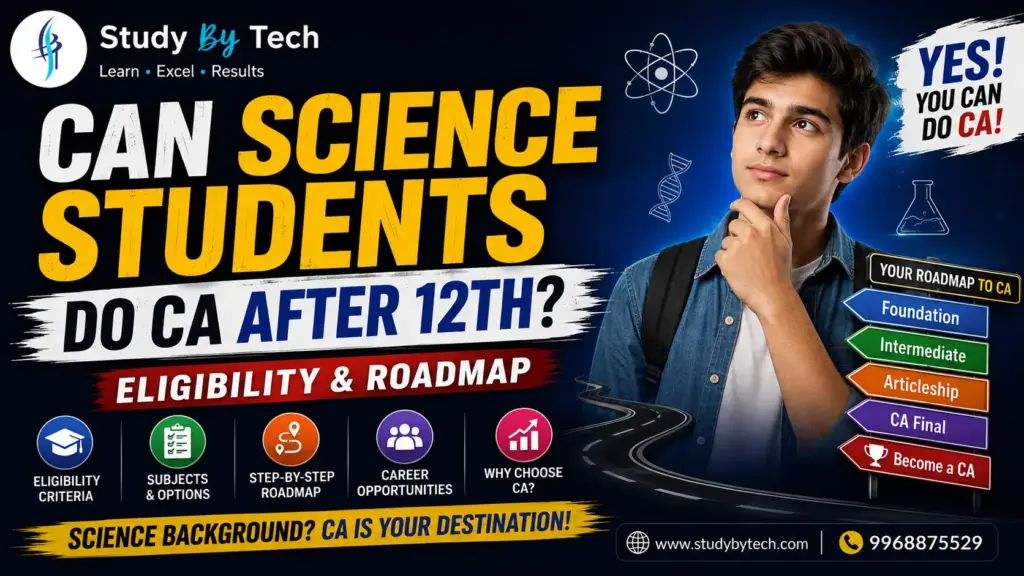
Can Science Students Do CA After 12th? Complete Guide, Eligibility & Strategy
📑 Table of Contents
⭐ Key Takeaways
- Yes, Science Students Can Do CA: ICAI allows students from any stream (PCM/PCB/PCMB) to pursue CA.
- Two Entry Routes: CA Foundation after 12th (no minimum %) or Direct Entry after B.Sc/B.Tech (≥60%).
- CA Foundation Papers: Accounting, Business Laws, Quantitative Aptitude, Business Economics.
- Science Students’ Advantages: Strong quantitative aptitude, analytical thinking, problem-solving stamina, and study discipline.
- Key Challenges: Understanding accounting terminology, adjusting to subjective law papers, and overcoming the commerce student mental block.
- Foundation Strategy: Master fundamentals, practice ICAI material, use PFAC format for law, and leverage graph theory for economics.
- Level Playing Field: By Month 3 of preparation, science and commerce students are on equal footing.
- Direct Entry Advantage: B.Sc/B.Tech graduates can skip CA Foundation and directly register for CA Inter (if ≥60%).
1. ICAI Eligibility Criteria for Science Students
All the candidates are evaluated equally irrespective of the streams opted during high school education. No special quota system based on the streams and extra certificates needed to be acquired by students opting for science are there in ICAI.
Entry Channels for Students with a Science Background
CA Foundation Course Path (Post 12th Science):
- Educational Requirement: Candidate must have either passed or appeared in class 12 board examinations (PCM/PCB/PCMB).
- Percentage Requirement: There is no minimum percentage restriction in class 12 to apply for the CA Foundation examination.
- Provisional Membership: Candidate can get provisional membership with ICAI BoS (Board of Studies) after passing class 10 examinations.
- Study Period Requirement: A compulsory 4 months study period is to be completed between ICAI membership and exam date.
Direct Entry Route (After B.Sc or B.Tech Graduation):
- Educational Qualification: Science graduates who have passed a 3-year B.Sc or 4-year B.Tech/B.E. graduation degree do not need to appear for CA Foundation at all.
- Minimum Marks Criteria: Those who graduate in non-commerce field require an aggregate score of 60% to be eligible for direct entry to CA Inter.
Know more about Direct Entry in CA →
2. Step-by-Step Roadmap: Becoming a CA After 12th Science
The CA qualification framework under ICAI’s New Scheme of Education and Training consists of three main exam stages along with practical articleship training:
| Step | Stage |
|---|---|
| STEP 1 | CA FOUNDATION EXAM (4 Papers: Accounts, Law, Maths/Stats, Economics) |
| STEP 2 | CA INTERMEDIATE (6 Papers split across Group 1 & Group 2) |
| STEP 3 | ICITSS & ARTICLESHIP (4-week Soft Skills/IT Training + 2-Year Practical Training) |
| STEP 4 | SPOM MODULES & AICITSS (Self-Paced Online Modules + Advanced IT) |
| STEP 5 | CA FINAL EXAM (6 Advanced Papers + Qualified CA Designation) |
Stage 1: CA Foundation
After completing the board examinations of class 12th, join ICAI and pass 4 basic papers:
- Paper 1: Accounting (100 Marks – Subjective)
- Paper 2: Business Laws (100 Marks – Subjective)
- Paper 3: Quantitative Aptitude (Business Mathematics, Logical Reasoning & Statistics) (100 Marks – Objective)
- Paper 4: Business Economics (100 Marks – Objective)
Stage 2: CA Intermediate
Passing the CA Foundation will pave way for the next step i.e., joining the CA Intermediate which comprises of 6 papers split up into Group 1 and Group 2.
Stage 3: ICITSS & 2 Years Articleship
Before moving to the practical training of 2 years, it is required to complete the ICITSS which lasts for 4 weeks.
Stage 4: Self-Paced Online Modules (SPOM) & CA Final
During the process of articleship, clear SPOM Sets A, B, C, D and Advanced ICITSS and after fulfilling all requirements of articleship as well as study, appear in CA Final examination.
3. Can I do CA after B.Tech or B.Sc? (Direct Entry Guide)
There are many engineering and science students who discover during or after their studies that they want to switch to career paths like corporate finance, investment banking, management consultancy or auditing.
- Eligibility: Science or Engineering graduates with ≥ 60% marks in aggregate are eligible to directly register for CA Intermediate.
- Advantage: Saves you from taking the 4 paper CA Foundation, which takes 6 to 12 months.
- Strategy: As direct entry students join CA Intermediate course straight away, the science students will have to study for 4 to 6 weeks about the basics of double entry book keeping, debit/credit system and basic accounting.
4. Strengths & Hidden Advantages of Science Students in CA
While commerce students enter CA with prior exposure to basic accounting terms, science students possess cognitive habits that prove to be major assets:
| Advantage | Why Science Background Helps | Direct CA Application |
|---|---|---|
| Quantitative Aptitude | In-depth familiarity with calculus, algebra, and statistics. | High scores in CA Foundation Quantitative Aptitude & CA Inter Costing / FM. |
| Logical & Analytical Thinking | Practice with complex scientific proofs and physical laws. | Analyzing complex case studies in Business Law, Tax Planning, and Audit. |
| Problem-Solving Stamina | Used to solving multi-step mathematical and physics problems. | Tackling lengthy numerical problems in Costing and Advanced Accounting. |
| Study Discipline | Habitual focus required for competitive entrance exams (JEE/NEET). | Managing the 8-10 hour daily study schedule required during CA revision. |
5. Common Issues Encountered By Science Stream Students Along With Their Solutions
The switch from equations to accounts can be tricky for science students in the beginning. Understanding the issues before an exam saves time.
📌 Challenge 1: Inability To Comprehend Common Terms Used In Accounting
The Issue: Debits, Credits, Trial Balance, Depreciation, Balance Sheet, Provision, Capital Expenditure are all Greek and Latin in the first few weeks.
✅ Solution: Devote 15-20 days to learn basic terminology of accounting which is covered in NCERT Accountancy books of class 11 and 12 (Golden Rules of Accounts, Journalizing and Ledgers). Don’t mug up Accounting, see it as a balance sheet equation:
📌 Challenge 2: Adjusting to Subjective Law Paper
The Problem: Students from science stream are accustomed to concrete mathematics answers or definitions whereas CA law paper requires good case analysis and citation.
✅ The Solution: Regular answer writing practice. Use the P-F-A-C Format Structure:
- Provision (Act/section)
- Facts of the case
- Analysis & Application
- Conclusion
📌 Challenge 3: Commerce Students Mental Block (“commerce students have an edge”)
The Problem: Being fearful of batch mates having commerce education at school level.
✅ The Solution: Realization that school level commerce has knowledge of just 10%-15% of the entire CA course. At CA Intermediate level, everything becomes perfectly balanced.
6. Strategy for Science Students for CA Foundation Exam
📘 Accounting (Paper 1)
- Understand the fundamentals first. Start with Rules of Debit & Credit, Journal Entries and Ledger Accounts.
- Identify important chapters: Bank Reconciliation Statement (BRS), Depreciation, Consignment, Final Accounts and Company Accounts.
- Do practical illustrations from ICAI study material at least twice.
⚖️ Business Laws (Paper 2)
- Emphasize on important acts such as Indian Contract Act, 1872, Sale of Goods Act, 1930 and Companies Act, 2013.
- Important legal terminology to focus: Quid Pro Quo, Consensus Ad Idem and Caveat Emptor.
- Solve past 5 attempts of Revision Test Papers (RTPs) and Mock Test Papers (MTPs).
📊 Quantitative Aptitude (Paper 3)
- A Paper for getting more than 80 marks in this exam to make an aggregate cushion.
- Important topics to learn: Business Mathematics and Logical Reasoning.
- Important topics under Business Mathematics include Ratio, Proportion, Logarithm and TVM.
- Calculator Tricks to do Compound Interest and Annuity Calculation fast.
📈 Business Economics (Paper 4)
- Apply graph theory that you have studied in physics/math to the theory-related graphs (Curves of Demand, Supply, Costs, and Market Structure).
- Practice topic-wise MCQs to increase speed and accuracy.
7. Science Students vs. Commerce Students: A Balanced Comparison
| COMMERCE STUDENTS | SCIENCE STUDENTS |
|---|---|
| • Immediate accounting fluency • Familiar with basic terms • Quick start in Month 1 |
• Stronger mathematical logic • Structured problem solving • High analytical stamina |
| EQUAL LEVEL PLAYING FIELD (By Month 3 of Preparation) |
|
🚀 Start Your CA Journey Today with StudyByTech
Get expert guidance, structured study material, and a proven path to success. Join India’s best CA Foundation & Inter coaching.
❓ Frequently Asked Questions (FAQs)
1. Is CA hard for science students?
CA can be challenging for science students because some commerce concepts may be new. However, StudyByTech helps CA students build fundamentals through structured CA Foundation and CA Inter preparation.
2. Can a science student apply for CA?
Yes. A science student can pursue CA through the CA Foundation route after Class 12. Graduates can also use CA Direct Entry if they meet ICAI’s eligibility requirements. StudyByTech provides guidance for students entering CA from different academic backgrounds.
3. Is CA easier than MBBS?
CA and MBBS are very different professional courses, so calling one universally easier isn’t accurate. StudyByTech believes CA students should choose based on their interests, strengths, and career goals rather than simply comparing difficulty.
4. Is CA harder than NEET?
CA and NEET involve different types of preparation, so difficulty varies from student to student. StudyByTech supports CA students through CA Foundation and CA Inter preparation with structured learning and exam-focused guidance.
Scroll to Top
⬆ Scroll to Top