CA Final

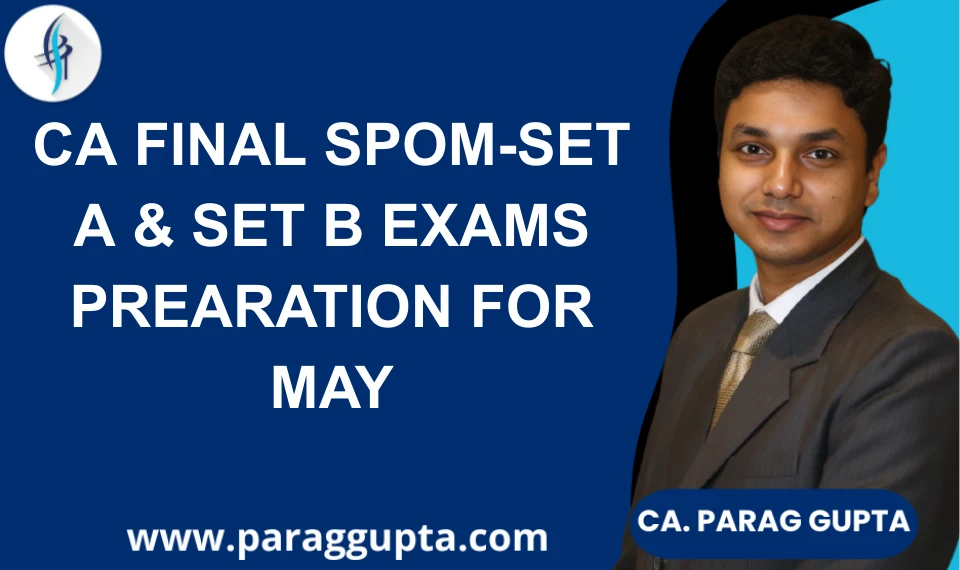
CA Final SPOM-Set A & Set B Exams preparation for May
CA, Blogs, SCPM

When should you start studying for CA Final SPOM-Set A & Set B for Jan 26 exams?

A new syllabus for Chartered Accountant students is proposed for CA Final level, especially for SPOM-Set A & Set B by the Institute of Chartered Accountants of India (ICAI). The proposal is sent to Ministry of Corporate Affairs for approval. It is expected that the exams may become harder, as a result, making it more difficult for candidates to pass them. ICAI proposed changes in CA Final Syllabus  A new program of online modules in the CA final syllabus that can be finished at one’s own pace has been introduced by the ICAI. The syllabus and subjects are published by ICAI on its official website. When one registers for practical training, also known as articleship, before the Final, the modules must be completed following Inter. In the SPOM-Set A & Set B syllabus two papers here supposed to be shifted from the Final to the self-paced online module: To Know more about CA Syllabus, Click Here When to start studying SPOM-Set A & Set B for the Jan’26 CA final exams? Many students confuse about when to start studying for SPOM-Set A & Set B for Jan 26 exams. So here, we would like to answer this question through Parag sir’s reply. As many questions prevail around this confusion, like, Well, as the ministry thinks in 50 different ways, so we cannot say anything. But definitely, any of the 3 above suggestions can be possible. Eg. If the ministry will feel that these papers are important and shall not be taken as self-paced, then they may be back as normal papers as well. So it is suggested that in all the above scenarios, you all shall keep studying hard for exams. Watch out Parag sir’s suggestion for students who are studying for CA final Jan 26 exams: To know more about CA Final costing latest batch, Click Here Conclusion: The Ministry of Corporate Affairs thinks in all different manners to make the CA Final course a better course in both practical & theoretical knowledge for students. The changes in course are always welcome. But take care that students shall not stop studying and keep focused on their studies in order to get his/her dream true. FAQ‘s

CA Final Exams details |Parag Gupta Classes
Blogs, CA Final

CA Final Exams details |Parag Gupta Classes

When are CA Final Exams? CA Final exam is the final stage exam to become a Chartered Accountant and after success in this, you can get a job in a good company as a CA or you can start your own work independently. CA final exam is the most difficult and important stage of becoming a CA and to get success in it, it is necessary to study hard with the right direction and hard work. In today’s post, we will give you complete information related to CA final course like the registration process for CA final, fees, eligibility, exam form, admit card, and result. CA Final exam is conducted twice a year in the month of May and November. And the students who have passed the CA Foundation and CA Intermediate examination as well as the students who have completed 2 yrs of articleship to get themselves registered for the CA final course. After 6 months of the registration, you can appear for CA final exams. The CA final exam is considered to be the most difficult of all the three phases and the result every year is very low. That’s why a lot of hard work is required to pass it. In CA Final, you are made to study the nuances of the law, international tax system, accounting, and other financial management. CA Final Exam Eligibility 2026 CA Final Exam Registration Validity After registering for CA Final, you registration is valid for 5 years. CA Final Exam Registration Process The complete process of registration for the CA final is given below, so read it carefully. A registration letter will be sent to you by ICAI within one month of filling out all this information. CA Final Exam Documents CA Final Exam Registration Fees The registration fee for both groups of the CA Final exam is ₹22,000 for Indian students and US $1,000 for overseas students(Valid for 5 years). The exam form fee is Rs. 1800 for a single group and Rs. 3300 for both groups(Valid for 1 attempt).  CA Final Exam Syllabus and Subjects Details ICAI has added Self paced online module exams which has to be clear before appearing for CA Final exams. These exams are MCQ based and are Computer based exams. Set A & Set B are compulsory and you are given choice for SET C & SET D.ICAI has made it compulsory to watch ICAI videos available at it’s portal before appearing for these exams. Self-Paced Online Modules (SET A: Corporate and Economic Laws)Self-Paced Online Modules (SET B: Strategic Cost & Performance Management)Self-Paced Online Modules -SET CPaper-1 : Risk ManagementPaper-2: Sustainable Development and Sustainability ReportingPaper-3 : Public Finance and Government AccountingPaper-4 : The Insolvency and Bankruptcy Code, 2016Paper-5: International TaxationPaper-6 : The Arbitration and Conciliation Act, 1996Paper-7 : Forensic AccountingPaper-8 : ValuationPaper-9 : Financial Services and Capital MarketsPaper-10 : Forex and Treasury ManagementSelf-Paced Online Modules – SET DPaper-1: The Constitution of India & Art of AdvocacyPaper-2: Psychology & PhilosophyPaper-3: Entrepreneurship & Start-up EcosystemPaper-4: Digital Ecosystem and Controls GROUP IPaper-1: Financial ReportingPaper-2: Advanced Financial ManagementPaper-3: Advanced Auditing, Assurance and Professional EthicsGROUP IIPaper-4: Direct Tax Laws & International TaxationPaper-5: Indirect Tax LawsPaper-6: Integrated Business Solutions (Multidisciplinary Case Study with Strategic Management) According to the CA Final Exam Patterns 2026 To clear CA Final, you need to secure at least 40% marks in all 6 papers of CA and 50% marks in all papers together. And in SPOM subjects, you need 50% to pass each subject(there is NO negative marking) CA Final Admit Card The admit card is issued by ICAI after 21 days of filling out the CA final exam form. This admit card is very important and only after seeing this admit card you can sit in CA final exam. CA Final Exam Form After registration, students can fill out the exam form. Follow the given procedure to fill out the exam form. CA Final Exam Result The results are declared by ICAI after 2 months of the CA final exam. You can know your result online or offline. In this article, you must have known what is the process of registration for CA, how much is the fee, how the examination form can be filled, and how many days you can get the admit card. We hope that you have liked this article today and you must have got all the information related to CA Final. Why Parag sir is considered as best faculty for SPOM-set B? CA Parag Gupta stands out as the premier faculty for SELF PACED ONLINE MODULE-SCPM(SPOM-Set B) for several compelling reasons. With over two decades of experience teaching Costing at the CA Final level, he brings unparalleled expertise and deep understanding of the subject matter. What sets him apart is his distinction as the only faculty member who has comprehensively covered SPOM classes in alignment with ICAI’s updated syllabus, ensuring students receive the most current and relevant education. His innovative approach extends beyond the core curriculum. Within SCPM classes, he uniquely incorporates the SCPM portion of the IBS exam (Paper-6), providing additional value and preparation for students pursuing multiple qualifications. This comprehensive coverage demonstrates his commitment to students’ broader professional development. The program offers exceptional flexibility with a generous 3-year validity period, allowing students to learn at their own pace and revisit materials as needed. Perhaps most notably, his one-on-one doubt clearing sessions have become highly sought-after among students. These personalized sessions, available through both video and voice calls, provide students with direct access to his expertise, ensuring thorough understanding of complex concepts. His teaching methodology combined with personalized attention makes him the preferred choice for SPOM-Set B preparation. FAQ’s

How To Improve Reading and Comprehensive Skills
Blog, CA Final

Improve Reading & Comprehensive Skills for CA Final

Improve Reading & Comprehensive Skills Final CA The biggest anxiety for a CA Final Costing (Strategic Cost Management & Performance Evaluation) student is to comprehend the question effectively and in the spirit in which the examiner posed it. Scoring well when the time is limited but the question is lengthy makes it difficult.Here are a few tips to Improve Reading & Comprehensive Skills that a student must follow to score wonders in his or her examination: Introduction ​ Types of questions in the CA Final SCMPE (Strategic Cost Management & Performance Evaluation): Case Study Based Questions & all other types of questions. Study Related blogs: Click Here ​Q. How much time do we need to invest in a question? We have very limited time for the examination: 100 marks Question paper is supposed to be completed in 3 hours i.e. 180 minutes. Proportionately we can calculate the time to be spent on a question. E.g. A 10 marks question shall be attempted in around 18 minutes. Q. How to approach a case study question? There are three sections to a case study query: The beginning Paragraph Several further sentences (Body of question)Concluding Paragraph and the conditions stated in the question. In the body of a question, there are always things that are unrelated to the requirements given in the question so we shall initially focus on the introduction paragraph or the initial few lines of the introduction paragraph to gain a gist about the company. Additionally, we shall focus on the requirements given in the question and/or concluding paragraph.Now, you are prepared to carefully read the question’s body, extract information that applies to the criteria specified in the question, and distinguish between material that does and doesn’t.Note: Read the requirements of the question at least twice. ​Q. How to approach a question other than a case study question? A different kind of query is often broken down into two parts: A concluding paragraph, requirements specified in the question, and several paragraphs (question body). There are usually aspects in a question’s body that are irrelevant to the needs stated in the question, so we will first concentrate on those requirements and/or the ending paragraph.Now you are prepared to carefully read the question’s body, extract the information that pertains to the requirements, and distinguish between that information and that which does not.Note: Read the requirements of the question at least 2 times. Must read – How To Get Rank in CA Final Examination in 3 Months Q.A Reason for choosing this topic in this video? Parag Gupta, am an ex-examiner of the ICAI Final Costing examination. We understand very well the thought process of both paper setters and paper evaluators. I can be the best guide for a student about how he or she can score remarkably on his or her examination paper and be a top scorer or a rank holder in the examination. ​ A Last minute-pro tip!Even though you are fluent in English, translate the question into your native language to gain unparallel comprehension of the same question.

CA Final Syllabus
CA, ICAI

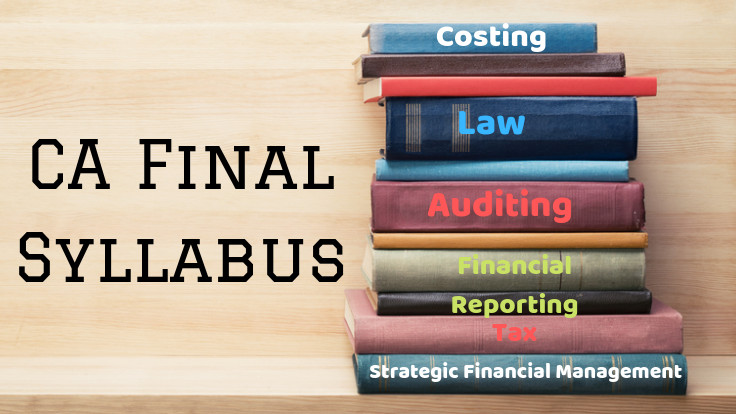
CA Final Syllabus

Do you want to know about CA syllabus, or searching for its topics, then you are in the right place, we will give you some information about the final syllabus. The CA Final Subjects is divided into eight subjects, which are divided into two groups. Learn: Each paper of the CA Final has a hundred points in each paper, and in all subjects, you want to get a minimum of four hundred marks and all the CA want to get five hundred points in the combination of CA Final Subjects. Download – CA Syllabus CA Final Subjects Paper No. Subjects Paper 1 Financial Reporting Paper 2 Strategic Financial Management Paper 3 Advanced Auditing and Professional Ethics Paper 4 Corporate and Economic Laws Paper 5 Strategic Cost Management and Performance Evaluation Paper 6A Risk Management Paper 6B Financial Services and Capital Markets Paper 6C International Taxation Paper 6D Economic Laws Paper 6E Global Financial Reporting Standards Paper 6F Multidisciplinary Case Study Paper 7 Direct Tax Laws and International Taxation Paper 8 Indirect Tax Laws Also Learn:-

CA Intemediate GST Classes
CA, ICAI

CA Intermediate GST Classes For CA Student

CA Intermediate GST (IPCC) Classes The objective of this document is to summarize all the updates of CA Intermediate GST Classes (CA IPCC) (Notifications, Circulars, other amendments, and updates) in one place.2 Central tax notifications,1 Integrated tax notification,And also the council has approved the new GST rates for the real estate sector in the 33rd meeting. CA Intermediate GST (CA IPCC) Important Notices 1.0 Notifications:Objective:I. Notification No. 8/2019_Central tax dated 08th Feb.2019:GSTR-7 (Return for TDS) for Jan’19 from 10th Feb’19 to 28th Feb’19 to 28th Feb’19.filing GSTR-3B for Jan’19 from 20th Feb to Feb.19 for Jammu & Kashmir Feb.19 for the remaining states III. Notification No. 2/2019_Integrated tax (Rate) dated 04.Feb.2019:Since the definition of exports and the Sec 54 of the CGST act have been amended to include the supplies to Nepal and Bhutan under definition of Exports, the Notification No.02/2019 was issued to rescind the exemption entry 10D (the exemption of IGST, for the supplies made to Nepal & Bhutan) of the Notification no.9/2017 dated 28th Jun’17. 2.0 CA Inter GST Classes CA Intermediate GST Circulars (CA IPCC): I. Circular No. 88/07/2019 Central Tax dated 01.02.2019:Circular No. 8/8/2017_04.10.2017_”Master circular relevant for the export procedures and refunds” was amended in view of the amendment allowing realization of export proceeds in INR, wherever allowed by the RBI (CA Intermediate/ IPCC). [2(6) of IGST act].Circular No. 38/12/2018_26.03.2018_”Clarification on issues related to Job Work” was amended to in view of the (IPCC) amendment carried empowering the Commissioner to extend the period for return of inputs and capital goods from the job worker and also the RCM on services received from un-registered job workers. [9(4) and 143 of CGST act.]Circular No. 41/15/2018_13.04.2018_” Procedure for interception of conveyances for inspection of goods in movement…………” was amended to in view of the amendment carried out extending the time limit from 7days to 14 days for owner/transporter to pay tax/penalty for seized goods. [Sec 129 of the CGST act]. CA Intermediate GST Updates (IPCC) After observing that the majority of taxpayers are not reporting details in Table 3.2 of GSTR-3B,III. Circular No. 90/09/2019 Central Tax dated 18.02.2019:IV. Circular No. 91/10/2019 Central Tax dated 18.02.2019:In Circular 46/2017_Customs_Dated 24.Nov.17, it was clarified that,In Circular 3/2018_IGST(CA Intermediate)_Dated 25.May.18, it was clarified that, considering the amendments in the Customs Tariff Act (IPCC),This shall be applicable w.e.f. 01.Apr.18.There was no provision in GSTR-1 for changing POS for such B2B supplies. If the supplier and recipient are in the same state, it was considered as Intra-state sales.3.0 33rd GST Council meeting updates (IPCC):I. GST on Residential properties The proposed GST rate for the residential flats are as followed: 1% for the Affordable housing5% for the othersFor qualifying as “affordable housing” below 2 conditions should be satisfied:Carpet area of up to 90 Sqm in non-metropolitan cities/towns and 60 Sqm in metropolitan cities andThe value < 45Laks in both Metro/Nonmetropolitan citiesThe effective date shall be 01.Apr.19.II. Others (IPCC)The existing rates shall continue for the commercial projectsThe taxation on betting and lotteries shall be taken up in the future council meetings. Click Here: CA Intermdiate New Course Also Read- CA Intermediate Courses CA Final Result 2019 CA Final Exam Date Sheet

CA Coaching Classes for CPT,IPCC,CA Final
ICAI

ICAI CA CPT, IPCC & CA Final | CA Online Classes

ICAI CA CPT, IPCC & CA Final | CA Online Classes ICAI CA Online Classes Benefits 1. Versatile Timings – Definitely, CA Online classes is a good option. Students can enjoy ICAI CA Classes (CPT/IPCC/CA Final) at home whatever time is best suitable for them. Many of the ca students doing an articleship/job along with the studies prefer to take the ICAI ca classes at night. For such kind of ca students, ICAI CA Online classes are the best option. 2. Comfort level – You comfort with study at home. You can pause the videos, you can replay the video, you can rewind the videos, you can adjust the speed of the video. No need to follow the rules and regulation of satellite classes. 3. Time-Saving – One of the best points of ICAI CA Online classes is that it saves time. Most of the ICAI ca students residing in other cities or far away from the ca coaching centers (CPT/IPCC/CA Final) can get benefit from these ca online classes. 4. Replay the Concept of video – Many of the times we miss the important concepts. You could not ask such a thing in satellite classes. Hence, CA online classes are better where you can replay the video and understand the vital concept until you are not satisfied (CPT/IPCC/CA Final). 5. Missing classes Problem – It’s difficult to understand the whole chapter when you missing a single class. CA Online Classes resolves this issue by providing video lectures according to your convenience (IPCC). Why Choose Parag Gupta Classes (CA Final)? Parag Gupta Classes is the best ICAI CA Coaching Classes (IPCC) all over India because it provides classes in Virtual Centres or in their app StudyByTech. It covers every concept of your ICAI ca course. Parag Gupta Classes have covered past attempt questions, questions from study material, questions from Practice Manual ,etc. Which means that you don’t need to go through the ICAI for ca study material on your own. Parag Gupta Classes smart compilers will also be provided to every ca student along with ICAI CA Online classes. The students will get connected on all social media platforms of the faculties where they can ask their doubts. All the lectures are available in Hindi and English Language (CPT/IPCC/CA Final) . Procedure for Joining the Best ICAI CA Online Classes Contact Parag Gupta Classes and complete the registration procedure for ICAI CA Online classes. For the first time, Parag Gupta Classes launched ICAI CA Foundation / CPT Online Classes (CPT/IPCC/CA Final) For ordering and further information on ICAI CA Foundation/CPT Online classes (CPT/IPCC/CA Final), you can contact us. Subjects of ICAI CA Foundation/CPT Paper 1: Principles and Practices of Accounting Paper 2: Mercantile Law and General English Paper 3: Business Mathematics and Logical Reasoning Paper 4: Business Economics and Business Commercial Knowledge Subjects of ICAI CA Intermediate/Inter/IPCC Paper 1: Accounting Paper 2: Corporate Laws and Other Laws Paper 3: Cost and Management Accounting Paper 4: Taxation Paper 5: Advanced Accounting Paper 6: Auditing and Assurance Paper 7: Enterprise Information Systems & Strategic Management Paper 8: Financial Management & Economics for Finance Subjects of ICAI CA Final Paper-1: Financial Reporting Paper-2: Strategic Financial Management Paper-3: Advanced Auditing and Professional Ethics Paper-4: Corporate and Economic Laws Paper-5: Strategic Cost Management and Performance Evaluation Paper-6A: Risk Management Paper-6B: Financial Services and Capital Markets Paper-6C: International Taxation Paper-6D: Economic Laws Paper-6E: Global Financial Reporting Standards Paper-6F: Multidisciplinary Case Study Paper-7: Direct Tax Laws and International Taxation Paper-8: Indirect Tax Laws Also Visit here– How to become a CA in India after 12th?

CA-Final-Course-1280x720
ICAI

ICAI CA Final Course

If you are searching for an ICAI CA Final course or a subject for a new course, then you are landed on the correct page. The Whole syllabus of the CA Final is divided into 2 groups, which are further divided into 8 subjects. Every paper contains 100 marks and you will need a minimum score of 40% marks in each subject. ICAI CA Final Course – New Scheme of Education and Training Paper No. Subjects Paper 1 Financial Reporting Paper 2 Strategic Financial Management Paper 3 Advanced Auditing and Professional Ethics Paper 4 Corporate and Economic Laws Paper 5 Strategic Cost Management and Performance Evaluation Paper 6A Risk Management Paper 6B Financial Services and Capital Markets Paper 6C International Taxation Paper 6D Economic Laws Paper 6E Global Financial Reporting Standards Paper 6F Multidisciplinary Case Study Paper 7 Direct Tax Laws and International Taxation Paper 8 Indirect Tax Laws CA Final Final Course is the last level of CA Course. After qualifying both the groups of the Intermediate course, a student can get registered for C.A. Final Course. Candidate can appear in CA Final examination during the last 6 months of practical training. But before appearing in CA Final Exam, one has to successfully complete four weeks Advanced Integrated Course on Information Technology and Soft Skills (AICITSS) during the last two years of practical training. CA FINAL COURSE DETAILS Paper 1: Financial Reporting (Maximum 100 Marks ) It covers existing Accounting Standards (ASs) 15, 21, 23, 25, 27 and 28, Accounting Standards interpretations, Framework for preparation and presentation of Financial Statements in accordance with Indian Accounting Standards, Application of Ind AS with reference to general purpose Financial Statements, application of IFRS & US GAAP, Corporate Financial Reporting, Accounting for Consolidated Financial Statements of Group Companies, Share-Based Payments, Carbon Credits, E-commerce, Common defects in Financial Statements, Corporate Social Reporting, Human Resource Reporting, Integrated Reporting and Value Added Statements etc. Paper 2: Strategic Financial Managment (Maximum 100 Marks ) It Covers important concepts relating to Strategic decision making, financial policy, Risk evaluation & its classification, value at Risk (VAR) Security analysis, and its Valuation, Portfolio analysis, Capital Market theory, Securitization, Mutual funds, Derivatives, Foreign exchange, international financial management, etc. Paper 3: Advanced Auditing & Professional Ethics (Maximum 100 Marks ) It Covers Auditing Standards, Statements, Guidance Notes, Audit plan, Audit Programme and importance of Supervision, Risk Assessment and internal control, Special Aspects of Auditing in an Automated environment, Audit of Limited Companies, Audit Reports, Audit Reports & Certificates for special purpose engagement, Audit Committee and Corporate Governance, Audit of Consolidated Financial Statements, Special features of Audit of Banks, Insurance & Non – Banking Financial Companies, Audit under fiscal laws, Special audit assignments, Audit of Public Sector undertakings, and concepts related to Professional ethics etc. Paper 4: Corporate and Economic Laws (Maximum 100 marks) This paper has been divided into two parts : Part I: Corporate Laws (70 Marks): This has two sections Section A: Company Law It Covers the entire provisions and relevant Rules & Regulations of the Companies Act, 2013 regarding appointment and Qualification of Directors, Appointment and remuneration of Managerial Personnel, Meetings of Board and its Power, Inspection, Inquiry and Investigation, Compromise, Arrangement and Amalgamations, prevention of oppression and Mismanagement, Winding up, Producer Companies, Companies incorporated outside India , Compounding offences, adjudication, special Courts, National Company Law Tribunal and Appellate Tribunal etc. it Covers also Corporate Secretarial Practices like Drafting Notices, Resolutions, Minutes & Reports etc. Section B: Securities Laws It includes The Securities Contract (Regulation) Act, 1956 and the Securities Contract (Regulation) Rules, 1957: introduction and important provisions. The Securities Exchange Board of India Act, 1992, SEBI (Issue of Capital and Disclosure Requirement) Regulation, 2009 and SEBI (Listing obligations and Disclosure Requirement) Regulations, 2015. Part II: Economic Laws (30 Marks)It Covers “ The Foreign Exchange Management Act, 1999, The Securitisation and Reconstruction of Financial Assets and Enforcement of Security Interest Act, 2002, the Prevention of Money Laundering Act, 2002, Foreign Contribution Regulation Act, 2010, the arbitration and Conciliation Act,1996, the Insolvency and Bankruptcy Code, 2016 Paper 5: Strategic Cost Management and Performance Evaluation (Maximum 100 marks) It contains concept of Strategic Cost Management, Limitations of Traditional Cost Management, Characteristics of the Modern Business Environment, Cost of Quality, TQM, Supply Chain Management, J/T, Kaizen Costing, Total Productive – Maintenance, Six Sigma (SS), Cost Control, Cost Reduction, Pareto analysis, value Analysis, Life Cycle Costing, Power Sector, Relevant Costing, ABC Costing, Theory of Product Pricing, Pricing – New Product, Sensitivity analysis, Pricing Strategies, Transfer pricing, Responsibility Accounting, Budgetary Control, Standard Costing, and Application of few Quantitative Techniques like Linear Programming, Learning curve / Experience Curve. Paper 6A: Risk Management (Maximum 100 marks) It includes the concept of Risk, Risk, and uncertainty; Distinction, classification of risks, Dynamic Nature of Risks, Types of Risk, Sources and Evaluation of Risks, Concept of Risk Management, objective and process of Risk Management, Risk Management Techniques, Quantitative analysis, Risk Model, Credit Risk Measurement and Management, Risks associated with Corporate Governance, Enterprise Risk Management, Operational Risk Management etc. Paper 6B: Financial Services and Capital Markets (Maximum 100 marks) It contains information to Global Financial Market, Role of Financial Market in Economic Development, Indian Financial Market Scenario, Credit policy of R.B. I, Fed Policy, Inflation Index, CPI, WPI etc. Primary Capital Market, Secondary Capital Market, Money Market ( CRR, SLR, MIBOR, LIBOR etc.), Institutions and Intermediaries, Commodity market, Banking – Management, Mutual Fund etc. Paper 6C: International Taxation (Maximum 100 marks) It Covers various concepts of Transfer pricing Provisions under the Income Tax Act, 1961, like concept of Arm’s length price, international transactions, functions, Assets and Risk Analysis, Documentation & Compliances, other provisions relating to taxation of international transactions and Non – resident taxation under the Income-tax Act, 1961, Non – resident taxation, Double taxation relief and Advance – Ruling, Law and procedures under the Black Money (Undisclosed Foreign Income and Assets) and imposition of Tax Act, 2015, other Aspects of International taxation – Model tax conventions, tax treaties,

Scroll to Top