CA

CA Parag Gupta is one of the pioneers in the Teaching industry for SCMPE and is considered the best faculty in the world of Old/New Course Costing.

CA INTER
Blog, CA Inter

CA Inter Result: Understanding the Outcome of Your Hard Work

In order to become a chartered accountant, candidates must pass the CA Inter exam. Waiting impatiently for the results after months of careful study and preparation can be both thrilling and unsettling. We’ll go through all the information you want regarding the CA Inter result in this blog, including the dates on which results are declared, how to verify your results, and what to do after getting them. The CA Inter results are released on the Institute of Chartered Accountants of India’s (ICAI) official website. Each examination cycle may have a different result declaration date, therefore it’s critical to remain current on all announcements. Within two to three months following the last exam, the ICAI normally announces the results. Candidates can access the official ICAI website to view their CA Inter result when the results are announced. Candidates can get their results by entering their roll number, registration number, and other necessary information on a special site provided by the ICAI. The ICAI also offers SMS and email services via which the result can be accessed. 1. Result Declaration Dates: The Institute of Chartered Accountants of India (ICAI) announces the CA Inter results on its official website. The result declaration dates may vary for each examination cycle, and it is important to stay updated with the latest notifications. The ICAI typically releases the results within two to three months from the date of the last examination. 2. Checking Your Result: Once the results are declared, candidates can check their CA Inter result through the official ICAI website. The ICAI provides a dedicated portal where candidates can enter their roll number, registration number, and other required details to access their result. Additionally, the result can also be obtained through SMS and email services provided by the ICAI. 3. Result Format: Candidates will receive comprehensive information about their performance in each topic from the CA Inter result. It comprises subject-specific grades, the overall score, and each group’s qualification status. The outcome can potentially reveal a candidate’s ranking in the CA Inter exam. 4. What to Do After Receiving the Result: Depending on their performance, applicants have a variety of alternatives after getting their CA Inter results: 5. Revaluation and Verification: Candidates have the ability to ask for reevaluation or answer script verification if they are dissatisfied with their CA Inter result or believe there was an error in the evaluation process. For applicants to apply for these processes, the ICAI specifies a specific method. It’s vital to remember that revaluation or verification come with fees, and that the ICAI’s judgement in these situations is final. Note: Now check the syllabus and tricks for Final CA Inter Scmpe here CLICK HERE Conclusion: The CA Inter result is a culmination of your hard work, dedication, and perseverance. It is essential to stay updated with the result declaration dates, know how to check your result, and understand the options available based on your performance. Remember, whether you clear the exam or face setbacks, each result is an opportunity for growth and learning. Stay motivated, seek guidance when needed, and keep working towards achieving your goal of becoming a Chartered Accountant. FAQ Want to subscribe to latest lectures?
CA INTERMEDIATE MOCK TEST
Blog, CA Inter

Benefits of CA Intermediate Mock test

Let’s first clarify what CA Intermediate mock test are, then we may discuss their advantages. Mock exams for CA Intermediate are simulations of the real CA Intermediate exams that are created to closely resemble them. These exams measure students’ exam-related knowledge, comprehension, and application. They assist students in becoming accustomed to the exam format, organization, and scoring system. The CA Intermediate exam holds immense importance as it serves as a gateway to the final stage of the Chartered Accountancy course. Therefore, students must be well-prepared and confident to excel in this critical exam. Preparation for CA Intermediate Exam The CA Intermediate exam preparation process might be difficult. Students frequently feel overwhelmed by the extensive material, time restrictions, and performance expectations. Many students find it difficult to balance their time management skills, conceptual knowledge, and question practice. In this situation, mock exams are useful. Mock exams give pupils the chance to evaluate their understanding, pinpoint their weak areas, and concentrate on strengthening them. Let’s delve deeper into the numerous advantages of CA Intermediate exams. Familiarity with Exam Pattern and Structure: One of the primary advantages of taking mock tests is that they familiarize students with the exam pattern and structure. By simulating the actual exam conditions, mock tests give students a firsthand experience of what to expect on the exam day. This entails being aware of how many questions are asked, how much time is allotted, and how the marks are divided up among the various sections. Students can better manage their time during the actual exam by becoming familiar with the format and organization of the test. They can plan their strategy, allot time to various portions in accordance with their skills and weaknesses, and attempt the questions as necessary. Time Management Skills Time management is crucial when it comes to any competitive exam, and the CA Intermediate mock test is no exception. Mock tests play a significant role in developing time management skills. During mock tests, students are required to complete the exam within a specific time frame, just like in the actual exam. This creates a sense of urgency and trains students to allocate their time wisely. By taking practice exams, students receive practice prioritizing questions, time management, and avoiding getting bogged down on challenging problems for too long. They become adept at identifying which questions to attempt first, which to skip and come back to later, and how to maintain a steady pace throughout the exam. Effective time management helps students finish the exam in the allotted time while also allowing them to spend enough time on each question, improving their chances of giving thoughtful and precise responses. Identifying Weak Areas and Improving Them Mock exams give pupils a great chance to pinpoint their areas of weakness and work on strengthening them. Insights into the areas where they struggle or frequently make mistakes are revealed as students take several mock exams. By analyzing their performance in mock tests, students can pinpoint the specific topics or concepts they need to focus on. They can then dedicate more time to studying and revising these areas, seeking additional guidance or resources if required. Regularly practicing mock tests helps students bridge their knowledge gaps, ensuring a comprehensive understanding of the exam syllabus. Boosting Confidence and Reducing Exam Anxiety Exam anxiety is a frequent problem. Many students experience pressure to perform well and the fear of failure can significantly impact their confidence levels. Mock exams are an effective way to reduce exam anxiety and increase confidence. The process of analyzing mock exam results and seeing development over time boosts students’ confidence even further. They can see their progress, identify areas where they have made great growth, and recognize their own strengths. This surge in confidence helps them do better on the CA Intermediate exam. Students gain more self-assurance in their skills and adopt a positive attitude toward the exam by constantly practicing under exam-like conditions. The process of analyzing mock exam results and seeing development over time boosts students’ confidence even further. They can see their progress, identify areas where they have made great growth, and recognize their own strengths. This surge in confidence helps them do better on the CA Intermediate exam. Enhancing Problem-Solving and Analytical Skills Students who plan to take the CA Intermediate exam need to be proficient at problem-solving and analysis. Mock exams provide a useful setting for developing these abilities. Students gain critical thinking skills and learn to apply their knowledge to real-world circumstances as they attempt a variety of topics in a time-restricted setting. Mock exams frequently contain difficult and hard questions that call for students to use critical thinking, research, and come up with effective solutions. By repeatedly working through these kinds of problems, students hone their analytical and problem-solving abilities, preparing them to easily handle questions of a similar nature on the real exam. Conclusion In conclusion, CA Intermediate mock tests are quite advantageous for students getting ready for the test. They act as a thorough preparation tool by acquainting students with the format of the exam, assisting them in learning time management techniques, recognizing their areas of weakness, and improving their self-confidence. Mock tests assist students in improving their analytical, problem-solving, and application-based skills as well as testing their understanding. They help students practice their test-taking strategies, as well as their stamina and focus because they simulate the conditions of a real exam.Every mock test includes thorough feedback and analysis, which makes it easier to gauge one’s progress and create efficient study schedules. By incorporating mock tests into their exam preparation, aspiring chartered accountants can significantly improve their chances of success in the CA Intermediate exam. Fess details: Click Here FAQs Want to subscribe to latest lectures of CA Inter from us?

CA INTERMEDIATE
Blog, CA Inter

CA Intermediate Exam Fees: What You Need to Know

A necessary step towards becoming a chartered accountant is passing the CA Intermediate exam administered by the Institute of Chartered Accountants of India (ICAI). For students aiming to become CAs, understanding the test fee structure is essential. In this article, we’ll delve into the particular expenditures associated with the CA Inter exam, including registration fees, exam fees, and other necessary charges. 1. Registration Fees: Before registering for the CA Inter test, candidates must complete the ICAI registration process. A lot of factors, including the candidate’s educational background and the registration date, affect the CA Inter registration cost. As of the deadline in September 2021, the following registration fees were applicable to CA Inter under the new system: It’s essential to remember that these costs might vary, so it’s best to check the official ICAI website or get in touch with the local ICAI office for the most recent details. 2. Examination Fees: In addition to the registration fee, candidates must pay examination fees for each try.When completing the exam application form, you must pay the examination cost for the CA Inter examinations. The following costs apply to each group: It is extremely important to remember that these costs were in effect at the time this blog was written but are liable to change. Candidates should consult the official ICAI website, which has the most up-to-date and accurate fee information. 3: Other Relevant Charges: Join us to learn the steps for How to Register for CA Intermediate Exams :Click Here Conclusion: It is advised to check the official ICAI website or contact the nearby ICAI office to get the most accurate and updated fee information. Remember that understanding the cost structure will help you plan your CA Inter trip well and prevent any unpleasant surprises. FAQ’s Want to subscribe to latest lectures?
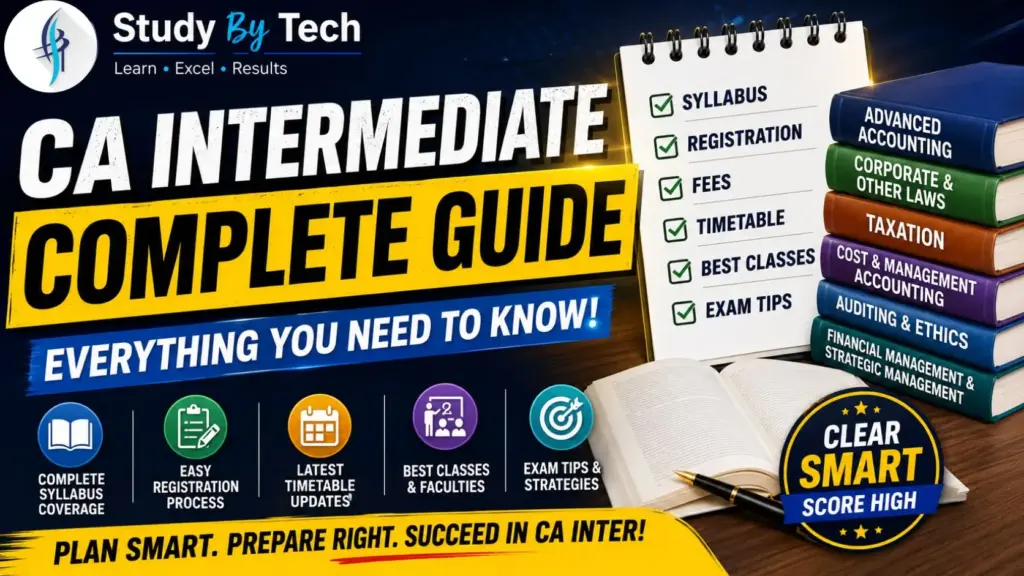
CA INTERMEDIATE REGISTRATION
Blogs, CA Inter

CA Inter Registration: Everything You Need to Know

The Chartered Accountancy (CA) course is one of the most prestigious and sought-after professional courses in India. The course is divided into three levels: Foundation, Intermediate, and Final. The CA Intermediate exam is the second level of the CA course. It is a compulsory exam for all students who want to become chartered accountants. The exam is conducted by the Institute of Chartered Accountants of India (ICAI).In this blog, we will provide you with a comprehensive step-by-step guide on how to register for CA Inter exams and kickstart your journey towards a successful career in accounting and finance. In order to register for the CA Intermediate exam, you must meet the following eligibility criteria: The CA Intermediate exam is a two-group exam, each group is having 3 exams. Each paper is of 3 hours duration and carries 100 marks. The exam is conducted in English and Hindi. Here are some tips for registering for the CA Intermediate exam: Once you have registered for the exam, you will be able to download your admit card from the ICAI website. The admit card will contain all the important information about the exam, such as the date, time, and venue. I hope this blog has been helpful. If you have any further questions, please feel free to contact the ICAI. CA Intermediate syllabus is available check it out to start studies earlier: CLICK HERE HERE ARE STEPS TO DO REGISTRATION: Step 1: Eligibility Criteria: Before proceeding with the registration process, it is important to ensure that you meet the eligibility criteria for CA Inter. To be eligible, you must have successfully cleared the CA Foundation exams and completed a minimum of nine months of study period from the date of registration for CA Inter. Step 2: Gather Required Documents: To complete the registration process smoothly, you will need to gather the following documents: Step 3: Open your Account on ICAI Portal: Visit the official website of the Institute of Chartered Accountants of India (ICAI) and create an account if you don’t already have one. Provide the necessary details and create a username and password. Step 4: Fill in the Registration Form: Log in to your ICAI account and fill in the CA Inter registration form. Enter your personal details, educational qualifications, and other required information accurately. Make sure to double-check the information before submitting the form. Step 5: Pay Registration Fee: After submitting the registration form, you will need to pay the registration fee. The fee structure may vary depending on the category you belong to (i.e., Indian student or foreign student). The fee can be paid online using a credit card, debit card, or net banking. Step 6: Submit Documents: Once the payment is made, you will be required to upload scanned copies of the necessary documents, including your CA Foundation mark sheet, Class 12th mark sheet, photograph, signature, and address proof. Ensure that the documents are in the prescribed format and meet the specified requirements. Step 7: Application Verification: After successfully uploading the documents, the next step is to verify your application. The ICAI will review your application and documents. If any discrepancies or issues are found, you may be asked to provide additional information or rectify any errors. Step 8: Study Material and Registration Letter: Upon successful verification of your application, you will receive a registration letter from the ICAI. This letter will contain your registration number and other important details. You will also receive the study material for the CA Inter exams, either physically or through online resources. Here are some additional tips for preparing for the CA Intermediate exam: We wish you all the best for your CA Intermediate exam! FAQ To be eligible for CA Inter, you must meet the following criteria: The registration for CA Inter is usually open a few months before the exam. You can check the ICAI website for the exact dates. You may register for CA Inter online through the ICAI website. In order to do so, you will need to create an account and submit your personal and academic details. You will also need to pay the registration fees. The registration fee for CA Inter is Rs. 18000 for both groups and 13000 for single group. Additionally, the following documents are required for CA Inter registration:

ca inter study material
Blogs, CA Inter

CA Intermediate Study Material for Success

You are aware of how difficult and demanding the intermediate stage of a Chartered Accountancy program can be if you have enrolled in it. It requires careful planning and study as well as a solid foundation in the foundations of accounting and finance. If you want to crack your CA Intermediate exam then you need suitable study resources. In this, you will go over the CA Intermediate Study Materials to help you crack the exam. 1. ICAI Study Guide The ICAI offers an extensive collection of study materials that include every subject matter needed for the CA Intermediate syllabus. The study materials for each subject on the syllabus include textbooks, study guides, and question banks. The study material is organized and simple to comprehend, which makes it a crucial tool for preparing for exams. 2. Mock Test Papers Mock test papers are simulated versions of the CA Intermediate exam which can be used as a study guide. They are a great tool for students to assess their subject matter expertise and understanding. Practice examinations also help pupils identify their areas of weakness and improve their test-taking strategies. 3. Reference Books Reference books are supplemental learning tools that students can use to further their understanding of a subject. These materials provide in-depth explanations of ideas and examples to help students grasp complex topics. Popular study guides for CA Intermediate exams include Taxmann’s Advanced Auditing and Professional Ethics, Padhuka’s Law, and Wiley Cost Accounting. 4. Online Courses For learners who prefer independent study, online courses are a great option. They provide a systematic approach to learning the material and often feature video lectures, tests, and other interactive tools. Udemy, CAclubindia, and EduPristine are some of the well-known online education companies that offer courses for CA Intermediate exams. 5. Offline Classes The institution is an excellent choice for learners who value face-to-face instruction. Coaching curricula offer a methodical and engaging way to study the material and frequently incorporate practice materials like mock exams. Several well-known instructors for the CA Intermediate. StudyByTeach is one of the best, that provides coaching classes for CA Foundation, CA Inter, and CA Final. Conclusion The study materials explained above are some of the best ones accessible to help CA Intermediate students to prepare for their exams. To be successful, you must pick the appropriate study materials depending on your abilities and shortcomings. FAQ’s

CA Intermediate Exam Pattern
CA Inter, Blogs, ICAI

CA Intermediate Exam Pattern

You have to understand the test structure, syllabus, and topics included if you plan to sit for the Chartered Accountancy (CA) Intermediate exam. Through this article, you will understand the CA Intermediate Exam Pattern. You can use this article to assist you in effectively preparing for the CA Intermediate exam. The CA Intermediate test is difficult and necessitates a thorough comprehension of the exam structure and scoring methodology. To assist you in properly preparing for the exam, we will provide you with a thorough insight into the CA Intermediate exam format and marking scheme.  Understanding the CA Intermediate Exam Pattern There are two groups of four papers each for the CA Intermediate exam. Each paper has a three-hour time limit and carries 100 points. The exam is offered in both offline and online formats, and applicants are free to select the format they want. Group I Group I of the CA Intermediate exam consists of the following 3 papers: Paper 1: Accounting (100 marks) This paper covers topics such as Accounting Standards, Accounting for Special Transactions, and Partnership Accounts. Paper 2: Corporate Laws and Other Laws (100 marks) This paper covers topics such as Company Law, Securities Laws, and FEMA. Paper 3: Taxation (100 marks) This paper covers topics such as Income Tax and GST. Group II Group II of the CA Intermediate exam consists of the following 3 papers: Paper 4: Cost and Management Accounting (100 marks) This paper covers topics such a0F5B88s Costing Methods, Budgeting, and Standard Costing. Paper 5: Auditing and Assurance (100 marks) This paper covers topics such as Audit Planning, Audit Procedures, and Audit Reports. Paper 6A: Strategic Management (50 marks) This paper covers topics such as Information Systems and IT Governance, Strategic Management, and Risk Management. Paper 6B: Financial Management(50 marks) This paper covers topics such as Financial Management, Capital Budgeting, and International Trade. Marking Scheme For the CA Intermediate exam, the Institute of Chartered Accountants of India (ICAI) uses a certain grading scheme. It is essential to comprehend the marking scheme because it offers information on how grades are assigned and how to approach the exam successfully. We will talk about the ICAI-recommended marking structure for the CA Intermediate exam. Overview of the marking system Conclusion The CA Intermediate exam is a difficult test that necessitates a thorough comprehension of the format and grading system. You can properly prepare for the exam and improve your chances of success by being aware of the format and grading scheme. We trust that this blog has given you a thorough insight into the CA Intermediate exam structure and scoring system. Please feel free to contact us in the comments box below if you have any questions or concerns. FAQ’s

CA Intermediate syllabus
Blogs, CA Inter

CA INTERMEDIATE SYLLABUS 2025

In India, Chartered Accountants is a respected and in-demand profession, and the CA Intermediate syllabus is a crucial step in that direction. Eight subjects over two groups are covered within the course. To keep the syllabus relevant to the present business environment, the disciplines are updated frequently. What is CA INTERMEDIATE? The Institute of Chartered Accountants of India(ICAI)offers the second level of the Chartered Accountancy (CA) program, known as CA Intermediate. In order to be certified and qualified to practice as a CA, aspirant Chartered Accountants in India must pass this professional course. Students will get a greater understanding of accounting, finance, taxation, auditing, and related topics through the CA Intermediate Syllabus There are two groups, each with four participants. While Group II contains Advanced Accounting, Auditing and Assurance, Enterprise Information Systems and Strategic Management, Financial Management, and Economics for Finance, and Taxation, Group I comprises Accounting, Corporate, and Other Laws, Cost and Management Accounting, and Taxation. Students can enroll in the CA Intercourse after completing the CA Foundation course, else they can apply for the direct-entry Scheme, which allows some graduates and postgraduates to skip the basics level. Students can advance to the final level of the CA course, the CA Final, after successfully completing both groups of the CA Intermediate course and satisfying other requirements. The ICAI-provided syllabus serves as the foundation for the CA Intermediate question paper. Candidates should be aware that only the revised syllabus will be used to produce the question paper by the ICAI. Therefore, it is crucial for applicants to review the official syllabus and create a study plan in accordance with it before beginning their preparation for the CA Intermediate exams. The syllabus contains detailed information about the topics and subtopics covered in the CA Intermediate exams. SYLLABUS OF CA INTERMEDIATE The CA Intermediate syllabus includes eight subjects, divided into two groups. Here is an overview of the syllabus: Group I: Group II: The CA Intermediate syllabus is designed to provide students with a strong foundation in accounting, finance, taxation, and related subjects, and prepares them for the final level of the CA course, the CA Final. Eligibility Criteria Of CA Intermediate Candidates need to fulfill the conditions that follow in order to be eligible to apply for the CA Intermediate exam: Before enrolling for the exam, candidates should carefully study the eligibility requirements to make sure they meet all prerequisites. The first step to becoming a Chartered Accountant and establishing a lucrative profession in accounting and finance is to satisfy the eligibility requirements. For any confusion, call ICAI student support no. 99975 99975 to clear all your doubts. To know more about registration step by step: CLICK HERE CA Intermediate Exam Pattern 2025 Here is the CA Intermediate exam pattern for 2025. In order to proceed to the last level of the CA course, applicants must pass the CA Intermediate exams. The examination is given thrice a year, in Jan, May & Sept , by the Institute of Chartered Accountants of India (ICAI). Students must pass both groups in order to be admitted to the CA Final course, which is broken down into two groups of 3 subjects each. Students must have an in-depth knowledge of accounting, finance, costing, law, taxation, auditing, and related topics because the CA Intermediate exam is famous for its rigor and complexity. In order to succeed in the exam, students must be well-prepared, highly concentrated, and dedicate a lot of time and effort to studying and preparing. The exam comprises both objective and subjective questions and is given in both offline and online methods. 40% of students must pass each subject, and 50% of students must pass each group. If they still meet the requirements, students who don’t pass a particular group might try again in the following exam cycle. The CA Intermediate exam, which assesses candidates’ knowledge and abilities in a variety of areas and equips them for a highly lucrative career in accounting and finance, is, overall, a difficult but rewarding experience for aspirants with the goal of becoming Chartered Accountants in India. Conclusion The CA Intermediate curriculum, in conclusion, is a thorough and difficult course that prepares students for a profession in accounting and finance. The course material covers a wide range of subjects, including taxation, legal frameworks, cost accounting, and strategic management. To advance to the final level of the CA course, students must pass both groups of the CA Intermediate exam. Although the course is challenging and demanding, it equips students with vital knowledge and abilities that can open up a variety of exciting and fulfilling work prospects in the accounting and finance industries. FAQ’s

criteria for ca inter exam
Blogs, CA Inter

Criteria For registration for CA Intermediate

The Institute of Chartered Accountancy of India (ICAI) establishes the qualifying requirements for the CA Intermediate exam in 2025-2026. Before submitting the CA Intermediate application form, candidates should review the most recent eligibility guidelines and other academic criteria. During the CA Intermediate registration process, students can verify their eligibility status, including the minimum educational requirement or age requirement, using the self-service portal (SSP). To learn more about CA Intermediate eligibility requirements 2023, including age restrictions and requisite educational backgrounds, read the full article below. The CA Inter exam is held twice a year by ICAI. Check the CA Inter registration dates if you want to take the CA Intermediate test during any of the two sessions. Dates to Remember for CA Intermediate in 2025-26 CA Intermediate Jan 2026 CA Intermediate May 2026 CA Intermediate Sept 2026 May 1, 2025 September 1, 2025 Feb 1, 2026 Exam forms- To be notified Exam forms- To be notified Exam forms- To be notified Exam forms- To be notified Exam Dates- To be notified Exam forms- To be notified CA Intermediate Eligibility Requirements There are two ways for candidates to sign up for the CA Intermediate programme. The CA Foundation curriculum is the first way, and the direct entrance route upon completion of a graduate, postgraduate, or specific level of professional degree programmes is the second. The complete eligibility requirements for candidates to take into account before completing the CA Inter exam form are provided below. Graduate and postgraduate students who meet the CA Intermediate requirements Candidates who have a masters degree in business with a minimum GPA of 55% are eligible to apply straight for the CA Intermediate programme. Candidates from fields other than commerce who get at least 60% in their final exams can register for the CA Inter exam. To be eligible to take the CA Inter exams, students must successfully finish the nine-month study course on or before the first day of the examination month. Criteria for students in CS and CMA to be eligible for CA Intermediate exams FAQ’s

Cost saving
Blog, CA Inter

Cost Saving Secrets Of Relevant Costing: Know Everything About It

CA Inter Classes ICAI Registration Process, Fees, & Syllabus Admit Card Exam Dates Study Guides & Tips CA Inter faculties FAQ Introduction Relevant costing is a managerial accounting technique that focuses on finding and assessing expenses and revenues that are similar to a certain decision. It is a critical decision-making tool in many sectors of business, including finance, marketing, production, and operations management. This outline will provide a high-level review of similar costs, its importance, and its historical history. Types of Costs Relevant costs and irrelevant costs are the two types of costs that are similar to decision-making. Relevant expenses are those that are directly tied to a certain action and can be altered as a result of that decision. Variable costs, opportunity costs, and incremental costs are examples of similar costs. Irrelevant expenses, on the other hand, are those that are unrelated to a specific decision and cannot be altered as a result of that decision. Sunk costs, fixed costs, and historical costs are examples of irrelevant expenses. Relevant Costing Techniques Differential analysis, marginal costing, and activity-based costing are some of the techniques Utilize in relevant costing (ABC). Differential analysis is a technique for comparing the costs and advantages of two or more alternatives. It entails identifying the relevant expenses and revenues for each alternative and comparing them to decide which alternative is the most cost-effective. The technique of marginal costing focuses on the analysis of variable costs and their impact on the overall profitability of a product or service. This technique determines between fixed and variable costs and estimates the contribution margin of each unit of output. ABC is a system for giving indirect costs to products or services based on the actions that utilize those costs. Relevant Costing Applications Appropriate costing can apply to a wide range of business choices. Make-or-buy decisions, special order decisions, and shutdown decisions are some of the most general applications. Making or purchasing decisions entail deciding whether to manufacture a product or service in-house or outsource it to a third party. The similar costs in this structure would include both the direct expenses of manufacturing the product or service and any opportunity costs connected with outsourcing. Special order decisions involve the decision to accept a one-time order for a product or service that is not normally available through normal business operations. The relevant costs in this structure would include both the direct expenses of manufacturing the goods or providing the service and any opportunity costs connected with accepting the order. Shut-down decisions entail deciding whether to stop the production of a product or service temporarily or permanently. In this situation, the relevant costs would include both the fixed expenses of keeping the production line operational and the opportunity costs of closing it down. Relevant Costing’s Limitations Relevant costing is an effective decision-making tool, but it is not without limits. One of the most significant disadvantages is the method’s underlying assumptions. Relevant costing, for example, supposes that all other elements remain constant, which is not often the case in practice. Moreover, similar costing solely rates financial issues and may overlook non-financial aspects that are significant in Determine. Conclusion In conclusion, relevant costing is a crucial instrument for corporate decision-making. It entails discovering and assessing the costs and revenues related to a certain decision and then using that knowledge to make educated decisions. While similar costing is a powerful tool, it is crucial to understand its limitations and to take both financial and non-financial aspects into account when making business choices. Rail tickets come in three categories: Tatkal, Current, and Available. Here Railways apply RELEVANT pricing Prices in Current Tickets. Here’s how: About four hours before a train departs, if there are still a few open seats, Indian Railways uses appropriate costing and offers the possibility to apply for the ticket with a quite significant fee cut. Why so? By filling seats on trains that would otherwise be vacant, Railways generate revenue. FAQ Want to subscribe to latest lectures by Parag Gupta sir?

HOW TO OVERCOME FEAR OF FAILURE IN CA EXAM
Blog, CA Course, CA Final, CA Foundation, CA Inter

How to Overcome fear of failing in CA Exam 2024

What is fear of failing? Fear is not about what is happening in present but Is all about what will happen in the future. We all know the future is Unexpected but still, people fear when they imagine the Worst & dangerous scenarios for any situation, without noticing the positive expect of the event. The main point here is that our fears are just our imagination of the worst possible scenarios, not reality. When we start believing our imagination as reality then we will have fear of failure. WHAT IS EXAM ANXIETY? It’s ok to be anxious before an exam, We all are. But for some people, the experience can be afflicting. Lack of focus, fast heart rate, headache, shallow breathing – all these are symptoms of exam anxiety. But, as we said before, Why do some people fear exams? why does this happen? CAUSES OF FEAR OF FAILURE There are many reasons due to which people can be afraid to fail the CA exams or have fear of failing. Before you know how to Conquer your fear of failure in exams, but first you need to know how deep the fear is in you and why you feel it. The reason for fear of failing can be due to a shocking event or poor experience. For example, you have performed poorly in a class test, and you are afraid that same will happen in the next test also, That possible scenario causes fear in you. students are afraid mostly because of How society thinks about them, how low their friends think if they score low or fail in exams. fear could be rooted Deep because students are afraid of how disappointed their parents and family members will be with them if they fail in exams. Another reason for failure in exams could be wrong decisions taken by students. For example, a common reason CA students fail in exams is because they make wrong decisions related to their future. Like selecting both groups when they could only do one, selecting the wrong study material, for Example- Selecting AMA over SCMPE, etc. As compared to other situations, students’ fear is justified if they are nervous because they have not learned anything or learned just a few topics for the exam, but you still shouldn’t let it control you HOW DOES FEAR OF FAILING AFFECT STUDENTS? If we let this fear of failing exams control us, it can affect us deeply. and Due to this fear. Our mind and body will take unwanted and unnecessary stress. Whenever we try to study, we will be uneasy, and our time which should be spent studying with concentration will be wasted on negative thoughts. We will waste time and delay our studies besides studying hard for exams. we will waste our time procrastinating. Even if we could have achieved our goals and passed the exams, this fear leads you to waste more precious time. This fear will take us away from the chance to perform and we will give up before trying and the result would be different than what we imagined. If we feel this fear because of peer pressure this fear will also become the reason for low self-esteem. The fear of failing can also affect students who have done enough preparation for exams and can score well. If students have read all the chapters and prepared a full syllabus but before the exam student let fear take over their minds, this will make their thinking process block. Regardless of their preparation, students will still perform very poorly in exams. THINGS TO DO TO REMAIN CALM Preparation is The Key This is the main factor for fear of failing in exams. Number One Reason for exam stress is weak preparation. So, prepare good and go through all of the study material with full understanding, Review all the important Concepts thoroughly.If you prepare well then you will walk out in the classroom with a cool mind and with full of confidence. Get Good Rest Students must take Good rest, That means no last-minute studying. Also, you must be aware that the institutes conduct the CA, CS, and CMA exams over several days. In some cases, more than three days. This means that students should take complete rest over the entire examination period. And have finished their main preparation well before the exam. It’s OK or even recommended If you are doing a revision of concepts. But don’t learn new concepts right before the exam. That will only give you stress and make you confused. *If you want to know How to Revise For CA Final Exams in 2 weeks then CLICK HERE * Eat Good Food During the examination make sure you eat healthy food. You must concentrate on food that has high nutritional value rather than eating food that will give you a high amount of sugar. Have to Avoid junk food and sugary snacks. Remember to drink plenty of water and always stay hydrated. Don’t get dehydrated because mild dehydration can lead to poor concentration. Think Positive Thoughts If you will think good, you will do good. meditation, yoga, and exercise are some ways to encourage positive feelings. Get rid of negative feelings and things that give you stress. cut all the negative people from your life and hang out with positive people. Forget About Past Failures you might have failed in exams Before or some of your previous exams may not have gone well. forget all the things that were happened in the past. Concentrate on the present. And do well with a free mind and without stress. This will accomplish your goal without even thinking about the fear of failing. HOW TO OVERCOME THE FEAR OF FAILING IN EXAMS? Fear of failing is only in the mind, not in reality, and most of the time far away from turning into a reality. Instead of giving up your life and you’re precious time due to fear, but you have to

Scroll to Top
CA Inter new batch starting
80+ club in last 3 attempts