
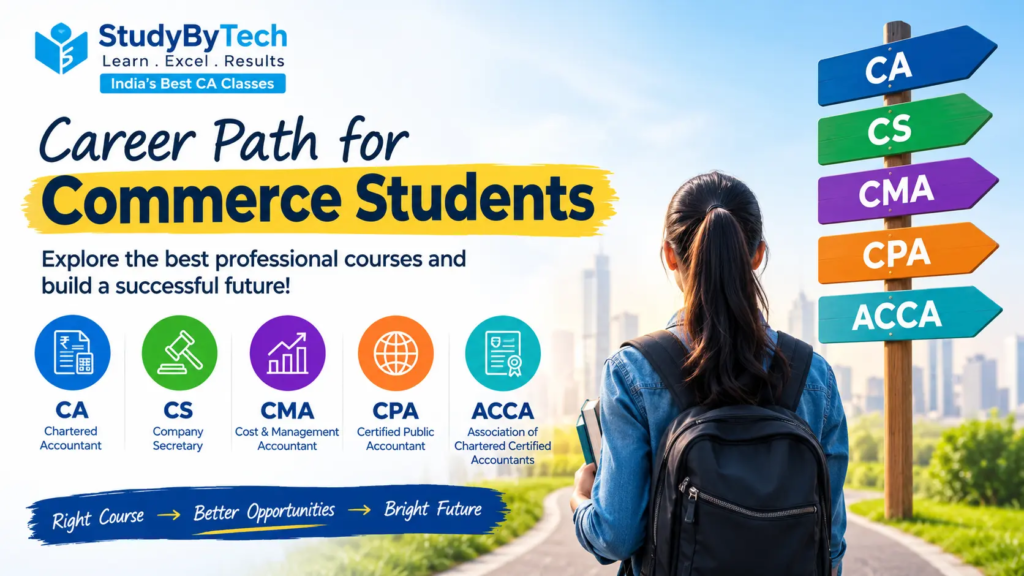
Know everything regarding Career path for commerce students
📘 Know everything regarding Career path for Commerce students
Choosing the professional path in commerce is a very important decision that a student makes after finishing Class 12 or after graduation. The Chartered Accountancy (CA) course is still the popular flagship choice but many global and local alternatives give strong career opportunities.
This guide details the CA course structure, the career paths that CA offers and a comparative breakdown of the top alternative qualifications such as CS, CMA, CPA and ACCA.
CA, CS, CMA, CPA (US), and ACCA (UK) – each with unique focus, duration, and global reach.
Detailed expenditure breakdowns, starting salaries, and 5‑year growth projections for every course.
Understand which qualifications open doors in India vs. the USA, UK, Middle East, and beyond.
From statutory audit to corporate leadership, investment banking, or legal governance – find your fit.
Match your interests (numbers, law, operations, global finance) to the right professional path.
- 1. CA Course Structure
- 2. Who Should Choose CA?
- 3. Career Paths After CA
- 4. Top Alternatives (CS, CMA, CPA, ACCA)
- 5. Side‑by‑Side Comparison
- 6. Which Course for Which Student?
- 7. Total Expenditure & Salary Growth
- 8. Frequently Asked Questions
Jump to any section using the links above.
While CA is widely respected many commerce students look for top professional qualifications. They choose these based on their career goals, interest in law or desire to work internationally.
Offered by the ICSI this course teaches company law, legal compliance and corporate governance. Company Secretaries are legal advisors in companies. They make sure businesses follow all rules and regulations.
The ICMAI runs this course. It covers cost systems, budgeting, supply chain and operational audits. CMAs help businesses reduce costs and improve profits from within.
The AICPA in the USA administers the CPA. It focuses on US tax laws, US GAAP and auditing. This qualification is ideal for those who want to work in US-based firms or global companies listed in the US.
The ACCA is based in the UK. It teaches financial reporting standards (IFRS) and global financial management. It is recognized in over 180 countries making it a strong choice for careers.
| Feature | CA | CS | CMA | CPA (US) | ACCA (UK) |
|---|---|---|---|---|---|
| Primary Domain | Audit, Taxation, Accounting | Corporate Law & Compliance | Costing & Management Accounting | US Tax & Financial Reporting | Global Finance & IFRS |
| Duration | 4.5 – 5 Years | 3 – 4 Years | 3 – 4 Years | 1 – 1.5 Years | 2 – 3 Years |
| Geographic Scope | Primary strength in India | Primary strength in India | Primary strength in India | USA & Global US MNCs | Global (180+ Countries) |
| Practical Training | 2 Years Mandatory | 21 Months Mandatory | 15 Months Mandatory | 1-2 Years Relevant Experience | 3 Years Relevant Experience |
| Exam Format | Descriptive / Group-based | Descriptive / Group-based | Objective & Descriptive | 100% Computer-Based | On-demand & Session-based |
You want statutory audit rights in India thrive in tax and financial accounting and want flexible options between independent practice and corporate leadership.
You enjoy law, legal drafting, reading regulations and want to work with corporate boards and legal compliance.
You are interested in manufacturing industries, supply chain economics, cost minimization and internal business strategies.
You already hold a commerce degree or have a CA background and want to work with US-based MNCs or relocate to North America.
You want modular global exams, early practical exposure and aim to build an international career across Europe, the Middle East or Asia.
💰 7. Total Expenditure of Course
A complete breakdown of mandatory fees, coaching costs, starting salaries and 5‑year growth for each qualification.
| Stage / Level | Mandatory ICAI Official Fees | Estimated Private Coaching | Total Stage-Wise Cost |
|---|---|---|---|
| CA Foundation | ₹11,300 (Reg: ₹9,800 + Exam: ₹1,500) | ₹15,000 – ₹30,000 | ₹26,300 – ₹41,300 |
| CA Intermediate | ₹20,700 (Both Groups Reg: ₹18,000 + Exam: ₹2,700) | ₹50,000 – ₹90,000 | ₹70,700 – ₹1,10,700 |
| Mandatory ICITSS | ₹13,500 (IT: ₹6,500 + Orientation: ₹7,000) | ₹0 (Conducted by ICAI) | ₹13,500 |
| Articleship Registration | ₹2,000 | ₹0 | ₹2,000 |
| CA Final | ₹25,300 (Both Groups Reg: ₹22,000 + Exam: ₹3,300) | ₹60,000 – ₹1,20,000 | ₹85,300 – ₹1,45,300 |
| Mandatory AICITSS | ₹14,500 (Advanced IT: ₹7,500 + MCS: ₹7,000) | ₹0 (Conducted by ICAI) | ₹14,500 |
| GRAND TOTAL | ₹87,300 | ₹1,25,000 – ₹2,40,000 | ₹2,12,300 – ₹3,27,300 |
| Stage / Level | Mandatory ICSI Official Fees | Estimated Private Coaching | Total Stage-Wise Cost |
|---|---|---|---|
| CSEET (Entry Test) | ₹2,000 (Registration & Test Fee) | ₹5,000 – ₹10,000 | ₹7,000 – ₹12,000 |
| CS Executive | ₹12,900 (Both Modules Reg: ₹10,100 + Exam: ₹2,800) | ₹35,000 – ₹60,000 | ₹47,900 – ₹1,07,900 |
| Pre-Exam & Orientation | ₹2,000 (One-Day Orientation & Online Tests) | ₹0 | ₹2,000 |
| CS Professional | ₹17,000 (Reg: ₹13,000 + Exam: ₹4,000) | ₹40,000 – ₹70,000 | ₹57,000 – ₹1,11,000 |
| Executive Development | ₹8,000 (EDP Training & Practical Workshops) | ₹0 | ₹8,000 |
| GRAND TOTAL | ₹41,900 | ₹80,000 – ₹1,40,000 | ₹1,21,900 – ₹1,81,900 |
| Stage / Level | Mandatory ICMAI Official Fees | Estimated Private Coaching | Total Stage-Wise Cost |
|---|---|---|---|
| CMA Foundation | ₹7,500 (Registration + Exam Fee) | ₹10,000 – ₹20,000 | ₹17,500 – ₹27,500 |
| CMA Intermediate | ₹25,600 (Both Groups Reg: ₹23,100 + Exam: ₹2,500) | ₹35,000 – ₹60,000 | ₹60,600 – ₹85,600 |
| Mandatory Training | ₹0 (Included in Intermediate Registration) | ₹0 | ₹0 |
| CMA Final | ₹31,800 (Both Groups Reg: ₹29,000 + Exam: ₹2,800) | ₹40,000 – ₹75,000 | ₹71,800 – ₹1,06,800 |
| GRAND TOTAL | ₹64,900 | ₹85,000 – ₹1,55,000 | ₹1,49,900 – ₹2,19,900 |
| Stage / Component | Mandatory Official Fees (INR Approx.) | Estimated Private Coaching | Total Component Cost |
|---|---|---|---|
| WES Evaluation Fee | ₹22,000 – ₹28,000 ($250 – $320) | ₹0 | ₹22,000 – ₹28,000 |
| Exam Registration Fee | ₹12,000 ($140 one-time NTS fee) | ₹0 | ₹12,000 |
| Section Exam Fees (4 Papers) | ₹1,00,000 – ₹1,15,000 ($300/paper) | ₹0 | ₹1,00,000 – ₹1,15,000 |
| International Surcharge | ₹1,25,000 – ₹1,40,000 ($390/paper for testing in India) | ₹0 | ₹1,25,000 – ₹1,40,000 |
| Coaching & Prep Software | ₹0 | ₹80,000 – ₹1,20,000 | ₹80,000 – ₹1,20,000 |
| Ethics Exam & Licensing | ₹18,000 – ₹25,000 | ₹0 | ₹18,000 – ₹25,000 |
| GRAND TOTAL | ₹2,77,000 – ₹3,20,000 | ₹80,000 – ₹1,20,000 | ₹3,57,000 – ₹4,40,000 |
| Stage / Level | Mandatory Official Fees (INR Approx.) | Estimated Private Coaching | Total Stage-Wise Cost |
|---|---|---|---|
| Initial Registration | ₹4,000 – ₹9,000 (One-time GBP fee) | ₹0 | ₹4,000 – ₹9,000 |
| Knowledge Level (3 Papers) | ₹30,000 – ₹36,000 (GBP 100–120/paper) | ₹20,000 – ₹30,000 | ₹50,000 – ₹66,000 |
| Skill Level (6 Papers) | ₹80,000 – ₹95,000 (GBP 140–160/paper) | ₹50,000 – ₹70,000 | ₹1,30,000 – ₹1,65,000 |
| Strategic Professional (4 Papers) | ₹75,000 – ₹90,000 (GBP 180–220/paper) | ₹50,000 – ₹75,000 | ₹1,25,000 – ₹1,65,000 |
| Annual Subscription Fees | ₹20,000 – ₹30,000 (Paid over 3 years) | ₹0 | ₹20,000 – ₹30,000 |
| GRAND TOTAL | ₹2,09,000 – ₹2,60,000 | ₹1,20,000 – ₹1,75,000 | ₹3,29,000 – ₹4,35,000 |
These are the most common doubts and queries that commerce students search for while deciding their professional career path. Click on any question to reveal the answer.
There is no single “best” course — it completely depends on your career interests, skills, and long-term goals:
- CA – Best if you love audit, taxation, and accounting and want statutory audit rights in India.
- CS – Best if you enjoy corporate law, legal compliance, and governance.
- CMA – Best if you are interested in cost management, operations, and supply chain.
- CPA – Best if you want to work with US-based MNCs or relocate to North America.
- ACCA – Best if you dream of a global career across 180+ countries with IFRS expertise.
✅ Pro tip: Ask yourself — “Do I want to practice independently in India? (CA) | Work in corporate law? (CS) | Go global? (ACCA/CPA)”
Starting salaries are comparable across all five, but the long-term earning potential varies based on your role and location:
- CA: Starting ₹9–13 LPA → 5-yr ₹18–30 LPA (highest in India for audit/tax roles).
- CS: Starting ₹6–9 LPA → 5-yr ₹14–22 LPA (excellent for governance roles).
- CMA: Starting ₹7–10 LPA → 5-yr ₹15–24 LPA (great in manufacturing/PSUs).
- CPA: Starting ₹8–12 LPA → 5-yr ₹18–28 LPA (US MNCs pay premium).
- ACCA: Starting ₹6–9 LPA → 5-yr ₹15–25 LPA (higher if relocating abroad).
💡 Bottom line: CA and CPA often lead the pack in India, but ACCA opens doors to international pay scales that can far exceed Indian averages.
Yes, absolutely! You can pursue CA right after Class 12 in any stream (Commerce, Arts, or Science).
- Maths is NOT mandatory for CA Foundation. The quantitative aptitude section covers basic maths that is manageable with practice.
- You can register for CA Foundation after appearing for your Class 12 exams.
- If you are a graduate, you can directly register for CA Intermediate (Direct Entry Route).
📌 Note: Even without maths, thousands of commerce students clear CA every year with consistent effort and the right guidance.
CA is widely considered the toughest among Indian commerce qualifications due to its low pass rates, rigorous articleship, and vast syllabus.
- CA – Pass rates: Foundation ~25–30%, Intermediate ~10–15%, Final ~10–15%. Requires 2 years of mandatory articleship.
- CS – Pass rates: Executive ~20–25%, Professional ~15–20%. 21 months of training.
- CMA – Pass rates: Foundation ~30–35%, Intermediate ~20–25%, Final ~15–20%. 15 months training.
- CPA – Pass rates: 45–55% per section (US-based, computer-based). No mandatory training but requires 1–2 years of experience.
- ACCA – Pass rates: 40–50% per paper. Flexible, on-demand exams with 3 years of practical experience requirement.
⚖️ Verdict: CA is objectively tougher in India, but CPA and ACCA have their own global challenges (e.g., US GAAP, IFRS, and English proficiency).
Yes, many CAs pursue CPA or ACCA as an add-on qualification to expand their global career opportunities.
- CA + CPA: You get exemptions in certain CPA papers. This combo is highly valued in US-based MNCs and Big 4 global delivery centers.
- CA + ACCA: You can get up to 9 exemptions out of 13 ACCA papers, making it a quick add-on. Great for IFRS-based global roles.
- Is it worth it? Absolutely — it opens doors to international postings, higher pay scales, and global credibility.
💡 Ideal path: Clear CA first, gain 2–3 years of work experience, then pursue CPA/ACCA while working.
In India, CA has the widest scope and recognition across all sectors — audit, tax, finance, and corporate advisory.
- CA: Highest demand in India — statutory audit, taxation, Big 4, corporate finance, and independent practice.
- CS: Strong demand in listed companies, banking, and regulatory compliance (SEBI, RBI).
- CMA: High demand in manufacturing, PSUs, and cost-intensive industries.
- CPA: Growing demand in US MNCs, Global Capability Centers (GCCs), and Big 4 offshore teams.
- ACCA: Increasing recognition in India, especially in MNCs, shared services, and IFRS-based reporting roles.
📊 Verdict: CA > CS ≈ CMA > CPA ≈ ACCA in terms of domestic Indian scope. But for global careers, ACCA and CPA take the lead.
Yes, you can pursue two courses simultaneously, but it requires exceptional time management and discipline.
- CA + CS: Very common. Many students do CS alongside CA articleship. ICSI allows this combination.
- CA + CMA: Also possible. ICMAI allows students to pursue CMA alongside other courses.
- CA + ACCA: You can pursue ACCA after CA (with exemptions) or alongside if you manage time well.
- ⚠️ Warning: Attempting two demanding courses together can delay both. It’s advisable to complete one first and then pursue the other.
✅ Smart approach: Clear CA first → then add CS/CMA/CPA/ACCA as a value-add while working.
Yes, ACCA is valid and recognized in India, though it does not grant statutory audit rights like CA.
- ACCA is recognized by the Reserve Bank of India (RBI) and many Indian companies.
- ACCA professionals are hired in MNCs, Big 4 firms, banks, and financial shared services in India.
- You can also work as a finance manager, internal auditor, or IFRS reporting specialist in Indian companies.
- However, for statutory audit and taxation practice in India, you still need a CA qualification.
💼 Job opportunities: ACCA is highly valued in cities like Mumbai, Delhi, Bangalore, and Pune, especially in global MNCs and GCCs.
Here are the typical pass rates for each qualification (may vary by attempt):
- CA Foundation: ~25–30% | CA Inter: ~10–15% | CA Final: ~10–15%
- CS Executive: ~20–25% | CS Professional: ~15–20%
- CMA Foundation: ~30–35% | CMA Inter: ~20–25% | CMA Final: ~15–20%
- CPA (US): ~45–55% per section (FAR, AUD, REG, BEC)
- ACCA: ~40–50% per paper (varies by level)
📉 Takeaway: CA and CS have the lowest pass rates, making them the most challenging. CPA and ACCA have relatively higher pass rates but require different skill sets (US GAAP/IFRS).
No, maths is NOT mandatory for any of these courses. However, basic numerical aptitude is helpful.
- CS: No maths requirement. You need to be good at legal language and compliance.
- CMA: No mandatory maths, but you’ll deal with cost sheets, budgeting, and financial ratios.
- CPA: No maths requirement. The exam focuses on accounting principles, tax laws, and auditing.
- ACCA: No maths requirement. You need analytical skills for financial reporting and management accounting.
📊 Reality check: While maths is not compulsory, being comfortable with basic arithmetic, percentages, and financial calculations will make your journey much smoother in all these courses.
Yes, you can clear all these courses through self-study, but the level of difficulty varies.
- CA: Very challenging without coaching due to vast syllabus and low pass rates. But many students do clear CA through self-study with ICAI study materials.
- CS/CMA: Moderate — ICSI and ICMAI provide comprehensive study materials. Self-study is possible with discipline.
- CPA: Highly self-study friendly! Many students use prep software (Becker, Wiley) and clear CPA without classroom coaching.
- ACCA: Very self-study friendly. ACCA provides official study materials and a flexible exam schedule.
💡 Pro tip: If you’re doing self-study, invest in good reference books, online test series, and join study groups for peer support.
Failing attempts is common in professional courses — it does not define your potential. Here’s what you can do:
- Re-evaluate your strategy: Identify weak subjects, join test series, or seek mentorship.
- Take a break: If you’re burnt out, take 1–2 attempts off to recharge and then restart with fresh energy.
- Switch to an alternative: If CA is not working out after multiple attempts, consider CS, CMA, CPA, or ACCA as a parallel or alternative path.
- Many successful professionals have failed multiple attempts before finally clearing. Persistence matters more than one-time success.
🌟 Inspiring fact: Many top CAs and CFOs in India failed 4–5 attempts before qualifying. The key is to learn, adapt, and keep going.
CMA has the highest demand in government (PSU) jobs, followed by CA and CS.
- CMA: PSUs like ONGC, BHEL, Coal India, SAIL, and banks actively recruit CMAs for cost and management accounting roles.
- CA: Also recruited in PSUs, RBI, CAG (Comptroller and Auditor General), and government financial departments.
- CS: Recruited in government companies, regulatory bodies (SEBI, RBI), and public sector banks for compliance roles.
- CPA/ACCA: Limited scope in Indian government jobs, but excellent for global organizations and MNCs.
🏛️ Recommendation: If your goal is a stable PSU job, CMA is your best bet. If you want elite government financial roles, CA is a strong choice.
Yes, all these courses offer flexible learning options, but the level of “online” availability varies:
- CA: ICAI offers online classes and virtual coaching. Exams are conducted in physical centers. Articleship is mandatory (in-person).
- CS: ICSI offers e-learning portals, online modules, and virtual classes. Training is partly in-person.
- CMA: ICMAI provides online study materials and virtual coaching. Practical training is required.
- CPA: 100% online-friendly! You can register, study (via prep software), and take exams at Prometric centers (computer-based).
- ACCA: Highly online-friendly! You can register, study, and take exams (on-demand or session-based) online or at test centers.
🌐 Best for online: CPA and ACCA are the most flexible and globally accessible. CA/CS/CMA have mandatory in-person training components.
The ideal time to start depends on the course and your academic stage:
- CA: Start right after Class 12. Register for CA Foundation and begin preparing immediately.
- CS: Start after Class 12 or during graduation. CSEET is the entry test.
- CMA: Start after Class 12. Register for CMA Foundation and begin.
- CPA: Best to start after graduation (or in the final year). Requires 120–150 credit hours of education.
- ACCA: Can start after Class 12 (with some exemptions if you have studied certain subjects).
📅 Golden rule: The earlier you start, the better. But it’s never too late — many professionals start these courses in their mid-20s or even later.
CA is the undisputed leader for independent practice in India, followed by CS and CMA for niche practices.
- CA: You can start your own audit, tax, and accounting firm. Statutory audit rights give you a huge advantage.
- CS: You can start a Practicing Company Secretary (PCS) firm offering compliance, secretarial audit, and legal advisory services.
- CMA: You can start a cost audit and management consulting practice for manufacturing and industrial clients.
- CPA/ACCA: Limited scope for independent practice in India (no statutory audit rights), but you can offer global tax, IFRS advisory, and US compliance services to MNCs.
🏢 Verdict: If your dream is to have your own firm with statutory authority, CA is the best choice. If you’re more inclined towards legal governance, choose CS.
📌 Still have questions? Consult with a career counselor or reach out to alumni from these courses for personalized guidance.
📘 Know everything regarding Career path for Commerce students — Complete guide with key takeaways, TOC, detailed expenditure, and FAQs.
All content preserved as provided. Designed for clarity & visual appeal.
