
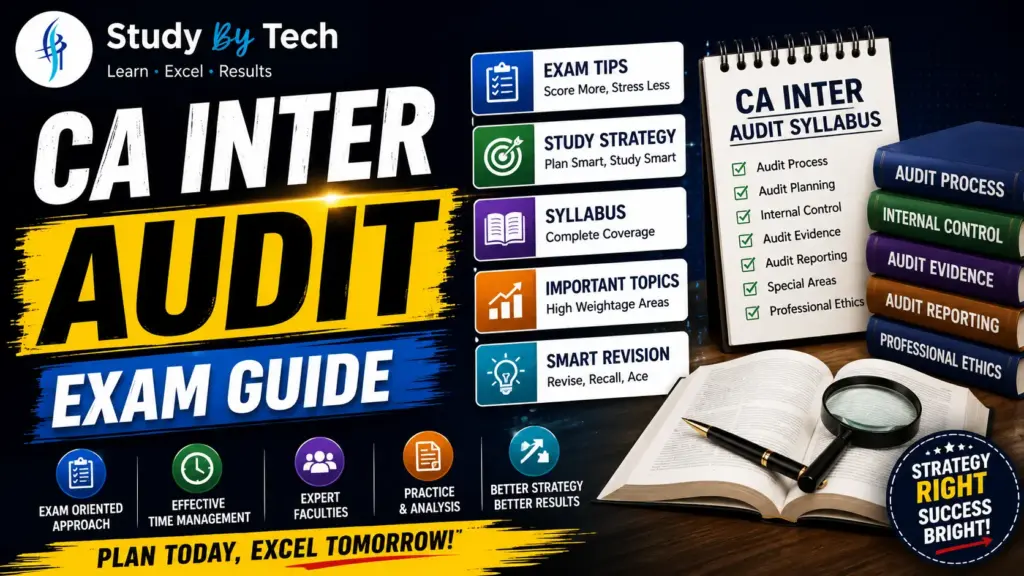
CA Inter Audit Exam Tips: Top 10 Secrets to Score Exemption (Updated Syllabus)
🎯 By CA Palki Lamba, Best Faculty for CA Inter Audit.
“Achieving anything, especially success, does not come easy. Just as a little plant takes months to grow into a tree, you have to do the same while preparing for CA Inter Audit.”
CA Inter Audit is Paper 5 of the ICAI CA Intermediate course, officially Auditing and Ethics, and a strong audit score can earn you an exemption. This guide is for CA Inter students who want the chapter-wise weightage and 10 practical exam tips from CA Palki Lamba. The key takeaway: understand the logic behind Standards on Auditing, use proper audit language, revise at least five times, and write answers in a four-step format.
⭐ Key Takeaways
- Concept over rote: ICAI tests how you apply concepts, not how you memorise.
- Master SAs: Standards on Auditing carry 20–25 marks. Know the logic behind each.
- Use audit language: terms like “verify supporting documentary evidence” fetch more marks.
- 5 revisions minimum: the syllabus is vast, so plan at least 5 revision cycles.
- 4-step answers: Provision → Explanation → Application → Conclusion.
- Never leave blanks: partial answers with relevant points still fetch step marks.
CA Inter Audit Syllabus & Chapter Weightage
To score 60+ in CA Inter Audit, prioritise topics by their past exam weightage and difficulty:
| Priority | Chapter / Topic Area | Expected Marks | Key Focus Areas |
|---|---|---|---|
| A | Standards on Auditing (SAs) | 20–25 Marks | SA 200, 240, 300, 315, 500, 505, 700 series (objectives, documentation & key principles). |
| A | Audit of Items of Financial Statements | 12–15 Marks | Assertions, verification of income, expenditure, assets, liabilities and disclosures. |
| A | Audit Report & Completion | 10–12 Marks | SA 700, 705, 706, Key Audit Matters (SA 701), CARO 2020 compliance. |
| B | Ethics & Professional Conduct | 8–10 Marks | Fundamental principles of ethics, independence of auditors, threats to independence. |
| B | Internal Control & Automated Environment | 8–10 Marks | Internal check vs internal audit, IT risks, application controls, testing controls. |
| C | Audit Documentation, Evidence & Sampling | 6–8 Marks | SA 230, SA 500, SA 530 (audit trail, working papers, sampling techniques). |
| C | Specialised Audits (Banks, Non-Profits, etc.) | 6–8 Marks | Audit of Banks, Educational Institutions, Hospitals and Hotels. |
Note for aspirants: follow the latest study material issued by ICAI for Paper 5: Auditing and Ethics, updated with the latest statutory amendments and ethical guidelines.
Top 10 Exam Secrets for CA Inter Audit
🔑 1. Know What You Are Studying (Concept over Rote Learning)
Audit isn’t just rote learning. ICAI tests concepts, principles and logic. If you memorise data, you’ll struggle to apply concepts in practical cases.
🔑 2. Master the Logic Behind Auditing Standards (SAs)
Don’t study SAs mechanically. Understand why each standard exists. After reading one, try to explain it in your own words.
🔑 3. Master the “Language of Audit” (Keywords Matter)
Presentation plays a massive role in scoring high. Examiners look for the professional terminology used in the ICAI study material.
🔑 4. Focus Heavily on Standards on Auditing (SAs)
SAs are the core of Paper 5. Know the purpose of each standard as well as where it applies.
Pro tip: if you remember the SA number, use it. If not, refer to it as the applicable standard on auditing and explain it precisely.
🔑 5. Practice Case-Based & Practical Scenario Questions
CA Inter Audit increasingly features scenario-based case studies. To prepare:
- Solve the last 5–10 attempts of RTPs, MTPs and Past Year Questions (PYQs).
- Learn to spot the core legal/auditing issue quickly in a long narrative question.
🔑 6. Follow a Strict Multi-Revision Cycle
The audit syllabus is huge, so it’s hard to retain. Use this revision technique:
- Do at least five revision cycles before the exam.
- Set aside at least 45 minutes every day to revise audit.
- Use flow charts, mind maps and summary notes to remember better.
🔑 7. Create Concise Summary Revision Notes
Draft short notes on:
- The core Audit Process & Assertions.
- Key summary points of Standards on Auditing (SAs).
- Company Audit provisions & CARO 2020 checklists.
🔑 8. Develop Professional Answer Writing Skills
Practising written answers under timed conditions is non-negotiable. Split every practical or case answer into four zones:
🔑 9. Master Exam-Day Time Management
🔑 10. Treat Audit as a Daily Practical Discipline
The biggest mistake is treating Audit as a “last-month theory subject.” Treat it like a practical discipline: understand it, apply it and revise it continuously.
Learn from the Best Faculty for CA Inter Audit
To build a solid understanding of concepts and master the language of audit, CA Palki Lamba Ma’am is considered the foremost faculty for CA Inter Audit.

Why Palki Lamba Ma’am?
Her interactive approach helps students learn tough auditing norms in a way that connects to daily life, through:
- Interactive classroom discussions where no doubt is too small.
- Exhaustive coverage of ICAI Study Material, past papers, RTPs and MTPs.
- Special presentation workshops for writing ICAI-compliant technical answers.
- Comprehensive doubt support via direct phone calls and discussion forums.
Course Highlights
🚀 Ready to Get Exemption in CA Inter Audit in Your First Attempt?
Don’t leave your audit preparation to chance. Join the structured online classes by CA Palki Lamba Ma’am at StudyByTech and get exhaustive video lectures, conceptual revision charts and regular test evaluations.
❓ FAQs
What is CA Inter Audit?
CA Inter Audit is Paper 5 of the ICAI CA Intermediate course, called Auditing and Ethics. It covers Standards on Auditing, audit of financial statement items, audit reports, ethics, internal control and specialised audits. It tests how well you apply auditing standards and professional conduct to practical case situations.
How does CA Inter Audit exam work?
The paper mixes case-based MCQs worth 30 marks with descriptive questions on standards, reports and ethics. Strong answers state the standard or provision, explain it, apply it to the case and conclude as an auditor. Partial attempts with relevant points still earn step marks.
Is CA Inter Audit worth studying seriously?
Yes. Audit is a core paper, and a strong score can secure an exemption. Standards on Auditing alone carry about 20 to 25 marks, so understanding their logic, using proper audit language and revising at least five times pays off in both marks and professional confidence.
Who is CA Inter Audit best for?
It’s for every CA Intermediate student, especially those who find standards heavy or struggle to write professional answers. If you tend to memorise rather than understand, interactive classes, scenario practice and a multi-revision plan will help you the most.
Is the Audit part of CA Inter really tough to handle?
The Audit part of CA Inter is manageable if you understand the concepts and study regularly. CA Palki Lamba Ma’am at StudyByTech makes it simple and helps you score well.
What is the Audit part of CA Inter about?
The Audit part of CA Inter teaches the principles of auditing, plus the ethics and procedures you need to follow. CA Palki Lamba Ma’am’s classes at StudyByTech help you understand these concepts clearly.
Can only Chartered Accountants do audits?
No. Other qualified people with the right experience can also do certain audits, depending on what the law requires. StudyByTech explains the concepts of the Audit part of CA Inter with relatable examples.
Who is the teacher for the Audit part of CA Inter?
CA Palki Lamba Ma’am is one of the best teachers for the Audit part of CA Inter. At StudyByTech she teaches it with a focus on concepts, which helps you prepare for exams. Her classes are very interactive, and she covers all SAs in the class itself.
What are the different types of audits?
There are four types of audits: Internal Audit, External Audit, Compliance Audit and Operational Audit. StudyByTech explains each type with examples you can relate to.