
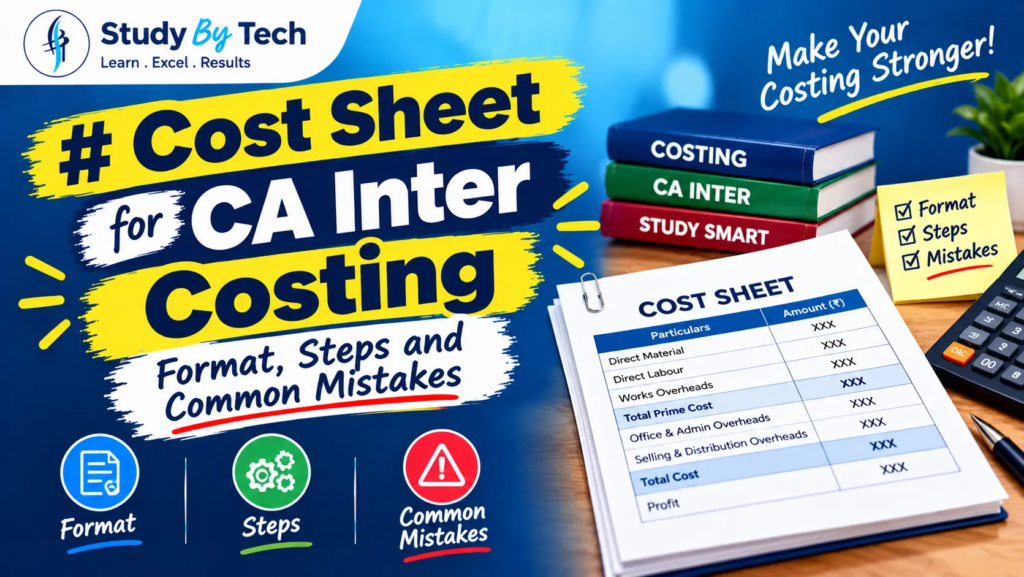
Cost Sheet I CA Inter Costing with Parag Gupta sir
Cost Sheet for CA Inter Costing: Format, Steps and Common Mistakes
In short: A cost sheet is a statement that shows the total cost of making a product, built up in stages: prime cost, factory cost, cost of production, cost of goods sold, cost of sales and profit. This guide is for CA Inter students learning the cost sheet in Cost & Management Accounting. You’ll get the format, the step-by-step method, common mistakes and FAQs from Parag Gupta sir. The key takeaway: build it stage by stage and never skip a layer.
Key takeaways
- A cost sheet shows total cost and cost per unit, stage by stage.
- Prime cost = direct material + direct labour + direct expenses.
- Each stage adds one type of overhead to the one before it.
- Stock adjustments (WIP and finished goods) decide the final numbers.
- Add profit to cost of sales to reach the selling price.
- Practise with ICAI material, RTPs and MTPs for the CA Inter exam.
What is a cost sheet?
Think of the cost sheet as a ladder. You start at the bottom with the cheapest, most direct costs. Every step up adds another layer of overheads. At the top, you’ve got the full cost of sales, and profit takes you to the selling price.
It’s a core part of CA Inter Costing, and it’s covered in the ICAI Cost & Management Accounting syllabus. Get this one right and the later chapters feel much easier.
Why does the CA Inter cost sheet matter?
Companies use it to price products, control costs and compare periods. In the exam, it tests whether you can classify costs correctly and keep calm with adjustments.
Cost sheet format and flow
Here’s the whole cost sheet at a glance. Read it left to right (or top to bottom on your phone).
- Prime costDirect material + labour + expenses
- Factory cost+ Factory overheads
- Cost of production+ Administration overheads
- Cost of goods sold+ Opening, − closing finished goods
- Cost of sales+ Selling & distribution overheads
- SalesCost of sales + profit
| Stage | What you add | What you get |
|---|---|---|
| 1 | Direct material, direct labour, direct expenses | Prime cost |
| 2 | Factory overheads (adjust for opening and closing WIP) | Factory cost / works cost |
| 3 | Administration overheads | Cost of production |
| 4 | Opening finished goods less closing finished goods | Cost of goods sold |
| 5 | Selling and distribution overheads | Cost of sales |
| 6 | Profit margin | Selling price |
Pro tip: Always show two columns: total cost and cost per unit. Dividing by units at each stage is where easy marks live.
How to prepare a cost sheet, step by step
Here’s the checklist we follow in class. Tick these off and you won’t miss a thing.
Understand cost concepts first
Know direct vs indirect, fixed vs variable, semi-variable and opportunity costs. Everything else depends on this.
Pick the right format
Choose a clear, columnar layout that fits what the question asks. Keep headings and sub-headings neat.
Classify every cost
Tag each item: direct or indirect, variable or fixed, manufacturing or non-manufacturing. Do this before you calculate.
Work out direct costs
Direct material: adjust for opening and closing stock. Direct labour: use wage rates, hours and any extra labour costs.
Allocate overheads
Split factory overheads into variable and fixed. Then spread them fairly across the units you produced.
Get cost per unit and price
Divide total cost by units. Add your profit margin to reach the selling price, keeping market conditions in mind.
Reconcile and document
Match the cost sheet with the financial statements. Keep records for every figure so you can explain it.
Comply and review
Follow the relevant accounting standards. Update the sheet whenever costs or production methods change.
Remember, requirements vary by industry and purpose. The stages stay the same, though.
Common cost sheet mistakes to avoid
Skipping stock adjustments
Forget opening or closing WIP and finished goods, and every later figure goes off.
Mixing up overheads
Factory, administration and selling overheads belong in different stages. Put each one where it should go.
Ignoring cost per unit
Many questions ask for it directly. Calculate it as you go, not at the end.
Resources to master the CA Inter cost sheet
Use these together: learn the concept, then practise, then revise.
Practise
Solve questions from ICAI study material and the latest RTPs and MTPs. Short on time? Start with Parag sir’s hand-picked 59 questions to score 60+ marks.
Why StudyByTech for CA Inter Cost?
StudyByTech has been a well-known name in CA classes since 2003. Our faculty are experienced professionals. One of the founders is Parag Gupta sir, a well-known faculty for CA Inter Costing and SM, and CA Final Costing.
You’ll get organised plans, clear direction and plenty of resources for your CA journey. Ready to start? Pick your batch below.
Cost sheet FAQs for CA Inter
What is a cost sheet?
A cost sheet is a statement that shows the total cost of a product or job, broken into stages. It starts with prime cost and builds up through factory cost, cost of production and cost of sales. Add profit at the end and you get the selling price. It also shows cost per unit.
How does a cost sheet work?
You list costs in the order they’re incurred. First add direct material, direct labour and direct expenses to get prime cost. Then add factory, administration and selling overheads, adjusting for stock along the way. Divide by units to get cost per unit, then add profit to reach the selling price.
Is the cost sheet worth studying for CA Inter?
Yes. It’s a foundation topic in CA Inter Cost & Management Accounting, and the logic of splitting costs into stages shows up in later chapters too. Practise the format on a few questions. Once the stages feel natural, most questions become careful classification and adjustments.
Who is the cost sheet best for?
It’s for CA Inter students preparing Cost & Management Accounting, whether you’re attempting one group or both. It also helps anyone who needs to price products, control costs or see where manufacturing money goes. If you’re new to costing, start here before moving to advanced topics.
How many months are required for CA Intermediate?
For one group, around 3 months can work. If you’re attempting both groups together, 3 months isn’t enough, so plan for at least 5-6 months. Self-study can get you through CA Inter, but a structured class helps you stay consistent and catch mistakes early.
Who is the best faculty for costing CA Inter?
Parag Gupta sir is a popular first choice for CA Inter Costing. He focuses on concepts, and his classes stay exam-oriented. Lakhs of CA students have learned from him. If concepts are where you slip, his approach is built for exactly that.
Which is the best book for CA Inter cost accounting?
Parag Gupta sir’s CA Inter Costing book is widely recommended. It has a wide variety of questions, including international ones, and links each concept to real life so ideas stick. Pair it with ICAI study material and RTPs/MTPs for complete exam prep.