
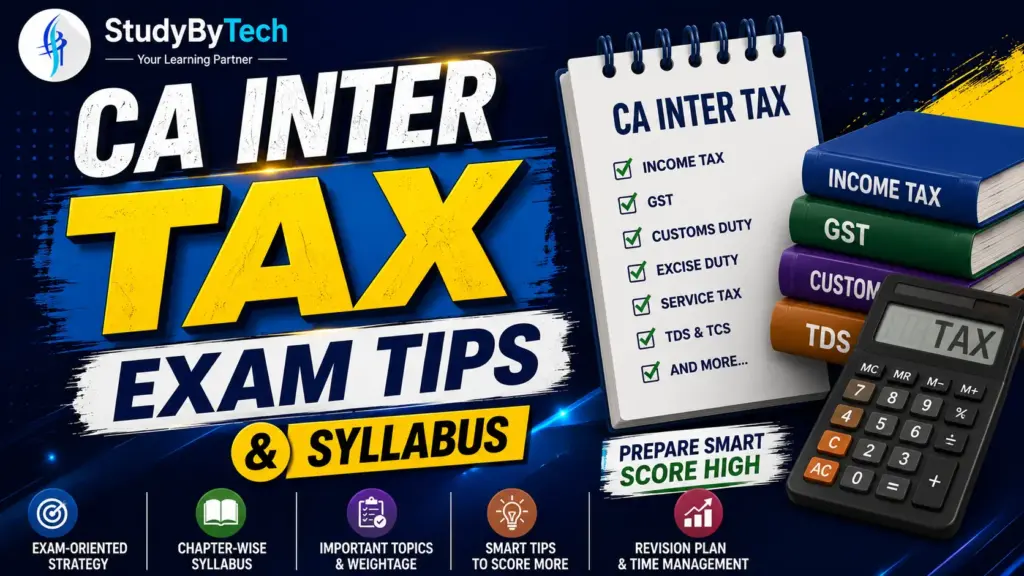
CA Inter Tax: Complete Syllabus, ABC Analysis & Exam Tips & Tricks (Jan 2027 Exams)
CA Inter Tax is Paper 3 of CA Intermediate Group 1, and it’s split evenly: 50 marks for Income-tax Law and 50 for GST. This guide is for CA students targeting the Jan 2027 exams. You’ll get chapter-wise weightage, an ABC analysis, a 4-step answer format, a time plan for the 3-hour paper, and common pitfalls. The key takeaway: put 70% of your early effort into Category A topics, which carry roughly 60% of the marks.
⭐ Key Takeaways
Income-tax (50 marks) + GST (50 marks). Both need equal attention.
Focus 70% of your time on Category A topics that carry ~60% marks.
Statute → Rule → Application → Final Answer. It gets you partial marks.
15 min reading → 20 min MCQs → 60 min GST → 100 min Direct Tax.
Write assumptions clearly (for example, the tax regime under Sec 115BAC).
Avoid switching between too many books. It creates visual memory.
Mentioning section numbers (like Sec 54, Sec 17(5)) fetches full marks.
1. CA Inter Tax Overview (Jan 2027 Syllabus Structure)
Under the ICAI scheme, Paper 3: Taxation in CA Intermediate is divided into two balanced sections totalling 100 marks:
| Section | Focus Area | Marks | Key Objective |
|---|---|---|---|
| Section A | Income-tax Law (Direct Tax) | 50 Marks | Develop conceptual clarity and compute total income under various heads. |
| Section B | Goods and Services Tax (Indirect Tax) | 50 Marks | Master provisions of CGST & IGST, ITC rules, and procedural compliance. |
Section A: Income-tax Law – 50 marks
Section B: GST – 50 marks
📌 Reminder for Jan 2027: Follow the latest study materials published by ICAI for Part A (Income-tax Law) and Part B (GST). They include the necessary Finance Act modifications and statutory updates relevant to 2027.
2. Chapter-Wise Weightage & Revision Strategy
To maximise your score, prioritise topics based on their historical exam weightage and difficulty level.
Section A: Income-tax Law (50 Marks)
| Chapter / Topic | Expected Marks | Priority | Key Focus Areas |
|---|---|---|---|
| Computation of Total Income & Tax Liability | 10 – 12 | A | Comprehensive problems combining multiple heads, AMT, and special rates. |
| Heads of Income (PGBP & Capital Gains) | 10 – 14 | A | Sec 54 exemptions, Indexation, Disallowances under Sec 40/40A, Presumptive taxation. |
| Heads of Income (Salaries, HP, Other Sources) | 8 – 12 | B | Perquisites, Deduction under Sec 24, Gift provisions under Sec 56(2)(x). |
| TDS, TCS & Advance Tax | 6 – 8 | A | Sec 194-IA, 194-IB, 194R, 194Q, Advance tax due dates, interest calculations. |
| Deductions from GTI (Chapter VI-A) | 6 – 8 | B | Sec 80C, 80D, 80DD, 80G, 80JJAA, and 80TTA/80TTB. |
| Clubbing, Set-off & Carry Forward | 6 – 8 | B | Order of set-off, loss carry-forward limits, minor child income clubbing. |
| Residential Status & Scope of Total Income | 4 – 6 | C | Deemed resident rules, taxable income based on residential status. |
| Return of Income & Self-Assessment | 4 – 6 | C | Updated return (Sec 139(8A)), due dates, fee for late filing (Sec 234F). |
Section B: Goods and Services Tax – GST (50 Marks)
| Chapter / Topic | Expected Marks | Priority | Key Focus Areas |
|---|---|---|---|
| Input Tax Credit (ITC) | 10 – 12 | A | Blocked credit (Sec 17(5)), apportionment rules, ITC utilisation order. |
| Time & Value of Supply | 8 – 10 | A | Sec 12 & 13, Valuation rules, discounts, voucher treatments. |
| Supply under GST & Charge of GST | 6 – 8 | A | Schedule I, II, III, Reverse Charge Mechanism (RCM) applicability. |
| Exemptions from GST | 6 – 8 | B | Healthcare, education, passenger transport, agricultural services. |
| Tax Invoice, Debit/Credit Notes, E-Way Bill | 6 – 8 | B | E-invoicing thresholds, e-way bill validity & exceptions. |
| Registration & Payment of Tax | 4 – 6 | C | Mandatory registration threshold limits, interest on delayed payment. |
| GST Returns | 2 – 4 | C | GSTR-1, GSTR-3B due dates, QRMP scheme features. |
Priority key: A high, B moderate, C low.
3. Strategic ABC Analysis for Smart Preparation
Split your CA Intermediate Tax syllabus into three parts so you spend 70% of your time on the issues that matter most:
~60% Marks
Direct Tax: PGBP, Capital Gains, Total Income Computation, TDS/TCS.
GST: Input Tax Credit (ITC), Supply under GST, Time and Value of Supply.
~30% Marks
Direct Tax: Salaries, Deductions (Chapter VI-A), Offsetting and Carry Over of Losses.
GST: Exemptions, Tax Invoice and E-way Bills, Payment of Tax.
~10% Marks
Direct Tax: Fundamental Ideas, Residential Status, Rules of Filing Returns.
GST: Basic Overview, Registration of GST, Basic Return Filing.
Category A: ~60%
Category B: ~30%
Category C: ~10%
4. Practical CA Inter Tax Study Tips & Exam Tricks
1. Master the 4-Step Answer Presentation Format
Reference to the relevant statute
Explaining the relevant exemption/rule/limitation
Application with appropriate figures
Final answer with tax liability
2. Time Allocation Strategy for the 3-Hour Exam
Rapidly review the paper, decide which optional question to skip, identify easy MCQs and GST questions.
Solve 30 marks of MCQs quickly while your mind is fresh.
GST questions are clear, simple and easily scorable.
Start with smaller heads, then go for the big Total Income question.
5. Key Pitfalls to Avoid
❌ Forgetting Working Notes
Every working note earns between 0.5 and 1.5 marks. Write your assumptions clearly, for example whether the taxpayer has chosen the default/new tax regime under Section 115BAC.
❌ Jumping from one book to another
Stick to one set of study resources: the ICAI material plus your faculty’s notes. Too much switching leads to confusion, and revising one resource helps build visual memory.
❌ Not citing sections and notifications
Mentioning section numbers (like Section 54, Section 17(5)) shows precise compliance and helps you get full marks.
6. Learn from the Best Faculty of CA Inter Tax
To get flawless conceptual clarity, simplify complex tax laws and learn in an exam-oriented way, the right mentor matters a lot.

CA Sachinn Gupta – Best Teacher for CA Inter Tax
Faculty for Taxation (Direct & GST). 25+ years of teaching experience with an exam-oriented approach. With numerous years of teaching experience, he uses an interactive approach that makes tough tax laws understandable through:
- Diagrams for fixing sections and rules of GST.
- Thorough study of past papers and ICAI Study Material.
- Regular tests following the ICAI pattern.
- Comprehensive conceptual clarity and simplified tax rules.
- Price
- ₹12,000
- EMI
- 0% Available
- No. of lectures
- 50-55
- Batch
- Small Batch, Big Benefits
- Modes
- Offline / Live / Recorded
- Valid for
- Jan 27 onwards
- Includes
- Full Syllabus + Tests + Books + Test Series
🚀 Ready to Get Exemption in the CA Inter Tax Exam?
Don’t take your tax preparation lightly. Enroll in the full online classes of CA Sachinn Gupta, which include complete concept lecture notes, summaries and practice tests based on the 2026/2027 ICAI pattern.
📚 Enroll in Offline/Online💻 Enroll in Recorded Mode▶️ Watch Demo Lectures
More CA Inter help: see the CA Inter course guide, the CA Intermediate syllabus guide and our CA Inter FAQs.
❓ Frequently Asked Questions
What is CA Inter Income Tax?
CA Inter Income Tax is Section A of Paper 3 and is worth 50 marks. It covers the tax laws for individuals and companies, including income, deductions and how to work out the tax someone owes.
Is CA Inter Taxation tough?
It can feel tough because the rules keep changing. But it’s manageable if you understand the basics really well, practise a lot and revise in a structured way.
How to study tax for CA Inter?
Start by learning the core concepts. Then practise solving problems regularly, using the ICAI Study Material, RTPs and MTPs. Revise the tax rules often. CA Inter Income Tax and GST are both very important, so make sure you understand them well enough to score in the exam.
Who is the best faculty for CA Intermediate income tax?
CA Sachinn Gupta Sir at StudyByTech is one of the most experienced Taxation faculty, with 25 years of teaching experience, and is the first choice of many CA Inter students. He uses real-life examples to explain the laws, which makes his teaching exam-oriented, and his revision videos are very useful before exams. StudyByTech teaches in small batches, so no doubt goes unanswered.
What is CA Inter Tax?
CA Inter Tax is Paper 3, Taxation, in CA Intermediate Group 1. It has two sections of 50 marks each: Income-tax Law (direct tax) and Goods and Services Tax (indirect tax). You study computation of income, TDS, deductions, supply, input tax credit and compliance, based on ICAI study material and the latest Finance Act amendments.
How does CA Inter Tax work?
You attempt one 100-mark paper with MCQs and descriptive questions, covering both income tax and GST. Plan your time across reading, MCQs, GST and income tax, and present answers in four steps: statute, rule, application and final answer. Cite section numbers and show working notes to earn step marks.
Is CA Inter Tax worth it?
Yes, if you plan it well. Tax can be a scoring paper because GST is clear and income tax follows set formats. Using ABC analysis, you can target the topics that carry about 60% of the marks. It needs steady practice and revision of amendments, but with focus and good guidance an exemption is realistic.
Who is CA Inter Tax best for?
It’s best for CA Intermediate students who like numerical problems and structured rules, and can practise regularly. It suits you whether you study alone or with coaching, as long as you stick to the ICAI material, solve RTPs and MTPs, and revise amendments. If you want a clear plan for Jan 2027, this guide fits you.