ICAI

Intermediate Course
ICAI

CA Intermediate Course

Intermediate Course CA Intermediate Course – Students after completion of FOUNDATION course enters into the second level of CA- CA Intermediate Course also called as IPCC. Let us have an overview of this level so that we can understand it before starting the course. CA Intermediate Course – This is the first stage of the Chartered Accountancy curriculum wherein only working knowledge of core and allied subjects to accountancy profession is covered, while at the Final course, advanced application knowledge of core and allied subjects to accountancy profession has been intended to be inculcated. The unique feature of the entire theoretical education of the Chartered Accountancy curriculum is the supportive and complementary practical training. A student would undergo theoretical education and three years of practical training compulsorily during the course of Chartered Accountancy. This balanced approach will help the students to appreciate the underlying practical applications of the theoretical education scheme. In order to develop a strong theoretical base, students of Intermediate Course, who have registered through Foundation Course route or Intermediate level examination passed students of The Institute of Cost Accountants of India or The Institute of Company Secretaries of India, are required to undergo eight months study course before appearing for the first time in the Intermediate Examination. Since a proper understanding of the modern world necessitates knowledge of present-day technology and skills, students are imparted Four Weeks Integrated Course on Information Technology and Soft Skills (ICITSS) before joining for the practical training. It is to be noted that such students can join practical training only after passing either or both Groups of Intermediate Course. Intermediate Course registration is valid for 4 years and can be revalidated any number of times for further 4 years period by paying revalidation fee of Rs.400/- or as decided by the Council from time to time. Subjects covered in CA Intermediate Course Group I Paper-1: Accounting (100 Marks)Paper-2: Corporate Laws & Other Laws (100 Marks) Paper-3: Cost and Management Accounting (100 Marks)Paper-4: Taxation (100 Marks) Group II Paper-5: Advanced Accounting (100 Marks)Paper-6: Auditing and Assurance (100 Marks)Paper-7: Enterprise Information Systems & Strategic Management (100 Marks) Paper-8: Financial Management & Economics for Finance (100 Marks) Download CA Intermediate Course PDF – Click Here CA Intermediate Courses Eligibility A student who has passed the Foundation Examination is eligible for registration to Intermediate Course. A student who is Graduate/ Post Graduate in Commerce having secured in aggregate a minimum of 55% of the total marks or its equivalent grade in the examination conducted by any recognized University (including open University) by studying any three papers carrying a minimum of 50 marks in a semester/year and cumulatively 100 or more marks over the entire duration of the concerned course out of Accounting, Auditing, Mercantile Laws, Corporate Laws, Economics, Management (including Financial Management), Taxation (including Direct Tax Laws and Indirect Tax Laws), Costing, Business Administration or Management Accounting or similar to the title of these papers with different nomenclatures or other than those falling under Commerce stream having secured in aggregate a minimum of 60% of the total marks or its equivalent grade in the examination conducted by any recognized University (including Open University)and candidates who have passed the Intermediate level examination conducted by The Institute of Cost Accountants of India or by The Institute of Company Secretaries of India are exempted from qualifying Foundation Examination and can join the Intermediate Course. Download CA Intermediate Courses Eligibility – Click Here CA Intermediate Courses Registration A candidate has to register for Intermediate Course by filling Online Registration Form available on ICAI website (www.icai.org) in “Course Registration Forms” under “Students tab”. Intermediate Students While filling the online form, candidates should take care of the following: Following documents are to be submitted to concerned RIntermediateegional Office within 7 days of the date of online registration along with the print out of the online registration form, duly signed by the candidate. The form and documents are to be submitted in consonance with the address at the following Regional Offices:Download CA Intermediate Course Registration PDF – Click Here CA Intermediate Courses Syllabus Download CA Intermediate Courses Syllabus – Download Here
ICAI Syllabus New Course
ICAI

ICAI Syllabus New Course

ICAI Syllabus New Course ICAI has provided the New course syllabus for CA Exams. We are providing the full syllabus for the new course for CA Final subjects. This will help students to study their course in a proper way. We have also written an article providing tips to score good marks in exams. You can view this article in this link- Click Here Learn:  ICAI Exam- CPT/IPCC/FINAL ICAI CA Final Course ICAI Syllabus New Course There are 8 papers in CA Final Exams, which are further divided into 2 groups. Group 1 contains 4 papers- Paper 1- Financial Reporting Paper 2- Strategic Financial Reporting Paper 3- Advanced Auditing & Professional Ethics Paper 4-Corporate & Economic laws Group 2 consists of 4 paper- Paper 5- Strategic Cost Management & Performance Evaluation Paper 6A- Risk Management Paper 6B- Financial Services & Capital Markets Paper 6C-International Taxation Paper 6D- Economic Laws Paper 7- Direct tax laws Paper 8- Indirect Tax laws PAPER – 1: FINANCIAL REPORTING (One paper – Three hours – 100 Marks)  Contents: Application of Existing Accounting Standards 15, 21, 23, 25, 27 and 28. (The students will also be required to apply other Accounting Standards if applicable in any of the questions). Application of Guidance Notes issued by ICAI on specified accounting aspects. Framework for Preparation and Presentation of Financial Statements in accordance with Indian Accounting Standards (Ind AS). Application of Indian Accounting Standards (Ind AS) with reference to General Purpose Financial Statements Consolidated and Separate Financial Statements (as per Ind AS) Application of Industry specific and Transaction Specific Indian Accounting Standards (other than Business Combination, Financial Instruments and Share Based Payment) Business Combinations and Accounting for Corporate Restructuring (including demerger)(as per Ind AS) Accounting and Reporting of Financial Instruments (as per Ind AS) Accounting for Share Based Payment (as per Ind AS) Analysis of Financial Statements Common defects in financial statements of corporate entities Accounting for Carbon Credits Accounting for E-commerce Emerging trends in Reporting (i) Integrated Reporting (ii) Corporate Social Responsibility Reporting (iii) Human Resource Reporting (iv) Value Added Statement Notes: If either a new Indian Accounting Standard (Ind AS) or Accounting Standard (AS) or Announcements and Limited Revisions to Ind AS / AS are issued or the earlier one are withdrawn or new Ind AS / AS, Announcements and Limited Revisions to Ind AS / AS are issued in place of existing Ind AS / AS, Announcements and Limited Revisions to Ind AS / AS, the syllabus will accordingly include / exclude such new developments in the place of the existing ones with effect from the date to be notified by the Institute. The specific inclusions/exclusions in any topic covered in the syllabus will be effected every year by way of Study Guidelines. The list of Guidance Notes in Accounting and significant Expert Advisory Opinions, wherever applicable, will also form part of the Study Guidelines.  PAPER – 2 : STRATEGIC FINANCIAL MANAGEMENT (One paper – Three hours – 100 marks) Contents: Financial Policy and Corporate Strategy (i) Strategic decision making framework (ii) Interface of Financial Policy and strategic management (iii) Balancing financial goals vis-à-vis sustainable growth. Indian Financial System (i) Introduction to Financial Market (ii) Role of Financial Market in Economic Development Risk Management (i) Identification of types of Risk faced by an organisation (ii) Evaluation of Financial Risks (iii) Value at Risk (VAR) (iv) Evaluation of appropriate method for the identification and management of financial risk. Security Analysis (i) Fundamental Analysis (ii) Technical Analysis a) Meaning b) Assumptions c) Theories and Principles d) Charting Techniques e) Efficient Market Hypothesis (EMH) Analysis Security Valuation (i) Theory of Valuation (ii) Return Concepts (iii) Equity Risk Premium (iv) Required Return on Equity (v) Discount Rate Selection in Relation to Cash Flows (vi) Approaches to Valuation of Equity Shares (vii) Valuation of Preference Shares (viii) Valuation of Debentures/ Bonds Portfolio Management (i) Portfolio Analysis (ii) Portfolio Selection (iii) Capital Market Theory (iv) Portfolio Revision (v) Portfolio Evaluation (vi) Asset Allocation (vii) Fixed Income Portfolio (viii) Risk Analysis of Investment in Distressed Securities (ix) Alternative Investment Strategies in context of Portfolio Management Securitization (i) Introduction (ii) Concept and Definition (iii) Benefits of Securitization (iv) Participants in Securitization (v) Mechanism of Securitization (vi) Problems in Securitization (vii) Securitization Instruments (viii) Pricing of Securitization Instruments (ix) Securitization in India Mutual Fund (i) Meaning (ii) Evolution (iii) Types (iv) Advantages and Disadvantages of Mutual Funds Derivatives Analysis and Valuation (i) Forward/ Future Contract (ii) Options (iii) Swaps (iv) Commodity Derivatives Foreign Exchange Exposure and Risk Management (i) Exchange rate determination (ii) Foreign currency market (iii) Management of transaction, translation and economic exposures (iv) Hedging currency risk (v) Foreign exchange derivatives – Forward, futures, options and swaps International Financial Management (i) International Capital Budgeting (ii) International Working Capital Management a) Multinational Cash Management Objectives of Effective Cash Management Optimization of Cash Flows/ Needs Investment of Surplus Cash b) Multinational Receivable Management c) Multinational Inventory Management Interest Rate Risk Management (i) Interest Rate Risk (ii) Hedging Interest Rate Risk a) Traditional Methods b) Modern Methods including Interest Rate Derivatives Corporate Valuation (i) Conceptual Framework of Valuation (ii) Approaches/ Methods of Valuation a) Assets Based Valuation Model b) Earning Based Models c) Cash Flow Based Models d) Measuring Cost of Equity Capital Asset Pricing Model (CAPM) Arbitrage Pricing Theory Estimating Beta of an unlisted company e) Relative Valuation Steps involved in Relative Valuation Equity Valuation Multiples Enterprise Valuation Multiple f) Other Approaches to Value Measurement Economic Value Added (EVA) Market Value Added (MVA) Shareholder Value Analysis (SVA) g) Arriving at Fair Value Mergers, Acquisitions and Corporate Restructuring (i) Conceptual Framework (ii) Rationale (iii) Forms (iv) Mergers and Acquisitions a) Financial Framework b) Takeover Defensive Tactics c) Reverse Merger (v) Divestitures a) Partial Sell off b) Demerger c) Equity Carve outs (vi) Ownership Restructuring a) Going Private b) Management/ Leveraged Buyouts (vii) Cross Border Mergers International Financial Centre (IFC) (i) Constituents of IFC (ii) Islamic Finance a) Major difference between Islamic Finance and other forms of

ICAI-CA-Final-Exam-Preparation-Tips
ICAI, Blogs

ICAI CA Final Exam Preparation Tips

Exam Preparation Tips for ICAI and CA Final Students Exam tips while writing our exam paper The biggest blunder we commit in an ICAI exam or other exam is that we don’t relax just before the exam. We try to mug up everything at the last moment. What we forget is that no race can be won by a fatigued mind. What we need to do is to close our eyes for a while and meditate for the time being.This will soothe our minds and we will perform well in the final exam. While writing exams we seem to be very slow at the beginning but as time passes we start gaining momentum and this will boost our confidence with the help of early exam meditation. Best way to write an exam paper Remember the best way to write an ICAI exam paper is to first analyze what has been asked in that paper. It will take around five to six minutes to gain that understanding. Your approach shall be now the whole paper is in your grip in just five to six minutes. Now, start writing the paper at full pace. Do not wait for an ultimate moment to increase your speed. Start writing at full pace from the initial moment itself. How to attempt the question paper? Let’s talk something about theoretical and numerical questions. Always prefer to do theoretical at the beginning. In theory, we have only two options : Either you know the answer or You don’t know the answer to the mind is clear but if we talk about the numerical part we would not be sure where we are going to be stuck while attempting the question. The reason for getting stuck can be an error in calculation, a comprehension problem in a line of questions, a lack of confidence in applying a concept, etc. Being an ex-examiner, I can assure you that, in general, every exam step marking is done in both theories as well as numerical and it does not hamper your impression if you attempt theory first. One more thing, in several CA final exam papers theory and numericals are in the blended form . What I mean to say is that , in general, one-third of paper belongs to theory questions so obviously, you can’t ignore it. Now, let’s allocate your time for writing our paper. Avoid these after exam : Don’t be afraid that you have not completed a question, Do not feel uncomfortable, Don’t lose your confidence If youa are unable to complete your question, do not worry at all because as I mentioned above you about the step marking processor . I know we don’t feel happy unless we write the whole solution but remember there is a difference between the cinema hall and exam hall so focus on scoring, not on happiness. After ICAI exam, keep this thing in mind that do not dicuss exam after attempting it beacuse it may leads to hamper your next exam . So, it will be better for you if you  focus on your next exam. Note– If you like this post then you can share this post with your friend, family members or another person.

ICAI

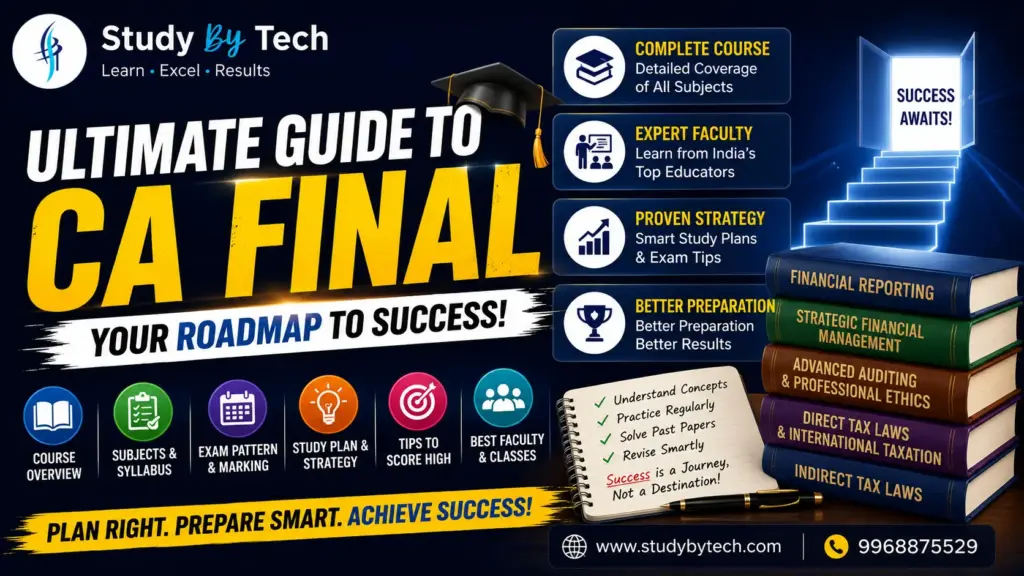
Ultimate Guide · CA Final Course StudyByTech ICAI New Scheme 2026 Ultimate Guide to CA Final Course ICAI New Syllabus, Best Classes & Preparation Strategy — your complete roadmap to success. Table of contents must-read What is CA Final? Eligibility Syllabus & Exam Structure Best CA Final classes Live vs Recorded Step-by-step strategy 6‑month timeline FAQs Key takeaways 6 papers · 2 groups 30% MCQ (no negative) Paper 6: open‑book case Live / recorded flexibility 180‑day smart plan ICAI material = 70% What is the CA Final Course? The CA Final Course is the last step in the process of becoming a Certified Accountant of India (ICAI). No doubt, preparing for the ICAI Final exam requires adequate plans made in advance, conceptual foundation, and efficient time management. In order to do your best under the new system of assessing CA Final Courses, you are welcome to use this comprehensive guide for online coaching, as well as for live classes. ICAI New Scheme Overview: The CA Final Course is established to measure the advanced knowledge, application level of the theory, as well as ethics of the prospective specialist in the field of accounting, time management, and other essential disciplines. The New ICAI Finals Program includes 6 core subjects of the course in the set of 2 groups in addition to other online courses. Eligibility Criteria Successfully pass both groups of CA Intermediate. Complete the necessary on‑job training. CA Final New Course Syllabus & Exam Structure Under the revised CA Final New Course, the curriculum focuses on analytical skills and global standards. Here is the updated group-wise subject distribution: Group Paper Subject Marks Focus Area Group 1 1 Financial Reporting (FR) 100 Ind AS, Business Combinations, Financial Instruments 2 Advanced Financial Management (AFM) 100 Forex, Portfolio Management, Derivatives, Valuation 3 Advanced Auditing, Assurance & Professional Ethics 100 Standards on Auditing (SAs), Ethics, Digital Audit Group 2 4 Direct Tax Laws & International Taxation (DT) 100 Income Tax Act, Transfer Pricing, DTAA 5 Indirect Tax Laws (IDT) 100 GST Laws, Customs Duty, Foreign Trade Policy 6 Integrated Business Solutions (Multidisciplinary Case Study) 100 Open-book case study integrating all subjects Why Enrolling in the Best CA Final Classes Matters The preparation for the ICAI Final exams needs more than self-study; it requires proper guidance of experienced professors who understand what examiners are looking for and new exam trends. The courses’ admission to the best CA Final classes consists of: Understanding Concept Thoroughly Timetable and Planning Exam-Centric Practice Answers to Questions and Mentoring Live Classes vs. Online Recorded Classes Feature CA Final Live Classes Pre-Recorded Online Classes Flexibility Fixed schedule / Real-time commitment Study anytime, anywhere at your own pace Doubt Solving Instant in-class interaction Dedicated doubt portals / email support Disciplined Routine Keeps you on track with daily live sessions Requires high self-motivation and goal-setting Playback Speed Real-time speed Option to watch at 1.25x – 2.0x for quick revision How to Choose the CA Final Best Classes Skill of the Faculty Study Material Backup Mock Tests Step-by-Step Preparation Strategy (First Attempt) Phase 1: Conceptual Building → Phase 2: First Revision & SPOM → Phase 3: Mock Tests & Final Revision 🏗️ 6-Month Macro Timeline 📘 Month 1–2 Primary Learning & First Reading (60 Days) 📙 Month 3–4 Second Reading & Detailed Problem Solving (60 Days) 📗 Month 5 Accelerated Revision & Full-Length Testing (30 Days) 📕 Month 6 Final Polish, Amendments & RTP/MTP Sprints (30 Days) ⏰ Daily Study Schedule (11–12 Hours Target) 06:00 – 09:30 Peak Focus Block (FR, AFM, DT) 10:30 – 13:30 Theory & Standards (Audit, SAs, Ethics) 15:00 – 18:00 Practice & Case Studies (IDT, IBS) 19:00 – 20:30 Daily Revision & MCQ Sprints FAQs Is CA Final very hard? CA Final exam, without a doubt, is one of the most difficult professional examinations in India. With structured CA Final classes focusing on conceptual understanding and application you can surely clear the exam successfully. Is 3 months enough for CA Final? 3 months is definitely not enough to crack the exam successfully, but it is sufficient if you are in a serious study mood and have a properly designed schedule. 12–15 hours daily, ICAI material, and mock tests are key. What is CA finalist salary? ₹3–6 LPA (approx); semi-qualified ₹20k–25k/month. Full-fledged CAs have exponential potential. Which are the best CA Final online classes? The “best” depends on your learning style. StudyByTech provides small batch classes with individual attention and high pass rate. Always watch demo lectures. Is the CA Final syllabus going to change? No structural changes expected for upcoming exams; minor amendments may apply. Stay updated via StudyByTech blog. What are the new changes in the CA course? Streamlined to 6 papers, 30% MCQs, Paper 6 (open-book), SPOM modules. Who is the best faculty for CA Final costing? Parag Gupta is highly recommended for Strategic Cost & Performance Management (SCPM). What is the biggest subject in CA Final? Financial Reporting (FR) and Direct Tax (DT) are often considered the most extensive. What is the fail rate of CA? In May 2026, overall pass rate was 14.07% (both groups). Fail rate ~85.93%. StudyByTech helps reduce this with comprehensive classes. StudyByTech — CA Final Live online classes & resources · New scheme ready · high pass rate

CA-Final-Course-1280x720
ICAI

ICAI CA Final Course

If you are searching for an ICAI CA Final course or a subject for a new course, then you are landed on the correct page. The Whole syllabus of the CA Final is divided into 2 groups, which are further divided into 8 subjects. Every paper contains 100 marks and you will need a minimum score of 40% marks in each subject. ICAI CA Final Course – New Scheme of Education and Training Paper No. Subjects Paper 1 Financial Reporting Paper 2 Strategic Financial Management Paper 3 Advanced Auditing and Professional Ethics Paper 4 Corporate and Economic Laws Paper 5 Strategic Cost Management and Performance Evaluation Paper 6A Risk Management Paper 6B Financial Services and Capital Markets Paper 6C International Taxation Paper 6D Economic Laws Paper 6E Global Financial Reporting Standards Paper 6F Multidisciplinary Case Study Paper 7 Direct Tax Laws and International Taxation Paper 8 Indirect Tax Laws CA Final Final Course is the last level of CA Course. After qualifying both the groups of the Intermediate course, a student can get registered for C.A. Final Course. Candidate can appear in CA Final examination during the last 6 months of practical training. But before appearing in CA Final Exam, one has to successfully complete four weeks Advanced Integrated Course on Information Technology and Soft Skills (AICITSS) during the last two years of practical training. CA FINAL COURSE DETAILS Paper 1: Financial Reporting (Maximum 100 Marks ) It covers existing Accounting Standards (ASs) 15, 21, 23, 25, 27 and 28, Accounting Standards interpretations, Framework for preparation and presentation of Financial Statements in accordance with Indian Accounting Standards, Application of Ind AS with reference to general purpose Financial Statements, application of IFRS & US GAAP, Corporate Financial Reporting, Accounting for Consolidated Financial Statements of Group Companies, Share-Based Payments, Carbon Credits, E-commerce, Common defects in Financial Statements, Corporate Social Reporting, Human Resource Reporting, Integrated Reporting and Value Added Statements etc. Paper 2: Strategic Financial Managment (Maximum 100 Marks ) It Covers important concepts relating to Strategic decision making, financial policy, Risk evaluation & its classification, value at Risk (VAR) Security analysis, and its Valuation, Portfolio analysis, Capital Market theory, Securitization, Mutual funds, Derivatives, Foreign exchange, international financial management, etc. Paper 3: Advanced Auditing & Professional Ethics (Maximum 100 Marks ) It Covers Auditing Standards, Statements, Guidance Notes, Audit plan, Audit Programme and importance of Supervision, Risk Assessment and internal control, Special Aspects of Auditing in an Automated environment, Audit of Limited Companies, Audit Reports, Audit Reports & Certificates for special purpose engagement, Audit Committee and Corporate Governance, Audit of Consolidated Financial Statements, Special features of Audit of Banks, Insurance & Non – Banking Financial Companies, Audit under fiscal laws, Special audit assignments, Audit of Public Sector undertakings, and concepts related to Professional ethics etc. Paper 4: Corporate and Economic Laws (Maximum 100 marks) This paper has been divided into two parts : Part I: Corporate Laws (70 Marks): This has two sections Section A: Company Law It Covers the entire provisions and relevant Rules & Regulations of the Companies Act, 2013 regarding appointment and Qualification of Directors, Appointment and remuneration of Managerial Personnel, Meetings of Board and its Power, Inspection, Inquiry and Investigation, Compromise, Arrangement and Amalgamations, prevention of oppression and Mismanagement, Winding up, Producer Companies, Companies incorporated outside India , Compounding offences, adjudication, special Courts, National Company Law Tribunal and Appellate Tribunal etc. it Covers also Corporate Secretarial Practices like Drafting Notices, Resolutions, Minutes & Reports etc. Section B: Securities Laws It includes The Securities Contract (Regulation) Act, 1956 and the Securities Contract (Regulation) Rules, 1957: introduction and important provisions. The Securities Exchange Board of India Act, 1992, SEBI (Issue of Capital and Disclosure Requirement) Regulation, 2009 and SEBI (Listing obligations and Disclosure Requirement) Regulations, 2015. Part II: Economic Laws (30 Marks)It Covers “ The Foreign Exchange Management Act, 1999, The Securitisation and Reconstruction of Financial Assets and Enforcement of Security Interest Act, 2002, the Prevention of Money Laundering Act, 2002, Foreign Contribution Regulation Act, 2010, the arbitration and Conciliation Act,1996, the Insolvency and Bankruptcy Code, 2016 Paper 5: Strategic Cost Management and Performance Evaluation (Maximum 100 marks) It contains concept of Strategic Cost Management, Limitations of Traditional Cost Management, Characteristics of the Modern Business Environment, Cost of Quality, TQM, Supply Chain Management, J/T, Kaizen Costing, Total Productive – Maintenance, Six Sigma (SS), Cost Control, Cost Reduction, Pareto analysis, value Analysis, Life Cycle Costing, Power Sector, Relevant Costing, ABC Costing, Theory of Product Pricing, Pricing – New Product, Sensitivity analysis, Pricing Strategies, Transfer pricing, Responsibility Accounting, Budgetary Control, Standard Costing, and Application of few Quantitative Techniques like Linear Programming, Learning curve / Experience Curve. Paper 6A: Risk Management (Maximum 100 marks) It includes the concept of Risk, Risk, and uncertainty; Distinction, classification of risks, Dynamic Nature of Risks, Types of Risk, Sources and Evaluation of Risks, Concept of Risk Management, objective and process of Risk Management, Risk Management Techniques, Quantitative analysis, Risk Model, Credit Risk Measurement and Management, Risks associated with Corporate Governance, Enterprise Risk Management, Operational Risk Management etc. Paper 6B: Financial Services and Capital Markets (Maximum 100 marks) It contains information to Global Financial Market, Role of Financial Market in Economic Development, Indian Financial Market Scenario, Credit policy of R.B. I, Fed Policy, Inflation Index, CPI, WPI etc. Primary Capital Market, Secondary Capital Market, Money Market ( CRR, SLR, MIBOR, LIBOR etc.), Institutions and Intermediaries, Commodity market, Banking – Management, Mutual Fund etc. Paper 6C: International Taxation (Maximum 100 marks) It Covers various concepts of Transfer pricing Provisions under the Income Tax Act, 1961, like concept of Arm’s length price, international transactions, functions, Assets and Risk Analysis, Documentation & Compliances, other provisions relating to taxation of international transactions and Non – resident taxation under the Income-tax Act, 1961, Non – resident taxation, Double taxation relief and Advance – Ruling, Law and procedures under the Black Money (Undisclosed Foreign Income and Assets) and imposition of Tax Act, 2015, other Aspects of International taxation – Model tax conventions, tax treaties,

Scroll to Top