
Author name: Studybytech

CA FOUNDATION TIPS & TRICKS SIMPLE STRATEGIES FOR SMART PREPARATION FOR CA FOUNDATION
Blog, CA Foundation, Exams tips

How to Prepare for CA Foundation 2026: The Ultimate Step-by-Step Strategy to Clear in One Attempt

CA Foundation Classes ICAI Registration Process Subjects, Syllabus & Exam Pattern Admit Card Exam Dates Exam Tips About the faculties FAQ “Starting your CA journey is like preparing for a marathon, not a sprint. If you’re wondering how to prepare for CA Foundation without getting overwhelmed, you’re in the right place. We’ve analyzed the toppers’ habits and the ICAI pattern to give you a roadmap that actually works.” The “3-Stage” Success Blueprint for CA Foundation preparation 2026 “Preparing for CA Foundation isn’t about studying 16 hours a day; it’s about studying 6 hours smartly. Here is the roadmap our AIR (All India Rank) holders follow:” 1. Start with the basics: the foundation is crucial! When studying subjects like economics, use your 12th grade economics textbook. A significant amount of the information required to pass the CA Foundation is covered in your school’s syllabus. Certain well-known concepts can be more easily understood and quickly read again. Take a look around you—law permeates every facet of daily existence! Basic legal principles, like the Sale of Goods Act, become much clearer when they are applied to real-world scenarios. Many students find classes like mathematics intimidating, especially if they haven’t done well in them before. But relax! Reviewing the tenth grade math basics should be the first step. The “Gravel Gugger” book is a great resource that explains fundamental mathematical concepts in an understandable and useful way. Building on these principles will provide you confidence and a strong foundation for taking on the CA basic mathematics course. 2. Refer to the ICAI study guide: your complete reference The Institute of Chartered Accountants of India (ICAI) provides official study resources for the CA Foundation course. These are the most trustworthy sources. So how to prepare for CA Foundation starts from here. Start by reading through these books to the end in order to get a fundamental understanding of each subject. Remember to practice with past exam papers. This will help you familiarize yourself with the exam’s structure and highlight the most commonly asked questions. Expert Tip: Why the “24-Hour Revision Rule” is a Game Changer “Our lead mentor, CA Parag Gupta, always says: ‘What you don’t revise in 24 hours, you lose 80% of.’ The Strategy: Spend the last 30 minutes of your day quickly skimming through everything you studied since morning. This moves the information from short-term memory to long-term memory.” “Most students fail because they study everything once but remember nothing during the exam. CA Parag Gupta recommends the ‘Triple-Threat’ revision strategy:” 3. Make your planning simple and handleable Avoid attempting to learn everything at once. Make a study plan that divides the material into digestible portions for each subject. Set aside specified periods of time every day for studying various subjects, and make sure you stick to your study schedule. In this manner, your planning stays consistent and targeted without becoming out of control. The 4-Month Master Plan Don’t just study; plan. Here is how you should divide your time: 4. Subject-Wise Strategy (The “Smart” Way) Paper 1: Accounting (The Scoring Subject) Paper 2: Business Laws (The “Language” Challenge) Paper 3: Quantitative Aptitude (The “Speed” Test) Paper 4: Business Economics Priority Table for CA Foundation subjects Subject Priority 1: The “Must-Dos” (60+ Marks) Priority 2: The “Rank-Builders” Accounts Final Accounts, Partnership, BRS, Depreciation Company Accounts, Consignment, NPO Law Indian Contract Act (Units 1-6) Companies Act, Sale of Goods Act Maths/Stats Logical Reasoning (Full), Central Tendency Time Value of Money, Probability Economics Demand & Supply, Production & Cost National Income, Public Finance Subject-Wise “Hack” Sheet Subject The “Secret Sauce” to Score 60+ Accounts Don’t chase the final total. Focus on ‘Step Marking’. Practice ‘Bank Reconciliation’ and ‘Final Accounts’ daily. Law Use legal keywords like ‘Consensus ad idem’ instead of ‘meeting of minds’. It earns you the extra 1 mark. Maths/Stats Master the ‘Time Value of Money’ chapter. It’s the highest weightage. Learn the GTO and M+ calculator shortcuts. Economics Read the ICAI book like a newspaper. Every line is a potential MCQ. 5. Practice, Practice & Practice……+ Pay attention to past papers The “Revision Triple-Threat” One of the most effective strategies is to analyze and practice using past exam papers. This will help you identify the topics that are tested on a regular basis and understand the structure of the questions. By focusing on subjects that are more likely to be covered on the test, you can make the most of your study time. 6. Remain assured and keep moving forward. The secret is to be confident! You’ve taken the first step in the correct manner if reading this blog makes you feel more at ease about your CA Foundation preparation. Recall that being prepared involves both diligent and intelligent study methods! Checkout our demo lectures for CA foundation classes. Click here to download our CA Foundation syllabus PRIORITY LIST to pass CA exam in 1st Attempt. If you’re ready to take on the CA Foundation with confidence, enroll in our new batch today! We provide all the guidance, support, and resources you need to succeed. FAQ’s

CA Inter Costing important topics for May 26 exams
CA Inter, Costing

CA Inter Costing important topics for May 26 exams

CA Inter Classes ICAI Registration Process, Fees, & Syllabus Admit Card Exam Dates Study Guides & Tips CA Inter faculties FAQ Hey future CAs! Today I’m going to share something super valuable – the exact topics you need to master for getting that dream exemption in CA Inter Costing. During my preparation journey, I discovered these golden topics from Parag Sir’s classes that can help you gain exemption in CA Inter Costing: 1. Marginal Costing (16-20 marks potential!) 2. Activity Based Costing (Modern & High-scoring) Activity-Based Costing is a contemporary method emphasizing overheads’ allocation on the basis of activities as opposed to conventional approaches. This chapter is concerned with determining cost drivers, activity cost pools, and calculating true product costs. It usually comprises case-based questions to examine real-world understanding. Every year 1 question on ABC is a must. 3. Material & Labor Costing (Foundation Topics) They form the core elements of calculating total production cost and are frequently assessed in the examination with numerous questions on their calculation, analysis, and control methods. 4. Cost Sheet (The Backbone) The basis of costing, the Cost Sheet, plays a crucial role in learning about cost structures and classifications. The chapter assists in breaking down several elements of total cost, like prime cost, factory cost, and cost of production. Problems frequently involve the preparation of detailed cost sheets or solving problems regarding adjustments for overheads, opening and closing stocks, and abnormal costs. 5. Standard Costing  In order to compare actual costs with standard costs, this chapter focuses on variance analysis. Variances are regularly examined, including material, labor, overhead, and sales. It is a useful skill to be able to interpret deviations and offer managerial insights. It is a highly scored question & is frequently asked in exams. 6. Process Costing For sectors like chemicals and textiles where production is constant, process costing is essential. Equivalent units, normal and abnormal process losses, inter-process profits, and joint costs are important ideas. You will learn how to effectively manage step-by-step computations in this chapter. Study Tip for CA Inter Costing by Parag Gupta sir Module Chapters Module 1 Chapter 1: Introduction to Cost and Management Accounting Chapter 2: Material Cost Chapter 3: Employee Cost Chapter 4: Overheads: Absorption Costing Method Chapter 5: Activity Based Costing Chapter 6: Cost Sheet Chapter 7: Cost Accounting System Module 2 Chapter 8: Unit & Batch Costing Chapter 9: Job Costing and Contract Costing Chapter 10: Process & Operation Costing Chapter 11: Joint Products & By Products Chapter 12: Service Costing Chapter 13: Standard Costing Chapter 14: Marginal Costing Chapter 15: Budget and Budgetary Control FAQ’s

CA Foundation Quantitative Aptitude: Syllabus & Best Classes
Blog, CA classes, CA Foundation

Ultimate Guide to CA Foundation Quantitative Aptitude 2026: Syllabus, Chapter Weightage, Preparation Strategy & Best Coaching 🎯 Your complete roadmap to CA Foundation Quantitative Aptitude (Paper 3) — From syllabus to exam strategy and best coaching. Everything you need to score 60+ or get an exemption. 📑 Table of Contents Overview & Syllabus 1. What is Quantitative Aptitude? 2. Syllabus & Weightage Strategy & Analysis 3. High-Yield Scoring Chapters 4. Step-by-Step Preparation Guide 5. 30-Day Study Plan 6. Handling Negative Marking 7. Best Books & Resources Coaching & Final Push 8. Best CA Foundation Mathematics Classes FAQ Frequently Asked Questions ⭐ Key Takeaways Paper 3: Quantitative Aptitude — 100 Marks, 100 MCQs, 2 Hours. Sections: Business Mathematics (40 Marks), Logical Reasoning (20 Marks), Statistics (40 Marks). Negative Marking: 0.25 mark deducted for every wrong answer. Passing Requirement: Minimum 40% in Paper 3 & 50% aggregate overall. High-Weightage Topics: Time Value of Money (12-16 Marks), Central Tendency & Dispersion (12-14 Marks). Key to Success: Conceptual clarity + Calculator shortcuts + MCQ practice + Smart negative marking strategy. Best Faculty: Nitesh Kumar Sir is highly recommended for his shortcut methods and non-math student-friendly approach. ICAI Material is Gold: Over 80% of questions come from ICAI study modules. 1. What is Quantitative Aptitude of CA Foundation? Quantitative aptitude of CA Foundation is Paper 3 of the CA Foundation exam which is taken out by the Institute of Chartered Accountants of India (ICAI). It tests the mathematical reasoning, logic and analysis ability of the candidate. Parameter Exam Details Paper Title Paper 3: Quantitative Aptitude Exam Mode Objective (Multiple-Choice Questions – MCQs) Total Marks 100 Marks (100 MCQs of 1 Mark Each) Exam Duration 2 Hours (120 Minutes) Negative Marking Yes (0.25 Mark Deducted per Incorrect Answer) Passing Standard Minimum 40% in Paper 3 & 50% Aggregate Overall Calculator Policy Non-Programmable Basic Financial Calculator Allowed 2. CA Foundation Quantitative Aptitude Syllabus and Weight Age in Sections Under the new scheme of ICAI, the ca foundation quantitative aptitude test will be divided into three different sections: Section A: Business Mathematics (40 Marks) Section B: Logical Reasoning (20 Marks) Section C: Statistics (40 Marks) Section Topic / Module Name Sub-Topics & Concepts Covered ICAI Weightage Part A: Business Maths (40 Marks) Ratio, Proportion, Indices & Logarithms Simplification, laws of indices, log properties, ratio applications 8 – 12 Marks Equations & Matrices Linear & quadratic equations, simultaneous equations, matrix operations 8 – 12 Marks Linear Inequalities Inequalities in one and two variables, feasible region solutions 3 – 5 Marks Time Value of Money Simple Interest, Compound Interest, Annuity Future/Present Value, Depreciation, Effective Rate 12 – 16 Marks Permutations & Combinations Factorial notation, fundamental counting principles, arrangements, selections 6 – 8 Marks Sequence & Series Arithmetic Progression (AP) and Geometric Progression (GP) properties and sum terms 6 – 8 Marks Sets, Relations & Functions Set operations, Venn diagrams, domain, range, composite functions 4 – 6 Marks Basic Calculus (Differential & Integral) Basic derivative applications, marginal cost/revenue, standard integration 4 – 6 Marks Part B: Logical Reasoning (20 Marks) Number Series, Coding & Decoding Finding missing terms, odd man out, alphanumeric pattern rules 5 – 6 Marks Direction Tests Spatial awareness, cardinal directions, shortest distance determination 4 – 5 Marks Seating Arrangements Linear and circular seating arrangements, facing inside vs outside 5 – 6 Marks Blood Relations Family tree diagrams, relation decoding, coded relations 4 – 5 Marks Part C: Statistics (40 Marks) Statistical Representation of Data Frequency distribution, histograms, ogives, pie charts, discrete vs continuous data 6 – 8 Marks Measures of Central Tendency & Dispersion Mean, Median, Mode, Standard Deviation, Mean Deviation, Quartile Deviation 12 – 14 Marks Probability Classical, empirical, and axiomatic probability, Bayes theorem, independent events 6 – 8 Marks Theoretical Distributions Binomial, Poisson, and Normal distributions and their properties 6 – 8 Marks Correlation & Regression Karl Pearson coefficient, Spearman rank correlation, regression lines and coefficients 6 – 8 Marks Index Numbers Laspeyres, Paasche, Fisher index numbers, time reversal & factor reversal tests 4 – 6 Marks 3. CA Foundation Quantitative Aptitude High-Yield Scoring Chapters To pass ca foundation quantitative aptitude with a score of 60+ and get exemption marks, study the following weight-age topics first: 1. Time Value of Money (12–16 Marks) Time Value of Money is the only important topic under Business Mathematics. Learn compound interest formula, annuity present value, annuity future value, net present value, perpetual annuity, and sinking fund. Using some calculator tips in compound growth reduces the time to solve questions from 3 minutes to just 15 seconds! 2. Logical Reasoning (20 Marks) Logical Reasoning is one of the easiest chapters for all the students, especially those without a maths background. As it doesn’t require any complicated algebraic formula, solving 200-300 problems of Direction Test, Seating Arrangements, and Blood Relations would easily fetch you 16-18 marks out of 20. 3. Measures of Central Tendency & Dispersion (12–14 Marks) The topics of central tendency (Mean, Median, Mode) and dispersion (Standard Deviation, Quartile Deviation, Variance) are highly weighted in Statistics. Be especially careful with theoretical properties such as the effect of change of origin and scale in central tendency and dispersion. 4. Sequences & Series (AP & GP) Be aware of the nth term and sum of n terms of AP and GP. Option elimination is a very quick method to solve difficult sequence problems. 4. CA Foundation Quantitative Aptitude Preparation Guide – Step by Step Approach Regardless of whether you have an aptitude for maths or even if you didn’t study maths at all in class 12, you are assured success in ca foundation maths by following this approach. Step 1: Conceptual Foundation Develop Sound Conceptual Foundation and Formulae Note Step 2: Calculator Tricks Learn Memory Keys and Exponent Shortcuts Step 3: MCQ Practice Topic-Wise Multiple Choice Questions Practice with Timing Step 4: Mock Tests Full Mock Tests and Negative Marks Management 🧮 1. Learn Calculator Shortcuts and Tricks to Use Memory Keys With 2 hours for 100 questions on

CA Foundation Maths Tips: To Study & Excel In Exam
Blog, CA Foundation, CA Foundation Maths

CA Foundation Maths: Tips to Study & Excel in the Exam

CA Foundation Classes ICAI Registration Process Subjects, Syllabus & Exam Pattern Admit Card Exam Dates Exam Tips About the faculties FAQ Mathematics is among the subjects covered under CA Foundation, which is considered as one of the harder, scoring subjects. For many students, it can be a disadvantage or an opportunity, depending on how well-prepared they are. Yes, you are right, Nitesh Kumar Sir in CA Foundation Maths has come up with Expert Tips for students to tackle the subject of CA Foundation Maths with ease and confidence. Understanding the Importance of CA Foundation Maths CA Foundation’s Mathematics, Logical Reasoning and Statistics paper is meant to evaluate your analytical capability and numerical ability. This subject can be further divided into three sections, namely, Mathematics, Logical Reasoning, and Statistics, which makes the subject an amalgam of theoretical and practical knowledge. It is important to keep in mind that Mathematics is 40 Marks section and scoring better in Mathematics can facilitate boosting your overall score. How to Study for & Ace CA Foundation Maths 1. Focus on Conceptual Clarity Learning mathematics is not about blind memorizing; its about recognizing the logic behind every concept and formula. Nitesh Kumar Sir states that one must first master the basics before the advanced problems. Learn foundational concepts like ratios, percentages, equations, and sequences. 2. Practice is the Key Practice is really important in most subjects, but it is essential in Maths. Next, do as much variety of questions from institute’s study material, past exam papers and mock tests. Spend quality time each day on sums, be sure to get a tight grip on every topic. 3. Time Management Time management in the exam hall is really crucial as well. To improve the speed of answering questions along with the accuracy, Nitesh Kumar Sir says that students should do question-solving practice in a time limit.If you spend too much time in particular areas, consider how to streamline them. 4. Make a Study Plan A systematic study plan is very much required to cover the huge syllabus. Plan the time you would give to each topic and make sure you put more effort in subjects which are given more value in the exam. Make sure that you include regular revisions in your plan so that you can strengthen what you’ve learnt. 5. Understand the Exam Pattern Familiarize yourself with the exam pattern and marking scheme. CA Foundation Maths includes multiple-choice questions (MCQs), so practicing with MCQ-based questions can help you adapt to the format and reduce the chances of errors. 6. Use Shortcut Techniques Mathematics often requires quick calculations. Learn shortcut methods and tricks for topics like percentages, time and work, and probability. Nitesh Kumar Sir shares several time-saving strategies in his classes to help students solve problems efficiently. 7. Focus on Logical Reasoning and Statistics Mathematics is an important part of the paper but you should not realize that Logical Reasoning and Statistics are equally important. These sections are comparatively easier and scoring. Focus equally on all three sections to maximize your total. How Nitesh Kumar Sir’s Teaching Stands Out Conclusion CA Foundation Maths is considered to be jargon heavy but with proper guidance and consistent practice, it can turn out to be your strength. Remember, with the right guidance, like that provided here by Nitesh Kumar Sir, and a dedicated study schedule, there is no reason that chemistry cannot be a strong area for you, improving your overall game. NOTE: in Maths, the keys to success are understanding the concepts, practicing regularly, and managing your time well. Implement these tips and you’ll ace your test! FAQ’s

Is CA Foundation Easy?
Blog, CA Foundation

Is CA Foundation easy? Tips and Strategies for Success

CA Foundation Classes ICAI Registration Process Subjects, Syllabus & Exam Pattern Admit Card Exam Dates Exam Tips About the faculties FAQ In India, becoming a chartered accountant is a highly recognized profession, but the path to this designation is not easy. The CA Foundation exam, the first hurdle in the Chartered Accounting program, is one of the most difficult obstacles students encounter whole ca foundation syllabus in a specific period of time. In this post, we’ll look – Is CA foundation tough or easy and offer some suggestions and methods for success. What is the CA Foundation Exam? In India, this exam serves as the entry-level test for the Chartered Accounting program. It is held twice a year, in May and November, by the Institute of Chartered Accountants of India (ICAI). The exam is divided into four sections: Accounting Principles and Practices, Business Laws and Business Correspondence and Reporting, Business Mathematics, Logical Reasoning, and Statistics, Business Economics, and Business and commercial knowledge. Is CA Foundation easy? The answer is subjective and depends on a number of factors, including your comprehension of the subjects, study habits, and preparation plan. This exam is difficult because it necessitates a thorough comprehension of the material, exceptional problem-solving abilities, and the ability to apply concepts to real-life settings. Furthermore, because the exam covers a wide range of topics, you must have a thorough understanding of each one. Tips and Strategies for Success CA Exam 1. Understand the Syllabus The first step in preparing for the CA Foundation exam is to study the material completely. You must understand the weightage of each topic as well as the number of questions in the exam. You can develop a study plan by downloading the syllabus from the ICAI website. 2. Create a Study Plan Developing a study strategy is essential for exam success, and this exam is no different. Begin by assigning time to each subject, taking into account the importance of each topic. Before the exam, try to cover the full curriculum and leave ample time for revision. 3. Practice The secret to passing this exam is practice. Answer as many problems as you can and take as many mock tests as you can. This can help you comprehend the exam pattern and increase your speed and accuracy. As so many students asks is CA exam tough, so here the key hack is practice. 4. Use Study Material The ICAI study material is thorough and covers all of the syllabus subjects. While studying for the exam, make sure to refer to the study material. You can also use supplementary study materials and reference books to obtain a better understanding of the subjects. 5. Take Mock Tests Taking mock tests is a good approach to measuring your level of preparation and discovering areas for growth. Develop the habit of taking mock tests and analyzing your results. This will assist you in identifying your strengths and shortcomings as well as improving your performance on the actual exam. 6. Stay Focused and Motivated Keeping engaged and motivated is essential for exam performance. Maintain your focus on your objectives and keep yourself motivated during the exam preparation period. Take breaks as needed, and reward yourself for your accomplishments. Preparing for the CA Foundation exam might be intimidating, but with the correct technique, success is achievable. In this article, we’ll walk you through a straightforward but effective way to Plan, Prepare, and Perform for the CA Foundation. Whether you’re just getting started or are already deep into your studies, this guide will help you stay focused, manage your time properly, and do well on exam day. Let’s make your CA trip simple and successful from the start Conclusion  As we already discussed is ca foundation tough, Yes it is, and passing it requires hard work and a solid study strategy. Students must have a thorough comprehension of the curriculum, as well as good problem-solving skills and the capacity to apply principles to real-world scenarios. Students can boost their chances of success in the exam by developing a study strategy, practicing regularly, using study materials, taking mock examinations, and being focused and motivated. Finally, the key to passing the exam is hard work, patience, and a strong desire to succeed. FAQ’s

Is Maths compulsory for CA in 11 and 12 (5)
Blog, CA Foundation

Is Maths compulsory for CA in 11 and 12?

CA Foundation Classes ICAI Registration Process Subjects, Syllabus & Exam Pattern Admit Card Exam Dates Exam Tips About the faculties FAQ In India, Chartered Accounting (CA) is a common career path that requires knowledge of accounting, taxation, auditing, and financial management. Many students want to be chartered accountants but have worries regarding the eligibility requirements so students frequently ask is Maths compulsory for CA in 11 and 12 and what is the importance of maths in CA Foundation and how alternative math takes place. Eligibility Criteria for CA A student must pass the CA Foundation course to become a Chartered Accountant in India. The following are the eligibility requirements for the CA Foundation course: Here’s the Best CA Foundation Classes provider Click Here Maths and CA Let’s discuss whether is maths compulsory for CA No it is not listed as a required subject in the eligibility criteria for the CA Foundation course. The course on the other hand, requires a lot of mathematical computations, and a good understanding of maths can help you understand ideas in accounting and finance. Alternative to Math If a student does not take maths in 11th or 12th grade, there are some alternative for acquiring math skills. One of the best options is to revise the fundamentals from your 10th class books. In CA Foundation, maths is not CORE maths, hence you can consider doing the fundamental maths only. At StudyByTech, we provide you the tips & trick to achieve success in MCQ questions in CA Foundation Maths paper. Benefits of Studying Maths Besides that assisting in the CA course, studying maths offers various other advantages. It enhances analytical and problem-solving abilities, which are necessary for any professional position. It also aids in the comprehension of complex data and the formulation of rational judgments. Even if a student does not want to become a chartered accountant, studying arithmetic is still a wise investment. Conclusion To summarise, while maths is not a required subject for CA in 11th and 12th grades, a solid understanding of the subject is highly recommended. Even if a student does not take math, there are other ways to gain the requisite information. Furthermore, studying maths has various advantages that go beyond the CA course. FAQ’s

CA Foundation: Syllabus, Preparation, Best Classes & Coaching
Blog, CA Foundation

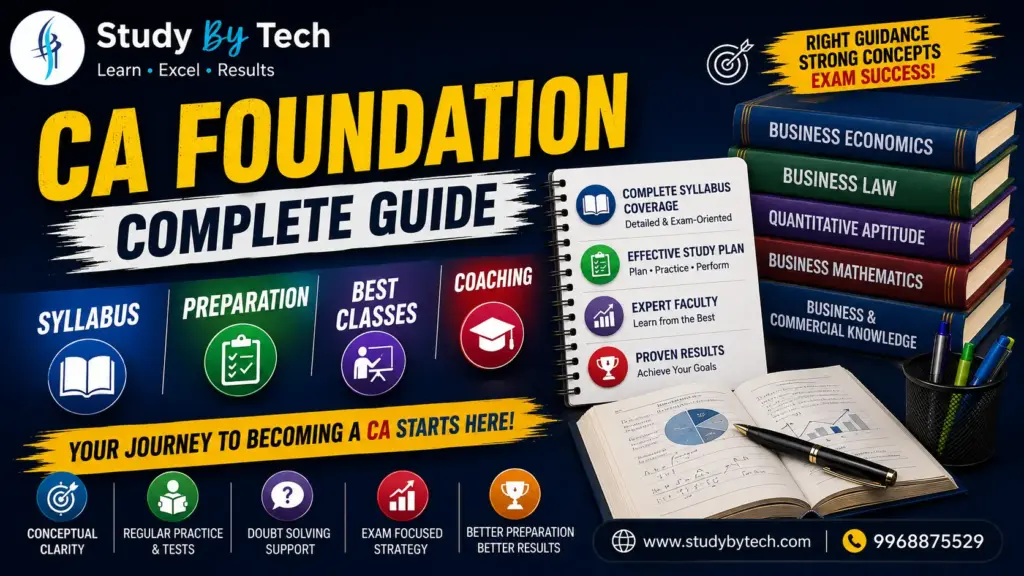
Ultimate guide to CA Foundation

Ultimate Guide to CA Foundation: Syllabus, Exam Pattern, Preparation Strategy & Best Coaching 🎯 Your complete roadmap to CA Foundation — From syllabus to exam strategy and best coaching. Everything you need to clear CA Foundation in your first attempt. 📑 Table of Contents Overview & Syllabus 1. What is the CA Foundation Course? 2. Subjects of CA Foundation & Syllabus Exam & Strategy 3. CA Foundation Registration: Quick Overview 4. Eligibility Criteria 5. Is CA Foundation Easy or Tough? 6. How to Study CA Foundation 7. Best Recommended Books 8. Exam Form Process & Major Steps Coaching & Final Push 9. Online vs Offline Classes 10. Why StudyByTech for CA Foundation 11. Awaiting Results? What to do? FAQ Frequently Asked Questions ⭐ Key Takeaways 4 Papers: Accounting, Business Laws, Quantitative Aptitude, Business Economics. Exam Pattern: 2 Subjective (Accounting, Law) + 2 Objective (Maths, Economics). Passing Criteria: 40% in each paper & 50% aggregate (200/400). Negative Marking: 0.25 marks deducted for wrong answers in Paper 3 & 4. Registration Validity: 4 years, can be revalidated as per ICAI norms. Study Period: Minimum 4 months between registration and exam month. Common Pitfalls: Neglecting law write-ups, maths phobia, undervaluing MCQs, skipping mock tests. Pass Rate: Generally between 15% to 25% (May 2026 overall pass rate was 20.09%). 1. What is the CA Foundation Course? CA Foundation course is the very first phase in the CA course curriculum that is being regulated by the ICAI. This course assesses the knowledge of the candidates about basic accounting concepts, business law, quantitative aptitude, and business economics. Eligibility Criteria After Class 10: Students are eligible to apply with ICAI provisionally after qualifying for class 10. After Class 12: Students can give the CA Foundation exam after clearing their Class 12 board exams and completion of mandatory 4 months after registration. Validity of Registration The CA Foundation registration is valid for 4 years. The registration can be revalidated if required, as per ICAI norms. CA Foundation Registration: Quick Overview If you are aiming for the CA Foundation examination under the Institute of Chartered Accountants of India (ICAI), completing your official registration on time is your very first step toward becoming a Chartered Accountant. Key Registration Highlights & Timeline Eligibility: You can register for the CA Foundation route after passing your Class 10th board exams (provisional registration) or after appearing in/clearing your Class 12th board exams. Cut-Off Dates: For June Attempt: Register on or before January 1 of the exam year. For September / December Attempts: Register at least 4 months prior to the exam month (e.g., on or before May 1 for September attempts). Validity: Your CA Foundation registration remains valid for 4 years from the date of initial registration. Step-by-Step Registration Process Visit Self Service Portal (SSP): Head over to the official ICAI SSP Portal. Create Student Account: Click on “First Time User / New Student” and fill in your basic personal details. Upload Documents: Submit scanned copies of your 10th/12th marksheets, passport-sized photo, signature, and valid ID proof. Pay Registration Fee: Complete the online fee payment (approx. ₹9,000 for Indian students). Download Acknowledgment: Save your generated Student Registration Number (SRN) and official fee receipt for future reference. 2. Subjects of CA Foundation and Syllabus (New ICAI Scheme) There are four main subjects of CA Foundation that cover both subjective and objective formats of tests. Overview of CA Foundation Papers Paper No. Subject Name Type of Paper Total Marks Negative Marking Paper 1 Accounting → Subjective (Descriptive) 100 Marks No Paper 2 Business Laws → Subjective (Descriptive) 100 Marks No Paper 3 Quantitative Aptitude (Maths, Stats, LR) → Objective (MCQ) 100 Marks Yes (0.25 Mark) Paper 4 Business Economics → Objective (MCQ) 100 Marks Yes (0.25 Mark) Breakdown of Subjects Paper 1: Accounting (100 Marks): Concepts and Accounting Process, Bank Reconciliation Statement (BRS) and Inventories, Depreciation and Final Accounts of Sole Proprietorship, Accounting for Special Transactions (Consignment, Bills of Exchange), Accounts of Partnership and NPO, Accounts of Company and Financial Statements. Paper 2: Business Laws (100 Marks): The Indian Contract Act, 1872, The Sale of Goods Act, 1930, The Indian Partnership Act, 1932, Limited Liability Partnership (LLP) Act, 2008, The Companies Act, 2013. Paper 3: Quantitative Aptitude (100 Marks): Business Mathematics (40 Marks), Logical Reasoning (20 Marks), Statistics (40 Marks). Paper 4: Business Economics (100 Marks): Introduction to Business Economics and Demand-Supply Approach, Production and Cost Theory, Price Theory under Different Market Structures, National Income and Public Finance, Money Market, Foreign Trade and Indian Economy. 3. Eligibility Criteria for CA Foundation The following is the eligibility criteria prescribed by the ICAI in order to clear CA foundation exam: Minimum Marks per subject: 40% Overall Minimum Marks: 50% in all four subjects (min. 200/400). 4. Is CA Foundation Exam Easy or Tough? An often-asked question by novices is if the CA Foundation Exam is easy or tough. The Facts Revealed The pass percentage is generally between 15% to 25%. Although the syllabus of Accounting and Economics extends the Commerce subjects of Class 11 & 12, it is not easy due to its depth, law language, speed in Math, and application of concepts. Why Do Students Fail in This Course? Neglecting Legal Write-ups: Study of laws without practicing descriptive write-ups. Mathematics Phobia: Loss of marks by non-math commerce students in Quantitative Aptitude due to slow calculation and shortcut methods. Undervaluing MCQs: Penalty of negative marking (0.25 marks) in Paper 3 & 4 for guessing blindly. Failure to Practice & Mock Test Papers: Lack of practice of complete 3-hour test papers. 5. How to Study CA Foundation: Step-by-Step Guide Self-Study Approach or Classes for CA Foundation – Regardless, a proper study approach will be necessary. 📚 Stage 1: Clearing Concepts (Months 1-2.5) Finish 100% of syllabus using ICAI study materials and reference books. Make your own hand written notes for formula list in Maths paper and legal provisions in Law. Working notes for accounting papers – Get those step marks by ICAI! ✍️ Stage 2: Initial Revision and

CA Inter Journey with StudyByTech
Blog, CA Inter

CA Inter Journey with StudyByTech: Your Comprehensive Guide

CA Inter Classes ICAI Registration Process, Fees, & Syllabus Admit Card Exam Dates Study Guides & Tips CA Inter faculties FAQ The journey to becoming a Chartered Accountant in India is a rigorous yet rewarding path, and the CA Inter 2026 (Chartered Accountancy Intermediate) level is a pivotal milestone in this pursuit. In this article, we aim to provide you with a comprehensive understanding of CA Inter’s significance and how you can achieve excellence with the help of StudyByTech’s CA Inter classes, Join us for more updates on our WhatsApp channel. Demystifying CA Inter The CA Inter level, the second stage of the Chartered Accountancy program by the Institute of Chartered Accountants of India (ICAI), is a comprehensive program that delves deeper into accounting, taxation, finance, and various facets of financial management. This level comprises two groups, each consisting of four subjects: Group I: Group II:  CA Inter acts as a bridge between the foundational knowledge of the CA Foundation and the advanced expertise required for the CA Final level. The Significance of CA Inter Why Choose StudyByTech for CA Inter Classes? StudyByTech is your trusted partner on the path to success in CA Inter. Our commitment to providing top-notch CA Inter classes stems from our passion for education and our dedication to our students. Here’s why StudyBytech is your ideal choice: 1. Expert Faculty: Our team of experienced and highly qualified faculty members ensures that you receive the best education possible. They guide you through the curriculum, offering valuable insights and support. 2. Comprehensive Study Material: We provide authorized study material that aligns with ICAI guidelines. It covers the syllabus in a thorough and effective manner, facilitating in-depth understanding. 3. Interactive Learning: Our classes are designed to be engaging and interactive. We believe in the power of two-way communication and encourage questions and discussions. 4. Regular Assessment: We offer regular assessments, including mock tests and practice questions, to help you gauge your progress and prepare you for the exams. 5. Flexibility: StudyByTech understands the importance of flexibility in your learning journey. Our classes are designed to accommodate your schedule, making it easier for you to balance your studies with other commitments. Elevate your CA Inter journey with StudyByTech and unlock your potential to excel in this challenging yet rewarding phase. Click here to check CA Inter classes by StudyByTech. Conclusion In conclusion, the CA Inter level is a critical phase on your path to becoming a Chartered Accountant. StudyByTech is here to support and guide you throughout your CA Inter journey, ensuring you have the knowledge and skills necessary for success. Embrace this journey with confidence, and success will be yours. FAQ’s

IS-CA-Foundation-Hard
CA Foundation

Is the CA Foundation Hard?

CA Foundation Classes ICAI Registration Process Subjects, Syllabus & Exam Pattern Admit Card Exam Dates Exam Tips About the faculties FAQ Do you think the CA Foundation exam is too much for you? Ultimately, your dedication and persistence will pave the way for success. At StudyByTech, we think that CA Foundation can be doable and even straightforward with the correct help & smart study. Why the CA Foundation can be difficult at times? Every challenge presents an opportunity for development. One of the primary reasons the CA Foundation exam is challenging, is the sheer volume of material you need to cover in 4 months. As CA is a professional course hence understanding and writing the answers in exams is a way different then what students have done until now. Also, the MCQ pattern in exams often test how your conceptual knowledge is, how calculative is your mind under the time constraint. How StudyByTech simplifies the learning process Our course has been created to make preparing for the CA Foundation exam easier: Are you ready to make preparing for the CA Foundation easier? Become a member of StudyByTech now & get all professional advice, assistance, guidance and all the resources you require. Let us assist you in achieving success on your CA Foundation path! For more information follow us in YOUTUBE, FACEBOOK, INSTAGRAM. FAQ IS-CA-Foundation-Hard

Blog, CA Inter, Costing, Exams tips

CA Inter costing Exam: Last minute hacks to ace your exams | CA Parag Gupta Sir

CA Inter costing Exam: Last minute hack by CA Parag Gupta Sir <table style=”width: 100%;”> CA Inter Classes ICAI Registration Process, Fees, & Syllabus Admit Card Exam Dates Study Guides & Tips CA Inter faculties FAQ The CA Intermediate Costing paper can be truly intimidating, to say the least, especially as the exam date draws nigh. Numerous students frequently ask themselves, “What exactly should I concentrate on? Which chapters should I focus on more?” This blog aims to assist you in being fully prepared for the CA Inter Costing exam paper by outlining the chapters that you need to know, the strategies, and some tips for getting a good grade. https://www.youtube.com/watch?v=f96jVqKef8k 1. Focus on key chapters first When you are studying for the CA Intermediate Costing paper, certain chapters carry more weight and are indispensable for a good score. Let us begin with the most important ones: Activity-based costing (ABC): This chapter is very significant. Be ready to answer the questions, as this is one of the most common topics that come out in the exam. Marginal costing: A central chapter, Marginal Costing, would be the best concept to tackle the questions that want your deeper analysis and calculations. Once you’re comfortable with these two, move on to the following chapters: Material costing Labor costing Cost Sheet Service sector costing Standard costing These chapters are also important but should be tackled after mastering activity-based and marginal costing. <h2>2. Revise formulas in advance.</h2> <p>One of the simplest yet effective techniques for the CA Intermediate Costing paper is to focus on formula <b>revision</b>. The evening before your examination, attempt to write and remember all the vital formulas from your work. This is a final guarantee that you experience the pride of preparedness and eliminate the hectic practice of last-minute cramming. As a result of this step, the probability of last-minute mistakes or confusion is reduced during the test. The purpose is to reach a point where you have become so competent that you would be able to recall all the formulas from memory on the night before the exam without looking at your notes. This recurring exercise will make the formulas preponderant in your mind, in turn, making you more competitive in the exam. 3. Stay hydrated and manage stress Studies have shown that students who sit for the CA Intermediate Costing paper are usually under mental stress however, one of the best ways to recover is to stay well-hydrated and to effectively manage stress. Drink as much water as you can, get enough rest, and avoid stress. It will be an added bonus if your body is fresh and your mind is sharp during the test. This will help you do better. 4. Avoid last-minute cramming There is a habit of students, which is to learn the whole of the CA Intermediate Costing paper in the last minute, which is the most important neglected point. It is the evening of the examination that you should overcome it by taking easy revisions, doing several workouts, and quickly reading through your notes. Do not attempt to pick up new ideas or chapters of a book at the examination night, rather, this will increase stress. 5. Believe in your preparation. Ultimately, hark back to the diligence you have steeped in while studying for the CA Intermediate Costing examination. However, the well-organized, systematic approach, along with a focus on such key chapters, will enable you to face the exam with confidence. The deeper, peaceful, positive,, and motivating self-talk is what is being referred to when you say, “Stay calm, believe in yourself, and maintain a positive mindset!” Need help? StudyByTech is here for you! If you feel like you are lost or you have no idea what you are doing, do not worry because we are available at StudyByTech. StudyByTech is a new educational venture of CA Parag Gupta, a professional with 20 years of CA tutorship at both the intermediate and final levels. Being an ex-examiner, he provides information on exams that have helped hordes of students who went through them perfectly with flying colors. Moreover, apart from access to the course’s video archives, the possibility of having the practice questions, and the opportunity to receive expert information for the CA Intermediate Costing examination, StudyByTech is the best option for students who desire clear, concise, and properly arranged study materials. Conclusion Although the CA Intermediate Costing paper would be quite a hard nut to crack, it will be a cinch if you adopt a smart approach. First, concentrate on the major sections like Activity-Based costing and marginal costing, and ensure to make the last memories of many of the important formulas the night before the exam. Keep hydrated, relax yourself, and do not cram the last minute. And it is to be kept in your mind that StudyByTech is standing by to lend you high-quality learning materials and expert advice. Armed with quality preparation and the proper attitude, you will no doubt nail the CA Intermediate Costing paper! Please do your best! 

Scroll to Top