Author name: Studybytech

CA Foundation Accounts 2026_ Complete Guide for Beginners
Blog, CA Foundation, CA Foundation Accounts

CA Foundation Accounts: Syllabus, Chapter Weightage, Preparation Strategy & Best Coaching CA Foundation Accounts is Paper 1 of the CA Foundation exam: a 100-mark descriptive paper with no negative marking. This guide is for CA Foundation students, from commerce or non-commerce backgrounds. You’ll get the module-wise syllabus and marks weightage, chapter analysis, a preparation strategy, a 7-day revision plan, common errors and recommended books. Key takeaway: Special Entities and Final Accounts carry 35% to 40% of marks, so practise them first. 🎯 Your complete roadmap to CA Foundation Accounts (Paper 1)From syllabus to exam strategy7 minute read Enroll NowWatch Demo Lectures 📑 Table of Contents 1. What is CA Foundation Accounts? 2. Syllabus & Marks Allocation 3. Chapter Analysis in Detail 4. Proven Preparation Strategy 5. 7-Day Revision Strategy 6. Common Errors to Avoid 7. Best Recommended Books 8. Learn From the Best Faculty Frequently Asked Questions ⭐ Key Takeaways Paper 1: Accounting 100 marks, descriptive/subjective exam. Exam duration 3 hours + 15 minutes reading time. No negative marking. Passing requirement Minimum 40 marks in Accounts and 50% aggregate overall. High-weightage modules Special Entities & Final Accounts (35–40%), Theoretical & Basic Process (25–30%). Key to success Conceptual understanding + step-wise working notes + time management. Common mistakes Skipping reasons for True/False, ignoring narrations, not covering theory. Best faculty CA Sonika Jain Ma’am is highly recommended for concept clarity and answer-writing guidance. Study resources ICAI Study Material, RTPs, MTPs and the past 5 years’ suggested answers are gold. 1. What is CA Foundation Accounts? CA Foundation Accounts is Paper 1 of the CA Foundation exams. It’s a 100-mark descriptive (subjective) exam that tests your knowledge of accounting basics, the double-entry system, financial statements and entity accounting. Feature Details Exam Format Descriptive (Subjective / Written) Total Marks 100 Marks Duration 3 Hours (+15 Minutes Reading Time) Negative Marking None (Descriptive paper) Passing Requirement Minimum 40 Marks (50% aggregate overall) Primary Focus Conceptual understanding + Step-wise working notes Part of the full course: see our CA Foundation guide. 2. CA Foundation Accounting Syllabus and Marks Allocation per Chapter As per the ICAI new scheme, the CA Foundation Accounts syllabus includes both concept-based and numerical questions. Module / Topic Covered Chapters Expected Weightage Module 1: Theoretical & Basic Process Theoretical Framework, Accounting Process, BRS, Inventories, Depreciation 25% – 30% (25 – 30 Marks) Module 2: Accounting for Special Transactions Bills of Exchange, Consignment, Average Due Date, Account Current 15% – 20% (15 – 20 Marks) Module 3: Special Entities & Final Accounts Final Accounts of Sole Proprietors, NPO, Partnership & LLP Accounts 35% – 40% (35 – 40 Marks) Module 4: Corporate Accounting Issue, Forfeiture & Re-issue of Shares, Issue of Debentures 15% – 20% (15 – 20 Marks) Module 3: Special Entities & Final Accounts: up to 40 marks Module 1: Theoretical & Basic Process: up to 30 marks Module 2: Special Transactions: up to 20 marks Module 4: Corporate Accounting: up to 20 marks 3. Chapter Analysis in Detail: What to Expect in the Exam 1. Theory and Accounting Process True/False question (12 marks): The very first question in your paper is 6 True/False questions of 2 marks each. You need some reasoning to get full marks. Accounting concepts and conventions: The most important topics are Accounting Principles, Capital vs Revenue Expenditure, and Contingent Assets and Liabilities. 2. Bank Reconciliation Statement and Inventories Bank Reconciliation Statement: Learn to prepare the statement from the Cash Book and Passbook using the Normal and Modified Cash Book methods. Inventory and Depreciation: FIFO, Weighted Average valuation, Straight Line and Diminishing Balance methods. 3. Special Entities (Partnership, NPO, Final Accounts) Partnership Accounts: Admission, retirement and death of partners, and calculation of goodwill. Non-Profit Organizations (NPO): Preparing the Income and Expenditure account and Balance Sheet from the Receipts and Payments Account. Final Accounts: Adjustments for outstanding and prepaid expenses, provision for bad debts and Manager’s Commission. 4. Company Accounts There’s a lot of emphasis on forfeiting and issuing of shares, pro-rata calculations and journal entries for debenture issuance. 4. Proven Preparation Strategy for CA Foundation Accounts Whether you’re starting from scratch or doing a final review, a structured preparation plan helps you perform at your best. 📚 Phase 1 Conceptual Building. ICAI Study Material & formats. ➜ ✍️ Phase 2 Master Working Notes. Focus on presentation standards. ➜ 📝 Phase 3 Practice Past Papers. Solve the last 5 years’ RTPs, MTPs and past exam papers. ➜ 🎯 Phase 4 Final Revision. Follow the 7-day final revision strategy. 📊 1. Concentrate on Working Notes & Format ICAI gives step marks for descriptive accounting answers. Always include proper journal entries, narrations, T-accounts in ledgers, and working notes numbered at the end of each numerical answer. ⏱️ 2. Time Management within the 3-Hour Exam First 15 minutes (reading): Read the whole paper and select the questions you can answer perfectly. Start with Question 1 (True/False & Theory) or any numerical you find easy. 1.8-minute rule: 1.8 minutes per mark (a 10-mark question takes 18 minutes). 🧮 3. Be Fast with Your Calculator Use your memory keys (M+, M-, MRC) to solve inventory and partnership questions quickly and save time. 5. Ultimate 7-Day Revision Strategy for CA Foundation Accounts If you have one week left before your exam, use this targeted daily revision roadmap to maximise your score: Day Focus Area / Topics Key Action Items Day 1 Company Accounts & NPO Solve 5 complex pro-rata share forfeiture & NPO questions Day 2 Partnership Accounts Practice admission, retirement, and death adjustments Day 3 Final Accounts & BRS Review key adjustments & amended cash book BRS methods Day 4 Inventories, Depreciation & Special Transactions Revise Bills of Exchange, Consignment & Valuation formulas Day 5 Theoretical Framework & True/False Statements Revise all past 5 years’ True/False statements with reasons Day 6 ICAI RTP & MTP Practice Solve latest Revision Test Paper and 1 Mock Test Paper Day 7 Formula Sheet & Format Quick Review Light revision of working note formats and calculator tricks
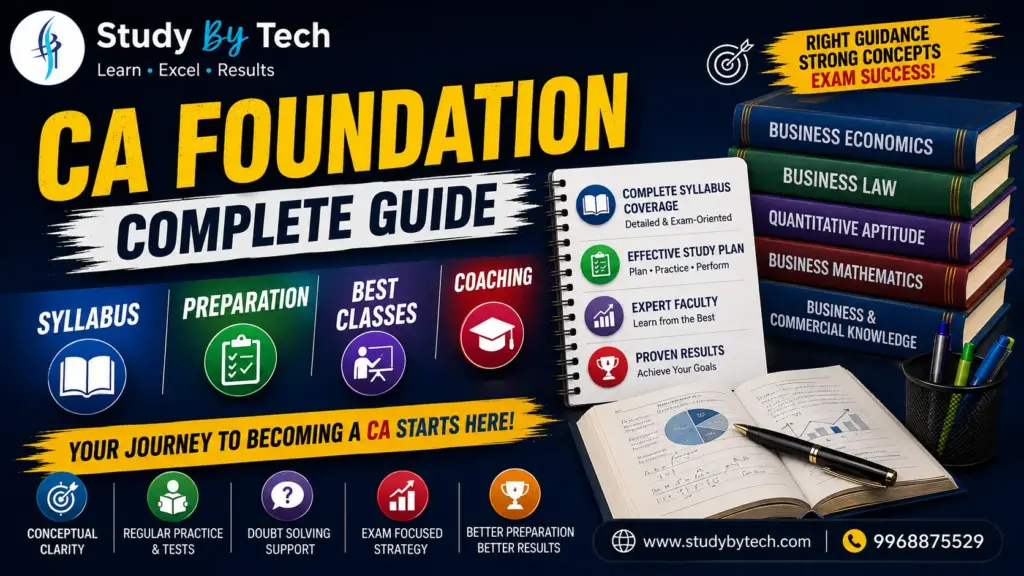
CA Foundation: Syllabus, Preparation, Best Classes & Coaching
Blog, CA Foundation

Ultimate guide to CA Foundation

CA Foundation: Syllabus, Exam Pattern, Preparation Strategy & Best Coaching CA Foundation is the first level of the Chartered Accountancy course, and this guide covers everything you need to clear it. It’s for Class 10 and Class 12 students, plus anyone starting their CA journey. You’ll get the four-paper syllabus, exam pattern, registration steps, passing marks, a 4-month study plan and book list. Key takeaway: you need 40% in each paper and 50% overall, and the pass rate sits around 15% to 25%. 🎯 Your complete roadmap to CA FoundationFrom syllabus to exam strategy8 minute read Enroll NowWatch Demo Lectures 📑 Table of Contents 1. What is the CA Foundation Course? 2. CA Foundation Registration: Quick Overview 3. Subjects of CA Foundation & Syllabus 4. Passing Criteria 5. Is CA Foundation Easy or Tough? 6. How to Study CA Foundation 7. Best Recommended Books 8. Exam Form Process & Major Steps 9. Online vs Offline Classes 10. Why StudyByTech for CA Foundation 11. Awaiting Results? What to Do Frequently Asked Questions ⭐ Key Takeaways 4 papers Accounting, Business Laws, Quantitative Aptitude, Business Economics. Exam pattern 2 subjective (Accounting, Law) + 2 objective (Maths, Economics). Passing criteria 40% in each paper and 50% aggregate (200/400). Negative marking 0.25 marks deducted for wrong answers in Paper 3 and 4. Registration validity 4 years, can be revalidated as per ICAI norms. Study period Minimum 4 months between registration and exam month. Common pitfalls Neglecting law write-ups, maths phobia, undervaluing MCQs, skipping mock tests. Pass rate Generally between 15% and 25%. May 2026 overall pass rate was 20.09%. 1. What is the CA Foundation Course? The CA Foundation course is the very first phase of the CA course curriculum regulated by ICAI. It assesses your knowledge of basic accounting concepts, business law, quantitative aptitude and business economics. Eligibility Criteria After Class 10: You can apply with ICAI provisionally after qualifying for Class 10. After Class 12: You can give the CA Foundation exam after clearing your Class 12 board exams and completing the mandatory 4 months after registration. Validity of Registration The CA Foundation registration is valid for 4 years. The registration can be revalidated if required, as per ICAI norms. 2. CA Foundation Registration: Quick Overview If you’re aiming for the CA Foundation examination under the Institute of Chartered Accountants of India (ICAI), registering on time is your very first step toward becoming a Chartered Accountant. Key Registration Highlights & Timeline Eligibility You can register for the CA Foundation route after passing your Class 10 board exams (provisional registration) or after appearing in or clearing your Class 12 board exams. Cut-Off Dates For June attempt: register on or before January 1 of the exam year. For September / December attempts: register at least 4 months before the exam month (for example, on or before May 1 for September attempts). Validity Your CA Foundation registration stays valid for 4 years from the date of initial registration. Step-by-Step Registration Process Step 1 Visit the official ICAI Self Service Portal (SSP). ➜ Step 2 Click “First Time User / New Student” and fill in your basic personal details. ➜ Step 3 Upload scanned 10th/12th marksheets, photo, signature and ID proof. ➜ Step 4 Pay the registration fee online (approx. ₹9,000 for Indian students). ➜ Step 5 Save your Student Registration Number (SRN) and official fee receipt. 3. Subjects of CA Foundation and Syllabus (New ICAI Scheme) There are four main subjects in CA Foundation, covering both subjective and objective test formats. Overview of CA Foundation Papers Paper No. Subject Name Type of Paper Total Marks Negative Marking Paper 1 Accounting Subjective (Descriptive) 100 Marks No Paper 2 Business Laws Subjective (Descriptive) 100 Marks No Paper 3 Quantitative Aptitude (Maths, Stats, LR) Objective (MCQ) 100 Marks Yes (0.25 mark) Paper 4 Business Economics Objective (MCQ) 100 Marks Yes (0.25 mark) Breakdown of Subjects Paper 1 · 100 marks Accounting Concepts and Accounting Process, Bank Reconciliation Statement (BRS) and Inventories, Depreciation and Final Accounts of Sole Proprietorship, Accounting for Special Transactions (Consignment, Bills of Exchange), Accounts of Partnership and NPO, Accounts of Company and Financial Statements. Paper 2 · 100 marks Business Laws The Indian Contract Act, 1872, The Sale of Goods Act, 1930, The Indian Partnership Act, 1932, Limited Liability Partnership (LLP) Act, 2008, The Companies Act, 2013. Paper 3 · 100 marks Quantitative Aptitude Business Mathematics (40 marks), Logical Reasoning (20 marks), Statistics (40 marks). Paper 4 · 100 marks Business Economics Introduction to Business Economics and Demand-Supply Approach, Production and Cost Theory, Price Theory under Different Market Structures, National Income and Public Finance, Money Market, Foreign Trade and Indian Economy. 4. Passing Criteria for CA Foundation This is what ICAI prescribes to clear the CA Foundation exam: 40%Minimum marks per subject 50%Overall minimum (200 out of 400) 0.25Negative mark in Paper 3 and 4 5. Is CA Foundation Exam Easy or Tough? A question novices often ask is whether the CA Foundation exam is easy or tough. The facts: The pass percentage is generally between 15% and 25%. The Accounting and Economics syllabus builds on Class 11 and 12 Commerce, but the exam isn’t easy because of its depth, law language, speed in Maths and application of concepts. May 2026: 20.09% passed (18,124 of 90,217 candidates) Why Do Students Fail in This Course? Neglecting legal write-ups Studying laws without practising descriptive write-ups. Mathematics phobia Losing marks in Quantitative Aptitude because of slow calculation and not knowing shortcut methods, especially for non-maths commerce students. Undervaluing MCQs Losing marks to negative marking (0.25) in Paper 3 and 4 by guessing blindly. Skipping mock tests Not practising complete 3-hour test papers. 6. How to Study CA Foundation: Step-by-Step Guide Whether you self-study or join classes for CA Foundation, you need a proper study approach. 📚 Stage 1 (Months 1–2.5) Clearing concepts. Finish 100% of the syllabus using ICAI study materials and reference books. Make your own handwritten notes: formula list for Maths and legal provisions for Law.

Can Science Students Do CA
Blog, CA classes, CA Course

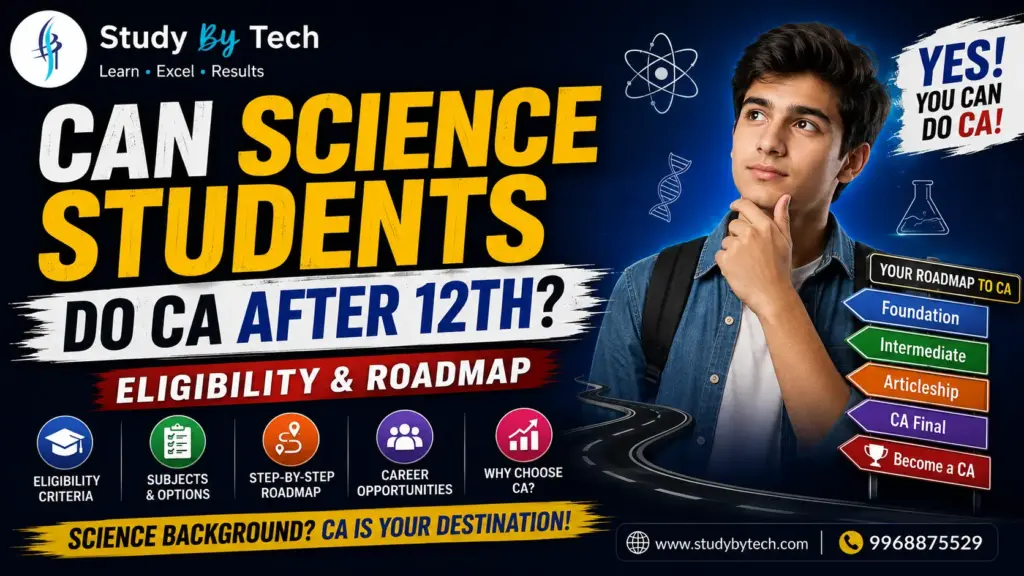
Can Science Students Do CA After 12th? Complete Guide, Eligibility & Strategy Yes, science students can do CA after 12th. ICAI accepts students from any stream, with no minimum percentage for CA Foundation. This guide is for Class 12 science students and B.Sc or B.Tech graduates considering CA. You’ll get the two entry routes, the step-by-step CA roadmap, science students’ strengths, common challenges and fixes, a CA Foundation strategy and a science-vs-commerce comparison. Key takeaway: by month three, you’re on a level playing field. 🎯 Your complete roadmap to CA for science studentsFrom eligibility to exam strategy7 minute read Enroll NowDirect Entry in CA 📑 Table of Contents 1. ICAI Eligibility Criteria for Science Students 2. Step-by-Step Roadmap: Becoming a CA 3. Can I Do CA After B.Tech or B.Sc? 4. Strengths & Hidden Advantages of Science Students 5. Common Issues & Solutions 6. Strategy for CA Foundation Papers 7. Science vs Commerce Students Frequently Asked Questions ⭐ Key Takeaways Yes, you can ICAI allows students from any stream (PCM/PCB/PCMB) to pursue CA. Two entry routes CA Foundation after 12th (no minimum %) or Direct Entry after B.Sc/B.Tech (≥60%). CA Foundation papers Accounting, Business Laws, Quantitative Aptitude, Business Economics. Science students’ advantages Strong quantitative aptitude, analytical thinking, problem-solving stamina and study discipline. Key challenges Understanding accounting terminology, adjusting to subjective law papers, and overcoming the commerce-student mental block. Foundation strategy Master fundamentals, practise ICAI material, use the PFAC format for law, and use graph skills for economics. Level playing field By month 3 of preparation, science and commerce students are on equal footing. Direct Entry advantage B.Sc/B.Tech graduates can skip CA Foundation and register directly for CA Inter (if ≥60%). 1. ICAI Eligibility Criteria for Science Students ICAI treats all candidates equally, whichever stream they chose in high school. There’s no special quota based on stream, and science students don’t need any extra certificates. Entry Channels for Students with a Science Background CA Foundation Course Path (After 12th Science) Educational requirement: You must have passed or appeared in your Class 12 board exams (PCM/PCB/PCMB). Percentage requirement: There’s no minimum percentage in Class 12 to apply for the CA Foundation exam. Provisional membership: You can get provisional membership with ICAI’s Board of Studies after passing Class 10. Study period: A compulsory 4-month study period must be completed between ICAI membership and the exam date. Direct Entry Route (After B.Sc or B.Tech) Educational qualification: Science graduates with a 3-year B.Sc or 4-year B.Tech/B.E. degree don’t need to appear for CA Foundation at all. Minimum marks: Graduates from a non-commerce field need an aggregate score of 60% to be eligible for direct entry to CA Inter. Know more about Direct Entry in CA 2. Step-by-Step Roadmap: Becoming a CA After 12th Science Under ICAI’s New Scheme of Education and Training, the CA qualification has three main exam stages along with practical articleship training: Step 1 CA Foundation Exam. 4 papers: Accounts, Law, Maths/Stats, Economics. ➜ Step 2 CA Intermediate. 6 papers split across Group 1 & Group 2. ➜ Step 3 ICITSS & Articleship. 4-week soft skills/IT training + 2-year practical training. ➜ Step 4 SPOM Modules & AICITSS. Self-Paced Online Modules + Advanced IT. ➜ Step 5 CA Final Exam. 6 advanced papers + qualified CA designation. Stage 1: CA Foundation After your Class 12 board exams, join ICAI and pass 4 basic papers: Paper 1: Accounting (100 marks, subjective) Paper 2: Business Laws (100 marks, subjective) Paper 3: Quantitative Aptitude: Business Mathematics, Logical Reasoning & Statistics (100 marks, objective) Paper 4: Business Economics (100 marks, objective) Stage 2: CA Intermediate Passing CA Foundation paves the way for CA Intermediate, which has 6 papers split into Group 1 and Group 2. Stage 3: ICITSS & 2 Years Articleship Before the 2-year practical training, you need to complete ICITSS, which lasts 4 weeks. Stage 4: SPOM & CA Final During articleship, clear SPOM Sets A, B, C, D and Advanced ICITSS. After fulfilling all articleship and study requirements, appear for the CA Final exam. 3. Can I Do CA After B.Tech or B.Sc? (Direct Entry Guide) Many engineering and science students find, during or after their studies, that they want to switch to careers like corporate finance, investment banking, management consultancy or auditing. Eligibility Science or Engineering graduates with ≥60% marks in aggregate can register directly for CA Intermediate. Advantage It saves you from taking the 4-paper CA Foundation, which takes 6 to 12 months. Strategy Since direct entry students join CA Intermediate straight away, science students should spend 4 to 6 weeks on the basics of double-entry bookkeeping, the debit/credit system and basic accounting. 4. Strengths & Hidden Advantages of Science Students in CA Commerce students enter CA with some exposure to basic accounting terms, but science students have thinking habits that turn out to be major assets: Advantage Why Science Background Helps Direct CA Application Quantitative Aptitude In-depth familiarity with calculus, algebra, and statistics. High scores in CA Foundation Quantitative Aptitude & CA Inter Costing / FM. Logical & Analytical Thinking Practice with complex scientific proofs and physical laws. Analysing complex case studies in Business Law, Tax Planning, and Audit. Problem-Solving Stamina Used to solving multi-step mathematical and physics problems. Tackling lengthy numerical problems in Costing and Advanced Accounting. Study Discipline Habitual focus required for competitive entrance exams (JEE/NEET). Managing the 8-10 hour daily study schedule required during CA revision. 5. Common Issues Faced by Science Stream Students, and Their Solutions The switch from equations to accounts can be tricky for science students at the beginning. Knowing the issues before the exam saves time. 📌 Challenge 1: Understanding common accounting terms The issue: Debits, Credits, Trial Balance, Depreciation, Balance Sheet, Provision and Capital Expenditure sound like a foreign language in the first few weeks. ✅ Solution: Spend 15-20 days learning the basic accounting terminology covered in the NCERT Accountancy books of Class 11 and 12 (Golden Rules of Accounts, Journalising and Ledgers). Don’t mug up accounting. See it as a

CA Foundation Coaching Classes
Blog, CA Foundation

CA Foundation Coaching Classes Near me

Would you like to learn how to become CA-certified? Are you eager to advance your job by traveling or attending classes in other cities? There are many things that you need to do for your career, and one of the most important is to get CA foundation coaching classes near me. The purpose of this article is to give you some tips on how you can choose the best CA foundation coaching brand in your city. When it comes to choosing a course, can seem like a daunting task, but don’t worry—we’ve done all the hard work for you by going through all the options with you and bringing our top three contenders into focus. What exactly is the CA Foundation? CA Foundation is an entry-level exam for students interested in chasing a career in CA. It is administered by the Institute of Chartered Accountants of India (ICAI) and is the first step towards becoming a CA in India. Students who have finished their 10+2 or equivalent examination from a recognized board or university are good candidates for the CA Foundation program. The course divides into four papers that include topics such as accounting principles and practices, business laws, business communication and reporting, business mathematics and logical reasoning, and statistics. The CA Foundation examination use to give twice a year, in May and November, and take online. Students who pass the CA Foundation examination are able to participate in the CA Intermediate course, which is the next level in the CA course. Here’s the short intro about CA Foundation Syllabus The CA Foundation course contains four papers, each carrying a weightage of 100 marks. The papers are as follows: The CA Foundation syllabus use to design to provide students with a strong foundation in the basics of accounting, business law, mathematics, statistics, and logical reasoning. It aims to equip students with the knowledge and skills required to pursue a career in chartered accounting. Join India’s Best CA Foundation Classes – StudyByTech: Click Here Who should take the CA Foundation Classes? CA Foundation classes are ideally suited for students who have completed their 10+2 or equivalent examination and are interested in pursuing a career in chartered accounting. The classes use to design to provide students with a strong foundation in the basics of business laws, mathematics, statistics, and logical reasoning, which are crucial for pursuing a career in chartered accountancy. In addition to students who want to become chartered accountants, CA Foundation classes may also be beneficial for students who want to pursue a career in finance, accounting, or business. The knowledge and skills gained through the CA Foundation course can apply in a variety of business and finance-related roles, making it a valuable qualification for anyone interested in these fields. Furthermore, students who have a strong aptitude for numbers, an analytical mind, and an interest in pursuing a career in finance or accounting may find the CA Foundation course particularly well-suited to their interests and abilities. Overall, anyone who wants to pursue a career in finance, accounting, or business, and has the requisite educational qualifications, may benefit from taking CA Foundation classes. How to find CA foundation classes near you? There are many ways to find the best coaching classes for CA Foundation near your area. One of the most effective ways is through the website. Which has almost all good institutes listed for CA classes in India, i.e., list.studybytech.com. Although if you are from Delhi, then our coaching center, Parag Gupta Classes in Laxmi Nagar, is said to be the most efficient coaching center in Delhi and provides both online and offline classes for CA. Since the last 10 years, Parag Gupta Classes has created so many efficient CAs in the industry that now students. First recommendation is PARAG GUPTA CLASSES. Don’t worry; if you are living in another city, you can join Parag Gupta classes through their online mode. Don’t worry about your doubts. Each and every doubt will be discuss through video calling by your teachers. FAQs Q. Which coaching is best for CA Foundation? A. Some factors that you should consider while choosing a coaching institute for the CA Foundation include:Faculty: Parag Gupta Classes has the best-experienced faculties in this industry.Location- The classes should situate at a place where students will not face any problem commuting to coaching.Fees: The fees for coaching shall be affordable so that average students can also use the facilities of good institutes.Student Teacher Ratio- This is one of the important factors for Students for comprehending & getting the goal at the earliest. At Parag Gupta Classes, the student-teacher ratio is always consider low to maintain student-teacher interactions at a high level. This is the reason why every year, the maximum passing percentage is from this institute. Q. What are the CA Foundation coaching fees? A. The CA Foundation coaching fees may vary depending on the coaching institute or the individual tutor you choose. Generally, the fees range from Rs. 15,000 to Rs. 35,000 in India. Some of the good institutes, like Parag Gupta Classes, offer quality education to CA students with very good scholarship programs for needy and eligible students so that each student can get the best for his or her education. Q. Is CA Foundation very easy? A. CA Foundation is the entry-level exam for the Chartered Accountancy (CA) course in India. While it may not consider an extremely difficult exam, it is also not very easy. It requires a good understanding of fundamental accounting principles, mathematics, and legal aspects related to business and finance. To pass the CA Foundation exam, one needs to study and prepare diligently, have a good grasp of the concepts and principles, and practice solving questions regularly. The exam use to design to test the candidates’ knowledge and understanding of the subjects, and it is not uncommon for students to attempt the exam multiple times before passing. Therefore, while it may not be impossible to clear the CA Foundation exam, it requires dedication,

CA Inter Direct Entry After Graduation
Blog, CA Inter, Direct entry

सीए डायरेक्ट एंट्री: CA Inter & CA Final की सम्पूर्ण मार्गदर्शिका (हिंदी में) ग्रेजुएशन के बाद सीए बनने का सबसे तेज़ रास्ता | फाउंडेशन स्किप करें सीए डायरेक्ट एंट्री ICAI की वह योजना है जिससे ग्रेजुएट सीधे CA Inter में प्रवेश लेते हैं और फाउंडेशन स्किप कर देते हैं। यह गाइड CA Inter & CA Final का सपना देखने वाले ग्रेजुएट और CA छात्रों के लिए है। कॉमर्स ग्रेजुएट के लिए 55% और नॉन-कॉमर्स के लिए 60% अंक चाहिए। इस रास्ते से CA 4–4.5 साल में बन सकते हैं, रजिस्ट्रेशन फीस ₹18,000 है (ICITSS फीस अलग) और आर्टिकलशिप 2 साल की है। StudyByTech | India’s No. 1 CA Classesहिंदी में पूरी जानकारी डायरेक्ट एंट्री स्पेशल क्लासेस – डेमो लेंCA Inter ClassesCA Final Classes विषय सूची (Table of Contents) डायरेक्ट एंट्री, फाउंडेशन और नॉन-कॉमर्स रूट सीए डायरेक्ट एंट्री क्या है? पात्रता (Eligibility) स्टेप बाय स्टेप रजिस्ट्रेशन प्रोसेस डायरेक्ट एंट्री बनाम फाउंडेशन – तुलना तालिका स्टडीबायटेक का विशेष मार्गदर्शन क्या डायरेक्ट एंट्री मुश्किल है? अक्सर पूछे जाने वाले सवाल (FAQs) CA Inter क्लासेस में एडमिशन मुख्य बातें (Key Takeaways) सीधा प्रवेश सीधे CA Inter में प्रवेश, फाउंडेशन नहीं। पात्रता कॉमर्स ग्रेजुएट: 55% | नॉन-कॉमर्स: 60%। CS या CMA इंटर पास भी पात्र। समय बचत डायरेक्ट एंट्री से 4–4.5 साल में CA, जबकि फाउंडेशन रूट में 5–5.5 साल। फीस ₹18,000 (रजिस्ट्रेशन + एक्टिविटी + आर्टिकलशिप) + ICITSS कोर्स फीस अलग। आर्टिकलशिप नई योजना में 2 साल, और इंटर के दोनों ग्रुप पास करने के बाद ही शुरू। डायरेक्ट एंट्री, फाउंडेशन और नॉन-कॉमर्स रूट डायरेक्ट एंट्री सीधे CA इंटर में प्रवेश, फाउंडेशन नहीं कॉमर्स ग्रेजुएट: 55% | नॉन-कॉमर्स: 60% समय बचत: 4-4.5 साल में CA नई योजना: आर्टिकलशिप 2 साल प्रोविजनल रजिस्ट्रेशन (फाइनल ईयर) फाउंडेशन रूट 12वीं के बाद फाउंडेशन पास करना ज़रूरी कुल 5-5.5 साल लगते हैं बेसिक अकाउंटिंग सीखने का मौका ग्रेजुएट्स के लिए अनावश्यक देरी नॉन-कॉमर्स ग्रेजुएट बी.एससी / बी.ए / इंजीनियरिंग: 60% → डायरेक्ट एंट्री स्टडीबायटेक ब्रिज कोर्स एक्स्ट्रा सहायता ICAI की ओर से स्पेशल छूट एक्स्ट्रा मेहनत से बेहतरीन करियर सीए डायरेक्ट एंट्री क्या है? (पूरी जानकारी) इंस्टीट्यूट ऑफ चार्टर्ड अकाउंटेंट्स ऑफ इंडिया (ICAI) हर साल हजारों स्नातकों को Direct Entry Scheme के तहत सीए कोर्स में फाउंडेशन स्तर छोड़ने की सुविधा देता है। यह मार्ग विशेष रूप से B.Com, BBA, BMS, M.Com, MBA Finance, BAF और अन्य स्ट्रीम (साइंस/आर्ट्स) के ग्रेजुएट्स के लिए है। ग्रेजुएशन के बाद सीए बनने का यह सबसे प्रभावी और समय बचाने वाला विकल्प है। समय बचत फाउंडेशन स्किप से 8-12 महीने बचते हैं, डायरेक्ट एंट्री से 4-4.5 साल में सीए संभव। फीस संरचना CA Inter रजि: ₹15,000 + ₹2,000 (स्टूडेंट एक्टिविटी) + ₹1,000 (आर्टिकलशिप) = ₹18,000 + ICITSS कोर्स फीस अलग। आर्टिकलशिप नियम (नई योजना) 2 वर्ष की प्रैक्टिकल ट्रेनिंग। अब 9 महीने की पुरानी शर्त खत्म, सीधे 2 साल। इंटर के दोनों ग्रुप पास करने के बाद ही आर्टिकलशिप शुरू। पात्रता (Eligibility) – कौन कर सकता है डायरेक्ट एंट्री? कॉमर्स ग्रेजुएट/पोस्ट ग्रेजुएट (B.Com, BBA, BMS, M.Com, MBA Finance) – न्यूनतम 55% अंक नॉन-कॉमर्स ग्रेजुएट (B.Sc, B.A, B.Tech, BCA आदि) – न्यूनतम 60% अंक ICSI (CS) इंटरमीडिएट या ICMAI (CMA) इंटर पास छात्र सीधे CA इंटर में प्रवेश पाते हैं। अंतिम वर्ष के छात्र: प्रोविजनल रजिस्ट्रेशन कर सकते हैं, लेकिन ग्रेजुएशन प्रमाणपत्र 6 महीने के भीतर ICAI को जमा करना अनिवार्य, नहीं तो रजिस्ट्रेशन रद्द और फीस ज़ब्त। स्टेप बाय स्टेप रजिस्ट्रेशन प्रोसेस Step 1 ICAI के SSP पोर्टल पर जाएं और नया अकाउंट बनाएं। ➜ Step 2 “Direct Entry Route” का चयन करें, CA इंटर के लिए आवेदन करें। ➜ Step 3 10वीं, 12वीं, ग्रेजुएशन की मार्कशीट, फोटो, सिग्नेचर, ID प्रूफ अपलोड करें। Step 4 ऑनलाइन फीस जमा करें – ₹18,000 (रजिस्ट्रेशन + एक्टिविटी + आर्टिकलशिप रजिस्ट्रेशन)। ➜ Step 5 कन्फर्मेशन मिलने के बाद आपकी 8 महीने की स्टडी पीरियड शुरू। अब CA इंटर की तैयारी करें। ➜ Step 6 ICITSS (Orientation Course + IT) कोर्स प्रोविजनल पीरियड के दौरान कर सकते हैं, लेकिन आर्टिकलशिप केवल इंटर क्लियर करने के बाद शुरू होगी। डायरेक्ट एंट्री बनाम फाउंडेशन – तुलना तालिका पैरामीटर डायरेक्ट एंट्री (ग्रेजुएट्स) फाउंडेशन रूट प्रवेश स्तर सीधे CA इंटर CA Foundation → Inter न्यूनतम अवधि 4 – 4.5 साल 5 – 5.5 साल योग्यता % कॉमर्स 55% / अन्य 60% 12वीं में 50% आर्टिकलशिप अवधि 2 साल (नई योजना) 2 साल फाउंडेशन एग्ज़ाम नहीं देना पड़ता देना अनिवार्य स्टडीबायटेक का विशेष मार्गदर्शन – डायरेक्ट एंट्री छात्रों के लिए बेस्ट रणनीति 1 सबसे पहले ICAI मॉड्यूल, RTP, MTP को प्राथमिकता दें – परीक्षा में अधिकतम प्रश्न इन्हीं पर आधारित होते हैं। 2 कांसेप्ट क्लियर करने के लिए StudyByTech की LIVE इंटरैक्टिव क्लासेस ज्वाइन करें – ऑनलाइन/ऑफलाइन दोनों माध्यम उपलब्ध। 3 समय प्रबंधन: आर्टिकलशिप के चक्कर में पढ़ाई को न टालें – पहले इंटर क्लियर करने पर फोकस करें। 4 रिवीजन प्लान: हर विषय का कम से कम 3 बार रिवीजन करें। मॉक टेस्ट नियमित रूप से दें। 5 ग्रेजुएट्स को फायदा: आप अकाउंटिंग, बिजनेस लॉ की बेसिक समझ रखते हैं – इसका लाभ उठाएं। डायरेक्ट एंट्री स्पेशल क्लासेस – डेमो लें क्या डायरेक्ट एंट्री मुश्किल है? चुनौतियाँ और समाधान CA इंटर सिलेबस ग्रेजुएशन से काफी एडवांस है, लेकिन ग्रेजुएट्स में मैच्योरिटी और डिसिप्लिन होता है। आम गलतियाँ जल्दी आर्टिकलशिप शुरू करके पढ़ाई पर ध्यान न देना ICAI स्टडी मटीरियल को नज़रअंदाज़ करना टाइम मैनेजमेंट में कमी समाधान एक रोज़ का 6-7 घंटे का रूटीन बनाएं हर हफ्ते टेस्ट दें StudyByTech के अनुभवी फैकल्टी से मार्गदर्शन लें लाखों छात्र पहले यह रास्ता अपना चुके हैं – आप भी कर सकते हैं! अक्सर पूछे जाने वाले सवाल (FAQs) – हिंदी में Q1. क्या मैं ग्रेजुएशन के फाइनल ईयर में डायरेक्ट एंट्री के लिए अप्लाई कर सकता हूँ? हाँ, ICAI प्रोविजनल रजिस्ट्रेशन की सुविधा देता है। लेकिन ग्रेजुएशन पूरा होने के 6 महीने के अंदर 55% (कॉमर्स) या 60% (अन्य) की मार्कशीट जमा करना अनिवार्य है। Q2. बिग 4 (Deloitte, PwC, EY, KPMG) डायरेक्ट एंट्री वालों को आर्टिकलशिप देते हैं? बिल्कुल! Big4 उन छात्रों को प्राथमिकता देती हैं जिन्होंने CA इंटर पहले या दूसरे प्रयास में डिस्टिंक्शन के साथ पास किया हो। संचार कौशल और आत्मविश्वास भी ज़रूरी है। Q3. सीए डायरेक्ट एंट्री

CA Inter & CA Final
Blog, CA Final, CA Inter

After CA Inter & CA Final Exam Result: Expert Tips and Strategies

After CA Inter & CA Final Exam Result: Expert Tips and Strategies Your CA Inter & CA Final result sets your next move, and the first 48 hours matter most. This guide is for CA students and covers all four outcomes. Passed CA Intermediate? Finish ICITSS training, clear SPOM, then hunt for articleship. Missed it? Study your certified copies and fix Costing. Cleared CA Final? Go for ICAI campus placements and upskill. Missed it? Master SPOM Set B (SCPM), because it feeds the IBS paper. For CA Inter & CA Final students48-hour action plan5–7 minute read CA Foundation ClassesCA Inter ClassesCA Final ClassesStudyByTech OffersContact us Table of Contents Part 1: The CA Inter Result – What’s Next? Part 2: The CA Final Result – The Final Leap Result Cheat Sheet: All Four Outcomes Conclusion FAQs on CA Inter & CA Final Results Want to Enroll in Our Classes? Key Takeaways Passed CA Inter? Do this in order: ICITSS training, SPOM exams (Set A, B, C, D), then your articleship hunt at a Big 4 or mid-sized firm. Failed CA Inter? Analyze your certified copies, focus on Costing (40 to 70), and build LDR revision notes. Passed CA Final? Register for ICAI Campus Placements, then upskill in Excel, Power BI and SAP. Failed CA Final? Master SPOM Set B (SCPM) for the IBS paper, use the keyword technique for Audit, and summary charts for IDT. The release of CA Inter and CA Final results is a defining moment. Whether you’re celebrating a pass or figuring out a fail, what you do in the next 48 hours shapes your career. At StudyByTech, we’ve split the path forward into two clear blueprints. Part 1: The CA Inter Result – What’s Next? Scenario A: You Passed CA Inter! Congratulations! You’re now a semi-qualified professional. Here’s your 3-step plan for what comes after CA Intermediate: Step 1 Complete ICITSS (ITT & OC) ➜ Step 2 Clear SPOM exams (Set A, B, C & D) ➜ Step 3 Start your articleship hunt 1. Complete ICITSS training (ITT & OC) immediately Before you step into an office for articleship, you need to finish the Integrated Course on Information Technology and Soft Skills (ICITSS). What it includes: 15 days of Information Technology Training (ITT) and 15 days of the Orientation Course (OC). Registration: You do it through the ICAI SSP Portal. Pro tip: Seats fill up within minutes of result declaration. Register ASAP to avoid a 3-month delay in starting your articleship. 2. Clear SPOM exams (Set A, B, C & D) Under the new scheme, you must clear the Self-Paced Online Modules (SPOM) before you’re eligible for CA Final. Strategic advantage: Understanding Set A and Set B (SCPM) will save you in CA Final, because this syllabus is heavily tested in the IBS paper. 3. The articleship hunt Aiming for the Big 4 or a reputed mid-sized firm? Make sure your resume shows the technical skills from ITT and the soft skills from your OC training. Scenario B: You Didn’t Pass CA Inter Analyze the “why” Request certified copies from ICAI. Was it a lack of conceptual clarity or presentation errors? Focus on Costing Struggled here? Try Parag Gupta Sir’s Costing Booster Batch, built to turn a 40 into a 70+. It can help you maintain aggregate in groups, which can help you pass. LDR strategy Start building Last Day Revision notes now. If you can’t revise a subject in 1.5 days, you won’t pass it in the exam cycle. Part 2: The CA Final Result – The Final Leap Scenario A: You Passed CA Final! You’re now a Chartered Accountant. The job hunt: Register for ICAI Campus Placements. Focus on technical rounds and your communication skills. Upskilling: Industry wants a tech-savvy auditor. Master Advanced Excel, Power BI and SAP to raise your market value. Scenario B: You Didn’t Pass CA Final The CA Final hurdle is high, but you can clear it with a tactical shift. 1. The IBS (Paper 6) “secret key” The Integrated Business Solutions (IBS) paper is where most students get stuck. Here’s where its marks come from: Marks from SPOM material: 40–42 Of which from SCPM (Set B): 22–24 The trap: Most students neglect Set B and treat it as a formality. Mastering the SPOM (SCPM) syllabus is the single most effective way to pass IBS. Explore CA Final SCPM classes. 2. Tactical subject tips Audit & IDT: Use the “keyword technique” for Audit Standards. For IDT, use summary charts to master the GST logic in a single day. FR & AFM: These are your scoring engines. Master Ind AS adjustments in FR and Forex/Derivatives in AFM. Result Cheat Sheet: All Four Outcomes Your result First move Focus areas Don’t miss Passed CA Inter ICITSS (15 days ITT + 15 days OC) via the ICAI SSP Portal SPOM Set A–D, articleship at a Big 4 or mid-sized firm Register fast. Batches fill within minutes. Failed CA Inter Request certified copies from ICAI Costing (40 to 70), LDR notes Separate conceptual gaps from presentation errors. Passed CA Final ICAI Campus Placements Advanced Excel, Power BI, SAP Technical rounds and communication skills. Failed CA Final Master SPOM Set B (SCPM) Audit keywords, IDT summary charts, Ind AS in FR, Forex/Derivatives in AFM Don’t treat Set B as a formality. Conclusion Getting your CA Inter or CA Final result is a big milestone, whatever the outcome. Use this time to reflect, plan and take proactive steps. Whether you’re stepping into the professional world or preparing for another attempt, bring determination and a strategic mindset. Every step, forward or back, is part of your journey to becoming a successful Chartered Accountant. Stay positive, stay focused, and keep striving for excellence. FAQs on CA Inter & CA Final Results Q1: I just passed CA Inter. Can I start my articleship tomorrow? Not quite. You must first complete your ICITSS training (15 days of ITT and 15 days of OC). Once you finish and the certificates are

CAI Self-Paced Module Details, Registration & Process
CA Final, Self paced online module

ICAI Self-Paced Online Module Details, Registration & Process

CA Final classes CA Final IBS classes(SPOM-set B portion) StudyByTech Offers Contact us In the fast-paced world of Chartered Accountancy, staying ahead of the curve is essential. With the advent of self-paced modules by the Institute of Chartered Accountants of India (ICAI), aspiring professionals now have a flexible and personalized way to enhance their skills and knowledge. In this comprehensive guide, we’ll delve into the details, registration process, and benefits of ICAI’s self-paced modules, empowering you to take control of your CA journey like never before. Understanding ICAI Self-Paced Modules: ICAI’s self-paced modules are designed to cater to the diverse learning needs and preferences of CA aspirants. These modules offer a flexible and convenient way to access high-quality study materials, lectures, and assessments at your own pace and convenience. Whether you’re a full-time student, a working professional, or someone with other commitments, self-paced modules provide the flexibility to learn anytime, anywhere, without compromising on the quality of education. Registration Process: The registration process for ICAI’s self-paced modules is simple and straightforward, allowing candidates to enroll with ease. Here’s a step-by-step guide to getting started: step 1– Visit the ICAI Website: Begin by visiting the official website of the Institute of Chartered Accountants of India (ICAI). step 2 – Navigate to Self-Paced Modules Section: Explore the website to locate the section dedicated to self-paced modules. step 3 -Choose Your Module: Browse through the available modules and choose the one that aligns with your learning objectives and career goals. step 4 -Register Online: Fill out the registration form provided on the website, providing accurate personal and contact information. step 5 -Make Payment: Complete the registration process by making the required payment online through secure payment gateways. step 6 -Access Study Materials: Upon successful registration and payment, you’ll gain access to the study materials, lectures, and other resources associated with the module. ICAI Self-Paced Module: What is Remote Proctoring? Basically, remote proctoring helps maintain the integrity of online exams by making sure everyone follows the rules, just like in a traditional exam hall. It gives students peace of mind that their hard work is being evaluated fairly and honestly, even when they’re not in a physical classroom. In ICAI’s self-paced modules, remote proctoring ensures that exams are conducted with the same level of security and credibility as in-person exams, allowing candidates to demonstrate their knowledge and skills confidently from the comfort of their own homes. ICAI Self-Paced Module Registration To register for the ICAI Self-Paced Module, students must visit https://icai.org/. The registration announcement will be available in the Students section of the Institute website and the PT test portal. The ICAI Self-Paced Module is not more accessible or challenging than the Center-Based Test, as it follows the same assessment criteria. Candidates must have a laptop or desktop computer to take the ICAI Self-Paced Module (Home Based Test), as mobile phones or tablets are not supported. Benefits of ICAI Self-Paced Modules: Flexibility: Self-paced modules offer unparalleled flexibility, allowing you to tailor your learning schedule to fit your lifestyle and commitments. Whether you prefer studying in the morning, evening, or during breaks, you have the freedom to learn at your own pace. Personalized Learning Experience: With self-paced modules, you take control of your learning journey. You can revisit challenging topics, skip ahead to areas of interest, or dedicate extra time to concepts that require more attention. This ensures a personalized and effective learning experience that caters to your unique needs. Quality Content: Experienced professionals and subject matter experts develop ICAI’s self-paced modules, guaranteeing high-quality study materials, lectures, and assessments. Cost-effectiveness: Self-paced modules are often more cost-effective compared to traditional classroom-based coaching. Without additional expenses for commuting or accommodation, you can save time and money while still accessing top-notch education. Accessible Anywhere, Anytime: Self-paced modules allow you to access study materials and lectures from anywhere with an internet connection. Whether you’re at home, in the office, or traveling, you have the flexibility to study at your convenience, without being bound by time or location. Conclusion: In conclusion, ICAI’s self-paced modules offer a flexible, convenient, and effective way for CA aspirants to enhance their skills and knowledge. By leveraging these modules, you can take control of your learning journey, access high-quality study materials, and prepare for success in your CA exams with confidence. So, why wait? Register for ICAI’s self-paced modules today and unlock your full potential as a chartered accountant.go through on studybytech for more information. FAQS Q1. How do I register with ICAI? Visit the official website of ICAI: icaiexam.icai.org. Fill in all the required details and click on generate OTP. To complete the validation process, enter the OTP you received. Q2. What are the 4 self-paced modules of ICAI? The ICAI CA New Scheme of Education and Training comprises four self-paced online modules: Set A, Set B, Set C, and Set D. These modules cover various subject areas. Q3. When will the ICAI CA New Scheme of Education come into effect? The ICAI CA New Scheme of Education and Training will be effective July 1, 2023. Q4. What is a self-paced online module in CA? In the context of Chartered Accountancy (CA) education, a “self-paced module” may refer to a learning approach where candidates have the flexibility to study at their own pace. CA programs, such as those offered by professional accounting bodies, often consist of multiple levels or stages of examinations. CA Final SCPM covers Balanced Scorecard, ABC, and Transfer Pricing. Parag Gupta is among the few faculty teaching SCPM with real company data.

Chapter-wise weightage- CA Inter Costing
CA Inter, Costing

CA Inter Costing Chapterwise Weightage 2026-27 | Strategic Planner & Study Tips 📅 Updated for Jan / May / Sep 2026-27 | New Scheme ICAI CA Inter Costing Chapterwise Weightage 2026: Priority Table & Smart Strategy to Score 60+ Target Keyword: CA Inter Costing chapterwise weightage • Paper 4 • Cost & Management Accounting 📊 70% numerical + 30% MCQs. Don’t study all chapters equally. Based on ICAI RTPs, MTPs & past 5 attempts — here’s the exact weightage to secure exemption (60+ marks). 74+Marks from A/A+ chapters 30%Paper is MCQs (no -ve marking) 2Chapters = 30+ marks (Cost Sheet + Cost Accounting System) 🎯 Priority Legend: A+ / A High Priority (must score) B Medium Priority (important) C Low Priority (MCQ / basic concepts) Priority Ch. No. Chapter Name Expected Marks Key Focus Area A+ 6 Cost Sheet 14 – 18 Formats, Reconciliation, Tenders A+ 7 Cost Accounting System 14 – 18 Integrated & Non-Integrated Accounts A 4 Overheads (Absorption Costing) 10 – 12 Machine Hour Rate, Under/Over absorption A 2 Material Cost 8 – 10 EOQ, Pricing (FIFO/LIFO), Stock Levels A 13 Standard Costing 8 – 10 Variance Analysis (Material & Labour) A 12 Service Costing 6 – 8 Transport, Hospital, Canteen costing B 3 Employee Cost & Direct Expenses 5 – 6 Bonus, Halsey/Rowan schemes B 5 Activity Based Costing (ABC) 5 – 6 Cost drivers vs traditional costing B 9 Contract & Job Costing 5 – 6 Work certified, notional profit B 10 Operation & Process Costing 5 – 6 Normal/abnormal loss, inter-process profit C 14 Marginal Costing 4 – 5 BEP, P/V ratio, decision making C 15 Budget & Budgetary Control 4 – 5 Flexible budget, cash budget basics C 1 Introduction to Costing 3 – 4 MCQ only — definitions, objectives C 8 Unit & Batch Costing 3 – 4 EBQ (Economic Batch Quantity) C 11 Joint Products & By Products 2 – 3 Methods of apportionment 📌 Strategic 90-Hour Study Planner (Based on Weightage) 🔷 Phase 1: Foundation Weeks 1-4 | Focus A+ & A chapters.Master Cost Sheet, Cost Accounting System, Overheads, Material Cost. Solve ICAI illustrations twice.✅ Target: 45/50 from high-weight topics. 🔄 Phase 2: The Buffer Weeks 5-7 | B chapters (Process, Contract, ABC). Start “Formula Diary” – write EOQ, variance, loss formulas. Revise daily 5 min.🎯 Boost speed with RTPs. ⚡ Phase 3: The Killer Weeks 8-12 | C chapters (MCQ prep) + Full Mock Tests. Solve 10-mark Q in ≤15 min.📈 Present formats cleanly = 40% marks ready. 🧠 Expert Edge: How to Score 60+ in Costing (CA Parag Gupta) “Students fail Costing not because it’s tough, but because they waste months on Process Costing (8 marks) while ignoring Cost Sheet (18 marks). Start with Unit 6 & 7. Master formats. Practice 1 Standard Costing variance sum daily — that’s your exemption formula.” ✅ CA Parag Gupta | ICAI Examiner & Observer | 20+ years experience 💡 3 Hacks that Outrank Generic Guides 📐 Hack 1: The Format Rule Cost Sheet, Operating Cost Sheet, Reconciliation Statement – memorize their standard formats. Even if calculation goes wrong, you grab 4-5 marks for structure. 📘 Hack 2: Reverse Engineering Stuck in Variance or Process Loss? Look at the answer first, retrace the logic, then close & reattempt. Builds neural pathways faster. 🧠 Hack 3: 5 Formulas Daily “Remember 5 formulas daily & remind for 7 days”. Keep a pocket formula diary. This helps long-term retention for Standard Costing, Budgeting & Marginal Costing. 🎯 Access 50+ Practice Questions to score 60+ marks in CA Inter Costing Handpicked by CA Parag Gupta — covers all A, B priority chapters with solutions. 📚 Get 50+ Practice Questions → Boost numerical speed & conceptual clarity ⏱️ Monthly & Daily Revision Schedule 🗓️ Monthly Milestones Month 1-2: A & A+ chapters (Cost Sheet, System, Material, Overheads, Standard Costing)Month 3: B chapters + MCQs for C chapters.Month 4: Mock tests & formula marathon. ⏲️ Daily Routine (3 hrs) 70% numericals + 30% theory/MCQs. Spend first 1 hour revising previous day’s formulas. Sunday = full-length mock test & analysis. 📋 Exam Day Strategy Attempt high-weightage questions first (Section II & III). Allocate 1.5 min per mark. Present working notes clearly — never skip formats. ❓ Frequently Asked Questions (CA Inter Costing Weightage) 📌 Is this chapter-wise weightage officially released by ICAI? ICAI does not release official chapter-wise marks. This data is compiled from ICAI past papers, RTPs, MTPs, and the New Scheme study material — most reliable estimate for 2026 attempts (Jan/May/Sep). ⚡ Can I skip Priority C chapters entirely? No. 30% of the paper consists of MCQs, and low-weight chapters (C) mostly appear as MCQs. Read them once & solve MCQ compilation. Don’t invest deep time, but don’t skip. 🏆 Which chapter guarantees an exemption (60+ marks)? Standard Costing (Priority A) – fully mechanical. Master 4 variances (Material, Labour, Variable, Fixed) and you secure 10/10 easily. Also Cost Sheet is high-scoring if formats are perfect. 📅 Is weightage different for Jan vs May/Sep 2026? Under the ICAI New Scheme, syllabus & pattern are consistent across 2026. The weightage table above remains valid for all 2026 attempts. Minor fluctuations possible but priority levels remain same. 🏅 Why CA Parag Gupta is India’s most trusted faculty for CA Inter Costing 📌 ICAI Examiner & ObserverDirect insight into exam patterns & marking schemes. 🎓 20+ Years ExperienceTop-rated faculty for Costing & Strategic Management. 📘 Comprehensive Course130+ hours, bilingual, doubt sessions & handwritten notes. 📈 Proven ResultsThousands of students scored exemption using weightage-based strategy. Start your smart preparation today — don’t rely on guesswork, rely on weightage. 📖 Explore Full CA Inter Costing Course Chapter-wise lectures + Practice manuals + Test series © CA Parag Gupta | Study By Tech. All rights reserved. | CA Intermediate requires conceptual clarity and application. Parag Gupta’s classes at StudyByTech follow ICAI study material with targeted revision.

CA Inter Costing With Parag Gupta Sir
CA Inter, Blogs, Costing

CA Inter Costing Exam 2026: Ultimate Guide to Syllabus, Weightage & Exemption Strategy | Parag Gupta CA Inter Costing Exam: A Real-World Guide to Syllabus, Weightage & That Coveted Exemption Master Paper 4: Cost and Management Accounting with expert insights, chapter-wise marks distribution, and a proven step-by-step strategy to score 70+ By Parag Gupta, CA | Updated June 2026 Table of Contents 1. What Does the CA Inter Costing Paper Actually Look Like? 2. Where Do the 100 Marks Actually Come From? 3. The 4-Step Strategy to Aim for an Exemption 4. Small Mistakes That Can Cost You Big 5. A Final Thought & Next Steps 1. What Does the CA Inter Costing Paper Actually Look Like? Before we talk about studying, let’s talk about what you’ll face on exam day. Knowing the structure in advance removes the shock factor. The CA Inter Costing exam (Paper 4) is a mix of descriptive numerical problems and case-based MCQs, totaling 100 marks over 3 hours, plus 15 minutes of reading time. Exam Parameter Details & What It Means for You Total Marks 100 Marks Duration 3 Hours (+15 minutes reading time) Format Descriptive numerical problems & Case-based MCQs Negative Marking None Language English / Hindi (as per your registration) The paper contains six questions. Question 1 is compulsory and usually consists of four sub-parts of 5 marks each. From the remaining five questions, you must answer any four. That choice is powerful. Use those 15 minutes of reading time wisely to decide which question to skip and to plan your sequence. It sets the tone for your entire three hours. 2. Where Do the 100 Marks Actually Come From? Not all chapters are equal. Some consistently command 10–12 marks, while others hover around 4–6. Treating them all with the same intensity leads to burnout. Here’s the realistic, trend-based CA Inter Costing weightage you need to guide your study. Module 1: Elements of Cost & Cost Ascertainment Chapter Approx. Weightage Key Focus Areas Introduction to Cost & Management Accounting ~4 Marks Pure theory; definitions, objectives, classifications Material Cost ~4–6 Marks EOQ, stock levels, inventory valuation Employee Cost (Labour) ~4–8 Marks Halsey, Rowan, labour turnover ratios Overheads ~4–6 Marks Primary/secondary distribution, machine hour rate Activity-Based Costing (ABC) ~8 Marks Cost drivers, cost pools; often a standalone question Cost Sheet ~10–12 Marks Format-driven, highly scoring, foundational Cost Accounting Systems ~4–6 Marks Integral & non-integral accounts Module 2: Costing Methods & Decision-Making Tools Chapter Approx. Weightage Key Focus Areas Job, Batch & Contract Costing ~6–8 Marks EBQ, profit on incomplete contracts Process & Operation Costing ~4–6 Marks Equivalent production, normal/abnormal loss Joint Products & By-Products ~4–8 Marks NRV method, physical unit method Service Costing (Operating Costing) ~6–8 Marks Transport, hospital, hotel; data organization Standard Costing ~10–12 Marks Material, labour, overhead variances Marginal Costing ~8–10 Marks P/V ratio, BEP, MOS, make-or-buy decisions Budgetary Control ~6–8 Marks Flexible budgets, cash budgets Pro Tip: Standard Costing, Cost Sheet, Marginal Costing, and Process Costing together contribute well over 40 marks. Make these chapters your fortress. 3. The 4-Step Strategy to Aim for an Exemption Most students prepare by passively watching lectures and solving a few module sums. That’s why the pass percentage remains stubbornly low. Here’s a battle-tested approach to score 70+ in the CA Inter Costing exam. Step 1: Build Concepts, Don’t Just Collect Formulas When you memorize a variance formula without understanding why the components sit that way, you’re building on sand. For every formula, ask yourself: what exactly is this comparing? Once the logic clicks, even tricky ICAI adjustments won’t shake you. This upfront investment pays off exponentially later. Step 2: Make the ICAI Module Your Best Friend Over 70% of practical exam questions are structural adaptations of illustrations and back-exercise problems from the official ICAI Study Material. Solve every illustration—not once, but until the process feels natural. Maintain a separate practice notebook. Physical writing reinforces memory in a way that scanning a screen never will. Step 3: Filter & Log Critical Questions (The L1-L2-L3 Method) While solving problems, categorize each one: L1 (Easy): You can solve quickly and accurately. These go into maintenance mode. L2 (Tricky Adjustments): Solvable but with a specific twist you need to watch for. L3 (Must-Revise): Gave you trouble. Conceptual error or time trap. These become your revision priority list. When the final week arrives, you’ll laser-focus on L2 and L3 problems instead of drowning in familiar material. Step 4: Simulated 3-Hour Mock Examinations Costing papers are notoriously long. The most common post-exam regret is “I knew everything but could only attempt 75 marks.” The antidote: take at least two RTPs, two MTPs, and the past three years’ question papers under a strict 3‑hour timer. No pausing, no peeking. The discomfort builds speed and mental stamina. 4. Small Mistakes That Can Cost You Big (And How to Avoid Them) I’ve seen bright students lose marks they didn’t need to lose. Here are the four points that break my heart every time. Skipping working notes: ICAI awards step marks generously. Even if your final answer is right, missing cross-referenced workings can lose you up to 30-40% of a question’s marks. Show your logic clearly. Mismanaging the 15-minute reading time: Don’t read the paper line by line. Use this window to identify the optional question you’ll drop and to sequence your first three answers. Start with a confidence-building question. Writing theory answers like essays: About 20-30% of the paper is theoretical. Use bullet points, be concise, and include ICAI technical keywords. The examiner wants precision, not paragraphs. Leaving questions unattempted: A blank page guarantees zero. Even writing the relevant formula and a partial attempt can fetch 2-3 crucial marks that make the difference between 58 and 63. 5. A Final Thought I’m not going to tell you the CA Inter Costing exam is easy. It isn’t. But here’s what I know after years of sitting across the table from students just like you: it’s coachable. The concepts don’t change. The patterns repeat. And

CA Inter Costing Best Faculty: 5 Qualities That Make Parag Gupta Sir Stand Out
CA Inter, Costing

CA Parag Gupta | Best CA Inter Costing Faculty CA Inter Costing best faculty | CA Parag Gupta So you’re trying to pick a CA Inter Costing faculty? Let me help you. Honestly, I know how confusing it gets. You want someone who helps you understand Costing — not just finish the syllabus. At ParagGupta.com, most rank holders & top scorers have studied with us. Here’s why. Explore Costing Batches What makes us different? Test series included Full test series — no extra fee, no hidden charges. Designed exactly like ICAI pattern to build speed & exam confidence. Real 1-on-1 doubt sessions Parag sir personally takes your doubts. Weekly sessions for online students. No Telegram bots, no assistants — just clarity. “59 Questions” – revision lifeline Last-day panic? Our 59 selected questions help you score 60+ marks even when you feel underprepared. Student favourite. Click here to get the list. Book + 20 hours video access Buy our Costing book & get 20 hours of full course videos FREE. Textbook & videos together, learn your way. Click here to get the book. Ex-ICAI examiner edge Parag sir used to check CA papers. He teaches you how to write answers examiners love. Plus difficulty-based in-class tests that actually show where you stand. Student said: “The 59 questions are a lifesaver for last-minute revision.” — CA Inter topper (May 2024) What our students share(real words, not edited) “Proper concepts understanding, regular tests and then mock tests. Itni mehnat koi teacher nai kerta apne students k saath. And best thing is online students k liye 1 to 1 weekly sessions bhi hain.” — Surya (Zeroinfy Review) “If you want to experience regular tests and regular doubt sessions that too for online students, go for Parag sir costing classes.” — Firoz (Zeroinfy) “I took Parag Gupta Sir’s classes and never regretted it. His 130-hour course is well-paced, and the 59 important questions really help in last-minute revision.” — Quora user One last thing from our team If you’re preparing for CA Inter Group 2 and you’re tired of teachers who just “cover the syllabus” – try us once. We don’t promise magic. But we do promise clarity, personal attention, and a teacher who actually cares whether you understand or not. Costing can feel scary. But with the right mentor? It becomes manageable. Even enjoyable. That’s what we believe. Join a Free Demo FAQs – answered simply How many attempts do I get for CA? No limit. Exams happen three times a year – Jan, May, Sep. At StudyByTech (our learning platform), we support you across attempts and help you improve based on your past performance. Can I clear CA Inter with self-study? Possible, but tougher. Subjects like Costing often need someone to clear your doubts and give structure. Parag sir has 20+ years of experience, and students under him tend to do better. That said, if you still prefer self-study, we do sell study material and test series separately. What’s a realistic 3-month strategy? Here’s what we follow: Month 1 – concepts (focus on high-weightage topics). Month 2 – practice and mocks. Month 3 – revision and exam simulation. But honestly, we recommend 4-5 months for deeper understanding. Can I clear Group 2 in 2 months? Technically yes, but I won’t lie – it’s rushed. We have crash courses for urgent situations. But for proper learning and good marks, give yourself at least 4-5 months. Ready to finally feel confident about Costing? Come say hi at paraggupta.com – we’d love to have you. Explore Courses → © CA Parag Gupta – ParagGupta.com | Best CA Inter Costing Faculty | Rankholders’ Choice Built for students, by educators who care. CA Intermediate requires conceptual clarity and application. Parag Gupta’s classes at StudyByTech follow ICAI study material with targeted revision.

Scroll to Top