Costing

CA Inter Costing
Blogs, CA Inter, Costing

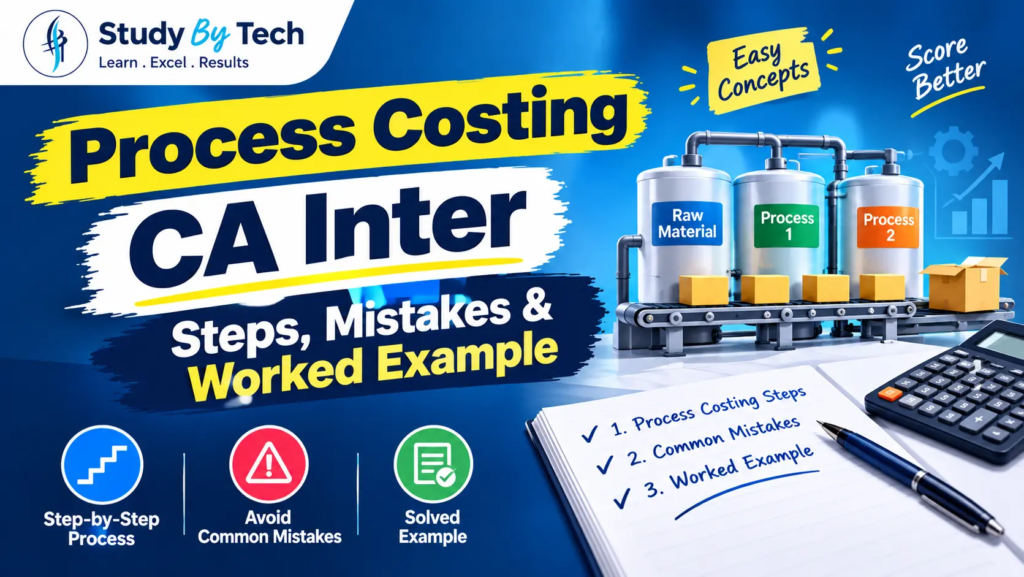
Process Costing: CA Inter Costing | May 24 Suggested Answers

Introduction to CA Inter Costing Classes by Parag Gupta Sir Parag Gupta Sir is renowned for his exceptional CA Inter Costing classes. With a focus on comprehensive understanding and practical application, his teachings ensure students excel in their exams. One of the critical components of the CA Inter May 24 Costing paper is Process Costing, specifically Question 4A. This blog delves into the suggested answer for this question, providing insights that align with Parag Gupta Sir’s teaching methodology. Understanding Q-4a Process Costing in CA Inter May 24 Costing Process Costing is a method used in industries where production is continuous, and the products pass through multiple stages or processes. It accumulates costs for each process and assigns them to units produced. This method is crucial for industries like chemicals, textiles, and oil refining. Key Components of Process Costing Step-by-Step Solution Example Problem Breakdown Given Data: Calculation: By applying these calculations, students can accurately allocate costs and understand the intricacies of Process Costing. Click here to see the all suggested answer for CA Inter Sept 25 Benefits of Parag Gupta Sir’s Classes Comprehensive Coverage Parag Gupta Sir’s classes provide in-depth coverage of all CA Inter Costing topics, including Process Costing. His structured approach ensures students grasp each concept thoroughly. Practical Examples His teaching includes numerous practical examples, mirroring the type of questions found in the CA Inter exams. This prepares students to tackle similar problems with confidence. Detailed Solutions Every problem is broken down step-by-step, as seen in the suggested answer for Q 4A. This methodical approach helps students follow along easily and understand the logic behind each step. Interactive Learning Classes are interactive, encouraging students to ask questions and engage with the material. This active participation enhances understanding and retention of complex concepts. Conclusion Mastering Process Costing is essential for success in the CA Inter Costing exam. Parag Gupta Sir’s classes offer the ideal preparation, providing detailed explanations, practical examples, and interactive learning opportunities. By following his guidance, students can confidently approach their exams and excel in their CA journey. FAQs

CA Inter costing process costing by parag gupta
CA Inter, Costing

CA Inter : Basic of Process Costing by CA Parag Gupta

CA Inter Classes ICAI Registration Process, Fees, & Syllabus Admit Card Exam Dates Study Guides & Tips CA Inter faculties FAQ This method provides a structured approach to allocate costs to products in a manufacturing environment where goods are produced in a continuous process. In this blog, we delve into the basics of process costing, as elucidated by CA Parag Gupta. Definition: Process costing is a method used to determine the cost of producing a product by assigning costs to each stage of the production process. Key Elements: Detailed explanation: Process costing is a managerial accounting method used to determine the cost of producing a product in a continuous production environment. It involves accumulating costs in various production departments or processes, including direct materials, direct labor, and manufacturing overhead. These costs are then allocated to units produced during a specific period based on the number of units completed or their stage of completion. Equivalent units are calculated to account for partially completed units, allowing for accurate cost allocation. The cost per equivalent unit is determined by dividing the total cost incurred in a department by the equivalent units. Finally, costs from different departments are reconciled to ensure accuracy. Process costing offers simplicity and efficiency in cost allocation, making it suitable for industries with standardized production processes like food and beverage, chemicals, and textiles. It enables businesses to estimate costs accurately, control costs, and evaluate departmental performance for informed decision-making. https://youtu.be/06Fc3tK2rPc When to use it ? Process costing is used for several reasons, making it a valuable tool in managerial accounting for industries with continuous production processes: Conclusion Process costing, as elucidated by experts like CA Parag Gupta, is a vital tool for businesses engaged in manufacturing processes. By systematically allocating costs to each stage of production, process costing provides valuable insights into the cost of production, facilitates cost control, and aids in performance evaluation. With its widespread applications across industries, understanding the basics of process costing is essential for effective managerial decision-making and financial management in manufacturing businesses. FAQ’S

CA Inter Costing New Syllabus
CA Inter, Blogs, Costing

CA Inter Costing Syllabus

The Chartered Accountancy (CA) curriculum’s crucial CA Inter Costing course gives students a thorough understanding of cost accounting concepts and methods. This course aims to give students the information and abilities they need to effectively manage expenses in various corporate situations. The course material covers a wide range of topics, including budgeting, standard costing, overheads, costing systems, and material and labor costing. For aspiring chartered accountants, CA Inter Costing is a crucial topic since it equips them with careers in cost management, budgeting, and financial analysis. An overview of the CA Inter Costing Syllabus, including the topics covered and their weighting, is provided in this section. Topics covered in CA Inter Costing Syllabus The following topics are covered by the CA Inter Costing Syllabus: Module-1 Module-2 Weightage of topics in CA Inter Cost Syllabus Before moving on to the chapter with less weight, students should concentrate on the chapter with more weight.  Chapter No. Chapter Name Marks  Weightage 1.    Introduction to Cost and Management Accounting 4 2.    Material Cost 6 3.    Employee Costs and Direct Expenses 8 4.    Overheads: Absorption Costing Method 6 5.    Activity Based Costing 8 6.    Cost Sheet 12 7.    Cost Accounting System 12 8.    Unit & Batch Costing 8 9.    Job Costing and Contract Costing 8 10.     Process & Operation Costing 6 11.     Joint Products & By Products 8 12.     Service Costing 8 13.     Standard Costing 12 14.     Marginal Costing 10 15.     Budget and Budgetary Control 8 Conclusion The CA Inter Cost Syllabus, in conclusion, is an important part that gives students a solid foundation in cost accounting principles and procedures. In order to make wise financial decisions, students need to have a solid understanding of how costs are controlled in various company contexts. The syllabus is a crucial part of the Chartered Accountancy Curriculum since it covers a wide range of subjects that are pertinent to the accounting industry. Overall, anyone hoping to become a competent chartered accountant should focus on learning the ideas presented in the Inter Costing Syllabus.  FAQ’s Want to subscribe to CA Inter Costing lectures? Read our blog on CA Inter costing- How to study CA Inter Cost study strategies?Read }, “publisher”: { “@type”: “Organization”, “name”: “Parag Gupta”, “logo”: { “@type”: “ImageObject”, “url”: “https://www.paraggupta.com/wp-content/uploads/cropped-Untitled-design-min.png” } }, “datePublished”: “” }

COST-AND-MANAGEMENT-ACCOUNTING
CA Inter, Costing

Mastering CA Intermediate Costing: Unlocking Success in Your Chartered Accountancy Journey

Introduction We’re happy that you’re here to learn how to take CA Intermediate Costing! As the leading authority on Chartered Accountancy (CA), we notice the value of offering outstanding information that not only informs but also inspires ambitious professionals like you. We will go into the complexities of CA Intermediate Costing in this blog, giving you the information and abilities needed to flourish in this field and advance yourself towards success. Cost and Management Accounting is a crucial subject in the CA Inter exams. It requires a thorough understanding of cost concepts, budgeting, cost control, and decision making. To excel in this subject, students need to adopt effective study strategies and apply their knowledge to practical scenarios. In this blog, we will provide you with valuable tips to help you master Cost and Management Accounting for CA Inter exams. CA INTERMEDIATE COST & MANAGEMENT ACCOUNTING PRODUCT: ENROLL NOW Understanding CA Intermediate Costing What is CA Intermediate Costing? CA Intermediate Costing, also known as the “Cost and Management Accounting” paper, is a vital component of the CA Intermediate curriculum. It focuses on developing your understanding of various cost and management accounting concepts, techniques, and tools. This subject plays a crucial role in preparing you to make informed financial decisions, analyze costs, and contribute to the strategic planning and control processes within organizations. Importance of CA Intermediate Costing: Mastering CA Intermediate Costing is essential for several reasons: 1. Comprehensive Knowledge: A strong foundation in cost and management accounting concepts is essential for aspiring CAs to navigate complex financial scenarios confidently. 2.Professional Competence: Competence in cost and management accounting enables CAs to provide valuable insights, aid decision-making, and contribute to the overall financial health of organizations. 3. Examination Significance: Scoring well in the CA Intermediate Costing paper is crucial for achieving a high overall score in the CA Intermediate examination. CA Intermediate Cost and Management Accounting Syllabus The CA Intermediate Costing Syllabus is made available by ICAI each year. The topics and chapters that will be covered in the examination are all current knowledge that is contained in the syllabus. Students will stay informed about any new ICAI modifications thanks to the CA Inter Costing syllabus. When creating your study plan, syllabuses are helpful. CA Intermediate Cost and Management Accounting- Study Material The CA Inter Costing syllabus guarantees that students are kept informed of any fresh ICAI modifications. Making a study plan involves using course resources. Once they have finished registering and creating a costing study plan in accordance with it, students should completely read over your CA Intermediate Costing study material. Download CA Intermediate Cost and Management Accounting PDF Now. Module-1 Module-2 CA Intermediate Costing Exam Pattern and Marking Scheme. The theory-based CA Intermediate Cost and Management Accounting paper. The CA Intermediate Costing Marking system is described below. How to study for CA Inter Cost & Management Accounting: Studying for the CA Inter Cost Management and Accounting paper requires a systematic and focused approach. Here are some tips to help you prepare effectively: 1. Understand the Syllabus: Start by familiarizing yourself with the syllabus and the topics covered in the Cost & Management Accounting paper. This will give you a clear roadmap of what you need to study and allocate your time accordingly. 2. Create a Study Plan: Develop a study plan that covers all the topics in the syllabus. Break down the subjects into manageable study sessions and allocate sufficient time to each topic. Be realistic in setting your study goals and make sure to include regular revision sessions. 3. Study Material: Best study material for CA Inter costing is ICAI study material & Parag Gupta sir’s 7th edition book set. This is the most updated material & includes all variety of questions which every student should do in case to get exemption in costing. 4. Understand Concepts: Cost Management and Accounting involve numerous concepts, formulas, and techniques. Take the time to understand the underlying principles of each topic. Start with the basics and gradually build upon your knowledge. If you come across any concepts that are challenging, seek clarification from your professors or refer to additional study resources. 5. Practice Numerical Problems: Cost Management and Accounting are practical subjects that require a strong application of concepts. Practice solving numerical problems from past exam papers and practice manuals. Focus on developing speed and accuracy in calculations. 6. Case Studies: Familiarize yourself with case studies that demonstrate real-life scenarios. Understand the problem, identify the relevant information, and apply the appropriate concepts and techniques to analyze and solve the case. This will help you develop a practical understanding of how to apply cost management principles in different situations. 7. Make Notes: While studying, create concise and organized notes. Summarize the key points, formulas, and examples for each topic. These notes will serve as a handy revision tool in the final days before the exam. 8. Revision: Regularly revise the topics you have covered to reinforce your understanding. Review your notes, solve additional practice questions, and participate in mock exams to assess your knowledge and identify areas that require further attention. Parag sir has also shared 50+ questions to score 60+ marks in examination, which is helping to revise the whole syllabus important concepts in 1 day. 9. Time Management: Manage your time effectively throughout your study period. Set deadlines for completing each topic and stick to them. Avoid procrastination and maintain a consistent study schedule. 10. Mock Exams: Take mock exams under exam-like conditions to simulate the actual exam experience. This will help you improve your time management, identify weak areas, and get accustomed to the exam format. 11. Stay Positive and Take Breaks: Maintaining a positive mindset is crucial during the preparation phase. Take short breaks to relax and rejuvenate. Engage in activities that help you destress and maintain a healthy balance between study and leisure. Remember, consistent effort and dedication are key to success in the CA Inter Cost Management and Accounting paper. Stay focused, practice regularly, and believe in

CA Inter, Costing

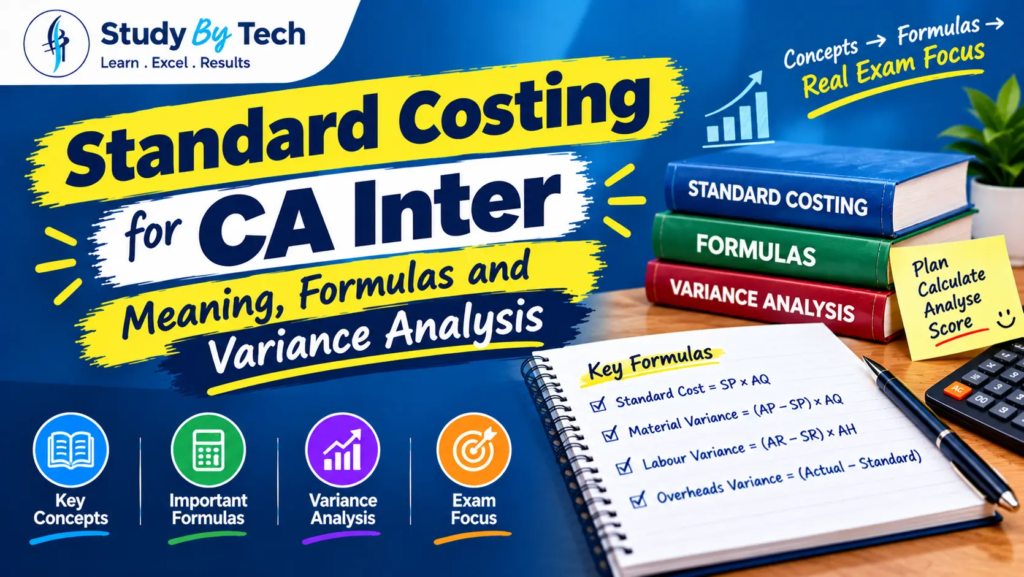
CA Inter Costing | STANDARD COSTING | Parag Gupta sir

What is Standard costing? Standard costing is a cost accounting technique where we calculate a planned or ‘standard’ cost of materials, labour and overhead, and then compare that to the actual costs to evaluate performance using variances.Standard costing is a recognised method of performance evaluation, as well as a recognised control and planning technique, and is used for decision-making because it provides benchmarks by which to assess activity efficiency, as well as allow for deviations from standards for cost purposes at the intermediate level recommended by ICAI. ImportanceVariance analysis provides important information to managers by identifying where and why actual costs diverge from standards and allows for implementation of targeted corrective actions to improve processes, profitability, and ultimately pricing by focusing on areas of research, development, or production cost development that are inefficient.Standard costing also facilitates budgeting and performance evaluation, making it useful as a control mechanism in manufacturing companies and service industries. Key terminologyStandard cost – planned unit cost of a product, component or service for a time period stipulated under defined conditions.Variance – money-value difference (i.e., excess or shortfall) between actual and standard; favourable variance: favourable if it decreases cost or increases profit; adverse variance: adverse if it increases costs or decreases profitStandard quantity (SQ), Standard price/rate (SP/SR), Actual quantity/hours (AQ/AH), Actual price/rate (AP/AR) – the core drivers of material, labour, and overhead variances. Thus, the commonplace price could be a pre-determined price, the calculation of that is finished when taking into thought, on the idea management’s standards of economical operation, the relevant necessary expenditure. the quality cost accounting technique was evolved for the aim of eliminating the shortcomings of historical cost accounting. Techniques of Standard Costing The techniques of ordinary Standard Costing square measure the following: Types of Standards Standards may be established as basic, ideal, attainable, or current depending on whether the intent is to establish benchmarks for time frames far into the future, optimum conditions, achievable levels of efficiency, or the manner in which we currently undertake activities.A key component in the derivation of standards is generally the use of technical specifications, engineering calculations, and past experiences to predict resources and rates of use that are aligned with policy and capacity assumptions. Core formulas Variance analysis overview In standard costing, total cost variance can be broken down into material, labour and overhead variances, which can be analyzed into price/rate and quantity/efficiency effects in order to precisely identify the cause of the variance.This structure enables a specific investigation and disposition of variances, thus providing clear accountability to departments concerning control measures.

Scroll to Top