
By CA Parag Gupta • Parag Gupta Classes
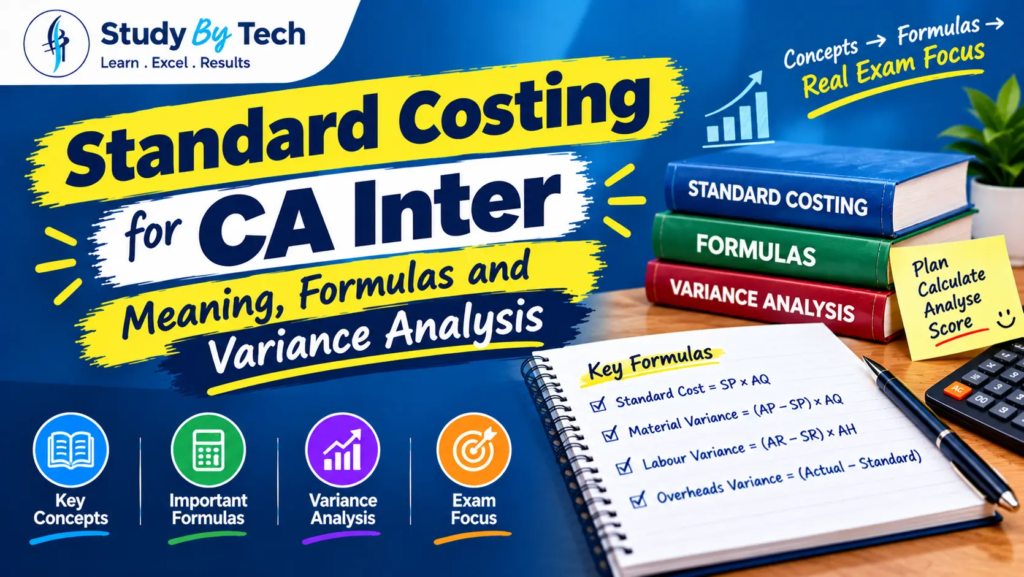
Standard Costing for CA Inter: Meaning, Formulas and Variance Analysis
Standard costing is a cost accounting method where you set a planned cost for materials, labour and overheads, then compare it with what you actually spent. The gap is called a variance, and it tells you what went wrong and why. This guide is for CA Inter students preparing Cost and Management Accounting. You’ll get the meaning, types of standards, every key variance formula and a clear way to analyse them.
Key takeaways
Standard costing means setting a planned cost, then comparing it with the actual cost.
The difference between the two is a variance: favourable (F) or adverse (A).
There are four kinds of standards: basic, ideal, attainable and current.
Every cost splits into price/rate and usage/efficiency variances.
Learn the formulas once, then practise numericals until they feel automatic.
What is standard costing?
Think of it as a budget for every unit you make. You decide what materials, labour and overheads should cost. Then you check what they actually cost. The difference is your variance, and it points straight to the problem.
It’s part of the ICAI syllabus for CA Inter Paper 4, and ICAI’s study material covers it too. This page gives you the plain-English version first.
Standard cost vs actual cost
A standard cost is the planned cost per unit under efficient, normal conditions. The actual cost is the real bill. Standard costing exists to compare the two and tell managers where to act.
Key terms in plain English
SQ / SP
Standard quantity and standard price. What you planned to use and pay.
AQ / AP
Actual quantity and actual price. What really happened.
SH / AH, SR / AR
Standard and actual hours, and the standard and actual labour rate.
Favourable (F) or Adverse (A)
F means cost came in lower than planned. A means it came in higher.
How standard costing works, step by step
It’s a loop, not a one-time exercise. Here’s the cycle you’ll use in every numerical.
What happens in each step
- Pre-determine the data. Fix the material and labour needed, the unavoidable losses and the expected efficiency.
- Set standards for materials, labour and overheads.
- Find the variances by comparing actual costs with standards.
- Analyse the causes. Was it price, usage, rate, efficiency or volume?
- Report to management so they can fix the issue or revise the standard.
Types of standards you need to know
Not every standard is set the same way. Your choice depends on what you want the number to do.
| Type | What it means | Best used for |
|---|---|---|
| Basic | Fixed for a long period and rarely revised | Tracking trends over the years |
| Ideal | Perfect conditions: no waste, no breakdowns | Setting stretch targets (rarely achieved) |
| Attainable | Reachable with efficient, normal effort | Day-to-day cost control |
| Current | Reflects today’s conditions and prices | Short-term control and pricing |
Standard costing formulas for CA Inter
Here are the formulas you’ll use most. In these formulas, a positive answer is favourable (F) and a negative answer is adverse (A). SQ and SH mean standard quantity and hours for the actual output.
Material variances
| Variance | Formula |
|---|---|
| Material Cost Variance (MCV) | (SQ × SP) − (AQ × AP) |
| Material Price Variance (MPV) | (SP − AP) × AQ |
| Material Usage Variance (MUV) | (SQ − AQ) × SP |
Labour variances
| Variance | Formula |
|---|---|
| Labour Cost Variance (LCV) | (SH × SR) − (AH × AR) |
| Labour Rate Variance (LRV) | (SR − AR) × AH |
| Labour Efficiency Variance (LEV) | (SH − AH) × SR |
Overhead variances
| Variance | Formula |
|---|---|
| Variable OH Cost Variance | Standard VOH for actual output − Actual VOH |
| Variable OH Expenditure Variance | (SR − AR) × AH |
| Variable OH Efficiency Variance | (SH − AH) × SR |
| Fixed OH Cost Variance | Standard FOH for actual output − Actual FOH |
| Fixed OH Expenditure Variance | Budgeted FOH − Actual FOH |
| Fixed OH Volume Variance | (Actual output − Budgeted output) × Standard rate per unit |
Exam tip: Price and rate variances use actual quantity or hours. Usage and efficiency variances use standard price or rate. Remember that and half the confusion goes away.
How variances fit together
Every total cost variance breaks down the same way. Price or rate on one side, usage or efficiency on the other.
Why standard costing matters
Gives you benchmarks
You can judge performance against a clear target, not a guess.
Shows where to look
Variances point to the exact cost that went off track, so managers focus there.
Supports budgeting
Standards feed directly into budgets and make planning easier.
Improves pricing
Knowing true efficient costs helps you price products with confidence.
Free resources and next steps
Learn the concept here, then practise. Solve the latest RTPs and MTPs, work through the 59 key questions and watch the lecture if you like learning by video.
Standard costing video59 key questionsLast-day revision notesRTPs and MTPsICAI syllabusICAI study material
New here? Start with the CA Inter guide. Want full coverage? See the complete CA Inter course or the Cost and Management Accounting classes and books.
Standard costing FAQs
What is standard costing?
Standard costing is a cost accounting method where you set a planned cost for materials, labour and overheads, then compare it with actual costs. The differences are called variances. Managers use them to spot waste, fix problems and judge performance. In CA Inter, it’s a core topic in Cost and Management Accounting.
How does standard costing work?
First, you set standards for each cost. Then you record actual costs, compare them with the standards and calculate variances. Next, you work out why they happened, like higher prices or poor efficiency. Finally, management acts or revises the standards. It’s a repeating control cycle.
What are favourable and adverse variances?
A favourable variance means actual cost is lower than standard, or profit is higher than planned. An adverse variance means actual cost is higher than standard, or profit is lower. Neither is automatically good or bad, so always check why it happened before you act on it.
Is standard costing worth studying for CA Inter?
Yes. Variance analysis is a practice-heavy chapter in CA Inter Costing, and it sets you up for budgetary control and later CA Final topics. Once the formulas click and you’ve solved enough numericals, the chapter becomes much more manageable. Practice matters more than memorising.
Who is standard costing best for?
It’s best for CA Inter students, but it also suits managers in manufacturing or service firms who want tighter cost control. If you know basic costing and want to learn how to measure performance against a target, this topic is a great fit for you.
What’s the difference between standard cost and actual cost?
Standard cost is the planned cost per unit under normal, efficient conditions. Actual cost is what you really spent. The gap between them is the variance. Comparing the two is the whole point of standard costing, because it shows exactly where your process is leaking money.