CA Inter Costing With Parag Gupta Sir
CA Inter, Blogs, Costing

CA Inter Costing Exam 2026: Ultimate Guide to Syllabus, Weightage & Exemption Strategy | Parag Gupta CA Inter Costing Exam: A Real-World Guide to Syllabus, Weightage & That Coveted Exemption Master Paper 4: Cost and Management Accounting with expert insights, chapter-wise marks distribution, and a proven step-by-step strategy to score 70+ By Parag Gupta, CA | Updated June 2026 Table of Contents 1. What Does the CA Inter Costing Paper Actually Look Like? 2. Where Do the 100 Marks Actually Come From? 3. The 4-Step Strategy to Aim for an Exemption 4. Small Mistakes That Can Cost You Big 5. A Final Thought & Next Steps 1. What Does the CA Inter Costing Paper Actually Look Like? Before we talk about studying, let’s talk about what you’ll face on exam day. Knowing the structure in advance removes the shock factor. The CA Inter Costing exam (Paper 4) is a mix of descriptive numerical problems and case-based MCQs, totaling 100 marks over 3 hours, plus 15 minutes of reading time. Exam Parameter Details & What It Means for You Total Marks 100 Marks Duration 3 Hours (+15 minutes reading time) Format Descriptive numerical problems & Case-based MCQs Negative Marking None Language English / Hindi (as per your registration) The paper contains six questions. Question 1 is compulsory and usually consists of four sub-parts of 5 marks each. From the remaining five questions, you must answer any four. That choice is powerful. Use those 15 minutes of reading time wisely to decide which question to skip and to plan your sequence. It sets the tone for your entire three hours. 2. Where Do the 100 Marks Actually Come From? Not all chapters are equal. Some consistently command 10–12 marks, while others hover around 4–6. Treating them all with the same intensity leads to burnout. Here’s the realistic, trend-based CA Inter Costing weightage you need to guide your study. Module 1: Elements of Cost & Cost Ascertainment Chapter Approx. Weightage Key Focus Areas Introduction to Cost & Management Accounting ~4 Marks Pure theory; definitions, objectives, classifications Material Cost ~4–6 Marks EOQ, stock levels, inventory valuation Employee Cost (Labour) ~4–8 Marks Halsey, Rowan, labour turnover ratios Overheads ~4–6 Marks Primary/secondary distribution, machine hour rate Activity-Based Costing (ABC) ~8 Marks Cost drivers, cost pools; often a standalone question Cost Sheet ~10–12 Marks Format-driven, highly scoring, foundational Cost Accounting Systems ~4–6 Marks Integral & non-integral accounts Module 2: Costing Methods & Decision-Making Tools Chapter Approx. Weightage Key Focus Areas Job, Batch & Contract Costing ~6–8 Marks EBQ, profit on incomplete contracts Process & Operation Costing ~4–6 Marks Equivalent production, normal/abnormal loss Joint Products & By-Products ~4–8 Marks NRV method, physical unit method Service Costing (Operating Costing) ~6–8 Marks Transport, hospital, hotel; data organization Standard Costing ~10–12 Marks Material, labour, overhead variances Marginal Costing ~8–10 Marks P/V ratio, BEP, MOS, make-or-buy decisions Budgetary Control ~6–8 Marks Flexible budgets, cash budgets Pro Tip: Standard Costing, Cost Sheet, Marginal Costing, and Process Costing together contribute well over 40 marks. Make these chapters your fortress. 3. The 4-Step Strategy to Aim for an Exemption Most students prepare by passively watching lectures and solving a few module sums. That’s why the pass percentage remains stubbornly low. Here’s a battle-tested approach to score 70+ in the CA Inter Costing exam. Step 1: Build Concepts, Don’t Just Collect Formulas When you memorize a variance formula without understanding why the components sit that way, you’re building on sand. For every formula, ask yourself: what exactly is this comparing? Once the logic clicks, even tricky ICAI adjustments won’t shake you. This upfront investment pays off exponentially later. Step 2: Make the ICAI Module Your Best Friend Over 70% of practical exam questions are structural adaptations of illustrations and back-exercise problems from the official ICAI Study Material. Solve every illustration—not once, but until the process feels natural. Maintain a separate practice notebook. Physical writing reinforces memory in a way that scanning a screen never will. Step 3: Filter & Log Critical Questions (The L1-L2-L3 Method) While solving problems, categorize each one: L1 (Easy): You can solve quickly and accurately. These go into maintenance mode. L2 (Tricky Adjustments): Solvable but with a specific twist you need to watch for. L3 (Must-Revise): Gave you trouble. Conceptual error or time trap. These become your revision priority list. When the final week arrives, you’ll laser-focus on L2 and L3 problems instead of drowning in familiar material. Step 4: Simulated 3-Hour Mock Examinations Costing papers are notoriously long. The most common post-exam regret is “I knew everything but could only attempt 75 marks.” The antidote: take at least two RTPs, two MTPs, and the past three years’ question papers under a strict 3‑hour timer. No pausing, no peeking. The discomfort builds speed and mental stamina. 4. Small Mistakes That Can Cost You Big (And How to Avoid Them) I’ve seen bright students lose marks they didn’t need to lose. Here are the four points that break my heart every time. Skipping working notes: ICAI awards step marks generously. Even if your final answer is right, missing cross-referenced workings can lose you up to 30-40% of a question’s marks. Show your logic clearly. Mismanaging the 15-minute reading time: Don’t read the paper line by line. Use this window to identify the optional question you’ll drop and to sequence your first three answers. Start with a confidence-building question. Writing theory answers like essays: About 20-30% of the paper is theoretical. Use bullet points, be concise, and include ICAI technical keywords. The examiner wants precision, not paragraphs. Leaving questions unattempted: A blank page guarantees zero. Even writing the relevant formula and a partial attempt can fetch 2-3 crucial marks that make the difference between 58 and 63. 5. A Final Thought I’m not going to tell you the CA Inter Costing exam is easy. It isn’t. But here’s what I know after years of sitting across the table from students just like you: it’s coachable. The concepts don’t change. The patterns repeat. And

CA Inter Costing Best Faculty: 5 Qualities That Make Parag Gupta Sir Stand Out
CA Inter, Costing

CA Parag Gupta | Best CA Inter Costing Faculty CA Inter Costing best faculty | CA Parag Gupta So you’re trying to pick a CA Inter Costing faculty? Let me help you. Honestly, I know how confusing it gets. You want someone who helps you understand Costing — not just finish the syllabus. At ParagGupta.com, most rank holders & top scorers have studied with us. Here’s why. Explore Costing Batches What makes us different? Test series included Full test series — no extra fee, no hidden charges. Designed exactly like ICAI pattern to build speed & exam confidence. Real 1-on-1 doubt sessions Parag sir personally takes your doubts. Weekly sessions for online students. No Telegram bots, no assistants — just clarity. “59 Questions” – revision lifeline Last-day panic? Our 59 selected questions help you score 60+ marks even when you feel underprepared. Student favourite. Click here to get the list. Book + 20 hours video access Buy our Costing book & get 20 hours of full course videos FREE. Textbook & videos together, learn your way. Click here to get the book. Ex-ICAI examiner edge Parag sir used to check CA papers. He teaches you how to write answers examiners love. Plus difficulty-based in-class tests that actually show where you stand. Student said: “The 59 questions are a lifesaver for last-minute revision.” — CA Inter topper (May 2024) What our students share(real words, not edited) “Proper concepts understanding, regular tests and then mock tests. Itni mehnat koi teacher nai kerta apne students k saath. And best thing is online students k liye 1 to 1 weekly sessions bhi hain.” — Surya (Zeroinfy Review) “If you want to experience regular tests and regular doubt sessions that too for online students, go for Parag sir costing classes.” — Firoz (Zeroinfy) “I took Parag Gupta Sir’s classes and never regretted it. His 130-hour course is well-paced, and the 59 important questions really help in last-minute revision.” — Quora user One last thing from our team If you’re preparing for CA Inter Group 2 and you’re tired of teachers who just “cover the syllabus” – try us once. We don’t promise magic. But we do promise clarity, personal attention, and a teacher who actually cares whether you understand or not. Costing can feel scary. But with the right mentor? It becomes manageable. Even enjoyable. That’s what we believe. Join a Free Demo FAQs – answered simply How many attempts do I get for CA? No limit. Exams happen three times a year – Jan, May, Sep. At StudyByTech (our learning platform), we support you across attempts and help you improve based on your past performance. Can I clear CA Inter with self-study? Possible, but tougher. Subjects like Costing often need someone to clear your doubts and give structure. Parag sir has 20+ years of experience, and students under him tend to do better. That said, if you still prefer self-study, we do sell study material and test series separately. What’s a realistic 3-month strategy? Here’s what we follow: Month 1 – concepts (focus on high-weightage topics). Month 2 – practice and mocks. Month 3 – revision and exam simulation. But honestly, we recommend 4-5 months for deeper understanding. Can I clear Group 2 in 2 months? Technically yes, but I won’t lie – it’s rushed. We have crash courses for urgent situations. But for proper learning and good marks, give yourself at least 4-5 months. Ready to finally feel confident about Costing? Come say hi at paraggupta.com – we’d love to have you. Explore Courses → © CA Parag Gupta – ParagGupta.com | Best CA Inter Costing Faculty | Rankholders’ Choice Built for students, by educators who care. CA Intermediate requires conceptual clarity and application. Parag Gupta’s classes at StudyByTech follow ICAI study material with targeted revision.

Latest Updates for CA Inter Exams
CA Inter, Blogs, ICAI

Latest Updates for CA Inter Exams

CA Inter Exam Dates January 2027: Date Sheet, Registration & Result The CA Inter exam for the January 2027 session runs from January 2 to 12, 2027, with Group 1 papers on alternate days from January 2 and Group 2 papers from January 8. This page is for CA Intermediate students planning their attempt. It covers the full date sheet, the exam form and late-fee window, the correction window, how to register through ICAI’s SSP portal, and when the results are expected in the first week of March 2027. Updated October 2026Latest updates for CA Inter exam dates3 minute read CA Inter ClassesRegistration, Fees & SyllabusCall +91 9968875529 Table of Contents CA Intermediate Exam Dates: Jan 2027 CA Intermediate Registration & Exam Form CA Intermediate January 2027 Date Sheet CA Inter Result 2027 (January) FAQs on CA Inter About Parag Gupta Sir Key Takeaways Exam window CA Inter exams run from January 2 to 12, 2027. Date sheet Group 1: Jan 2, 4 and 6. Group 2: Jan 8, 10 and 12. Exam form ICAI releases the January 2027 form on November 3, 2026. Late fee: ₹600 until November 16, 2026. Correction window You can change your form, including test city or medium, until November 18, 2026. Centres Exams are held in multiple states across India and 8 locations abroad. Result Expected in the first week of March 2027 on ICAI’s exam website. ICAI Registration Process, Fees & Syllabus Admit Card Exam Dates Study Guides & Tips CA Inter Faculties FAQ CA Intermediate Exam Dates: Jan 2027 For the January 2027 session, ICAI revealed the complete CA Intermediate schedule on August 20, 2026. The admit card for the exam will be available online closer to the exams. ICAI hasn’t announced the hall ticket release date yet. ICAI handles registration session by session, in online mode. For fresh registration, you need to register at the Self Service Portal (SSP) of the ICAI and create a login ID. If you already have a login, use it to fill the ICAI CA application form. The CA Inter exam for the January 2027 session will be held from January 2 to 12, 2027. The CA Inter exam is the second phase of the Chartered Accountancy programme. Knowing the exam date helps you plan your preparation. Any changes to the ICAI schedule for 2027 will be published here. Key Dates at a Glance Nov 3, 2026 Exam form released ➜ Nov 16, 2026 Last date with ₹600 late fee ➜ Nov 18, 2026 Correction window closes ➜ Jan 2–12, 2027 CA Inter exams ➜ March 2027 Result (first week, expected) Always confirm the final dates on icai.org before you plan your attempt. CA Intermediate Registration & Exam Form CA Intermediate Registration 2027 CA Inter exam registration for January 2027 ended on May 1, 2026. Exam Form for the January 2027 Session ICAI will release the CA Intermediate January 2027 exam form on November 3, 2026. If you miss the regular deadline, you can still submit the form with a late fee of ₹600 until November 16, 2026. Correction Window: January 2027 The correction window for your CA Intermediate exam application form starts on November 3, 2026. You can make changes to your submitted form until November 18, 2026. This includes updating your test city or test medium if needed. CA Intermediate January 2027 Date Sheet The CA Intermediate exam for the January 2027 phase will be held from January 2 to 12, 2027. It will be held in multiple states across India and 8 locations abroad. Group Paper Subject Exam date Group 1 Paper 1 Advanced Accounting January 2, 2027 Group 1 Paper 2 Corporate and Other Laws January 4, 2027 Group 1 Paper 3 Taxation January 6, 2027 Group 2 Paper 1 Cost and Management Accounting January 8, 2027 Group 2 Paper 2 Auditing and Ethics January 10, 2027 Group 2 Paper 3 Financial Management & Strategic Management January 12, 2027 CA Inter Result 2027 (January) ICAI is expected to announce the CA Intermediate (January session) results in the first week of March 2027. The official exam webpage, ICAIExam.ICAI.org, will host the results. Log in to your account to view your result. Along with the results, ICAI will also publish the CA Intermediate pass rate and a list of the top performers. FAQs on CA Inter Which is the toughest chapter in CA Inter? CA Inter’s Auditing is widely regarded as the toughest subject due to its complexity. How many hours do you need to study for CA Inter? This will vary depending on when you start your CA Intermediate preparation, but anywhere from 8 to 12 hours (or more) per day on average is required to crack the CA Inter exams. Can I pass CA Inter with self study? You can manage to clear CA Inter exams through self-study. To do that, you will need a solid routine and strict discipline to stick to it. While ICAI material, previous years’ papers, and RTP are good enough, most students benefit from specialized CA Inter coaching classes, especially the mock tests. How long is CA Intermediate valid? Intermediate Course registration is valid for 5 years and can be revalidated for a further 5 years by paying a revalidation fee of Rs. 400. Revalidation is permitted only once for the Intermediate Course. When is the CA Inter exam in January 2027? The CA Inter exam for the January 2027 session is scheduled from January 2 to 12, 2027. Group 1 papers fall on January 2, 4 and 6, while Group 2 papers fall on January 8, 10 and 12. The exam is held across India and at 8 locations abroad, so check your allotted centre. What is CA Inter? CA Inter is the second level of the Chartered Accountancy course run by ICAI, coming after CA Foundation and before CA Final. It has two groups with three papers each. You register through the ICAI SSP portal and fill an exam form for each session you

ICAI CA may 2025 result countdown begins
ICAI news & updates

ICAI CA May 2025 Result Countdown Begins: Check the Latest Updates!

CA Foundation Classes CA Inter Classes CA Final Classes StudyByTech Offers Contact us For thousands of candidates aspiring to become Chartered Accountants (CAs), the wait is almost over! In only ten days, the Institute of Chartered Accountants of India (ICAI) will release the CA May 2025 results. Now is the moment to be vigilant and prepared if you were a student who took the CA Foundation, Intermediate, or Final exams. The CA community is getting more and more excited as the countdown officially starts. ICAI CA May 2025 Date and Anticipated Results Based on past performance and current events, ICAI is anticipated to release the CA May 2025 findings between July 6 and July 10, 2025. However, the ICAI website will shortly confirm the official outcome date. Several ICAI official are posting on Twitter the tentative dates for ICAI result as 6th July(image shared). Where Can I View the Results of the ICAI CA May 2025? The following ICAI https://www.paraggupta.com/icai-ca-may-2025-result-countdown-begins-stay-updated/official websites allow candidates to view their results online: (https://icaiexam.icai.org)(https://icai.nic.in/caresult/) To access the result, you’ll need: Make sure you have these details ready in advance! Email and SMS Alerts Additionally, ICAI offers the option to receive your results by email or SMS. To receive your results instantly on your phone, you can send an SMS in the required format or register on the ICAI result portal for email alerts. The Pass Percentage and Merit List In addition to the outcome, ICAI will publish: Revaluation or Verification If you’re not satisfied with your result, ICAI offers the option for: These options are available shortly after the result is announced. What Happens After the Outcome? Depending on whether you took the Foundation, Inter, or Final CA levels, you can perform the following:Students in the CA Foundation program should begin preparing for the CA Intermediate course. Students in the CA Inter program should enroll for an articleship and develop a plan for their CA Final approach. CA Final Students: If you passed, congratulations! Start your career by registering to become an ICAI member. Keep yourself updated! For thorough updates, news coverage, and expert guidance, stay ahead of the curve by visiting reputable education portals like StudyByTech Concluding remarks Ten days remain, and the stress is intense. But keep in mind that it’s only one step on your path, regardless of the outcome. Remain optimistic and get ready for the next phase. I wish all aspiring CAs the best of luck! Let the countdown begin! ⏳ Disclaimer: The result date is tentative and subject to change. Always check the official ICAI website for the final announcement. FAQ’s

Is Direct Entry in CA After Graduation Right for You_
CA Inter, Direct entry

CA Direct Entry | The Complete Guide to Become a CA After Graduation | Parag Gupta Classes

Direct Entry in CA: The Complete Guide to Becoming a CA After Graduation 🎯 Your fast-track roadmap — No fluff, no sugar-coating. Just the real deal.Let’s know everything about Direct entry in CA. Let’s Be Real About Your CA Dreams You just graduated. You’re staring at your degree, wondering what’s next. And somewhere in the back of your mind, that CA thought keeps popping up—but you’re scared. “Am I too old?”“Is it even worth it?”“Won’t I struggle without the Foundation background?” I’ve heard these questions from hundreds of students. And honestly? They’re valid concerns. But here’s what most people won’t tell you—the Direct Entry scheme exists precisely because ICAI knows graduates have unique advantages. Let me walk you through everything you actually need to know. No fluff. No sugar-coating. Just the real deal. 1. What Exactly Is This Direct Entry Thing? Here’s the simple version: Instead of taking the CA Foundation exam (which fresh 12th-pass students have to clear), you can jump straight to the CA Intermediate level if you’re a graduate. FAST-PASS ICAI trusts that your graduation has given you enough foundation knowledge to skip the entry-level test. And honestly? For most commerce grads, that’s absolutely true. The catch? The Intermediate syllabus is no joke. It’s advanced. It’s rigorous. And it expects you to apply concepts, not just memorize them. I’ve seen brilliant graduates struggle here because they underestimated the leap. But more on that later. 2. Are You Actually Eligible? (Check This Carefully) ✅ Are You Actually Eligible? Check this carefully. This is where students mess up — they assume they qualify, only to face rejection during registration. 🎓 Commerce Graduates B.Com, BBA, M.Com, MBA‑Finance & similar 55% min. You need a minimum 55% aggregate in your graduation to register.No rounding off — 54.9% is not 55%. 🔬 Non‑Commerce Graduates Science, Arts, Engineering & others 60% min. The bar is higher here — a minimum of 60% marks is required.Uneven rule across streams. But it is the rule. 📜 ICSI / CMA Intermediate Passouts ✅ Eligible Cleared Intermediate from the Institute of Company Secretaries or the Institute of Cost Accountants? You qualify — good for you. ⚠️ Final‑Year Students — Yes, But With a Huge Warning You can register provisionally during your final year — which means you can start the 8‑month study period before graduation itself even shows up on paper. But it comes with a hard deadline attached. Step 1: Provisional Registration Step 2: Final Exam Sat Deadline: 6 Months to Submit Marksheet The Trap: You must submit your final marksheet within 6 months of your final exam. Miss this, and your registration is cancelled — even if you eventually meet the percentage requirement. ₹18,000 gone. ICAI keeps the fee — no refund, no appeal. Know your number. Know your date. Miss neither. 3. The Registration Process 🚀 Your 6‑stop journey to CA Intermediate registration Everything you need to register for CA Intermediate (Direct Entry) on ICAI’s Self Service Portal — start to finish. 🌐 eservices.icai.org 1 Start here — Open the portal Head to eservices.icai.org — ICAI’s Self Service Portal, the only official place to register. 2 Account — Create your student account Keep your email and phone nearby — both get an OTP, and this login carries you through every step ahead. 3 Course selection — Pick “CA Intermediate (Direct Entry)” Choose it carefully from the list of course options.⚠️ Don’t select “Foundation” by mistake — it’s a different track entirely. 4 6 uploads needed — Upload your scanned documents Have clean, legible scans ready before you begin.10th marksheet · 12th marksheet · Graduation marksheets · Passport photo · Signature · ID proof 5 Payment — Pay the fees online Use credit card, debit card, or net banking. Save the confirmation — it’s handy if anything needs re‑checking later. 6 Final step — Submit — and hope the portal holds The SSP portal is known to slow down or crash during peak admission rushes.💡 Register a few days early — never on the last day. ⏳ Timing is everythingLast‑day traffic has crashed the SSP portal before. Finishing your registration early avoids the rush entirely.Best practice: submit 3–5 days before deadline 4. How Much Does This Cost? (Breakdown) Item Amount CA Intermediate Registration Fee ₹15,000 Student Activities Fee ₹2,000 Articleship Registration Fee ₹1,000 Total ₹18,000 This is just the registration. You’ll pay extra for: ICITSS training (IT + Soft Skills): ~₹13,500 total Each exam form (both groups): ~₹3,000+ per attempt 💡 PRO TIP Some students don’t budget for the training fees and get stuck later. Plan for at least ₹35,000-40,000 in your first year. 5. When Can You Actually Write the Exam? Here’s the rule: 8 months from your registration date.So if you register in January, your earliest exam attempt is September. ICAI conducts exams in January, May, and September every year. Real talk: 8 months sounds like a lot, but it isn’t. The Intermediate syllabus is massive. Most students need at least one more attempt beyond their first—and that’s okay. Don’t beat yourself up if you don’t clear both groups in one go. 6. What Direct Entry Students Get Wrong ❌ Mistake #1: Starting Articleship Too Early You can’t. Even if you try to bribe someone to register you early, ICAI’s system will reject it. Don’t waste your time or money. ❌ Mistake #2: Ignoring ICAI Study Material YouTube lectures are great. I recommend them. But ICAI’s modules, RTPs, and MTPs are GOLD. I’ve seen 60-70% of exam questions come directly from these. And yet, students ignore them. ❌ Mistake #3: Not Revising Enough You know what separates successful CA students from failed ones? Revision. Not classes. Not notes. Revision.Most students spend 90% of their time studying new content and 10% revising. Flip that ratio. Spend 50% on revision. Trust me. ❌ Mistake #4: Overconfidence From Graduation “I got 80% in B.Com. CA Inter will be easy.”No. It won’t. The application level is completely different. You’re not just writing theory—you’re solving complex problems,

Best faculty for CA Inter Costing: 5 qualities that make Parag Gupta Sir stand out
Costing, Blogs, CA Inter

Best faculty for CA Inter Costing: 5 qualities that make Parag Gupta Sir stand out

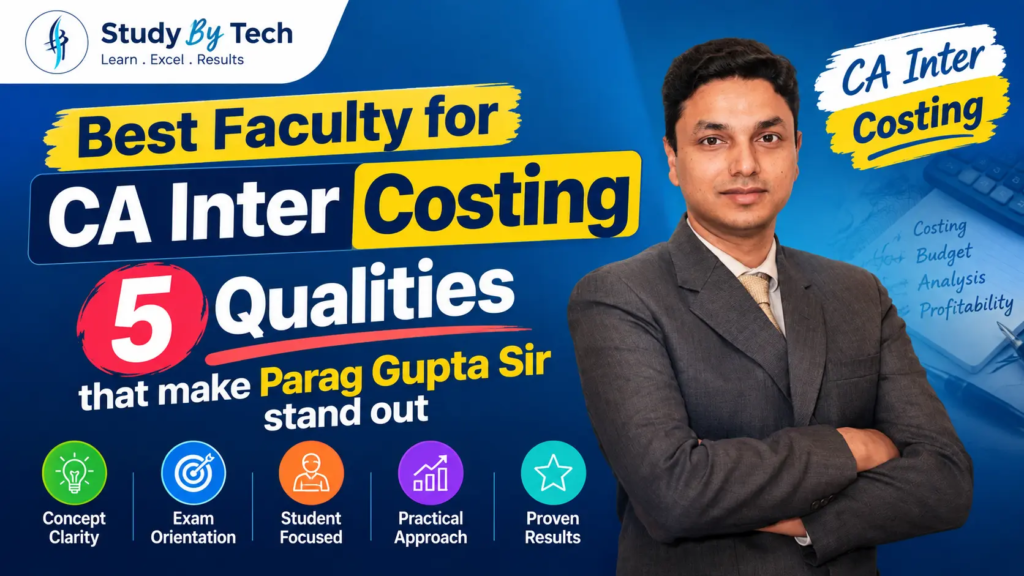
CA Inter Costing Best Faculty: Why Parag Sir is the Best? | StudyByTech 📞 +91 99688 75529  •  StudyByTech — Learn · Excel · Results STUDY BY TECH CA INTER · COST & MANAGEMENT ACCOUNTING Best Costing Faculty for CA Inter Costing: 5 Qualities That Make Parag Gupta Sir Stand Out Parag Gupta Sir is the best CA Inter Costing faculty for five reasons: ex-examiner insight, included test series, same-day 1-on-1 doubt resolution, the 59-question revision list, and 20 hours of bonus course access with his book. By StudyByTech Team · Cost & Management Accounting Choosing a faculty for CA Inter Costing can be challenging. There are so many different teachers and options available online and offline that picking one who will actually help you understand this subject — not just finish the syllabus — is tough. CA Parag Gupta Sir is considered students’ most recommended faculty for Costing at CA Inter & Final level. He does not just teach costing; his way of concept clarity, combined with his approach to taking doubts from each student, is admirable. Let’s find out what makes Parag Gupta Sir different from other faculties. Related resources CA Inter Classes Registration, Fees & Syllabus Admit Card Exam Dates Study Guides & Tips CA Inter Faculties FAQ Table of Contents 1. Insights from an ex-examiner + in-class difficulty-based tests 2. Test series included with the course enrollment 3. 1-on-1 doubt sessions that are actually accessible 4. The magical 59 questions to score 60+ marks 5. Bonus 20 hours of full course access with his book Final thoughts Key takeaways FAQs About Parag Gupta Sir Here are 5 standout qualities that truly make Parag Gupta Sir the best CA Inter Costing faculty 1 Insights from an Ex-Examiner + In-Class Difficulty-Based Tests Parag Sir’s background as an ex-examiner is a huge advantage. He teaches you how to write answers the way examiners want to see them. In his classes, he breaks down how papers are checked, common mistakes students make, and how to present your answer properly. He also conducts in-class tests that are difficulty-based — not just a formality. These tests actually help you measure your real understanding of a topic. They’re an eye-opener and guide your preparation in the right direction. 2 Test Series Included With the Course Enrollment One of the first things that impresses students is that Parag Sir provides a full-fledged test series as part of the course itself — no extra payment, no separate registration. And these aren’t just any random tests. They’re curated to ensure that every important topic gets covered. The questions are structured to reflect real exam patterns, helping you build both confidence and speed as you prepare. 3 1-on-1 Doubt Sessions That Are Actually Accessible Doubt-solving is often where many faculties fail. They either redirect you to Telegram groups or assistants, or may take a week or so to solve your doubts. But Parag Sir personally attends to students’ doubts, usually the same day they are asked. Whether it’s a small confusion or a concept you completely missed, his 1-on-1 sessions are easily accessible and super helpful. You feel like you’re actually being guided by someone who cares about your learning — and he assures you that he’s with you till you reach your exam hall. This kind of guidance and approach is really very much appreciated by his students. 4 The Magical 59 Questions to Score 60+ Marks for Last-Day Revision Every CA student feels under pressure to revise the whole course before their exams. That’s why Parag Sir’s list of 59 selected questions is a blessed handout. These questions ensure your revision covers the most exam-relevant topics and concepts. Simply using this list will help improve your confidence and your chances of scoring 60+ marks in Costing — even if you haven’t prepared perfectly. 5 Bonus 20 Hours of Full Course Access With His Book Another thoughtful feature: when you get Parag Sir’s book, you also get 20 hours of access to his full course videos. This means if you’re stuck on a topic or just want to revisit something in detail, you can simply log in and watch that portion again. It’s a perfect blend of textbook and video learning, giving you the flexibility to revise as needed. Subscribe to the 8th Edition Book → Final Thoughts If you’re preparing for CA Inter Group 2 and looking for someone who doesn’t just cover the syllabus but helps you master it — Parag Gupta Sir is the name to trust. From personalized doubt support to deep insights from an examiner’s point of view, his classes offer a complete learning experience. Costing may seem like a tough subject, but with the right mentor, it becomes manageable — even enjoyable. Parag Sir proves that the right teacher makes all the difference. Key Takeaways Parag Sir is an ex-examiner, so he teaches you to write answers the way examiners actually check them. In-class difficulty-based tests give an honest, eye-opening measure of your real preparation. A full test series is included with enrollment — no extra cost, exam-pattern questions. 1-on-1 doubt sessions are personally handled by Parag Sir, usually resolved the same day. The curated list of 59 questions is built to help you score 60+ marks even in last-day revision. His book comes with a bonus of 20 hours of full course video access for self-study learners. Overall, students get concept clarity, exam-ready practice, and mentorship that lasts till exam day. Ready to start your CA Inter Costing preparation? Learn Costing the way examiners expect it — with India’s most recommended faculty. Explore Costing Classes → FAQs Is Parag Gupta good for CA Inter Costing? Absolutely! CA Parag Gupta Sir is widely regarded as one of the best faculties for CA Inter Cost & Management Accounting. What sets him apart is his concept-first teaching approach—instead of asking students to memorize complex formulas, he breaks down the logic behind every concept so it actually sticks. CA Parag Gupta sir

Best CA Inter Classes
CA Inter

How to Master Both Groups with the Best CA Inter Classes: Full Preparation Guide 🎯 Your complete roadmap — From exam strategy to choosing the right coaching, we cover it all. The Chartered Accountancy (CA) path is one of the most respected and satisfying career options in finance and business. Positioned between the Foundation exam and the ultimate CA Final stage, the CA Intermediate level is widely regarded as the most decisive milestone. It tests far more than your memory—it evaluates your analytical power, conceptual clarity, and resilience. 🔑 Key Questions Every Aspirant Faces: Should you attempt both groups simultaneously or one after the other? Is formal coaching mandatory, or can you clear the exams through dedicated self-study? Are flexible online lectures better than traditional Offline classroom setups? How do you map out an effective study plan and select the right mentors? This comprehensive guide addresses every single aspect—from understanding the exam framework to building a winning learning timetable. 1. Knowing the CA Intermediate Exam Setup To succeed in the CA Intermediate exam, you must first understand the curriculum layout. Formulated under ICAI guidelines, the program is divided into two groups, comprising six critical papers: 📘 GROUP 1 Paper 1: Advanced Accounting Paper 2: Corporate and Other Laws Paper 3: Taxation (Direct Tax & Indirect Tax) 📙 GROUP 2 Paper 4: Cost and Management Accounting Paper 5: Auditing and Ethics Paper 6: Financial Management & Strategic Management (FM & SM) ⚡ Both Groups vs. Single Group Strategy: Preparing for both groups together allows you to leverage the “Set-Off” rule (where surplus marks in one group offset a shortfall in another) and saves considerable time in your overall CA timeline. However, it demands high discipline and 8 to 12 hours of dedicated study daily. 2. Coaching vs. Self-Study: Making the Right Choice Choosing between taking coaching classes or studying independently depends on your learning style, budget, and personal self-discipline. ✅ Benefits of Coaching Expert Guidance: Complex subjects like Costing, Tax, and Law are simplified by experienced faculties. Structured Learning & Doubt Resolution: Regular interaction allows fast clearing of doubts and peer learning. Routine Mock Tests: Continuous evaluation provides constructive feedback on exam readiness. ✅ Benefits of Self-Study Full Schedule Control: Learn at your own comfortable pace without rigid class timings. Highly Cost-Effective: Eliminates high tuition fees and daily commute expenses. Tailored Focus: Allocate extra time to weak subjects while speeding through familiar topics. Builds Problem-Solving Skills: Fosters independence, an indispensable skill for your future career. 🚀 The Optimal Strategy: A Hybrid ApproachTop scorers rarely rely on just one mode. They enroll in coaching for core conceptual clarity and tough practical problems, while dedicating equal personal study hours to revise, solve exercises, and build original notes. 3. Online Classes vs. Offline Classes With modern technological advancements, CA students are no longer required to relocate to major hubs for quality education. Feature 💻 Online Classes 🏫 Offline Classes Flexibility High. Watch live or recorded sessions anytime. Low. Fixed batch timings and physical presence required. Learning Pace Self-paced. Rewind, pause, or rewatch complex topics. Set by class speed; fixed pace for all students. Cost & Travel Economical. No travel, lodging, or commuting costs. Higher expenses including commute & accommodation. Interaction Live chats, discussion forums, scheduled Q&A. Direct, face-to-face real-time interaction. Self-Discipline High. Requires internal drive to stay on schedule. Medium. Peer presence helps maintain routine. 💡 Which should you choose? If you thrive in a competitive classroom setting, in-person classes may suit you. However, if you prefer learning from India’s top educators from home without commuting fatigue, online classes offer superior efficiency. 4. 7 Key Factors When Selecting Coaching Selecting the right institute or mentor significantly influences your preparation quality. Consider these seven critical aspects: 1 Faculty Expertise: Choose domain experts who emphasize real-life application over rote learning. 2 Track Record & Results: Review historical pass percentages and rank holders from past exam cycles. 3 Updated Study Material: Ensure study materials are aligned with the latest ICAI curriculum updates. 4 Doubt Resolution Mechanism: Check if prompt assistance is available via faculty or dedicated support systems. 5 Batch Size & Personal Attention: Smaller batches ensure individual focus and personalized mentoring. 6 Evaluated Test Series: Exam-oriented test series with analytical feedback are mandatory for performance tracking. 7 Lecture Views & Validity: Verify lecture view limits and access validity up to your exam date. 5. Step-by-Step Preparation Plan (Both Groups) Clearing CA Intermediate requires structured execution over an 8-to-10-month timeline. 📅 Months 1 – 5 Syllabus Completion & Concepts: Focus on core understanding, attending classes, and daily practice. 📅 Months 6 – 7 First Full Revision: Systematic topic reviews and preliminary subject-wise mock tests. 📅 Months 8 – 9 ICAI Papers & Practice: Solve Revision Test Papers (RTPs), Mock Test Papers (MTPs), and past papers. 📅 Exam Month Final Touch-Up: Fast-track revision using summary notes, formula sheets, and key standards. 🌟 Golden Rules for Execution: ⏰ Daily Schedule: Dedicate 8 to 12 hours daily split between two subjects (e.g., Practical subject in the morning, Theory in the afternoon). 🔄 The 24-Hour & 7-Day Revision Rule: Review previous day’s material before starting new topics, and consolidate weekly learning every Sunday. 📝 Practice Past Papers: Solve at least 3 to 5 years of ICAI past exam papers under timed conditions. 📢 Stay Updated with Amendments: Track official ICAI updates, especially for Taxation, Law, and Auditing. 🧘 Health & Consistency: Maintain 7 hours of sleep, proper nutrition, and short breaks to avoid mental burnout. 💭 Final Thoughts Passing CA Intermediate on your first attempt is not a matter of luck—it is the result of strategic planning, conceptual clarity, and unrelenting execution. Focus on deep understanding, practice regularly under exam conditions, and stay true to your revision roadmap. Start early, trust your strategy, and work consistently toward your goal! 🚀 Want to join classes from Parag Gupta sir? Get expert guidance, structured learning, and proven strategies to crack CA Inter with confidence. 📚 Enroll Now ❓ FAQ Which online class

Can Science students do CA ? ultimate guide for students
CA Foundation

Can Science students do CA? Expert advice by CA Parag Gupta

Can Science students do CA? Expert advice by CA Parag Gupta      CA Foundation Classes ICAI Registration Process Subjects, Syllabus & Exam Pattern Admit Card Exam Dates Exam Tips About the faculties FAQ Science students are often at a juncture when they think of pursuing a career in Chartered Accountancy (CA). The question on everyone’s mind is: Can science students pursue this tough professional route successfully? Drawn from renowned CA expert Parag Gupta’s expert views, this comprehensive guide is structured to dispel myths and provide insight for prospective science students. The Chartered Accountancy programme is a controlled process with three general stages: CA Foundation: A preliminary test to assess basic knowledge in a series of subjects. CA Intermediate: A more advanced level with a greater understanding of intricate financial and commercial topics. CA Final: The peak of professional skills and profound professional knowledge. . https://www.youtube.com/watch?v=agA5qrWeBas Click here Good news for students of science:  Your stream of study is no hindrance to eligibility. The Institute of Chartered Accountants of India (ICAI) is open to students from all streams of study, including science. Challenges Facing Science Students in CA Science students can face some challenges while pursuing the CA profession: Differences in Academic Background Lack of prior exposure to courses in commerce like Accounting, Law, and Taxation Different method of analysis as opposed to traditional study of commerce Initial inability to comprehend accounting terminology Shattering Early Hurdles These issues would seem formidable at first, but they are most certainly not. With structured study and concerted supervision, students studying science can beat the knowledge lag. . Why Science Students Can Succeed in CA Science students contribute special strengths to the CA career: Analytical Skills Strong mathematical and logical reasoning skills Organized problem-solving style Rapid understanding of intricate numerical principles Adaptability Science students tend to be: Quick learners Well versed in technical and theoretical matters. Capable of attaining advanced insight through systematic education. Success Stories Numerous science graduates not only cleared CA but have also become the most skilled professionals in the field, which proves that educational background is no hindrance to success. Science Students’ Advantages CA Parag Gupta employs his creative StudyByTech platform to provide insightful advice: Study timetables crafted with non-commerce students’ needs in mind, personalized education, clear explanations of complex financial concepts, and a comprehensive guide to understanding complex material Bridging the Knowledge Gaps; a comprehensive course on business fundamentals; interactive learning resources; and useful guidance and counselling Tips for Science Students Aspiring to Clear CA Choose Proper Coaching who provide proper 1-1 sessions to help you understand the basic of Accounts & Economics. Develop Routine Study Habits Develop a planned study schedule Regular practice Focus on understanding concepts rather than memorization Read this article to know about – ‘Common challenges faced by Science Students in CA and how to overcome them?‘  Conclusion Science students can certainly explore and succeed in Chartered Accountancy. It just needs hard work, good advice, and good strategy. The path to CA is not just an option but can lead to a very rewarding career. But always remember, choose a coaching centre which is always there to help you & guide you wherever you need. At StudyByTech, Parag Gupta sir guides & motivates students and helps them to overcome all hindrances coming in the way to clear the CA Foundation exam. FAQ’s Is CA difficult for science students A science background can provide some early challenges because of the lack of prior exposure to commerce-related disciplines, but with the appropriate approach and persistent effort, it is undoubtedly attainable. The CA course is difficult for everyone. how can a science students become CA A science student can become a Chartered Accountant (CA) by passing the CA Foundation, Intermediate, and Final exams, and completing the required article-ship training, all administered by the Institute of Chartered Accountants of India (ICAI). Is CA harder than NEET The Chartered Accountancy (CA) exam is generally regarded as more difficult than the National Eligibility cum Entrance Test (NEET) because of its extensive syllabus, numerous tests, and lower pass rate.

CA FOUNDATION TIPS & TRICKS SIMPLE STRATEGIES FOR SMART PREPARATION FOR CA FOUNDATION
Blog, CA Foundation, Exams tips

How to Prepare for CA Foundation 2026: The Ultimate Step-by-Step Strategy to Clear in One Attempt

CA Foundation Classes ICAI Registration Process Subjects, Syllabus & Exam Pattern Admit Card Exam Dates Exam Tips About the faculties FAQ “Starting your CA journey is like preparing for a marathon, not a sprint. If you’re wondering how to prepare for CA Foundation without getting overwhelmed, you’re in the right place. We’ve analyzed the toppers’ habits and the ICAI pattern to give you a roadmap that actually works.” The “3-Stage” Success Blueprint for CA Foundation preparation 2026 “Preparing for CA Foundation isn’t about studying 16 hours a day; it’s about studying 6 hours smartly. Here is the roadmap our AIR (All India Rank) holders follow:” 1. Start with the basics: the foundation is crucial! When studying subjects like economics, use your 12th grade economics textbook. A significant amount of the information required to pass the CA Foundation is covered in your school’s syllabus. Certain well-known concepts can be more easily understood and quickly read again. Take a look around you—law permeates every facet of daily existence! Basic legal principles, like the Sale of Goods Act, become much clearer when they are applied to real-world scenarios. Many students find classes like mathematics intimidating, especially if they haven’t done well in them before. But relax! Reviewing the tenth grade math basics should be the first step. The “Gravel Gugger” book is a great resource that explains fundamental mathematical concepts in an understandable and useful way. Building on these principles will provide you confidence and a strong foundation for taking on the CA basic mathematics course. 2. Refer to the ICAI study guide: your complete reference The Institute of Chartered Accountants of India (ICAI) provides official study resources for the CA Foundation course. These are the most trustworthy sources. So how to prepare for CA Foundation starts from here. Start by reading through these books to the end in order to get a fundamental understanding of each subject. Remember to practice with past exam papers. This will help you familiarize yourself with the exam’s structure and highlight the most commonly asked questions. Expert Tip: Why the “24-Hour Revision Rule” is a Game Changer “Our lead mentor, CA Parag Gupta, always says: ‘What you don’t revise in 24 hours, you lose 80% of.’ The Strategy: Spend the last 30 minutes of your day quickly skimming through everything you studied since morning. This moves the information from short-term memory to long-term memory.” “Most students fail because they study everything once but remember nothing during the exam. CA Parag Gupta recommends the ‘Triple-Threat’ revision strategy:” 3. Make your planning simple and handleable Avoid attempting to learn everything at once. Make a study plan that divides the material into digestible portions for each subject. Set aside specified periods of time every day for studying various subjects, and make sure you stick to your study schedule. In this manner, your planning stays consistent and targeted without becoming out of control. The 4-Month Master Plan Don’t just study; plan. Here is how you should divide your time: 4. Subject-Wise Strategy (The “Smart” Way) Paper 1: Accounting (The Scoring Subject) Paper 2: Business Laws (The “Language” Challenge) Paper 3: Quantitative Aptitude (The “Speed” Test) Paper 4: Business Economics Priority Table for CA Foundation subjects Subject Priority 1: The “Must-Dos” (60+ Marks) Priority 2: The “Rank-Builders” Accounts Final Accounts, Partnership, BRS, Depreciation Company Accounts, Consignment, NPO Law Indian Contract Act (Units 1-6) Companies Act, Sale of Goods Act Maths/Stats Logical Reasoning (Full), Central Tendency Time Value of Money, Probability Economics Demand & Supply, Production & Cost National Income, Public Finance Subject-Wise “Hack” Sheet Subject The “Secret Sauce” to Score 60+ Accounts Don’t chase the final total. Focus on ‘Step Marking’. Practice ‘Bank Reconciliation’ and ‘Final Accounts’ daily. Law Use legal keywords like ‘Consensus ad idem’ instead of ‘meeting of minds’. It earns you the extra 1 mark. Maths/Stats Master the ‘Time Value of Money’ chapter. It’s the highest weightage. Learn the GTO and M+ calculator shortcuts. Economics Read the ICAI book like a newspaper. Every line is a potential MCQ. 5. Practice, Practice & Practice……+ Pay attention to past papers The “Revision Triple-Threat” One of the most effective strategies is to analyze and practice using past exam papers. This will help you identify the topics that are tested on a regular basis and understand the structure of the questions. By focusing on subjects that are more likely to be covered on the test, you can make the most of your study time. 6. Remain assured and keep moving forward. The secret is to be confident! You’ve taken the first step in the correct manner if reading this blog makes you feel more at ease about your CA Foundation preparation. Recall that being prepared involves both diligent and intelligent study methods! Checkout our demo lectures for CA foundation classes. Click here to download our CA Foundation syllabus PRIORITY LIST to pass CA exam in 1st Attempt. If you’re ready to take on the CA Foundation with confidence, enroll in our new batch today! We provide all the guidance, support, and resources you need to succeed. FAQ’s

CA Inter Costing Important Topics
CA Inter, Costing

CA Inter Costing important topics for Jan 27 exams

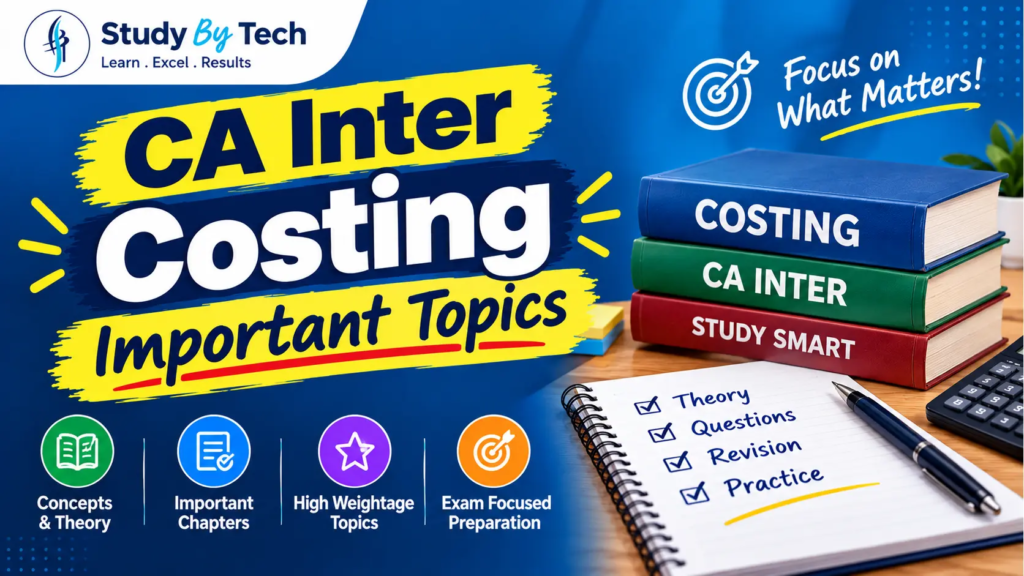
By CA Parag Gupta • CA Inter Costing CA Inter Costing Important Topics: Sure Shot Exemption List CA Inter costing important topics are the chapters examiners keep coming back to: Marginal Costing, Activity Based Costing, Material & Labour, Cost Sheet, Standard Costing and Process Costing. This guide is for CA Intermediate students aiming for an exemption in Cost & Management Accounting. Master these six sure shot exemption topics first, follow the must-do study tips, then cover the rest of the syllabus. It won’t replace full preparation, but it’ll make your revision sharper. Join CA Inter Costing ClassesBooster Batch On This Page CA Inter Costing Important Topics at a Glance 6 Sure Shot Exemption Topics in Costing CA Inter Cost Must-Do Topics: Your Study Plan Full CA Inter Costing Syllabus Free Resources and Next Steps CA Inter Costing FAQs About CA Parag Gupta Key Takeaways Six chapters are your CA Inter costing sure shot exemption topics: Marginal Costing, ABC, Material & Labour, Cost Sheet, Standard Costing and Process Costing. Marginal Costing alone can carry 16-20 marks. Standard Costing and ABC show up regularly. Expect at least one ABC question. Practise, keep a formula notebook, and revise these topics at least 4 times. These are priorities, not shortcuts. Still cover the full syllabus. Buy the CA Inter Costing book and Parag Sir gives you 20 hours of complimentary classes from his latest batch. Check exam dates, registration, syllabus and admit card for CA Inter. CA Inter Costing Important Topics at a Glance Here’s the short version. These are the CA Inter Cost must do topics to lock in before anything else. Topic Chapter Why it matters Marginal Costing Ch. 14 (Module 2) 16-20 marks potential. CVP and break-even are examiner favourites. Activity Based Costing Ch. 5 (Module 1) Modern, case-based and high-scoring. One question every year. Material & Labour Costing Ch. 2 & 3 (Module 1) Foundation of total production cost. Asked in many forms. Cost Sheet Ch. 6 (Module 1) The backbone of costing. Prime, factory and production cost. Standard Costing Ch. 13 (Module 2) Variance analysis. Highly scoring and frequently asked. Process Costing Ch. 10 (Module 2) Equivalent units, losses and inter-process profits. 6 Sure Shot Exemption Topics in Costing Hey future CAs! These are the golden topics from Parag Sir’s classes that can help you get that exemption in CA Inter Costing. Let’s go one by one. 1Marginal Costing 16-20 marks This one’s a big scorer. Break-even analysis is your best friend. CVP analysis is an examiner favourite. Decision-making questions? Pure gold if you’ve practised. ▶ Watch Marginal Costing Lecture 2Activity Based Costing Modern ABC allocates overheads by activities instead of old-school methods. You’ll work with cost drivers, activity cost pools and true product costs. Questions are usually case-based, so real-world understanding counts. Expect one ABC question every year. 3Material & Labour Costing These two are the core of total production cost. Examiners test calculation, analysis and control methods, so don’t skip the basics. ▶ Watch Material & Labour Lecture 4Cost Sheet The backbone The Cost Sheet shows how costs are structured: prime cost, factory cost and cost of production. Expect detailed cost sheets and adjustments for overheads, opening and closing stock, and abnormal costs. ▶ Full Cost Sheet Playlist 5Standard Costing High scoring Here you compare actual costs with standard costs through variance analysis: material, labour, overhead and sales. Learn to read the deviations and explain what they mean for management. It’s asked frequently. ▶ Watch Standard Costing Lecture 6Process Costing Essential for industries like chemicals and textiles where production never stops. Focus on equivalent units, normal and abnormal losses, inter-process profits and joint costs. Practise step-by-step workings. ▶ Watch Process Costing Lecture CA Inter Cost Must-Do Topics: Your Study Plan Knowing the topics is half the job. Here’s the flow to follow for each one: 1. ConceptsUnderstand first 2. PractiseDaily questions 3. Formula notebookRead it daily 4. Revise x4Mark tough Qs 5. Present wellNeat answers Study tips from Parag Sir Focus on concept clarity. Practise as much as you can. Don’t forget to open the ICAI study material. Keep a separate notebook for formulas and read it daily till your exam. In your first revision, solve as many questions as you can yourself. Keep marking the difficult ones for the second revision. Take extra care with answer presentation. Revise the topics above at least 4 times before the exam. Full CA Inter Costing Syllabus Here’s the complete chapter list so you know where each topic sits. Module Chapters Module 1 Chapter 1: Introduction to Cost and Management AccountingChapter 2: Material CostChapter 3: Employee CostChapter 4: Overheads: Absorption Costing MethodChapter 5: Activity Based CostingChapter 6: Cost SheetChapter 7: Cost Accounting System Module 2 Chapter 8: Unit & Batch CostingChapter 9: Job Costing and Contract CostingChapter 10: Process & Operation CostingChapter 11: Joint Products & By ProductsChapter 12: Service CostingChapter 13: Standard CostingChapter 14: Marginal CostingChapter 15: Budget and Budgetary Control Free Resources and Next Steps Book + 20 hours of free classes With the CA Inter Costing book, Parag Sir gives you 20 hours of complimentary classes from his latest batch. If you’re doing self-study or learning from another faculty, it’s a must-have. Ready to put this into action? Grab these: Parag Sir’s Costing 59 Questions PDFCosting Book + 20 Hrs Free ClassesJoin the Booster BatchExplore ICAI BoS resources Want to see how other students found their way? Read our media coverage. CA Inter Costing FAQs What are the CA Inter costing important topics? The CA Inter costing important topics are Marginal Costing, Activity Based Costing, Material and Labour Costing, Cost Sheet, Standard Costing and Process Costing. They’re the sure shot exemption chapters because examiners ask them often and they carry high marks. Master these first, then finish the remaining syllabus. How does the CA Inter costing important topics strategy work? You rank chapters by marks and how often they’re asked, then master the top ones first. Practise questions daily, keep a formula notebook, and revise these

Scroll to Top