CA Inter Journey with StudyByTech
Blog, CA Inter

CA Inter Journey with StudyByTech: Your Comprehensive Guide

CA Inter Classes ICAI Registration Process, Fees, & Syllabus Admit Card Exam Dates Study Guides & Tips CA Inter faculties FAQ The journey to becoming a Chartered Accountant in India is a rigorous yet rewarding path, and the CA Inter 2026 (Chartered Accountancy Intermediate) level is a pivotal milestone in this pursuit. In this article, we aim to provide you with a comprehensive understanding of CA Inter’s significance and how you can achieve excellence with the help of StudyByTech’s CA Inter classes, Join us for more updates on our WhatsApp channel. Demystifying CA Inter The CA Inter level, the second stage of the Chartered Accountancy program by the Institute of Chartered Accountants of India (ICAI), is a comprehensive program that delves deeper into accounting, taxation, finance, and various facets of financial management. This level comprises two groups, each consisting of four subjects: Group I: Group II:  CA Inter acts as a bridge between the foundational knowledge of the CA Foundation and the advanced expertise required for the CA Final level. The Significance of CA Inter Why Choose StudyByTech for CA Inter Classes? StudyByTech is your trusted partner on the path to success in CA Inter. Our commitment to providing top-notch CA Inter classes stems from our passion for education and our dedication to our students. Here’s why StudyBytech is your ideal choice: 1. Expert Faculty: Our team of experienced and highly qualified faculty members ensures that you receive the best education possible. They guide you through the curriculum, offering valuable insights and support. 2. Comprehensive Study Material: We provide authorized study material that aligns with ICAI guidelines. It covers the syllabus in a thorough and effective manner, facilitating in-depth understanding. 3. Interactive Learning: Our classes are designed to be engaging and interactive. We believe in the power of two-way communication and encourage questions and discussions. 4. Regular Assessment: We offer regular assessments, including mock tests and practice questions, to help you gauge your progress and prepare you for the exams. 5. Flexibility: StudyByTech understands the importance of flexibility in your learning journey. Our classes are designed to accommodate your schedule, making it easier for you to balance your studies with other commitments. Elevate your CA Inter journey with StudyByTech and unlock your potential to excel in this challenging yet rewarding phase. Click here to check CA Inter classes by StudyByTech. Conclusion In conclusion, the CA Inter level is a critical phase on your path to becoming a Chartered Accountant. StudyByTech is here to support and guide you throughout your CA Inter journey, ensuring you have the knowledge and skills necessary for success. Embrace this journey with confidence, and success will be yours. FAQ’s

IS-CA-Foundation-Hard
CA Foundation

Is the CA Foundation Hard?

CA Foundation Classes ICAI Registration Process Subjects, Syllabus & Exam Pattern Admit Card Exam Dates Exam Tips About the faculties FAQ Do you think the CA Foundation exam is too much for you? Ultimately, your dedication and persistence will pave the way for success. At StudyByTech, we think that CA Foundation can be doable and even straightforward with the correct help & smart study. Why the CA Foundation can be difficult at times? Every challenge presents an opportunity for development. One of the primary reasons the CA Foundation exam is challenging, is the sheer volume of material you need to cover in 4 months. As CA is a professional course hence understanding and writing the answers in exams is a way different then what students have done until now. Also, the MCQ pattern in exams often test how your conceptual knowledge is, how calculative is your mind under the time constraint. How StudyByTech simplifies the learning process Our course has been created to make preparing for the CA Foundation exam easier: Are you ready to make preparing for the CA Foundation easier? Become a member of StudyByTech now & get all professional advice, assistance, guidance and all the resources you require. Let us assist you in achieving success on your CA Foundation path! For more information follow us in YOUTUBE, FACEBOOK, INSTAGRAM. FAQ IS-CA-Foundation-Hard

ca parag gupta is explain ca final costing topic value chain analysis in just 60 second
Blogs, CA Final, SCPM

Value Chain Analysis: Quick Concept with Parag Gupta

Value chain analysis (VCA) that Michael Porter had developed is a very effective tool for every operational step that might be involved in the production process, which makes the company final product or service. In the CA Final Costing, this technique is very important as it is the one that will help the students understand how to obtain cost efficiency and value addition. Let’s quickly break down how Value Chain Analysis can help CA students tackle costing questions, thus sharpening your basic understanding using a 60-second video by Parag Gupta sir. What is Value Chain Analysis? Value Chain Analysis is a careful investigation of the functions that a company performs in a course of the production of a product or service. It is a missing link between the companies where value is created on the production line and where the problems are along with the appropriate solutions, cost reduction or, opportunities for differentiation, are shown. The main aim is to improve effectiveness, to cut expenses, and to enhance the business’s competitiveness level. Value Chain Analysis in 60 Seconds Primary Activities Primary activities are the essential business operations that directly create and distribute value to customers. They consist of: Support Activities Support activities such as teamwork, planning, and strategic management facilitate the flow of primary activities efficiently. The various support activities include the following: Why Use Value Chain Analysis? An effect between a strategy and profit could be established if the entity continuously scanning through allocating for those specific tasks that are non-expensive and assigning competitive advantages to the higher priced-costs ones. In brief, the analysis can raise the lowermost expenses and increase the efficient service more which will have a direct or indirect impact on the level of satisfaction of every user. Value Chain Ability of business is additionally the ability to concentrate on their main competence, get subcontractors to do non-critical tasks, and be more innovative wanted areas respectively. Conclusion Value Chain Analysis can reveal how your business operates most efficiently and it shows the potential for strategic growth. This could be achieved by dismantling every step in logistics as well as the sales process to identify where the cost can be cut, whether it’s changing the kind of supplier or some other solution that the customer will find appealing. With the help of experts such as Parag Gupta. FAQ’s

CA Final IBS – Expert Strategy & Case Study Tips by Parag Sir
CA, Blogs, CA Final

CA Final IBS – Expert Strategy & Case Study Tips by Parag Sir

What is CA Final IBS? CA Final IBS (Integrated Business Solutions), is quite difficult in nature with its long case studies that do not only need the technical knowledge but the strategic thinking too. The powerful part of the curriculum is the application of knowledge through case studies of all CA Final subjects, be it from self-paced online modules, or CA Final Group 1 subjects or CA Final Group 2 subjects. So this exam actually tests your applicability of all subjects in 1 exam. This blog is by CA Parag Gupta who is a well-known faculty in the CA Final SCPM(SPOM-set B). He has come up with a couple of ideas that can help you manage the long case studies in the CA Final IBS paper. The Council has decided that the duration of the examination of this paper would continue to be four hours and the manner of assessment of this paper would also be 40% by way of MCQs and 60% in the form of Descriptive Questions in each case study of 25 marks. Accordingly, there will be five case studies of 25 marks each out of which students will be required to attempt any four. Quick Tips for Long Case Studies | CA Final IBS | CA Parag Gupta: Why CA Parag Gupta is the Best Mentor for CA Final IBS? Parag Gupta sir is considered the most experienced and most recommended faculties amongst CA students. With his 2 decades of teaching experience as CA Inter Costing SM and CA Final SCPM(SPOM-set B) & IBS(SCPM portion), he has always helped & guided lakhs of students to achieve their goal of becoming CA. After every few years, ICAI make changes in syllabus and pattern of exams, which always confused CA students. Everytime, CA Parag Gupta sir’s guidelines has being the most helpful guide. His years of analysis and experience has helped him to understand how the course is evolving and how ICAI is actually thinking to take the examination and evaluation process. CA Final IBS May 25 Exam review: Break Down the Questions The initial stage in solving any long case study is to correctly comprehend the scenario. Frequently, scholars question their understanding of the case itself, which eventually leads to errors and confusion further in. Here are the ten essential steps to follow when working on the case: One important step that should not be missed is to comprehend the whole case before moving on to the set of questions. In the in IBS paper, a large number of questions are composed of different parts and involve detailed analysis. Follow these steps: CA Final IBS | How to Solve Case Studies (70+ Strategy) by Parag Sir: IBS Case Study Strategy The IBS paper deliberated over the management of strategic cost where cost management and decision making, performance measurement, and cost control are examined. By applying a framework, it is possible to follow a schedule to approach a case study. Several such concepts might be useful: Applying the use of these frameworks demonstrates to the examiner the fact that you are strategic in your mindset and you are not just working with numbers. Also, these frameworks help you in the way that they enable you to break the masses of information down into smaller parts which you can easier manage. Common Mistakes in IBS Exam & How to Avoid Them One can be tempted to retell the case study’s information, but instead, examiners are looking for original independent analysis. Utilise information provided to: Structure Your Answer Well Understanding is what plays a major role in lengthy case studies. Even with a perfect analysis, an improperly structured answer can lead the examiner to question your thoughts. The answers have always had to be structured as follows: Time Management Long case studies can be time-consuming, yet make sure they don’t take up all your exam time. Set a specific amount of time for each question, and if time is running down you should go to the next one. You are still able to revisit the question later if necessary. Conclusion To deal with these types of scenarios with the CA Final IBS paper, one must have a structured approach, logical analysis and good time management skills. This way, you can handle the exam even if there is a really difficult question, confidently and increase your marks also. FAQ’s

CA Inter SM
Blogs, CA Inter, SM

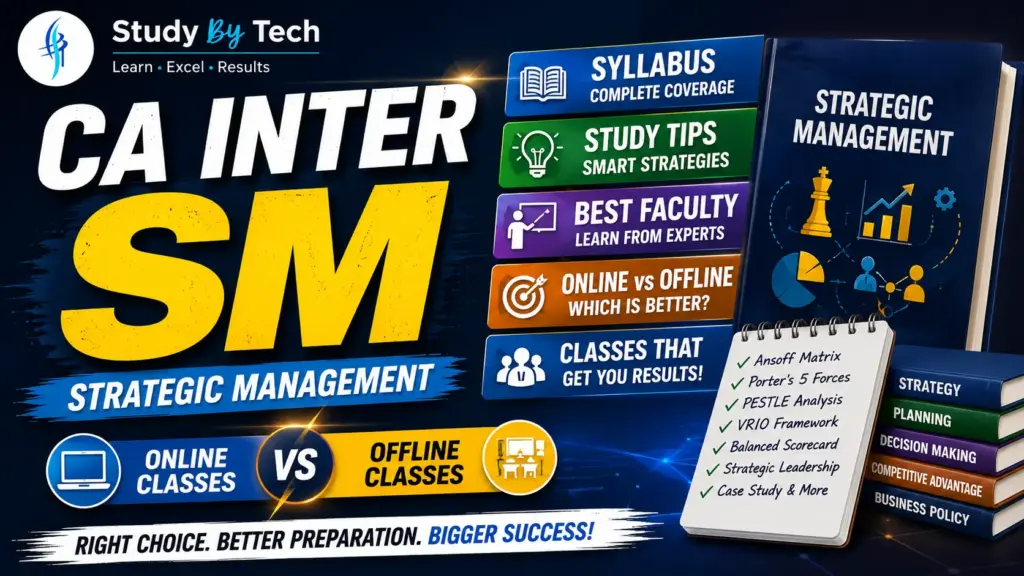
CA Inter SM: Syllabus, Study Tips, Best Faculty & Online vs Offline Classes 🎯 Your complete guide to Strategic Management (Paper 6B) — From syllabus to scoring 40+ out of 50. Everything you need to master SM. 📑 Table of Contents Overview & Syllabus 1. What is CA Inter Strategic Management? 2. Is SM Easy in CA Inter? 3. ICAI CA Inter SM Syllabus & Weightage Key Models & Strategy 4. Key Strategic Models You Must Master 5. CA Inter SM Strategy that Works Coaching & Final Push 6. Online vs Offline Classes 7. Best Faculty at StudyByTech FAQ Frequently Asked Questions ⭐ Key Takeaways SM = Paper 6B: 50 Marks (30% MCQs + 70% Descriptive) — highly scoring. 5 Chapters: Introduction, External/Internal Analysis, Strategic Choices, Implementation. Master Key Models: Ansoff Matrix, BCG Matrix, Porter’s Five Forces are frequently tested. Use ICAI Terminology: “Core competencies” and “sustainable competitive advantage” score more. 4-Step Case Study Format: Problem → Framework → Facts → Conclusion. Practice Case-Based MCQs: 15 marks come from case-based MCQs — practice them. SM is Easy if: You understand concepts, retain technical terms, and practice case studies. Common Mistake: Writing casual/general answers instead of using ICAI module language. 1. What is CA Inter Strategic Management? The subject of Strategic Management in the CA Intermediate course makes the aspirant Chartered Accountant learn to think like a business strategist. It checks their capability of how businesses analyze opportunities in the market, create corporate strategy, assess competitive advantage, and make organizational changes. Overview of Paper 6 Section B: Subject Name: Strategic Management (SM) Total Weightage: 50 Marks Exam Pattern: 30% Integrated Case-Scenario MCQs (15 Marks) + 70% Descriptive Practical Questions (35 Marks) Exam Time: 3-hour integrated exam along with Financial Management (FM) 2. Is SM Easy in CA Inter? One of the common queries by many students who have cleared CA Foundation is Is SM easy in CA Inter? The simple answer is Yes, though there’s a huge caveat here. SM involves less of concepts compared to those numerical subjects such as Costing or Advanced Accounts. However, students find it hard to secure high grades since they treat SM as an English essay-writing subject. ❌ WHY STUDENTS LOSE MARKS IN SM Writing general/casual answers Ignoring heading titles in modules Skipping case study practice Lack of strategic diagrams ✅ HOW TO SCORE 40+ OUT OF 50 IN SM Using official ICAI technical terms Memorizing standard framework titles Structuring answers into 4 clear zones Drawing matrices (Ansoff, BCG, SWOT) If you master the core concepts, retain ICAI terminology, and practice case studies, SM becomes one of the easiest subjects to score an exemption in. 3. ICAI CA Inter SM Syllabus & Weightage Breakdown The updated ca inter sm syllabus under the ICAI New Scheme consists of 5 comprehensive chapters: Chapter Number & Title Expected Marks Key Focus Areas Chapter 1: Introduction to Strategic Management 8 – 10 Marks Concept of Strategy, Strategic Management Process, Strategic Leadership, Vision, Mission, and Objectives. Chapter 2: Strategic Analysis: External Environment 10 – 12 Marks Competitive Landscape, Porter’s Five Forces Model, PESTLE Analysis, Industry Driving Forces, Strategic Groups. Chapter 3: Strategic Analysis: Internal Environment 8 – 10 Marks Value Chain Analysis, Core Competencies, Competitive Advantage, Portfolio Analysis (BCG Matrix, Ansoff Matrix, ADL, General Electric). Chapter 4: Strategic Choices 10 – 12 Marks Corporate Level Strategies (Growth, Stability, Retrenchment), Business Level Strategies (Porter’s Generic Strategies), Directional Growth. Chapter 5: Strategy Implementation & Evaluation 8 – 10 Marks Strategic Control, Operations & Resource Allocation, Digital Transformation, Organizational Structure & Change Management. 4. Key Strategic Models You Must Master for Exams ICAI often questions about practical applications through certain models related to strategic management. Make sure that you know these models: 1. Ansoff’s Product-Market Growth Matrix How companies grow based on products and markets: Market Penetration: Present products in present market. Market Development: Present products in new market. Product Development: New products in present market. Diversification: New products in new market. 2. BCG Growth-Share Matrix Classification of Business Units: Stars: High Growth, High Market Share. Cash Cows: Low Growth, High Market Share. Question Marks: High Growth, Low Market Share. Dogs: Low Growth, Low Market Share. 3. Porter’s Five Forces & Generic Strategies Five Forces: New Entrants, Buyers, Suppliers, Substitutes, Rivalry. Generic Strategies: Cost Leadership, Differentiation, Focus. 5. CA Inter SM Strategy that Works 📘 1. Keep an SM Terminology Dictionary Handy Have a small notepad wherein you maintain the terms used in the context of SM. Instead of using such statements as “the company is better than its rivals,” use terminology such as “the enterprise is using core competencies to get a sustainable competitive advantage.” 📝 2. Adhere to the 4-Point Structure for Case Studies In solving case questions in the exam: 1. Highlight the Core Problem 2. Framework: Define the conceptual model 3. Facts: Correlate facts with the framework 4. Conclusion: Provide your strategic solution 🧠 3. Solve Case Based MCQs Given that 15 marks are allotted to case based MCQs, try solving the case and arriving at the right strategic option without wasting much time. 6. CA Inter SM Classes: Online vs Offline Classes Depending on your daily study schedule and location, choosing the right learning mode plays a huge role in your exam preparation: Feature CA Inter SM Online Classes CA Inter SM Offline Classes Flexibility & Convenience Learn from anywhere with HD recorded or live interactive lectures. Requires daily commuting to offline coaching centers. Speed Control & Revisions Re-watch lectures at 1.2x/1.5x speed during revision rounds. Single-pass live lecture experience. Doubt Support Direct mentor chat, Telegram community, and call support. In-person face-to-face doubt clearance post-class. Cost & Time Savings Highly affordable; saves 2 hours of daily travel time for self-study. Involves higher tuition fees and travel overheads. 7. CA Inter SM Best Faculty at StudyByTech In the process of choosing the CA INTER SM BEST FACULTY, you will require a guide who can do much more than just read out from books to make one understand how


Altman’s Z, H Score, and Argenti’s A Score by CA Parag Gupta
Blogs, CA Final, SCPM

Understanding Financial Health: Altman’s Z, H Score, and Argenti’s A Score

In the field of financial analysis, evaluating a company’s stability and health is essential. Altman’s Z-Score, H Score, and Argenti’s A Score are three well-known models that are employed in this context. With the aid of these models, stakeholders can make well-informed judgements regarding a company’s financial situation. Each model provides distinct insights. Click here to learn Financial health & similar topic of SPOM-set B by Parag Gupta sir. ALTMAN’S Z score H Score The formula is: H = \frac{D_0 (1 + g_L) + D_0 H (g_S – g_L)}{r – g_L}H=r−gL​D0​(1+gL​)+D0​H(gS​−gL​)​ Where: Argenti’s A Score Argenti’s A Score is a diagnostic tool used to identify the risk of corporate failure. It was developed by John Argenti in the 1970s and focuses on three main areas: defects, mistakes, and symptoms. The A Score is calculated by assessing various factors within these areas, such as management quality, financial structure, and operational efficiency. The scoring system is: Each factor is scored, and the total score indicates the likelihood of corporate failure. Conclusion Altman’s Z-Score, H Score, and Argenti’s A Score are powerful tools for assessing the financial health of a company. While the Z-Score focuses on bankruptcy prediction, the H Score evaluates growth potential, and Argenti’s A Score diagnoses the risk of failure. Together, these models provide a comprehensive view of a company’s financial stability, aiding stakeholders in making well-informed decisions. FAQ’s

Blog, CA Inter, Costing, Exams tips

CA Inter costing Exam: Last minute hacks to ace your exams | CA Parag Gupta Sir

CA Inter costing Exam: Last minute hack by CA Parag Gupta Sir <table style=”width: 100%;”> CA Inter Classes ICAI Registration Process, Fees, & Syllabus Admit Card Exam Dates Study Guides & Tips CA Inter faculties FAQ The CA Intermediate Costing paper can be truly intimidating, to say the least, especially as the exam date draws nigh. Numerous students frequently ask themselves, “What exactly should I concentrate on? Which chapters should I focus on more?” This blog aims to assist you in being fully prepared for the CA Inter Costing exam paper by outlining the chapters that you need to know, the strategies, and some tips for getting a good grade. https://www.youtube.com/watch?v=f96jVqKef8k 1. Focus on key chapters first When you are studying for the CA Intermediate Costing paper, certain chapters carry more weight and are indispensable for a good score. Let us begin with the most important ones: Activity-based costing (ABC): This chapter is very significant. Be ready to answer the questions, as this is one of the most common topics that come out in the exam. Marginal costing: A central chapter, Marginal Costing, would be the best concept to tackle the questions that want your deeper analysis and calculations. Once you’re comfortable with these two, move on to the following chapters: Material costing Labor costing Cost Sheet Service sector costing Standard costing These chapters are also important but should be tackled after mastering activity-based and marginal costing. <h2>2. Revise formulas in advance.</h2> <p>One of the simplest yet effective techniques for the CA Intermediate Costing paper is to focus on formula <b>revision</b>. The evening before your examination, attempt to write and remember all the vital formulas from your work. This is a final guarantee that you experience the pride of preparedness and eliminate the hectic practice of last-minute cramming. As a result of this step, the probability of last-minute mistakes or confusion is reduced during the test. The purpose is to reach a point where you have become so competent that you would be able to recall all the formulas from memory on the night before the exam without looking at your notes. This recurring exercise will make the formulas preponderant in your mind, in turn, making you more competitive in the exam. 3. Stay hydrated and manage stress Studies have shown that students who sit for the CA Intermediate Costing paper are usually under mental stress however, one of the best ways to recover is to stay well-hydrated and to effectively manage stress. Drink as much water as you can, get enough rest, and avoid stress. It will be an added bonus if your body is fresh and your mind is sharp during the test. This will help you do better. 4. Avoid last-minute cramming There is a habit of students, which is to learn the whole of the CA Intermediate Costing paper in the last minute, which is the most important neglected point. It is the evening of the examination that you should overcome it by taking easy revisions, doing several workouts, and quickly reading through your notes. Do not attempt to pick up new ideas or chapters of a book at the examination night, rather, this will increase stress. 5. Believe in your preparation. Ultimately, hark back to the diligence you have steeped in while studying for the CA Intermediate Costing examination. However, the well-organized, systematic approach, along with a focus on such key chapters, will enable you to face the exam with confidence. The deeper, peaceful, positive,, and motivating self-talk is what is being referred to when you say, “Stay calm, believe in yourself, and maintain a positive mindset!” Need help? StudyByTech is here for you! If you feel like you are lost or you have no idea what you are doing, do not worry because we are available at StudyByTech. StudyByTech is a new educational venture of CA Parag Gupta, a professional with 20 years of CA tutorship at both the intermediate and final levels. Being an ex-examiner, he provides information on exams that have helped hordes of students who went through them perfectly with flying colors. Moreover, apart from access to the course’s video archives, the possibility of having the practice questions, and the opportunity to receive expert information for the CA Intermediate Costing examination, StudyByTech is the best option for students who desire clear, concise, and properly arranged study materials. Conclusion Although the CA Intermediate Costing paper would be quite a hard nut to crack, it will be a cinch if you adopt a smart approach. First, concentrate on the major sections like Activity-Based costing and marginal costing, and ensure to make the last memories of many of the important formulas the night before the exam. Keep hydrated, relax yourself, and do not cram the last minute. And it is to be kept in your mind that StudyByTech is standing by to lend you high-quality learning materials and expert advice. Armed with quality preparation and the proper attitude, you will no doubt nail the CA Intermediate Costing paper! Please do your best! 

How to score high in the CA Foundation law paper: A simple guide
Blog, CA Foundation, ca foundation law, Exams tips

CA Foundation Law 2026: Study Tips, Important Chapters & Preparation Strategy

CA Foundation Law 2026: Study Tips, Important Chapters & Preparation Strategy <table style=”width: 100%;”> CA Foundation ClassesICAI Registration ProcessSubjects, Syllabus & Exam PatternAdmit CardExam DatesExam TipsAbout the facultiesFAQ Every CA Foundation student hears the same thing before Law exams: “Law is all about mugging up.” But after talking to hundreds of CA students, one thing becomes clear — students usually fail in Law not because the subject is impossible, but because they study it the wrong way. Some students only watch lectures. Some highlight entire books. Some try to memorize sections without understanding concepts. And then panic starts one month before exams. The truth is: CA Foundation Law can become one of the highest-scoring subjects if you prepare smartly. What’s the CA Foundation law paper about? https://www.youtube.com/shorts/psbCHjN6i9s CA Foundation Law Chapter-Wise Weightage Stop studying blindly. The ICAI follows a specific pattern. Prioritize your energy where the marks are: Explore: Latest New Scheme Syllabus Of CA Foundation Law (2026) Act Name Marks Weightage (Out of 100) The Indian Contract Act, 1872 25 – 30 Marks The Companies Act, 2013 20 – 25 Marks The Sale of Goods Act, 1930 15 – 20 Marks The Indian Partnership Act, 1932 15 – 20 Marks The Negotiable Instruments Act, 1881 10 – 15 Marks The Limited Liability Partnership Act, 2008 05 – 10 Marks Indian Regulatory Framework 00 – 05 Marks Chapter-wise Marks Weightage To outperform the competition, you need to know exactly which concepts the examiners love to test. Here are the most heavily tested, high-reward topics from every act: 1. The Indian Contract Act, 1872 This is the heart and soul of your syllabus. If you master this, half your battle is won. Essentials of a Valid Contract: What makes a contract legally binding? Free Consent: Understand coercion, undue influence, fraud, and misrepresentation inside out. Discharge & Breach of Contract: Specifically, what are the remedies available if someone breaks a promise? Liability of Joint Promisors: A major favorite for case study questions. 2. The Companies Act, 2013 Welcome to the corporate world! You’ll carry these concepts all the way to CA Final. Lifting the Corporate Veil: Highly tested! Know the scenarios where owners are held personally liable. Types of Companies: Focus heavily on One Person Company (OPC), Private vs. Public, and Small Companies. Key Doctrines: Doctrine of Indoor Management and Doctrine of Ultra Vires (Expect direct questions or case studies here). 3. The Sale of Goods Act, 1930 Think of this as the law behind everyday buying and selling. Conditions and Warranties: Understand the difference and when a breach of condition is treated as a breach of warranty. Transfer of Ownership: Nemo dat quod non habet (No one can transfer a better title than he himself has) and its exceptions. Rights of an Unpaid Seller: Mark this in red. The right of lien and right of stoppage in transit are absolute must-knows. 4. The Indian Partnership Act, 1932 A very predictable and scoring section. True Test of Partnership: What actually makes a partnership valid? Implied Authority of a Partner: When does a partner’s action legally bind the rest of the firm? Registration and Dissolution: The consequences of non-registration are frequently tested. 5. The Limited Liability Partnership (LLP) Act, 2008 A small act, but a guaranteed 10-15 marks. LLP vs. Traditional Company: Understand the core differences. Incorporation Process: How is an LLP officially born? How to Solve CA Foundation Law Paper? Okay, the practical side of the matter: how do you actually study this massive syllabus? Here are a few battle-tested tips: Understand the “Why”: Behind every law, there is a real-world problem it’s trying to solve. Try to understand why the rule was made. Once you understand the logic, you won’t have to cram. Use Visuals & Flowcharts: Legal provisions can get messy. Drawing quick diagrams and flowcharts for processes (like the formation of a company) makes it 10x easier to recall in the exam hall. Make 1-Page Summaries: Write down the key points of an entire chapter on a single sheet of paper using your own words. It’s a lifesaver on the day before the exam. Worship the ICAI Study Material: Never stray too far from the official ICAI modules. The examiners set the paper straight from it! Practice Writing: Law is as much about presentation as it is about knowledge. You need to practice writing answers down to get the professional tone right. How to Write Case Studies in CA Foundation Law? You’ll face direct theory questions asking you to explain provisions. Keep it crisp and professional: Start Strong: Always begin with a clear, one-line definition of the core legal term. Quote the Section Number (Only if 100% sure!): If you remember the exact section number, definitely write it! It adds massive credibility. If you forgot it, do not guess. Just write “As per the provisions of the Act…”. Use Bullet Points: Examiners check hundreds of papers. Make their life easy by organizing your answer into neat bullet points. Drop an Example: Even if not asked, a quick, one-line example proves to the examiner that your concepts are crystal clear. How to Answer Case-Study Questions? Case studies are basically puzzles, and they are incredibly fun once you crack the code. Use the IRAC formula to structure your answer: Issue (I): Read the case carefully. Start your answer by identifying the core problem. (Example: “The issue in this case relates to the right of an unpaid seller…”) Rule/Provision (R): Explain the legal rule or section that applies to this specific situation. Do not talk about the characters in the question yet. Just explain the pure law. Analysis/Application (A): Now, connect the law to the story given in the question. Explain how the rule impacts the characters. Conclusion (C): End with a clear, 1-2 sentence conclusion. Make sure you clearly state who is right, who is wrong, or what the final outcome should be. Why choose StudyByTech for CA Foundation law?  Problem:Legal studies giving you stress? Solution: Enrol in StudyByTech for

Just Passed 12th Ready to Become a CA Get Started with CA. Parag Gupta
Blog, CA Foundation

Just Passed 12th? Ready to Become a CA’s Get Started!

Just passed 12th? Ready to become a CA? Let’s get started ! Hey there, congrats on clearing your 12th exams!  It is a great time now, and if you have come up with the idea of a Chartered Accountant, here is the right place for you. The CA foundation test will be your first step in the journey of becoming a CA. What can I do to start preparing for such things? One may ask. Apart from selecting a CA Foundation coaching program, your choice to avail StudyByTech’s service becomes the pivotal one. We will play the role of the study mate to you, and we shall stand by you at every point, whether it is to take over the syllabus or pass the exam with flying colors! Why StudyByTech? Why you should select StudyByTech as your one-stop CA Foundation coaching center? Great! To begin with, we’re much more than just a coaching center. We’re an online platform created by CA Parag Gupta, the man who has devoted his life to helping students pass CA exams for over 20 years. But we still doubt you’ll be able to resist us: Learn from the Best: You’ll be in the great company of teacher CA Parag Gupta as well as other qualified teachers who are experts in their fields. Study on YOUR Time: If you are an evening or a morning person, StudyByTech will allow you to learn at your preferred time. Take online courses from a location and in a time that is convenient for you. All in One Perfect classes: With top-notch video lectures, brief question-and-answer resources, and easy-to-read notes, we are the one-stop-shop for all your academic needs. Free demo classes–Try before you buy Not sure if online coaching is your thing? No worries! You can try out our free demo classes before you commit to anything. This way, you get to see how our courses work, how we break down the syllabus, and why so many students trust us with their CA Foundation coaching. You’ll get a sneak peek into our teaching style, and once you experience it, I’m pretty sure you’ll want to dive right in! https://youtu.be/MSaRl0nLr5Mhttps://youtu.be/4xyFkUE_vmohttps://youtu.be/bCgWSbBtiZUhttps://youtu.be/j395i0il-Mc Can you join CA Foundation coaching? <p>Let’s make sure you’re eligible to get started:</p><ul><li style=”font-weight: 400;” aria-level=”1″>If you’ve passed your 12th exams from a recognized board (like CBSE, ICSE, or state boards) with more than 50% of mark, you’re good to go!</li><li style=”font-weight: 400;” aria-level=”1″>You’ll also need to register for the CA Foundation exam with ICAI (the Institute of Chartered Accountants of India).</li></ul><p>If you’ve ticked those boxes, you’re all set to begin your CA journey!</p> <h2>What’s the CA Foundation Coaching like?</h2> <p>Let me break it down for you real quick. Here’s what you’ll get when you join StudyByTech’s <b>CA Foundation coaching</b>:</p><table style=”border-collapse: collapse; width: 100%;”><tbody><tr><td style=”width: 50%; text-align: center;”><b>Course Feature</b></td><td style=”width: 50%; text-align: center;”><b>Details</b></td></tr><tr><td style=”width: 50%;”><b>Course Duration</b></td><td style=”width: 50%;”>4-6 months</td></tr><tr><td style=”width: 50%;”><b>Mode of Learning</b></td><td style=”width: 50%;”>100% offline/online through our easy-to-use app</td></tr><tr><td style=”width: 50%;”><b>Class Timings</b></td><td style=”width: 50%;”>Completely flexible—watch when it suits you</td></tr><tr><td style=”width: 50%;”><b>Faculty</b></td><td style=”width: 50%;”>Experts with 10+ years of experience</td></tr><tr><td style=”width: 50%;”><b>Support</b></td><td style=”width: 50%;”>24/7 doubt resolution</td></tr></tbody></table><p>Basically, we’re giving you all the tools you need to prep for the exam in a way that fits your schedule and your learning style. No need to rush or stress—just learn at your own pace!</p> <h2>CA Foundation course syllabus</h2> <p>The <b>CA Foundation</b> exam covers four main subjects, and we’ve got each one covered in detail. Here’s what you’ll be diving into with our coaching:</p><table style=”border-collapse: collapse; width: 100%;”> Subject Topics Covered Principles and practice of accounting All the basic accounting principles you’ll need. Business laws Business laws + how to communicate professionally. Business mathematics, logical reasoning, and statistics Problem-solving and data analysis skills. Business Economics Economics applied to real-life business situations. Sounds tough? Don’t worry—we make it easy for you to understand and ace every topic. <h2>How to Register for the CA Foundation exam and start with us</h2> <p>Here’s how to get going with your <b>CA Foundation coaching</b>:</p><ol><li style=”font-weight: 400;” aria-level=”1″><b>Register for the CA Foundation exam</b> on ICAI’s website.</li><li style=”font-weight: 400;” aria-level=”1″>Once you’re registered, come back to StudyByTech, and start learning!</li></ol><p>Now are you <b>thinking about our fees?</b> Don’t worry about the fee. We at StudyByTech have certain plans to help the needy students. Connect our Student care no. at +91 9968875529 and get all information in detail about CA Course & they can even connect you directly with our well experienced faculties, if required, for subject based queries. Here’s a quick look: CA Foundation Ccoaching Fees Amount StudyByTech subscription ₹7000–₹28500 depending on the plan you choose. <h2>Study material that’s always there for you</h2> <p>We mainly teach you from ICAI study material which is actually recommended for CA Foundation preparation. Our study material isn’t just a bunch of boring notes. We’ve designed everything to make sure you can actually <i>understand</i> the topics and feel confident about the exam. Here’s what you’ll get:</p><ul><li style=”font-weight: 400;” aria-level=”1″>Easy-to-follow video lectures on every subject.</li><li style=”font-weight: 400;” aria-level=”1″>Extra bunch of questionnaires to practice each concept thoroughly.</li><li style=”font-weight: 400;” aria-level=”1″>PDFs and handwritten notes for Law &amp; other subjects </li><li style=”font-weight: 400;” aria-level=”1″>Regular mock tests to help you see how prepared you are.</li><li style=”font-weight: 400;” aria-level=”1″>Live doubt-clearing sessions so you’re never stuck on a problem.</li></ul><p>We make sure that once you start, you have everything you need to keep moving forward without any roadblocks.</p> <h2>What other Students are saying about StudyByTech?</h2> <p>We’re not the only ones who think StudyByTech is great—our students do, too! Here’s what some of them have said: These are just a few of the success stories out of millions of students who actually have benefitted from StudyByTech, and you could be next! Ready to Start? Subscribe Today! Don’t wait until the last minute to start preparing. Join StudyByTech’s CA Foundation coaching today and give yourself the best shot at acing the exam. With a subscription, you’ll get instant access to: All our video lectures. Live sessions and mock tests. 24/7 support from our faculties Start today, and let’s make

How Examiners Mark Your Exams: Key Mistakes to Avoid by CA Parag Gupta Sir
Blog, CA Course, Exams tips

How Examiners Mark Your Exams: A Deep Dive into the Checking Process

CA Foundation Classes CA Inter Classes CA Final Classes StudyByTech Offers Contact us To be very honest, after our exams are sent in, we students make a bit of a riddle for the folks who sit down to read them. How should we actually gauge the quality of our work? Are there any specific requirements? However, these are a few of the unanswered questions. Now we are stepping behind the scene and will give some of the insights from CA Parag Gupta sir, the Institute of Chartered Accountants of India (ICAI) experienced examiner. The Step-Marking Approach Among many interesting facts about the marking process, step marking is a quite difficult concept. Thinking all of the steps given the same weight in solving a problem is the concept that is refuted by the presence of “step marking”. Through his work as an examiner, Chartered Accountant Parag Gupta shares facts originally learned from good examination papers that the ICAI provides a list of directions containing their evaluation of the students’ answers. His overviews are such that different steps, according to their levels of difficulty and importance, are allotted various marks. Common Pitfalls in Exam Writing Key Insights: 1 Unequal Step Values: Not all steps in answering a question are necessarily worth the same amount of points. The marks are given based on the degree of rigor and significance pertaining to some or another element of the task. 2. Difficulty-Based Marking: By scoring the most difficult parts better, the examination helps students learn problem-solving skills. Students who are capable of solving more difficult assignments are the ones who will benefit from this technique. 3. Not All Important Steps Are Equal: However, the plan may be such that an step that appears to be the key does not necessarily receive the highest score. The very nature of the marking scheme that requires classifiers to rank the solutions on level of complexity. A Glimpse into the Examiner’s Sheet During a revealing demonstration, Parag Gupta sir who is a Chartered Accountant & had been an examiner at ICAI has brought with him a real examiner’s paper that is given by the ICAI. This rare insight into the examiners’ inner maze of evaluation was attended to what was: The Rationale Behind Step Marking Approach The step-marking method accomplishes the following: Fidelity: It certifies that students who grasp the general principle and who can handle complex tasks, earn their proper scores. Thorough Assessment: By dissecting the scoring into steps, examiners are in a position to give more detailed evaluations of a student’s knowledge. What This Means for Students Comprehending the marking system do project the way you tackle the examination: Concentrate on the Concepts: It is equally important to yourself with the most difficult steps if you want to master the concepts in-depth rather than learn the processes. Demonstrate Your Work: Even though you don’t know the final result, showing your problem-solving method will give you several points. Time Allocation: Divide your study hours according to the difficulty of the steps that are likely to fetch more marks. Accept Challenges: Do not escape yourself with the hard bits of any question. These are the ones that you can score the highest with. Therefore, instead of finding out an easier way to solve the problem, which is not right, you should concentrate on understanding the genuine problem. Ask for help or do further reading. By understanding the examiner’s perspective, the students are guided towards learning, not only for the exam but rather, to a more profound comprehension of their issue. You know these exam are not just to check if one remembered; they are to test if the student can apply the learned knowledge on the battlefield. This includes whether the point will serve you in your future career that you aspire to as Remember, the aim of the exam is not just to evaluate your memory but also to test your ability to apply knowledge in hard situations skill that would be of much use to you in your future job as a Chartered Accountant. As you prepare for your next exam, keep these insights in mind. They might just be the key to unlocking your full potential and achieving the scores you aspire to! FAQ’s

Scroll to Top