ca inter costing

Avoid These 5 Mistakes in Process Costing by Parag Gupta
CA classes

Avoid these 5 Mistakes in CA Inter Process Costing I By Parag Gupta sir

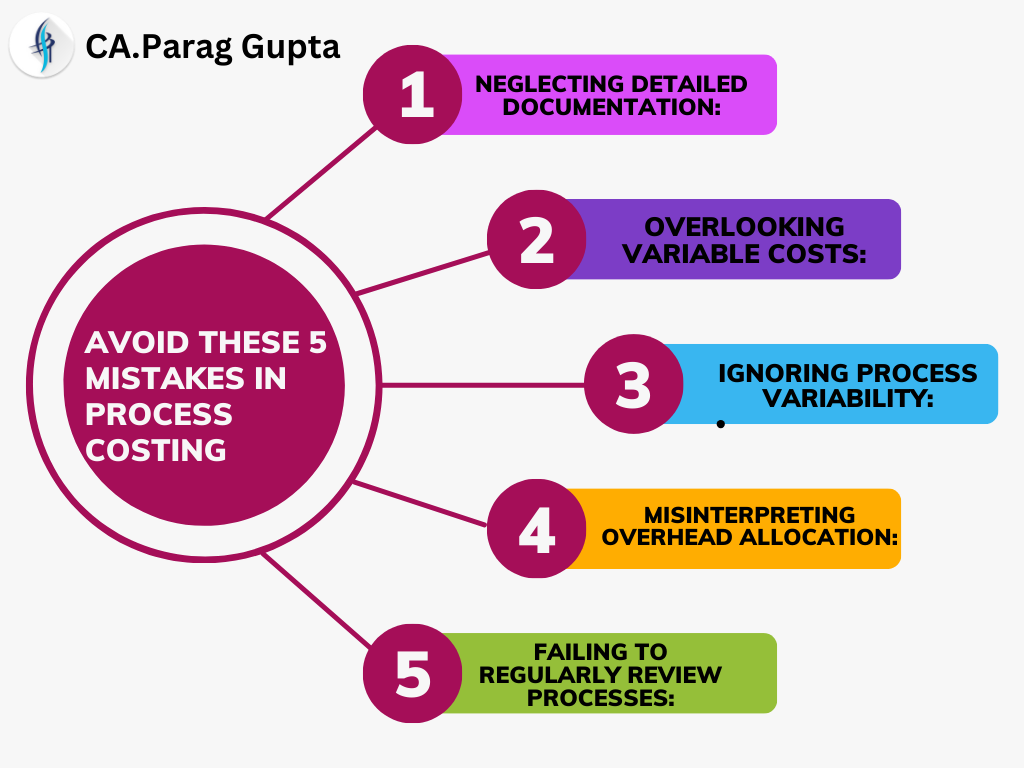
CA Inter Classes ICAI Registration Process, Fees, & Syllabus Admit Card Exam Dates Study Guides & Tips CA Inter faculties FAQ Introduction Process costing is a vital aspect of cost accounting, enabling businesses to allocate costs accurately and make informed decisions. However, mastering process costing can be challenging, and even small mistakes can lead to significant errors in financial data. In this blog post, we’ll delve into five common mistakes in process costing, drawing insights from the expertise of Parag Gupta, a renowned authority in the field of accounting and finance. Want to understand more about Process Costing in depth, read this. 5 mistakes to avoid in Process Costing at CA Inter level are: https://youtu.be/aApMURGSlNA 5 tips to avoid mistakes in Process Costing by Parag Gupta sir: Tips Description 1. Detailed Documentation Maintain thorough records of production costs incurred at each stage to ensure accurate cost allocations and financial reporting. 2. Consider Variable Costs Identify and account for fluctuating costs associated with production processes to avoid skewed cost calculations and inaccurate profitability assessments. 3. Address Process Variability Recognize variations in production processes and adjust cost allocation methods accordingly to ensure accurate cost estimations. 4. Accurate Overhead Allocation Allocate overhead costs correctly to prevent distorted product costs and ensure reliable profitability analysis. 5. Regular Process Review Periodically review and update process costing methods to adapt to changing business dynamics and optimize cost allocation for improved performance. These tips provide actionable advice to help businesses avoid common mistakes and enhance the accuracy of process costing. Conclusion Process costing is a critical tool for businesses to determine product costs and make informed decisions. By avoiding these five mistakes outlined by Parag Gupta, organizations can enhance the accuracy of their process costing data and improve overall financial performance. Remember to prioritize detailed documentation, account for variable costs, address process variability, allocate overhead costs accurately, and regularly review and refine costing processes for optimal results. FAQ’S Want to Enroll to our classes?

Process Costing CA Inter: Steps, Mistakes & a Worked Example
CA Inter, Costing

CA Inter : Basic of Process Costing by CA Parag Gupta

Process Costing CA Inter: Steps, Mistakes & Answers Parag Gupta Classes📞 +91 99688 75529 Process Costing CA Inter: Steps, Mistakes & a Worked Example By CA Parag Gupta · Parag Gupta Classes · Updated September 2026 Process costing CA Inter is the method you use to find the cost of products made in a continuous, multi-stage process, like chemicals, textiles or oil refining. This guide by CA Parag Gupta is for CA Inter students preparing Cost & Management Accounting. You’ll learn equivalent units, normal and abnormal loss, five common exam mistakes and a worked example. The key takeaway: divide each process’s total cost by equivalent units, then split it between finished and unfinished units. Table of Contents What Is Process Costing in CA Inter? How CA Inter Process Costing Works Process Costing Worked Example 5 Process Costing Mistakes to Avoid Why Learn with Parag Gupta Sir Process Costing CA Inter FAQs Key Takeaways Process costing fits continuous, multi-stage production, not one-off jobs. Equivalent units turn partly finished units into full-unit terms. Cost per equivalent unit = total process cost ÷ equivalent units. Normal loss is absorbed by good units. Abnormal loss is costed separately. Most marks are lost through weak records, wrong overhead allocation and skipped reviews. Always reconcile costs at the end of each process. What Is Process Costing in CA Inter? The simple definition Process costing finds the cost of a product by assigning costs to each stage of production. It works when goods flow continuously through the same steps, so every unit is basically identical. Where you’ll see it Think food and beverages, chemicals, textiles and oil refining. Your exam questions use the same logic. Why use it? Benefit What it means for you Simple and efficient It tracks the process, not every single job. Less paperwork than job costing. Accurate cost estimates You know what production really costs, so pricing and budgeting get easier. Cost control Tracking each stage shows where you can cut waste. Performance checks Compare actual with standard costs to spot inefficiency early. How CA Inter Process Costing Works The 5-step flow 1Collect costsDirect materials, labour and overheads for the process. 2Find equivalent unitsUnits completed + (units in process × % completion). 3Cost per equivalent unitTotal cost ÷ equivalent units. 4Allocate costsSplit between completed units and closing WIP. 5ReconcileCheck totals so nothing is left unexplained. Key elements of CA Inter process costing Element What you do Cost accumulation Collect direct materials, direct labour and overheads in each process or department. Cost allocation Assign the accumulated cost to units produced in the period. Equivalent units Convert partly finished units into the equivalent amount of completed work. Cost per equivalent unit Divide total department cost by equivalent units. Use it for finished units and WIP. Cost reconciliation Match costs across processes and fix any differences. Normal vs abnormal loss Process loss is the gap between input and output. It comes in two types. Type What it is Usual treatment Normal loss Expected, unavoidable wastage. Also called normal process loss. Its cost is absorbed by good units. Any scrap value reduces process cost. Abnormal loss Unexpected, non-recurring loss. Valued at cost per unit and costed separately from good output. Want the full syllabus coverage? Read the ICAI CA Inter costing syllabus and the official ICAI study material. Watch: process costing basics ▶ Watch on YouTube: Process Costing Basics Process Costing Worked Example (May 24 Practice) This is a practice example in the style of CA Inter May 24 Costing Q4A. It isn’t the ICAI question. For the official answer, see ICAI’s suggested answers. Given data (Process 1) Item Amount Raw materials ₹50,000 Labour ₹20,000 Overheads ₹10,000 Normal loss 5% of input The calculations 1. Total cost: 50,000 + 20,000 + 10,000 = ₹80,000 2. Normal loss: 5% × input units 3. Equivalent units: Units completed + (units in process × % completion) 4. Cost per equivalent unit: Total cost ÷ equivalent units Follow these steps and you’ll allocate cost to finished units and work-in-progress cleanly. Want more? ▶ Watch all suggested answers on YouTube 5 Process Costing Mistakes to Avoid Parag Sir has seen these again and again. Even one small slip can throw off your whole answer. Mistake Why it hurts Do this instead 1. Sloppy documentation You can’t allocate costs correctly without clear records. Note every cost for every stage, every time. 2. Overlooking variable costs Costs get skewed and profitability looks wrong. Spot and account for variable costs in each process. 3. Ignoring process variability Variations change how costs should be allocated. Adjust your allocation method to match the process. 4. Misreading overhead allocation Product costs get distorted. Use an appropriate allocation basis. 5. Never reviewing methods Inefficiencies stay hidden. Review and update your costing approach regularly. Watch: 5 mistakes explained ▶ Watch on YouTube: 5 Mistakes Explained Why Learn Process Costing with Parag Gupta Sir Full coverageEvery CA Inter Costing topic, including process costing, in a clear structure. Practical examplesQuestions that mirror what you’ll see in the exam. Step-by-step solutionsYou see the logic behind every line. Interactive classesAsk questions. Stay involved. Remember more. Join CA Inter Costing classes Get the 8th-edition book 59 questions for 60+ marks (PDF) Group 2 combo New here? See the CA Inter registration, fees, syllabus and study tips, compare CA Inter faculties, or browse the best CA coaching classes in Delhi. Process Costing CA Inter FAQs What is process costing in CA Inter? Process costing is a method for finding the cost of products made through continuous, multi-stage production. You collect materials, labour and overheads for each process, divide by equivalent units, and assign cost to finished and unfinished units. In CA Inter Cost & Management Accounting, it’s a chapter you can’t skip. How does process costing work? You accumulate costs for each process first. Then you convert partly finished units into equivalent units, work out cost per equivalent unit, and split the total between completed units and closing work-in-progress. Normal loss is absorbed by good

CA INTER COSTING BEST FACULTY - CA Parag Gupta Sir
Blog, CA Inter

CA Inter Cost & Management Accounting Best Faculty – CA Parag Gupta Sir

Introduction One of the critical factors that can dramatically affect your exam preparation and success is the correct selection of the Cost & Management Accounting Best Faculty. Besides, the rivalries are stiff. Are you going through a hard time in search of the best guide to simplify them? Do not be perplexed. There are many options out there, each of them bearing the curse of choice. But the best decision you can make is to enroll with the best faculty, who can be both intelligible and give you the graces of success. This blog provides step-by-step assistance on how to choose the right educator for your CA Inter Costing requirements. Why Choosing the Cost & Management Accounting Best Faculty? With CA Inter in mind, the faculty that is not only acquainted with the syllabus but, most importantly, understands what specifically you need when studying for the exam is of supreme importance. Opting for an expert faculty ensures you maximize your study efforts, preparing more efficiently and boosting your confidence. Key Qualities of the Cost & Management Accounting Best Faculty 1. Experience in Teaching CA Inter Costing Teachers with a lot of teaching experience who are ICAI syllabus experts have a clear advantage. They keep themselves updated on the syllabus and the new types of exams they should do, so they can use different kinds of methods for their students. 2. Strong Educational Background Choose educators who have passed their CA exams with the highest marks or who have a major in Cost and Management Accounting. This way they are able to have an in-depth understanding of the subject. 3. Availability of Multiple Learning Modes Expert professors frequently provide students with flexible learning opportunities such as the alternative of live online classes, video recorded lectures or even discussing privately their doubts. According to the priority list, which includes the scheduled time of the teaching point, students are controlled by the class instructors. 4. Consistently Positive Student Reviews One of the best indications of how good a teacher is the students’ feedback. See the students’ comments that reflect this style: 5. 1 to 1 doubt sessions Parag sir’s usual saying in class: “There is No silly doubt” 6. Regular Tests during classes Regular tests with different difficulty levels has always helped students to understand the performance and understanding level of the students, with a proper analysis of test performance guide them to improve their scores. 7. Test series included with Class subscription Parag sir’s test series is one of the thing which can never be replaced by anyone. His especially selected questions has helped millions of students to score good marks in exams. 8. Regular new variety of questions added to students portal This helps in regular practice of questions and further improvement in scores. 9. Regular 1-1 sessions for Recorded batch students For those who enrolled to recorded sessions, Parag sir keeps talking to students to take the track of how they are studying. This is one of the best thing which you never get from any faculty. How to Maximize Your Learning with Top Faculty 1. Make the Most of Study Materials The best faculties typically provide detailed study materials, including: Use these resources effectively by following a study schedule that aligns with your syllabus progress. 2. Practice with Mock Exams Demo exams that are offered by the best academy are meant to replicate the real CA Inter Costing test thus helping students cope with the time issue and better understand the exam patterns 3. Engage in Doubt-Solving Sessions Extract as much as is possible out of doubt-solving sessions. Get into these courses consistently, make a point to ask well-defined questions, and ascertain you grasp the crux of the concepts. Who is the most Recommended CA Inter Cost & Management Accounting Best Faculty for 2025? CA Parag Gupta With 20 years of experience in teaching CA Inter Cost & Management Accounting, Parag Gupta sir is considered as India’s most recommended faculty amongst students. Here’s why? Conclusion Popular for his thorough explanations and interactive teaching style, CA Parag Gupta classes with many exercises, assisting CA Inter students. He presents the learners with lectures where the main themes are covered, test papers are done, and with personal advice, he can help them finally understand the subjects they do not know very well through other exercises. FAQ’s

Introduction to Reconciliation of Cost and Financial Statements
Blog, CA Inter

Reconciliation of Cost and Financial Accounts

What is Reconciliation of cost & Financial Accounts? Reconciliation of cost and financial statements is a critical aspect of financial accounting. It involves aligning the cost records with the financial statements to ensure accuracy and consistency. This process enables businesses to identify discrepancies, rectify errors, and present a clear financial picture to stakeholders. Importance of Reconciliation in Financial Accounting Ensuring Accuracy in Financial Reporting Reconciliation ensures that the cost records and financial statements reflect the same financial transactions. This accuracy is vital for compliance with accounting standards and regulations. It helps in building trust among investors, creditors, and other stakeholders. Identifying Discrepancies and Errors By reconciling cost and financial statements, businesses can quickly identify discrepancies and errors. Whether it’s a simple data entry mistake or a more complex accounting error, reconciliation helps in rectifying these issues promptly. Enhancing Decision-Making Accurate and consistent financial data provided by reconciliation aids businesses in making informed decisions. It provides a clear understanding of costs, revenues, and profitability, enabling better strategic planning and resource allocation. Steps to Reconcile Cost and Financial Statements Gather Relevant Data The first step in reconciliation is to gather all relevant cost records and financial statements. This includes invoices, receipts, bank statements, and general ledger entries. Compare and Analyze Data Next, compare the cost records with the financial statements line by line. Analyze the differences and identify any discrepancies or errors. Make Adjustments Once discrepancies are identified, make the necessary adjustments to align the cost records with the financial statements. This may involve correcting errors, updating records, or reallocating costs. Document the Reconciliation Process It’s essential to document the reconciliation process, including the steps taken, adjustments made, and reasons for discrepancies. This documentation serves as a reference for future reconciliations and audits. Best Practices for Effective Reconciliation Regular Reconciliation Performing reconciliation regularly, such as monthly or quarterly, helps in maintaining accuracy and consistency in financial reporting. Utilize Automated Tools Use of automated reconciliation tools can streamline the process, reduce manual errors, and save time. These tools can automatically match transactions, highlight discrepancies, and generate reconciliation reports. Review and Approval Always have a review and approval process in place to ensure the accuracy and integrity of the reconciliation process. This involves having a second set of eyes to verify the reconciliation and approve the adjustments made. Conclusion Reconciliation of cost and financial statements is a crucial process that ensures accuracy, consistency, and transparency in financial reporting. By following the steps mentioned above and implementing best practices, businesses can master the reconciliation process and present a clear and reliable financial picture to stakeholders. Implementing these strategies not only enhances the credibility of financial statements but also supports informed decision-making and strategic planning. Therefore, mastering the reconciliation of cost and financial statements is essential for the financial health and success of any business. FAQ’S Want to subscribe to latest lectures by Parag Gupta sir?

Blog, CA Inter

CA Inter-Costing Best Classes: Unlocking Success with StudyByTech

Facebook Twitter Youtube Whatsapp Telegram Linkedin Instagram Pinterest Best CA Inter Costing Classes – Why Parag Gupta Sir is a Student Favorite When we talk about CA Inter Group 2 preparation, Cost and Management Accounting (Costing) is a subject which many students either like or hate. It is generally agreed upon that the subject is rank productive, but the trick is to have a sound conceptual base, with an ability to solve questions under time pressure, which is the conditions of an examination. With numerous faculty choices in the online and offline education sphere, students are faced with a genuine confusion regarding who is the Best for CA Inter Costing classes. Having been through the same confusion myself, I can confidently say that CA Parag Gupta Sir’s classes offer everything a student needs to understand the subject thoroughly and score well. Why Choosing the Right Costing Faculty Matters CA Inter Costing is not just about memorizing formulas. It’s about: Understanding real-life applications of costing techniques Managing time during lengthy questions Avoiding silly calculation or presentation mistakes Interpreting examiner expectations A good faculty doesn’t just teach the syllabus; they teach you how to think like a ranker. CA Inter Demo Lectuers- Click Here Why CA Parag Gupta Sir Stands Out CA Parag Gupta Sir is one of the best faculties for CA Inter Costing all over India. His decades of experience and success in helping students get top grades makes his lessons perfect if you want to understand a concept or if you’re prepared for the exam. Key Highlights of His CA Inter Costing Classes: 1. Concept-Based Teaching with Practical Application Parag Sir doesn’t teach any formulae—he teaches the “why” behind each topic, because “why” brings understanding. This transforms problem-solving from being a mechanical process to a logical one. 2. Inbuilt Test Series to Track Progress With your course enrollment, you get access to a well-structured test series. These tests are carefully designed to cover every important topic and are based on actual difficulty levels—a great way to prepare before the real exam. 3. Personal Doubt Solving (1-on-1 Sessions) This is a big advantage. Parag Sir offers direct support for doubt clearing, ensuring no confusion is left unresolved. Whether it’s a small conceptual doubt or a difficult question, you’re not left alone to figure it out. 4. Smart Revision Support You also get access to 20 hours of the full course for selective revision—perfect when you’re close to the exam and want to brush up on weak areas quickly. 5. Exam Strategy from an Ex-Examiner’s Perspective One of Parag Sir’s biggest strengths is that he is a former ICAI examiner. This gives students a rare and valuable insight into: How answers are evaluated What common mistakes to avoid How to present solutions effectively in exams He even discusses examiner mindset and presentation techniques during classes, which gives students a strong edge. Final Verdict: The Best Choice for Costing If you’re serious about scoring well in CA Inter Costing and want to build strong concepts, structured practice, and confidence for exam day, CA Parag Gupta Sir’s classes are among the best available. His focus on clarity, consistent practice, and smart exam techniques makes his teaching truly stand out. As a student, choosing Parag Sir for Costing was one of the smartest decisions I made in my CA journey. It didn’t just help me clear the subject—it helped me understand and enjoy it. Reviews FAQ’s Which group is harder in CA Inter? The majority of individuals concur that auditing is the most challenging CA Intermediate subject. For many students, independent study is challenging and competitive. How many hours do you need to study for CA Inter? The amount of time you need to study for the CA intermediate exams will depend on when you begin, but on average, you should dedicate 8 to 12 hours a day, or more, to succeed. How to get rank in CA Inter in 2 months? Don’t leave any subject behind. It is important that you go through every subject of Group I and Group II and then revise it as many times as possible. This will ensure you remember your concepts. Ensure to understand the subject and not memorize things or practice rote learning. How much time to study for CA Inter? This will vary depending on when you start your CA intermediate preparations, but anywhere from 8 to 12 hours (or more) per day on average is required to crack the CA inter exams. How many hours do you need to study for CA Inter? The amount of time you need to study for the CA intermediate exams will depend on when you begin, but on average, you should dedicate 8 to 12 hours a day, or more, to succeed.

Unlocking Success in CA Inter-Costing: The StudyByTech Advantage
Blog, CA Inter

Unlocking May 24 Success in CA Inter-Costing: The StudyByTech Advantage

Facebook Twitter Youtube Whatsapp Telegram Linkedin Instagram Pinterest Are you a Chartered Accountancy (CA) Inter student gearing up for the May 2024 examination? If so, you’re already familiar with the complexity and vast syllabus of the CA Inter-Costing paper. With its multitude of concepts, formulas, and problem-solving requirements, mastering the subject can be a challenging endeavor. But fear not, for at StudyBytech, we’re here to ensure your success by offering you the best CA Inter-Costing Syllabus and top-notch study materials. Our Commitment to Excellence At StudyBytech, we take immense pride in our commitment to providing the best learning resources for CA Inter-Costing. Our primary goal is to equip students with the knowledge, confidence, and skills they need to excel in their examinations. With our extensive experience and expertise in the field, we offer a range of resources and guidance to make your preparation journey as smooth and effective as possible. Online Classes with Parag Gupta: Your Path to Success In your CA Inter-Costing journey, it’s vital to have access to expert guidance. That’s where Parag Gupta sir, India’s best faculty for CA Inter-Costing, comes into play. When you enroll in StudyByTech’s online classes, you gain direct access to Parag Gupta sir’s wisdom and knowledge. His teaching methodology, insights, and practical approaches are invaluable for students aiming to ace their CA Inter-Costing exams. Why study with Parag Gupta, sir? 1. In-Depth Knowledge: Parag Gupta sir is renowned for his deep understanding of the subject matter. His teaching isn’t limited to just the theoretical aspects; he provides real-world insights, ensuring you can apply the concepts in practical scenarios. 2. Problem-Solving Skills: CA Inter-costing often presents intricate problems that require a logical approach. Parag Gupta sir’s guidance empowers you with problem-solving skills that are vital for acing the exam. 3. Exam-Oriented Preparation: The CA Inter-Costing exams are rigorous. Parag Gupta sir tailors his teaching to ensure you’re well-prepared to tackle the exam format, answering patterns, and time constraints effectively. 4. Regular Assessments: To gauge your progress, regular assessments are crucial. Parag Gupta sir conducts assessments to help you identify areas of improvement and work on them efficiently. The Importance of CA Inter-Costing Notes Comprehensive and well-structured notes are an indispensable part of CA inter-costing preparation. They serve as your quick reference guide, helping you revise and consolidate your learning effectively. At StudyBytech, we understand this need and have meticulously crafted CA Inter-Costing notes that are comprehensive, easy to understand, and tailored to the requirements of the exam. Our notes cover the entire syllabus, including topics like material costing, labor costing, overheads, and standard costing. Each concept is explained in a lucid and student-friendly manner, ensuring that even complex ideas are easy to grasp. Additionally, our notes include practical examples and problem-solving exercises to strengthen your understanding and application of the subject. Time Management: The Key to Success One of the most challenging aspects of CA inter-costing is managing your time effectively. The sheer volume of the syllabus, coupled with the need for deep understanding and rigorous practice, can be overwhelming. Here are some tips to help you master time management: 1. Create a Study Schedule: A well-structured study schedule is your best friend. Allocate specific time slots for each topic and stick to the plan. This will help you cover the entire syllabus systematically. 2. Prioritize Weak Areas: Identify your weaker areas and allocate more time to them. It’s essential to address your weaknesses rather than just focusing on your strengths. 3. Practice Regularly: Consistent practice is key to mastering CA inter-costing. Solve problems, attempt mock tests, and practice previous years’ question papers to build confidence and accuracy. 4. Take Breaks: Don’t forget to include short breaks in your study schedule. These breaks help you recharge and maintain focus. 5. Seek Expert Guidance: Don’t hesitate to reach out to Parag Gupta sir and the StudyByTech team when you’re stuck or need clarification. Expert guidance can save you valuable time. 6. Stay Updated: Keep an eye on any updates or changes in the syllabus or exam pattern. Staying informed will ensure your preparation remains relevant. 7. Mock Tests and Assessments: Regularly take mock tests and assessments to improve your speed and accuracy. These tests will also help you get accustomed to the exam format. At StudyByTech, we provide a range of mock tests and assessments to help you evaluate your progress and fine-tune your preparation accordingly. A Wealth of Resources at Your Disposal When you join StudyByTech, you gain access to a wealth of resources beyond CA Inter-Costing notes and online classes. We provide a comprehensive learning ecosystem to support your journey: 1. Doubt-Solving Sessions: We conduct regular doubt-solving sessions to ensure you have a clear understanding of all topics. 2. Interactive Learning: Our online classes are interactive, creating an engaging learning experience. 3. Study Materials: In addition to notes, we offer study materials, question banks, and reference books to enhance your preparation. 4. Community Support: Connect with fellow CA Inter students through our online forums and discussion groups. Sharing experiences and insights can be incredibly valuable. 5. One-on-One Guidance: If you need personalized guidance, our team is always ready to assist you. Prepare Effectively for CA Inter-Costing May 2024 In conclusion, your journey through CA Inter-Costing doesn’t have to be daunting. With the right resources, expert guidance, and effective time management, you can not only conquer the subject but also excel in your May 2024 exams. Enrolling in StudyByTech’s CA Inter-Costing program opens the doors to a world of opportunities. You’ll receive the best CA Inter-Costing notes, access to online classes with Parag Gupta, sir, and a plethora of resources to ensure your success. Take the first step toward your dream career by investing in the best possible preparation for your CA Inter-Costing exams. Remember, success in CA Inter-Costing isn’t just about passing the exam; it’s about gaining a deep understanding of the subject and being well-prepared for your future endeavors as a Chartered Accountant. Study with dedication, manage your time wisely

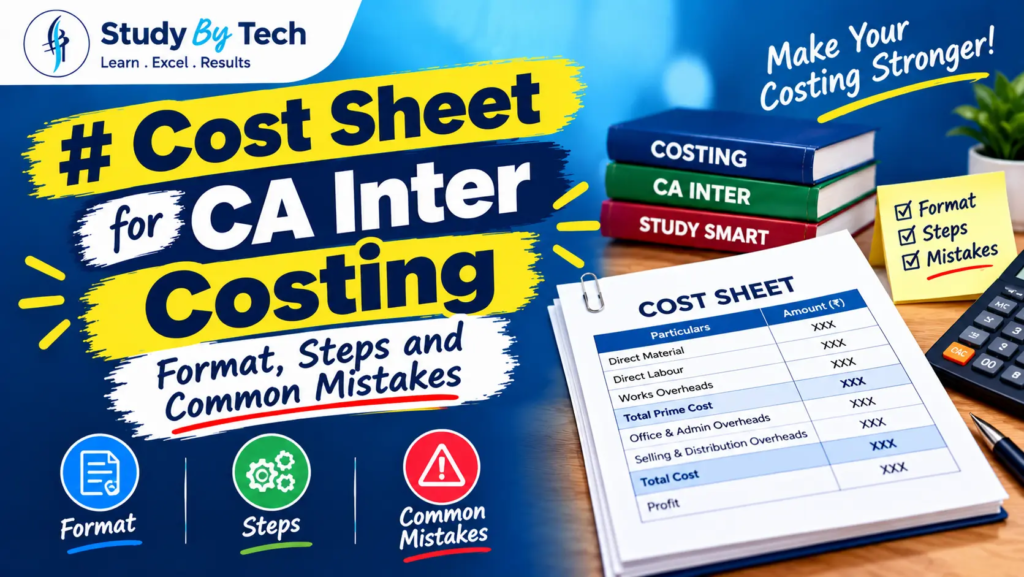
Cost Sheet for CA Inter Costing: Format, Steps and Common Mistakes
Blog, CA Inter

Cost Sheet I CA Inter Costing with Parag Gupta sir

Cost Sheet for CA Inter Costing: Format, Steps and Common Mistakes By Parag Gupta sir, Parag Gupta Classes · Updated October 2026 Join CA Inter Costing classes Watch demo lectures PrimeFactorySales costPrice In short: A cost sheet is a statement that shows the total cost of making a product, built up in stages: prime cost, factory cost, cost of production, cost of goods sold, cost of sales and profit. This guide is for CA Inter students learning the cost sheet in Cost & Management Accounting. You’ll get the format, the step-by-step method, common mistakes and FAQs from Parag Gupta sir. The key takeaway: build it stage by stage and never skip a layer. Table of contents What is a cost sheet? Cost sheet format and flow How to prepare a cost sheet Common mistakes to avoid Resources for CA Inter Cost sheet Why StudyByTech FAQs Key takeaways A cost sheet shows total cost and cost per unit, stage by stage. Prime cost = direct material + direct labour + direct expenses. Each stage adds one type of overhead to the one before it. Stock adjustments (WIP and finished goods) decide the final numbers. Add profit to cost of sales to reach the selling price. Practise with ICAI material, RTPs and MTPs for the CA Inter exam. What is a cost sheet? Think of the cost sheet as a ladder. You start at the bottom with the cheapest, most direct costs. Every step up adds another layer of overheads. At the top, you’ve got the full cost of sales, and profit takes you to the selling price. It’s a core part of CA Inter Costing, and it’s covered in the ICAI Cost & Management Accounting syllabus. Get this one right and the later chapters feel much easier. Why does the CA Inter cost sheet matter? Companies use it to price products, control costs and compare periods. In the exam, it tests whether you can classify costs correctly and keep calm with adjustments. Cost sheet format and flow Here’s the whole cost sheet at a glance. Read it left to right (or top to bottom on your phone). Prime costDirect material + labour + expenses Factory cost+ Factory overheads Cost of production+ Administration overheads Cost of goods sold+ Opening, − closing finished goods Cost of sales+ Selling & distribution overheads SalesCost of sales + profit Stage What you add What you get 1 Direct material, direct labour, direct expenses Prime cost 2 Factory overheads (adjust for opening and closing WIP) Factory cost / works cost 3 Administration overheads Cost of production 4 Opening finished goods less closing finished goods Cost of goods sold 5 Selling and distribution overheads Cost of sales 6 Profit margin Selling price Pro tip: Always show two columns: total cost and cost per unit. Dividing by units at each stage is where easy marks live. How to prepare a cost sheet, step by step Here’s the checklist we follow in class. Tick these off and you won’t miss a thing. Understand cost concepts first Know direct vs indirect, fixed vs variable, semi-variable and opportunity costs. Everything else depends on this. Pick the right format Choose a clear, columnar layout that fits what the question asks. Keep headings and sub-headings neat. Classify every cost Tag each item: direct or indirect, variable or fixed, manufacturing or non-manufacturing. Do this before you calculate. Work out direct costs Direct material: adjust for opening and closing stock. Direct labour: use wage rates, hours and any extra labour costs. Allocate overheads Split factory overheads into variable and fixed. Then spread them fairly across the units you produced. Get cost per unit and price Divide total cost by units. Add your profit margin to reach the selling price, keeping market conditions in mind. Reconcile and document Match the cost sheet with the financial statements. Keep records for every figure so you can explain it. Comply and review Follow the relevant accounting standards. Update the sheet whenever costs or production methods change. Remember, requirements vary by industry and purpose. The stages stay the same, though. Common cost sheet mistakes to avoid Skipping stock adjustments Forget opening or closing WIP and finished goods, and every later figure goes off. Mixing up overheads Factory, administration and selling overheads belong in different stages. Put each one where it should go. Ignoring cost per unit Many questions ask for it directly. Calculate it as you go, not at the end. Resources to master the CA Inter cost sheet Use these together: learn the concept, then practise, then revise. Learn Start with our CA Inter guide, then watch the demo lectures. Watch demos Practise Solve questions from ICAI study material and the latest RTPs and MTPs. Short on time? Start with Parag sir’s hand-picked 59 questions to score 60+ marks. 59 questions PDF for 60+ marksICAI study materialRTP & MTP Revise Short on time? Our last-day costing tips keep the key points in one place. Last-day revision Why StudyByTech for CA Inter Cost? StudyByTech has been a well-known name in CA classes since 2003. Our faculty are experienced professionals. One of the founders is Parag Gupta sir, a well-known faculty for CA Inter Costing and SM, and CA Final Costing. You’ll get organised plans, clear direction and plenty of resources for your CA journey. Ready to start? Pick your batch below. CA Inter Cost & MA classes CA Inter Group 2 classes CA Inter Costing book Cost sheet FAQs for CA Inter What is a cost sheet? A cost sheet is a statement that shows the total cost of a product or job, broken into stages. It starts with prime cost and builds up through factory cost, cost of production and cost of sales. Add profit at the end and you get the selling price. It also shows cost per unit. How does a cost sheet work? You list costs in the order they’re incurred. First add direct material, direct labour and direct expenses to get prime cost. Then add

Cost Saving Secrets Of Relevant Costing: Know Everything About It
Blog, CA Inter

Cost Saving Secrets Of Relevant Costing: Know Everything About It

Relevant Costing: Meaning, Examples and Techniques Explained By CA Parag Gupta | Updated October 2026 | 6 min read Relevant vs irrelevant costMake or buySunk costOpportunity costCA Inter Watch the quick video Relevant costing is a way of making business decisions by looking only at the costs and revenues that change because of that decision. It ignores sunk costs and unavoidable fixed costs. This guide is for CA Inter, CA Final and commerce students who want clear, simple examples. The key takeaway: if a cost stays the same whichever option you pick, leave it out, and compare only the future cash that differs. What’s on this page What is relevant costing? Relevant vs irrelevant costs How relevant costing works Relevant costing techniques Where you’ll use it A worked make-or-buy example Limitations FAQs Key takeaways Relevant costs are future costs that differ between your options. Sunk costs and historical costs never matter for the decision. Fixed costs are irrelevant only if they’re unavoidable. Avoidable fixed costs count. Opportunity costs are relevant, even though no cash leaves your pocket. It powers make-or-buy, special order and shutdown decisions. It looks at numbers only, so weigh quality, people and strategy too. What is relevant costing? Relevant costing is a managerial accounting technique. You use it to decide between alternatives by looking at just the costs and revenues that change with your choice. Everything else is noise. Think of it as a filter. You start with every number you can find. Then you throw out whatever stays the same no matter what you decide. What’s left is what actually drives the decision. It’s used across finance, marketing, production and operations management. And if you’re preparing for CA Inter Cost and Management Accounting, it’s one of the most useful chapters you’ll learn. For a formal definition, see AccountingTools or the Wikipedia entry on relevant cost. Relevant costs vs irrelevant costs Every cost in a decision falls into one of two buckets. Here’s the quick split. Relevant costs Future costs that change with the decision. Variable costs Opportunity costs Incremental costs Avoidable fixed costs Irrelevant costs Costs that stay the same whatever you choose. Sunk costs (already spent) Historical costs Unavoidable fixed costs Allocated overheads that won’t change Cost type Relevant? Why Raw material for a new order Yes You’ll spend it only if you accept the order. Machine bought last year No It’s a sunk cost. You can’t get it back. Rent that stops if you close a unit Yes It’s avoidable, so it changes with the decision. Head-office rent that continues anyway No It’s the same under every option. Profit you give up by using a machine for one job Yes That’s the opportunity cost. How relevant costing works You can run almost any decision through the same six steps. Spot thedecision List youroptions Keep futurecash only Drop whatdoesn’t differ Comparewhat’s left Pick thebest option Relevant costing techniques Differential analysis This is the main tool. You list the relevant costs and revenues for each alternative, then compare them. The cheapest or most profitable option wins. Marginal costing Marginal costing separates fixed and variable costs. It then works out the contribution margin per unit, which is selling price minus variable cost. It’s handy when you’re deciding whether extra units are worth making. Activity-based costing (ABC) ABC assigns indirect costs to products based on the activities that cause them. It isn’t a relevant costing method by itself. But it helps you spot which overheads really change with a decision. Read more on activity-based costing. Where you’ll use relevant costing Make or buy Should you produce a part in-house or outsource it? Compare the avoidable cost of making with the vendor’s price. Special order Should you accept a one-off order at a lower price? If it covers its extra costs and your capacity is idle, it can add profit. Shutdown Should you stop a product or unit? Compare the revenue you’d lose with the costs you’d truly avoid. A real-life example: last-minute train seats Picture a train with a few empty seats just before departure. Once it leaves, those seats earn nothing. Carrying one more passenger adds almost no cost. So the relevant cost of filling a seat is tiny, and even a discounted fare adds revenue. Last-minute seat sales follow exactly this logic. A worked make-or-buy example A company needs 1,000 units of a component. Making it costs the figures below per unit. A vendor offers it at ₹90 per unit. Item (per unit) Make (₹) Buy (₹) Relevant? Direct material 40 – Yes Direct labour 30 – Yes Variable overhead 10 – Yes Allocated fixed overhead (unavoidable) 20 – No Vendor price – 90 Yes Relevant cost per unit 80 90 Make it The ₹20 fixed overhead is there whether you make or buy, so you ignore it. Making saves ₹10 per unit, or ₹10,000 on 1,000 units. If you could rent out the spare capacity for more than ₹10,000, that opportunity cost would flip the answer. Prefer to watch it explained? Watch Parag Sir’s video on YouTube. Limitations of relevant costing It’s powerful, but it isn’t perfect. It assumes everything else stays constant. In real life, prices, demand and capacity keep moving. It focuses on numbers. Quality, brand, staff morale and supplier reliability matter too. It needs good estimates. Future costs are forecasts, and wrong forecasts give wrong answers. So use it as a strong starting point, then add your own judgment on the non-financial side. Relevant costing FAQs What is relevant costing? Relevant costing is a managerial accounting technique that picks out the costs and revenues that change because of a specific decision. You compare only those figures across your options. Businesses use it in finance, marketing, production and operations to decide with confidence. What are some examples of relevant costs? Relevant costs are future costs that differ between options. Variable costs, opportunity costs, incremental costs and avoidable fixed costs are the usual examples. If a cost changes because of your choice, it

Scroll to Top