
Author name: Studybytech

ca foundation books
CA Foundation

Best CA Foundation Books 2026

CA Foundation Classes ICAI Registration Process Subjects, Syllabus & Exam Pattern Admit Card Exam Dates Exam Tips About the faculties FAQ Preparing for the CA Foundation exam can be daunting, but choosing the right study material can simplify the journey significantly. The best approach is to focus on the ICAI study material and past year question papers. Let’s check what CA Parag Gupta sir, who have 20 years of experience in teaching CA students, have to say about this topic: Here’s why these resources are more than enough: ICAI Study Material The Institute of Chartered Accountants of India (ICAI) provides comprehensive study material tailored to the CA Foundation syllabus. This material is meticulously designed to cover every aspect of the exam, ensuring that you grasp the fundamental concepts and applications required. By sticking to the ICAI study material, you align your preparation with the exact expectations of the examiners, reducing the risk of studying irrelevant topics. Past Year Question Papers Analyzing past year question papers is crucial for understanding the exam pattern, frequently asked questions, and the marking scheme. Practicing these papers helps in time management, enhances problem-solving skills, and builds confidence. They also provide insights into important topics and the examiner’s mindset. Avoid Overloading with Additional Books While it might be tempting to refer to supplementary books, this can lead to confusion and neglect of the primary materials. The ICAI study mat and past papers are designed to be comprehensive. Adding more books might overwhelm you and divert your focus from these essential resources. StudyByTech: Enhancing Your CA Foundation Preparation At StudyByTech, we offer CA Foundation classes with exceptional quality through our experienced faculties. We focus on small batches to ensure that each student gets a clear understanding of the concepts. Our commitment is to discuss every small example available in the ICAI study material during our classes, providing thorough and detailed explanations. In conclusion, trust the ICAI study material and past year question papers for your CA Foundation preparation. They are sufficient to help you succeed, ensuring a focused and effective study plan. And for those seeking additional support, StudyByTech is here to guide you every step of the way. FAQ’s

Kano Model
CA Final, CA Final IBS, Self paced online module

The Kano Model of Customer Satisfaction and its Importance

CA Final classes CA Final IBS classes(SPOM-set B portion) StudyByTech Offers Contact us Introduction Customer satisfaction is a cornerstone of successful business strategy. Understanding and addressing the diverse needs and expectations of customers can set a business apart from its competitors. The Kano Model, developed by Dr. Noriaki Kano, provides a valuable framework for categorizing and prioritizing these needs. This blog delves into the intricacies of the Kano Model, exploring its key components—Threshold Attributes, Performance Attributes, Excitement Attributes, and Indifferent Attributes—and highlighting its practical applications in enhancing customer satisfaction. In today’s highly competitive market, businesses strive to understand and meet customer expectations effectively. The Kano Model of Customer Satisfaction, introduced by Japanese quality management guru Dr. Noriaki Kano in the 1980s, offers a systematic approach to achieve this goal. By categorizing product or service attributes based on how they influence customer satisfaction, the Kano Model helps businesses prioritize their development efforts to maximize customer delight and loyalty. Parag Sir’s insight on Kano’s Model Parag Gupta Sir breaks down the intricacies of the Kano Model, explaining its core principles and illustrating its importance in the realm of customer satisfaction and quality management. Watch this video to get a great insight on this topic: https://youtu.be/fyk1KpZ6nwA Product attributes based on Kano’s model Threshold Attributes Threshold Attributes, also known as Basic Attributes or Must-Be Attributes, are the fundamental features that customers expect in a product or service. These attributes are not typically vocalized by customers because their presence is assumed. However, their absence leads to significant dissatisfaction. Performance Attributes Performance Attributes, or One-Dimensional Attributes, are those features that directly correlate with customer satisfaction. The better these attributes perform, the more satisfied the customers will be. Conversely, poor performance in these areas leads to dissatisfaction. Using the smartphone example again, performance attributes might include camera quality, processing speed, and screen resolution. Enhancing these attributes generally leads to higher customer satisfaction because customers can clearly see the benefits and improvements. Businesses should focus on continuously improving these attributes to stay competitive. Excitement Attributes Excitement Attributes, also known as Attractive Attributes, are the features that surprise and delight customers. These are unexpected and not typically demanded by customers, but their presence generates significant satisfaction. Conversely, their absence does not cause dissatisfaction because customers do not expect them. For instance, an innovative facial recognition feature in a smartphone can be considered an Excitement Attribute. When first introduced, it wasn’t an expected feature, but it created a “wow” factor and set the product apart from its competitors. Investing in these attributes can turn customers into enthusiastic promoters of the product or service. Indifferent Attributes Indifferent Attributes are features that neither contribute to customer satisfaction nor cause dissatisfaction. These attributes have little to no impact on how customers perceive the product or service. An example might be the color of the internal components of a smartphone. Most customers are indifferent to such aspects as they do not affect the user experience. Identifying and minimizing resources spent on Indifferent Attributes can help businesses allocate their efforts more effectively towards attributes that enhance customer satisfaction. Uses The Kano Model serves multiple purposes in the realm of customer satisfaction and product development: Conclusion The Kano Model of Customer Satisfaction is a powerful tool for understanding and prioritizing customer needs. By categorizing features into Threshold, Performance, Excitement, and Indifferent Attributes, businesses can strategically enhance their offerings to maximize customer satisfaction and loyalty. Utilizing the Kano Model can lead to more effective resource allocation, better strategic planning, and ultimately, a stronger competitive advantage in the market. In an era where customer expectations are constantly evolving, the Kano Model provides a structured approach to staying ahead and continuously delighting customers. FAQ’s

CA Foundation Law Syllabus Sept 2026
Blog, CA Foundation, ca foundation law

CA Foundation Law Syllabus 2026 (Latest ICAI Update) – Complete Guide for Sept 2026

CA Foundation Classes ICAI Registration Process Subjects, Syllabus & Exam Pattern Admit Card Exam Dates Exam Tips About the faculties FAQ’s 📌 Key Takeaways – CA Foundation Law Syllabus (Sept 2026) What every CA Foundation aspirant must know 1 Complete Syllabus for Sept 2026Paper 2: Business Laws (100 marks, subjective). Covers 7 key acts – Indian Contract Act (highest weightage: 25-30 marks), Sale of Goods, Partnership, LLP, Companies Act 2013, Negotiable Instruments, and Indian Regulatory Framework. 2 Exam Pattern & Passing Criteria40% marks required in Law (40 out of 100) and 50% aggregate across all Foundation papers. Important Update: BCR (Business Communication) is removed. Law is now a full 100-mark paper. 3 Smart Study Strategy to Score 70+Focus on Contract Act, Companies Act & Partnership Act (cover 65-70% of paper). Practice case studies daily using Provision-Analysis-Conclusion format. Use legal keywords like “Consensus-ad-idem” for step-marking. Don’t skip the ICAI module. 📖 Paper Name: Business Laws 🎯 Total Marks: 100 (Subjective) 📅 Target Exam: Sept 2026 ⭐ Highest Weightage: Indian Contract Act (25-30 marks) 📘 Download Syllabus PDF: Click here for future reference Introduction If you’re preparing for CA Foundation Sept 2026, one mistake most students make is starting preparation without fully understanding the syllabus. And trust me — in Law, that’s dangerous. Because this subject is not about mugging up sections… It’s about understanding concepts + applying them in case studies. So in this blog, let’s break down the latest CA Foundation Law syllabus (2026) in the simplest way possible. CA Foundation Law Paper Overview 👉 Important update: Earlier BCR (Business Communication) was included, but now Law is a full 100-mark paper, making conceptual clarity even more important. CA Foundation Law Syllabus 2026 (Chapter-wise) 1. Indian Regulatory Framework 👉 This is introductory but important for building base. 2. The Indian Contract Act, 1872 (MOST IMPORTANT 🔥) This is the heart of your syllabus. Key topics: 👉 Exam Reality: This chapter alone can carry 40–50% weightage. 3. Sale of Goods Act, 1930 👉 Case-study based questions are very common here. 4. Indian Partnership Act, 1932 5. Limited Liability Partnership (LLP) Act, 2008 6. Companies Act, 2013 👉 Students usually ignore this — but ICAI doesn’t. 7. Negotiable Instruments Act, 1881 Topic-Wise Weightage Strategy Chapter Name Topics Covered Expected Weightage 1. Indian Regulatory Framework Regulatory Bodies (MCA, SEBI, RBI, IBBI) 0 – 5 Marks 2. The Indian Contract Act, 1872 Nature of Contract, Consideration, Indemnity, Guarantee, Bailment 25 – 30 Marks 3. The Sale of Goods Act, 1930 Formation, Conditions & Warranties, Unpaid Seller 15 – 20 Marks 4. The Indian Partnership Act, 1932 Nature of Partnership, Relations, Dissolution 15 – 20 Marks 5. The LLP Act, 2008 Incorporation, Characteristics of LLP 5 – 10 Marks 6. The Companies Act, 2013 Incorporation, MOA, AOA, Corporate Veil 15 – 20 Marks 7. Negotiable Instruments Act, 1881 Meaning, Classification, Dishonour of Cheques 10 – 15 Marks High Priority (Focus 60% of your time): Medium Priority (30% time): Lower Priority (10% time): To Download PDF for future reference, click here Study Strategy: How to Score 70+ in Law Smart Study Strategy for Law (2026) 1. Don’t skip ICAI module Most tricky questions come directly from module examples. 2. Focus on keyword ICAI gives marks for: 3. Practice case studies daily Law is not reading — it’s application. 4. Revise multiple times CA Foundation is more about revision than intelligence Common mistakes students makes- Final Words CA Foundation Law is not difficult — but it is tricky. If you: 👉 You can easily score 60+ marks. FAQ’s

CA Inter Costing
Blogs, CA Inter, Costing

Process Costing: CA Inter Costing | May 24 Suggested Answers

Introduction to CA Inter Costing Classes by Parag Gupta Sir Parag Gupta Sir is renowned for his exceptional CA Inter Costing classes. With a focus on comprehensive understanding and practical application, his teachings ensure students excel in their exams. One of the critical components of the CA Inter May 24 Costing paper is Process Costing, specifically Question 4A. This blog delves into the suggested answer for this question, providing insights that align with Parag Gupta Sir’s teaching methodology. Understanding Q-4a Process Costing in CA Inter May 24 Costing Process Costing is a method used in industries where production is continuous, and the products pass through multiple stages or processes. It accumulates costs for each process and assigns them to units produced. This method is crucial for industries like chemicals, textiles, and oil refining. Key Components of Process Costing Step-by-Step Solution Example Problem Breakdown Given Data: Calculation: By applying these calculations, students can accurately allocate costs and understand the intricacies of Process Costing. Click here to see the all suggested answer for CA Inter Sept 25 Benefits of Parag Gupta Sir’s Classes Comprehensive Coverage Parag Gupta Sir’s classes provide in-depth coverage of all CA Inter Costing topics, including Process Costing. His structured approach ensures students grasp each concept thoroughly. Practical Examples His teaching includes numerous practical examples, mirroring the type of questions found in the CA Inter exams. This prepares students to tackle similar problems with confidence. Detailed Solutions Every problem is broken down step-by-step, as seen in the suggested answer for Q 4A. This methodical approach helps students follow along easily and understand the logic behind each step. Interactive Learning Classes are interactive, encouraging students to ask questions and engage with the material. This active participation enhances understanding and retention of complex concepts. Conclusion Mastering Process Costing is essential for success in the CA Inter Costing exam. Parag Gupta Sir’s classes offer the ideal preparation, providing detailed explanations, practical examples, and interactive learning opportunities. By following his guidance, students can confidently approach their exams and excel in their CA journey. FAQs

Avoid These 5 Mistakes in Process Costing by Parag Gupta
CA classes

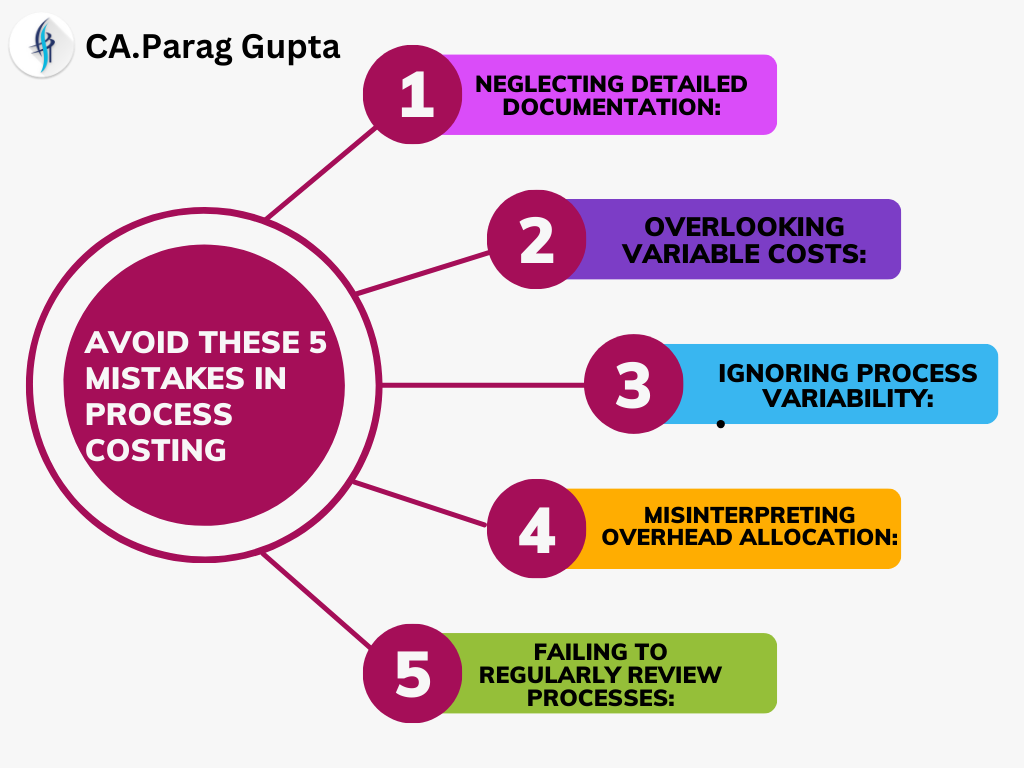
Avoid these 5 Mistakes in CA Inter Process Costing I By Parag Gupta sir

CA Inter Classes ICAI Registration Process, Fees, & Syllabus Admit Card Exam Dates Study Guides & Tips CA Inter faculties FAQ Introduction Process costing is a vital aspect of cost accounting, enabling businesses to allocate costs accurately and make informed decisions. However, mastering process costing can be challenging, and even small mistakes can lead to significant errors in financial data. In this blog post, we’ll delve into five common mistakes in process costing, drawing insights from the expertise of Parag Gupta, a renowned authority in the field of accounting and finance. Want to understand more about Process Costing in depth, read this. 5 mistakes to avoid in Process Costing at CA Inter level are: https://youtu.be/aApMURGSlNA 5 tips to avoid mistakes in Process Costing by Parag Gupta sir: Tips Description 1. Detailed Documentation Maintain thorough records of production costs incurred at each stage to ensure accurate cost allocations and financial reporting. 2. Consider Variable Costs Identify and account for fluctuating costs associated with production processes to avoid skewed cost calculations and inaccurate profitability assessments. 3. Address Process Variability Recognize variations in production processes and adjust cost allocation methods accordingly to ensure accurate cost estimations. 4. Accurate Overhead Allocation Allocate overhead costs correctly to prevent distorted product costs and ensure reliable profitability analysis. 5. Regular Process Review Periodically review and update process costing methods to adapt to changing business dynamics and optimize cost allocation for improved performance. These tips provide actionable advice to help businesses avoid common mistakes and enhance the accuracy of process costing. Conclusion Process costing is a critical tool for businesses to determine product costs and make informed decisions. By avoiding these five mistakes outlined by Parag Gupta, organizations can enhance the accuracy of their process costing data and improve overall financial performance. Remember to prioritize detailed documentation, account for variable costs, address process variability, allocate overhead costs accurately, and regularly review and refine costing processes for optimal results. FAQ’S Want to Enroll to our classes?

Best CA Foundation Classes in Delhi
Blog, CA classes, CA Foundation

CA Foundation Classes in Delhi (2026) – Best Coaching for Real Results

Facebook Twitter Youtube Telegram Youtube Whatsapp Instagram Pinterest Linkedin The “First Attempt” Roadmap: Why your CA Foundation journey should starts at StudyByTech- Delhi CA Foundation Classes ICAI Registration Process Subjects, Syllabus & Exam Pattern Admit Card Exam Dates Exam Tips About the faculties FAQ’s 📌 Key Takeaways – CA Foundation Classes in Delhi (2026) What makes StudyByTech the smart choice for your CA journey 1Complete Foundation Coverage (New ICAI Scheme 2026)All 4 subjects – Principles & Practice of Accounting, Business Laws, Business Mathematics (LR & Stats), and Business Economics. 100% syllabus aligned with the latest ICAI pattern. Focus on conceptual clarity, not rote learning.2Learn from an Insider – CA Parag Gupta & Expert TeamMentored by CA Parag Gupta Sir (20+ years experience, Ex-Examiner). Learn how exam papers are checked. Faculty team personally chosen by him for deep subject expertise.3Personalized Support + Flexible Modes (Offline/Online)Small batch sizes in Delhi (Laxmi Nagar) for personalized attention. Choose Face-to-Face, Live Online, or Recorded classes. Direct WhatsApp & call support – doubts don’t wait for class hours. 📍 Location: Laxmi Nagar, Delhi (Offline)💻 Modes: Offline | Live Online | Recorded🎓 Target: CA Foundation 2026📞 Free Demo: +91 9968875529 🎯 Want to experience the difference? Call now or book your FREE demo class – No sales pitch, just pure learning. <h2>Why CA Foundation Coaching Matters More Than You Think</h2> <p data-path-to-node="4">Let’s be real—the moment you register for the CA Foundation, the pressure starts. You aren’t just looking for "classes"; you’re looking for a way to survive the most grueling professional course in India without losing your mind.</p><p data-path-to-node="5">In a city like Delhi, where every street corner in Laxmi Nagar promises a "Rank 1," it’s easy to feel like just another enrollment number in a massive hall. At <b data-path-to-node="5" data-index-in-node="160">StudyByTech</b>, we do things differently. We don't run a factory; we run a mentorship.</p><p data-start="951" data-end="1062">Many students believe they can prepare on their own. But CA Foundation is not just about studying — it’s about:</p><ul><li>Understanding ICAI exam patterns</li><li>Practicing the right questions</li><li>Avoiding common mistakes</li><li>Managing time during exams</li></ul><p data-start="1197" data-end="1237">Without proper guidance, students often:</p><ul data-start="1238" data-end="1334"><li data-section-id="1utxfzm" data-start="1238" data-end="1273">Waste time on irrelevant topics</li><li data-section-id="y4u6xo" data-start="1274" data-end="1301">Skip important concepts</li><li data-section-id="1j36c02" data-start="1302" data-end="1334">Lose confidence before exams</li></ul> <h2>Why StudyByTech is Among the Best CA Foundation Classes in Delhi</h2> <img width="1024" height="572" src="https://www.paraggupta.com/wp-content/uploads/2024/05/best-ca-foundation-classes-in-delhi-studybytech-1024×572.webp" alt="Best CA Foundation classes in Delhi- StudyByTech" srcset="https://www.paraggupta.com/wp-content/uploads/2024/05/best-ca-foundation-classes-in-delhi-studybytech-1024×572.webp 1024w, https://www.paraggupta.com/wp-content/uploads/2024/05/best-ca-foundation-classes-in-delhi-studybytech-300×167.webp 300w, https://www.paraggupta.com/wp-content/uploads/2024/05/best-ca-foundation-classes-in-delhi-studybytech-768×429.webp 768w, https://www.paraggupta.com/wp-content/uploads/2024/05/best-ca-foundation-classes-in-delhi-studybytech-600×335.webp 600w, https://www.paraggupta.com/wp-content/uploads/best-ca-foundation-classes-in-delhi-studybytech.webp 1376w" sizes="(max-width: 1024px) 100vw, 1024px" /> <h3 data-path-to-node="6"><b data-path-to-node="6" data-index-in-node="0">1. You aren't learning from a "Teacher"—You're learning from an Insider</b></h3><b data-path-to-node="6" data-index-in-node="0"> </b><p data-path-to-node="7">Most institutes give you a teacher who has mastered the textbook. At StudyByTech, you get mentor <b data-path-to-node="7" data-index-in-node="97">CA Parag Gupta sir(one of the reknowned faculty for CA Inter Costing &amp; CA Final Costing)</b>. He has an experience of more than 20 years in teaching industry and also was an <strong>Ex-examiner.</strong> At StudyByTech, He &amp; his team of CA foundation makes sure that each of you shall understand the concepts &amp; is able to present it in the proper format as required by ICAI formats. Each faculty is chosen by Parag Gupta sir himself on the basis of knowledge &amp; expertise in their subjects.</p><p data-path-to-node="8">Why does that matter? Because Parag Sir has seen the CA world from the inside—including the examiner's perspective. He doesn’t just teach you how to solve a problem; he teaches you <b data-path-to-node="8" data-index-in-node="181">how the paper is checked.</b> When you know what the examiner is looking for, the "fear of the unknown" disappears.</p><h3 data-path-to-node="9"><b data-path-to-node="9" data-index-in-node="0">2. Conceptual Clarity: No more "Rote Learning" nightmares</b></h3><p data-path-to-node="10">The ICAI 2026 New Scheme has one clear message: <i data-path-to-node="10" data-index-in-node="48">If you memorize, you fail. If you understand, you fly.</i></p><p data-path-to-node="11">We don't believe in "ratta-mar" (rote learning). Whether it’s the intricacies of Business Law or the logic behind a Balance Sheet, we break it down until it clicks.</p><ul data-path-to-node="12"><li><p data-path-to-node="12,0,0"><b data-path-to-node="12,0,0" data-index-in-node="0">The "Aha!" Moment:</b> We strive for that second in class where a student says, <i data-path-to-node="12,0,0" data-index-in-node="76">"Oh, so THAT'S why we do this!"</i> That is where a Chartered Accountant is born.</p></li></ul><h3 data-path-to-node="13"><b data-path-to-node="13" data-index-in-node="0">3. Because Doubts don't wait for "Class Hours"</b></h3><p data-path-to-node="14">Imagine it’s 8:30 PM. You’re deep into your revision, and a single adjustment in an Accounts problem is driving you crazy. In a traditional coaching setup, you’d have to wait days to ask that question.<strong> A direct call to faculties</strong> is one the feature which is actually required to help you stay motivated during your studies.</p><p data-path-to-node="15"><b data-path-to-node="15" data-index-in-node="0">At StudyByTech, we’re in your pocket.</b> Through our dedicated WhatsApp support, your momentum stays unbroken. We provide a safety net that ensures you never feel alone in your room while studying.</p><h3 data-path-to-node="16"><b data-path-to-node="16" data-index-in-node="0">4. Small Batches = Personalized Growth</b></h3><p data-path-to-node="17">We’ve all seen those "mega-batches" where the teacher is a tiny dot on a distant stage. That’s not education; that’s a concert.</p><p data-path-to-node="18">We keep our batches in Delhi intentionally sized so that:</p><ul data-path-to-node="19"><li><p data-path-to-node="19,0,0">Every question you ask is heard.</p></li><li><p data-path-to-node="19,1,0">Every mock test you give is analyzed personally.</p></li><li><p data-path-to-node="19,2,0">You get a customized study plan that fits <i data-path-to-node="19,2,0" data-index-in-node="42">your</i> pace, not the crowd's.</p></li></ul><h3 data-path-to-node="20"><b data-path-to-node="20" data-index-in-node="0">5. Your Success is Our Only Metric</b></h3><p data-path-to-node="21">We don’t measure our success by how many posters we print, but by how many of our students clear their Foundation on the <b data-path-to-node="21" data-index-in-node="121">first attempt.</b> Whether you join us Face-to-Face in Delhi or via our Live-Streamed classes, you get the same energy, the same rigor, and the same dedication.</p> <h2>Subjects Covered in CA Foundation Coaching</h2> <ul data-start="2525" data-end="2662"> Principles & Practice of Accounting Business Laws Business Mathematics, Logical Reasoning & Statistics Business Economics Each subject requires a different strategy — and that’s exactly what proper coaching provides. <h2>Online vs Offline CA Foundation Classes in Delhi</h2> <h4 data-section-id=”8q2ben” data-start=”2818″ data-end=”2837″>Offline Classes</h4><ul data-start=”2838″ data-end=”2914″><li data-section-id=”12gmk9e” data-start=”2838″ data-end=”2859″>Better discipline</li><li data-section-id=”ikuqx” data-start=”2860″ data-end=”2888″>Face-to-face interaction</li><li data-section-id=”1h9oarw” data-start=”2889″ data-end=”2914″>Classroom environment</li></ul><h4 data-section-id=”1irhlwx” data-start=”2916″ data-end=”2934″>Online Classes</h4><ul data-start=”2935″ data-end=”3009″><li data-section-id=”1qmedyp” data-start=”2935″ data-end=”2958″>Learn from anywhere</li><li data-section-id=”11db3no” data-start=”2959″ data-end=”2979″>Save travel time</li><li data-section-id=”18biez5″ data-start=”2980″ data-end=”3009″>Access recordings anytime</li></ul><p data-start=”3011″ data-end=”3078″>👉 <strong data-start=”3014″ data-end=”3030″>Best choice?</strong> A coaching that offers both — like StudyByTech.</p> <h2>Final Words</h2> <p

CA Inter costing process costing by parag gupta
CA Inter, Costing

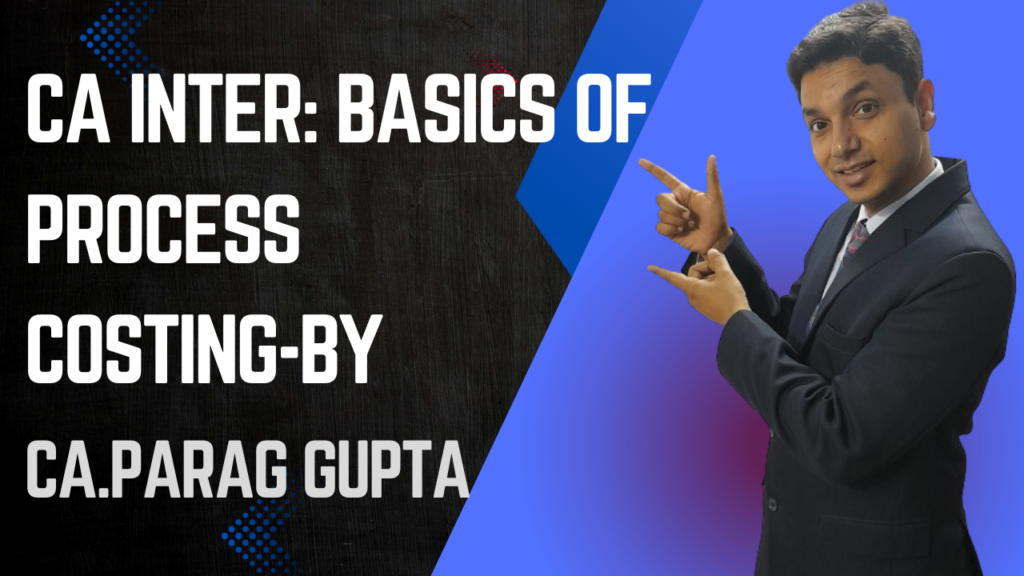
CA Inter : Basic of Process Costing by CA Parag Gupta

CA Inter Classes ICAI Registration Process, Fees, & Syllabus Admit Card Exam Dates Study Guides & Tips CA Inter faculties FAQ This method provides a structured approach to allocate costs to products in a manufacturing environment where goods are produced in a continuous process. In this blog, we delve into the basics of process costing, as elucidated by CA Parag Gupta. Definition: Process costing is a method used to determine the cost of producing a product by assigning costs to each stage of the production process. Key Elements: Detailed explanation: Process costing is a managerial accounting method used to determine the cost of producing a product in a continuous production environment. It involves accumulating costs in various production departments or processes, including direct materials, direct labor, and manufacturing overhead. These costs are then allocated to units produced during a specific period based on the number of units completed or their stage of completion. Equivalent units are calculated to account for partially completed units, allowing for accurate cost allocation. The cost per equivalent unit is determined by dividing the total cost incurred in a department by the equivalent units. Finally, costs from different departments are reconciled to ensure accuracy. Process costing offers simplicity and efficiency in cost allocation, making it suitable for industries with standardized production processes like food and beverage, chemicals, and textiles. It enables businesses to estimate costs accurately, control costs, and evaluate departmental performance for informed decision-making. https://youtu.be/06Fc3tK2rPc When to use it ? Process costing is used for several reasons, making it a valuable tool in managerial accounting for industries with continuous production processes: Conclusion Process costing, as elucidated by experts like CA Parag Gupta, is a vital tool for businesses engaged in manufacturing processes. By systematically allocating costs to each stage of production, process costing provides valuable insights into the cost of production, facilitates cost control, and aids in performance evaluation. With its widespread applications across industries, understanding the basics of process costing is essential for effective managerial decision-making and financial management in manufacturing businesses. FAQ’S

Learn Income Tax Act Section 87A basics with StudyByTech. Smartly grasp essentials for optimal financial decisions. Explore expert-led courses now.
CA classes

How to Understand the Section 87A Income Tax Act

CA Foundation Classes CA Inter Classes CA Final Classes StudyByTech Offers Contact us The intricacies of the Income Tax Act Section 87A can often seem like a labyrinth of legal jargon, leaving individuals bewildered. However, understanding the basics of this significant legislation is not only empowering but crucial for making informed financial decisions. In this quest for knowledge, StudyByTech emerges as a beacon, providing expert guidance through online and offline classes for aspiring Chartered Accountants. Understanding the Basics Income Tax Act Section 87A The Income Tax Act is a comprehensive document that governs taxation in India. To navigate its complexities, one must start with the basics. For resident individuals with a total income not exceeding Rs. 5,00,000, there’s a golden opportunity to claim a rebate under Section 87A. This provision can significantly reduce tax liabilities, and understanding its nuances is a smart move for individuals seeking financial optimization. Tactful and Smart Studying: Embarking on the journey to comprehend tax laws demands a tactful and smart approach. At StudyByTech, we take pride in offering courses designed to simplify complex subjects. Our classes, both online and offline, feature expert faculties covering all subjects under the guidance of seasoned professionals. This ensures that students not only understand the basics of the Income Tax Act but also gain a tactical edge in applying this knowledge. Individual Attention for Optimal Results: StudyByTech goes beyond conventional teaching methods. We understand that each student has unique needs and learning styles. Therefore, our approach revolves around providing individual attention to ensure the best results. This personalized touch ensures that our students grasp the intricacies of the Income Tax Act effectively. Empowering Your Tax Journey: Tackling the Income Tax Act is a strategic process, and StudyByTech is here to guide you through it. Our courses are meticulously designed to empower you with both knowledge and practical application. Choose StudyByTech for a comprehensive understanding of tax laws, where individual attention meets expertise. Conclusion: As you embark on the journey to comprehend the basics of the Income Tax Act, remember that a tactful and smart approach is key. StudyByTech offers the ideal platform for aspiring Chartered Accountants, providing the necessary tools to navigate through complex tax provisions. Empower yourself with financial wisdom – choose StudyByTech and step confidently into the world of taxation. Your success is our priority. FAQ’S

CA Inter Tax
Blog, CA Inter

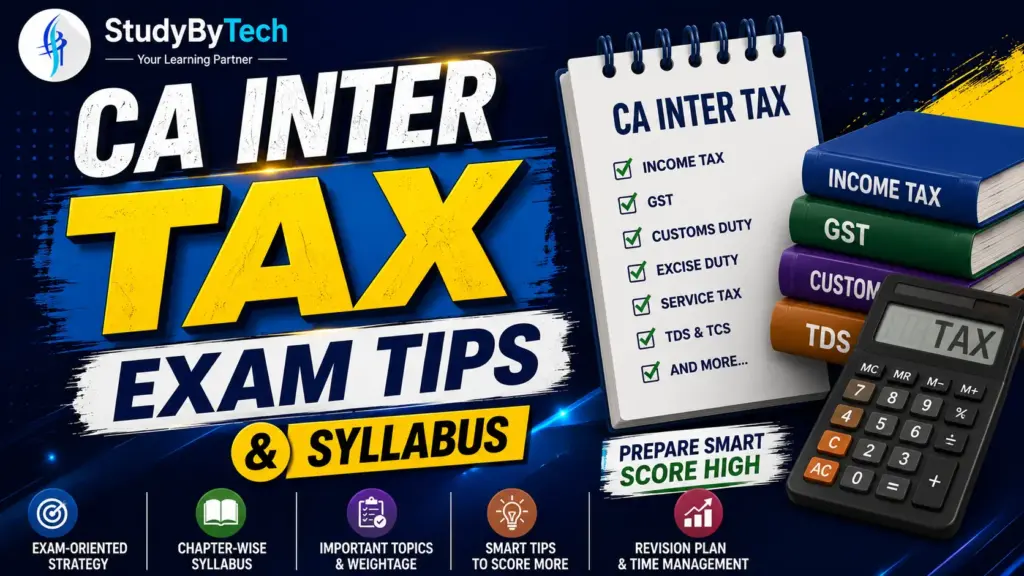
How to Master CA Inter Tax: Complete Syllabus, ABC Analysis & Exam Tips & Tricks (Jan 2027 Exams) 🎯 Your ultimate strategy guide — For Income-tax Law & GST. No fluff, just the right plan. 📑 Table of Contents Overview & Strategy 1. CA Inter Tax Overview (Jan 2027) 2. Chapter-Wise Weightage & Revision Strategy 3. Strategic ABC Analysis for Smart Preparation Exam Tips & Tricks 4. Practical Study Tips & Exam Tricks 5. Key Pitfalls to Avoid Faculty & Final Push 6. Learn from the Best Faculty Ready to Top in Your First Attempt? FAQ Frequently Asked Questions ⭐ Key Takeaways Balanced Paper: Income-tax (50 Marks) + GST (50 Marks) — both need equal attention. ABC Analysis: Focus 70% of your time on Category A topics that carry ~60% marks. 4-Step Answer Format: Statute → Rule → Application → Final Answer. Gets you partial marks. Time Allocation: 15 min reading → 20 min MCQs → 60 min GST → 100 min Direct Tax. Working Notes = Marks: Write assumptions clearly (e.g., tax regime under Sec 115BAC). Stick to One Resource: Avoid switching between too many books; creates visual memory. Cite Sections: Mentioning section numbers (like Sec 54, Sec 17(5)) fetches full marks. 1. CA Inter Tax Overview (Jan 2027 Syllabus Structure) Under the ICAI Scheme, Paper 3: Taxation is divided into two balanced sections totaling 100 marks: Section Focus Area Marks Key Objective Section A Income-tax Law (Direct Tax) 50 Marks Develop conceptual clarity & compute total income under various heads. Section B Goods and Services Tax (Indirect Tax) 50 Marks Master provisions of CGST & IGST, ITC rules, and procedural compliance. 📌 Reminder for Jan 2027: Adhere to the latest study materials published by ICAI for Part A (Income tax Law) and Part B (GST), which are tailored with the necessary Fin. Act modifications and statutory updates relevant to 2027. 2. Chapter-Wise Weightage & Revision Strategy To maximize your score, prioritize topics based on their historical exam weightage and difficulty level. Section A: Income-tax Law (50 Marks) Chapter / Topic Expected Marks Priority Key Focus Areas Computation of Total Income & Tax Liability 10 – 12 A Comprehensive problems combining multiple heads, AMT, and special rates. Heads of Income (PGBP & Capital Gains) 10 – 14 A Sec 54 exemptions, Indexation, Disallowances under Sec 40/40A, Presumptive taxation. Heads of Income (Salaries, HP, Other Sources) 8 – 12 B Perquisites, Deduction under Sec 24, Gift provisions under Sec 56(2)(x). TDS, TCS & Advance Tax 6 – 8 A Sec 194-IA, 194-IB, 194R, 194Q, Advance tax due dates, interest calculations. Deductions from GTI (Chapter VI-A) 6 – 8 B Sec 80C, 80D, 80DD, 80G, 80JJAA, and 80TTA/80TTB. Clubbing, Set-off & Carry Forward 6 – 8 B Order of set-off, loss carry-forward limits, minor child income clubbing. Residential Status & Scope of Total Income 4 – 6 C Deemed resident rules, taxable income based on residential status. Return of Income & Self-Assessment 4 – 6 C Updated return (Sec 139(8A)), due dates, fee for late filing (Sec 234F). Section B: Goods and Services Tax – GST (50 Marks) Chapter / Topic Expected Marks Priority Key Focus Areas Input Tax Credit (ITC) 10 – 12 A Blocked credit (Sec 17(5)), apportionment rules, ITC utilization order. Time & Value of Supply 8 – 10 A Sec 12 & 13, Valuation rules, discounts, voucher treatments. Supply under GST & Charge of GST 6 – 8 A Schedule I, II, III, Reverse Charge Mechanism (RCM) applicability. Exemptions from GST 6 – 8 B Healthcare, education, passenger transport, agricultural services. Tax Invoice, Debit/Credit Notes, E-Way Bill 6 – 8 B E-invoicing thresholds, e-way bill validity & exceptions. Registration & Payment of Tax 4 – 6 C Mandatory registration threshold limits, interest on delayed payment. GST Returns 2 – 4 C GSTR-1, GSTR-3B due dates, QRMP scheme features. 3. Strategic ABC Analysis for Smart Preparation Segment your CA Intermediate Tax syllabus into three main parts to use 70% of your time on significant issues: Category A High ~60% Marks Direct Tax: PGBP, Capital Gains, Total Income Computation, TDS/TCS. GST: Input Tax Credit (ITC), Supply under GST, Time and Value of Supply. Category B Moderate ~30% Marks Direct Tax: Salaries, Deductions (Chapter VI-A), Offsetting and Carry Over of Losses. GST: Exemptions, Tax Invoice and E-way Bills, Payment of Tax. Category C Low ~10% Marks Direct Tax: Fundamental Ideas, Residential Status, Rules of Filing Returns. GST: Basic Overview, Registration of GST, Basic Return Filing. 4. Practical CA Inter Tax Study Tips & Exam Tricks 1. Master the 4-Step Answer Presentation Format Step 1: Reference to the relevant statute Step 2: Explaining the relevant exemption/rule/limitation Step 3: Application with appropriate figures Step 4: Final answer with tax liability 2. Time Allocation Strategy for the 3-Hour Exam ⏰ 15 min (Reading): Rapidly review the paper, decide which optional question to skip, identify easy MCQs and GST questions. ⏰ 20 min (MCQs): Solve 30 marks of MCQs quickly while your mind is fresh. ⏰ 60 min (Section B – GST): GST questions are clear, simple and easily scorable. ⏰ 100 min (Section A – Income-tax): Start with smaller heads, then go for the big Total Income question. 5. Key Pitfalls to Avoid ❌ Forgetting Working Notes Every Working Note provides marks of somewhere between 0.5 and 1.5. Make sure to write down assumptions clearly (e.g., whether a taxpayer has chosen the default/new tax regime under Section 115BAC). ❌ Jumping from one book to another Stick to the study resources of Jain and other reputed faculties. Too much switching leads to confusion; revising one resource helps create visual memory. ❌ Not citing sections and notifications The mention of section numbers (like Section 54, Section 17(5), etc.) is helpful in ensuring precise compliance and getting full marks. 6. Learn from the Best Faculty Of CA Inter Tax For having flawless conceptual clarity, simplifying complex tax laws, and making excellent exam-oriented teaching, the choice of right mentor is very essential. CA Sachinn Gupta –

ICAI CA Inter Best Coaching In India, contact for demo lecture
Blog, CA Inter

ICAI CA Inter Best Coaching In India

CA Inter Classes ICAI Registration Process, Fees, & Syllabus Admit Card Exam Dates Study Guides & Tips CA Inter faculties FAQ Revealing the Best Training for CA Inter by StudyByTech Do you want to do well in your CA Inter examinations? StudyByTech is the place to go for unparalleled coaching that will help you achieve your goals. Parag Gupta sir is the undisputed leader in high quality education for CA Inter, committed to it’s cause of academic excellence and producing highest calibre students. Why Choose StudyByTech for CA Inter Preparation? At StudyByTech we understand the importance of value education in shaping the future of aspiring Chartered Accounters. We are the best among the regular bogging coaching institutes for following reasons: Exceptional Faculty Our faculty, headed by the acclaimed Parag Gupta Sir, comprises industry experts and experienced professors who have an ocean of accounting knowledge and exposure. Focusing on logical lucidity and practical usability, our professors ensure that students imbibe difficult concepts with ease. Comprehensive Curriculum Students will get the in-depth knowledge on important topics of accounting, law, taxation and more through our exhaustive curriculum that covers the entire CA Inter syllabus. Through a mix of intuitive talks, complete review material, and normal evaluations, we outfit understudies with the abilities and information expected to succeed in their assessments. Personalized Attention Because we are convinced that individual attention can have a powerful impact, we keep class sizes small to encourage more interaction between students and teachers. To ensure that each student receives the support they need to succeed, our approachable instructors are always available to answer questions, offer direction, and serve as mentors. Conclusion Try not to agree to anything short of the best with regards to your CA preparation planning. Join StudyByTech(an initiative by Parag Gupta sir) and leave on a way to progress that is cleared with greatness, devotion, and unflinching obligation to your intellectual and expert development. Join us right away to help you reach your full potential in the accounting industry. FAQ’s

Scroll to Top