CA Inter

CA Parag Gupta is one of the pioneers in the Teaching industry for CA Inter and is considered the best faculty in the world of CA Inter Course Costing and SM.

HOW TO OVERCOME FEAR OF FAILURE IN CA EXAM
Blog, CA Course, CA Final, CA Foundation, CA Inter

How to Overcome fear of failing in CA Exam 2024

What is fear of failing? Fear is not about what is happening in present but Is all about what will happen in the future. We all know the future is Unexpected but still, people fear when they imagine the Worst & dangerous scenarios for any situation, without noticing the positive expect of the event. The main point here is that our fears are just our imagination of the worst possible scenarios, not reality. When we start believing our imagination as reality then we will have fear of failure. WHAT IS EXAM ANXIETY? It’s ok to be anxious before an exam, We all are. But for some people, the experience can be afflicting. Lack of focus, fast heart rate, headache, shallow breathing – all these are symptoms of exam anxiety. But, as we said before, Why do some people fear exams? why does this happen? CAUSES OF FEAR OF FAILURE There are many reasons due to which people can be afraid to fail the CA exams or have fear of failing. Before you know how to Conquer your fear of failure in exams, but first you need to know how deep the fear is in you and why you feel it. The reason for fear of failing can be due to a shocking event or poor experience. For example, you have performed poorly in a class test, and you are afraid that same will happen in the next test also, That possible scenario causes fear in you. students are afraid mostly because of How society thinks about them, how low their friends think if they score low or fail in exams. fear could be rooted Deep because students are afraid of how disappointed their parents and family members will be with them if they fail in exams. Another reason for failure in exams could be wrong decisions taken by students. For example, a common reason CA students fail in exams is because they make wrong decisions related to their future. Like selecting both groups when they could only do one, selecting the wrong study material, for Example- Selecting AMA over SCMPE, etc. As compared to other situations, students’ fear is justified if they are nervous because they have not learned anything or learned just a few topics for the exam, but you still shouldn’t let it control you HOW DOES FEAR OF FAILING AFFECT STUDENTS? If we let this fear of failing exams control us, it can affect us deeply. and Due to this fear. Our mind and body will take unwanted and unnecessary stress. Whenever we try to study, we will be uneasy, and our time which should be spent studying with concentration will be wasted on negative thoughts. We will waste time and delay our studies besides studying hard for exams. we will waste our time procrastinating. Even if we could have achieved our goals and passed the exams, this fear leads you to waste more precious time. This fear will take us away from the chance to perform and we will give up before trying and the result would be different than what we imagined. If we feel this fear because of peer pressure this fear will also become the reason for low self-esteem. The fear of failing can also affect students who have done enough preparation for exams and can score well. If students have read all the chapters and prepared a full syllabus but before the exam student let fear take over their minds, this will make their thinking process block. Regardless of their preparation, students will still perform very poorly in exams. THINGS TO DO TO REMAIN CALM Preparation is The Key This is the main factor for fear of failing in exams. Number One Reason for exam stress is weak preparation. So, prepare good and go through all of the study material with full understanding, Review all the important Concepts thoroughly.If you prepare well then you will walk out in the classroom with a cool mind and with full of confidence. Get Good Rest Students must take Good rest, That means no last-minute studying. Also, you must be aware that the institutes conduct the CA, CS, and CMA exams over several days. In some cases, more than three days. This means that students should take complete rest over the entire examination period. And have finished their main preparation well before the exam. It’s OK or even recommended If you are doing a revision of concepts. But don’t learn new concepts right before the exam. That will only give you stress and make you confused. *If you want to know How to Revise For CA Final Exams in 2 weeks then CLICK HERE * Eat Good Food During the examination make sure you eat healthy food. You must concentrate on food that has high nutritional value rather than eating food that will give you a high amount of sugar. Have to Avoid junk food and sugary snacks. Remember to drink plenty of water and always stay hydrated. Don’t get dehydrated because mild dehydration can lead to poor concentration. Think Positive Thoughts If you will think good, you will do good. meditation, yoga, and exercise are some ways to encourage positive feelings. Get rid of negative feelings and things that give you stress. cut all the negative people from your life and hang out with positive people. Forget About Past Failures you might have failed in exams Before or some of your previous exams may not have gone well. forget all the things that were happened in the past. Concentrate on the present. And do well with a free mind and without stress. This will accomplish your goal without even thinking about the fear of failing. HOW TO OVERCOME THE FEAR OF FAILING IN EXAMS? Fear of failing is only in the mind, not in reality, and most of the time far away from turning into a reality. Instead of giving up your life and you’re precious time due to fear, but you have to
Standard Costing for CA Inter: Meaning, Formulas and Variance Analysis
CA Inter, Costing

CA Inter Costing | Standard Costing | Parag Gupta sir

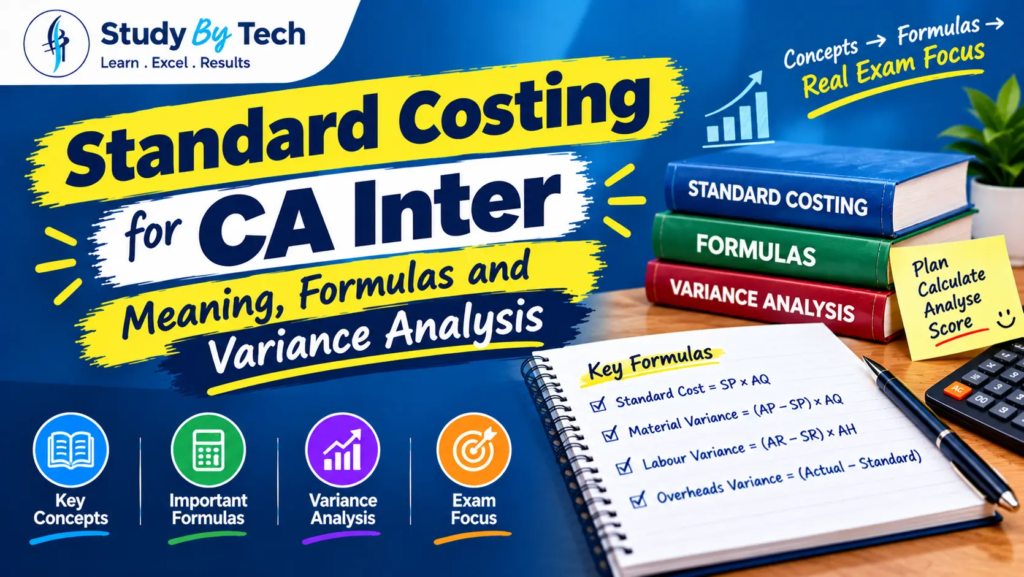
By CA Parag Gupta • Parag Gupta Classes Standard Costing for CA Inter: Meaning, Formulas and Variance Analysis Standard costing is a cost accounting method where you set a planned cost for materials, labour and overheads, then compare it with what you actually spent. The gap is called a variance, and it tells you what went wrong and why. This guide is for CA Inter students preparing Cost and Management Accounting. You’ll get the meaning, types of standards, every key variance formula and a clear way to analyse them. Watch the video lectureGet the 59 key questions Quick navigation What is standard costing? How it works Types of standards Formulas Variance map Why it matters Free resources FAQs Key takeaways Standard costing means setting a planned cost, then comparing it with the actual cost. The difference between the two is a variance: favourable (F) or adverse (A). There are four kinds of standards: basic, ideal, attainable and current. Every cost splits into price/rate and usage/efficiency variances. Learn the formulas once, then practise numericals until they feel automatic. What is standard costing? Think of it as a budget for every unit you make. You decide what materials, labour and overheads should cost. Then you check what they actually cost. The difference is your variance, and it points straight to the problem. It’s part of the ICAI syllabus for CA Inter Paper 4, and ICAI’s study material covers it too. This page gives you the plain-English version first. Standard cost vs actual cost A standard cost is the planned cost per unit under efficient, normal conditions. The actual cost is the real bill. Standard costing exists to compare the two and tell managers where to act. Key terms in plain English SQ / SP Standard quantity and standard price. What you planned to use and pay. AQ / AP Actual quantity and actual price. What really happened. SH / AH, SR / AR Standard and actual hours, and the standard and actual labour rate. Favourable (F) or Adverse (A) F means cost came in lower than planned. A means it came in higher. How standard costing works, step by step It’s a loop, not a one-time exercise. Here’s the cycle you’ll use in every numerical. 1. Setstandards2. Recordactual costs3. Compareand find variances4. Analysethe causes5. Act orrevise standards What happens in each step Pre-determine the data. Fix the material and labour needed, the unavoidable losses and the expected efficiency. Set standards for materials, labour and overheads. Find the variances by comparing actual costs with standards. Analyse the causes. Was it price, usage, rate, efficiency or volume? Report to management so they can fix the issue or revise the standard. Types of standards you need to know Not every standard is set the same way. Your choice depends on what you want the number to do. Type What it means Best used for Basic Fixed for a long period and rarely revised Tracking trends over the years Ideal Perfect conditions: no waste, no breakdowns Setting stretch targets (rarely achieved) Attainable Reachable with efficient, normal effort Day-to-day cost control Current Reflects today’s conditions and prices Short-term control and pricing Standard costing formulas for CA Inter Here are the formulas you’ll use most. In these formulas, a positive answer is favourable (F) and a negative answer is adverse (A). SQ and SH mean standard quantity and hours for the actual output. Material variances Variance Formula Material Cost Variance (MCV) (SQ × SP) − (AQ × AP) Material Price Variance (MPV) (SP − AP) × AQ Material Usage Variance (MUV) (SQ − AQ) × SP Labour variances Variance Formula Labour Cost Variance (LCV) (SH × SR) − (AH × AR) Labour Rate Variance (LRV) (SR − AR) × AH Labour Efficiency Variance (LEV) (SH − AH) × SR Overhead variances Variance Formula Variable OH Cost Variance Standard VOH for actual output − Actual VOH Variable OH Expenditure Variance (SR − AR) × AH Variable OH Efficiency Variance (SH − AH) × SR Fixed OH Cost Variance Standard FOH for actual output − Actual FOH Fixed OH Expenditure Variance Budgeted FOH − Actual FOH Fixed OH Volume Variance (Actual output − Budgeted output) × Standard rate per unit Exam tip: Price and rate variances use actual quantity or hours. Usage and efficiency variances use standard price or rate. Remember that and half the confusion goes away. How variances fit together Every total cost variance breaks down the same way. Price or rate on one side, usage or efficiency on the other. MaterialPrice (MPV)Usage (MUV)LabourRate (LRV)Efficiency (LEV)OverheadExpenditureEfficiency/VolumeTotal Cost Variance Why standard costing matters Gives you benchmarks You can judge performance against a clear target, not a guess. Shows where to look Variances point to the exact cost that went off track, so managers focus there. Supports budgeting Standards feed directly into budgets and make planning easier. Improves pricing Knowing true efficient costs helps you price products with confidence. Free resources and next steps Learn the concept here, then practise. Solve the latest RTPs and MTPs, work through the 59 key questions and watch the lecture if you like learning by video. Standard costing video59 key questionsLast-day revision notesRTPs and MTPsICAI syllabusICAI study material New here? Start with the CA Inter guide. Want full coverage? See the complete CA Inter course or the Cost and Management Accounting classes and books. Standard costing FAQs What is standard costing? Standard costing is a cost accounting method where you set a planned cost for materials, labour and overheads, then compare it with actual costs. The differences are called variances. Managers use them to spot waste, fix problems and judge performance. In CA Inter, it’s a core topic in Cost and Management Accounting. How does standard costing work? First, you set standards for each cost. Then you record actual costs, compare them with the standards and calculate variances. Next, you work out why they happened, like higher prices or poor efficiency. Finally, management acts or revises the standards. It’s a repeating control cycle.

Scroll to Top